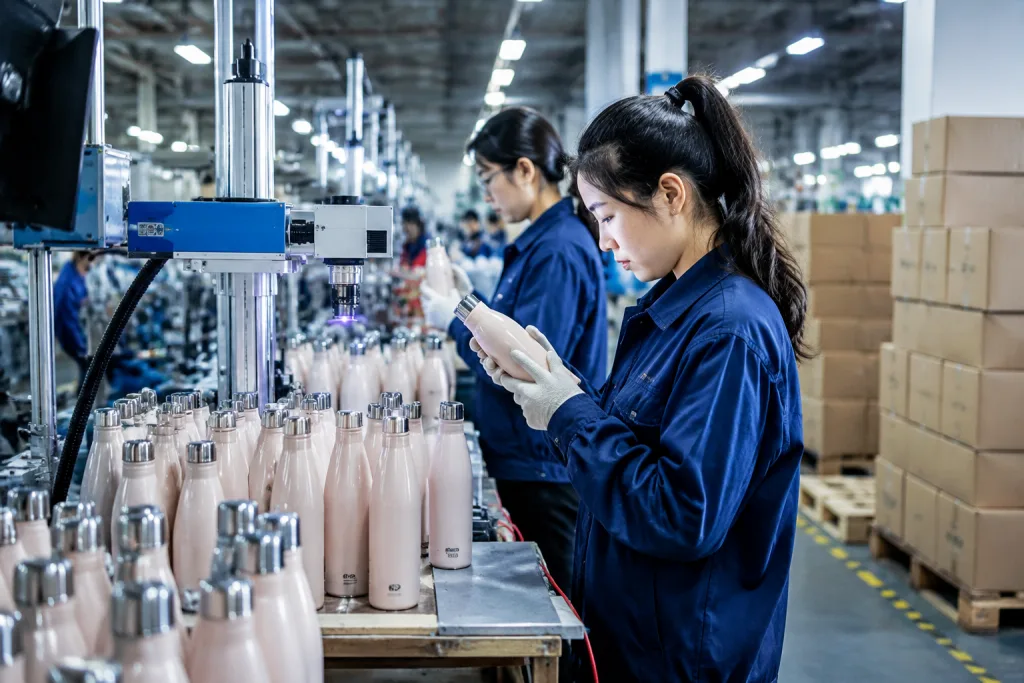
Key Takeaways
- Use 304 inner stainless steel at 0.40-0.50 mm wall thickness for most retail thermos programs
- Set MOQ by decoration method: 500 pcs for laser, 1,000 pcs for powder coat plus logo
- Ask for 6-hour and 12-hour temperature data, not only a broad 24-hour claim
- Confirm AQL 2.5/4.0 inspection, drop test, carton spec, and FOB port before deposit
A with custom logo thermos looks simple on a sell sheet: capacity, color, logo, carton quantity. Then the bulk order lands and the problems show up: coating fails the 3M tape test, lids have 0.4 mm side play, laser engraving shifts 2 mm off center, or 12-hour heat retention on the retail pack tests closer to 8 hours in QC.
If you buy for outdoor retailers or promotional brands, treat the spec sheet as a risk-control document, not paperwork. In our Hangzhou, Zhejiang factory, we see this in about 6 out of 10 new thermos RFQs: the buyer approves artwork before locking steel grade, wall thickness, vacuum test method, and AQL level. That is the wrong order. QC pulled a sample last month where the PO said 304 stainless, but the lid insert drawing still called out 201; that small mismatch can sink a custom logo thermos order before the line even starts.
Steel Grade And Wall Thickness
The first line on a custom thermos spec should be material, not logo size. For a stainless thermos used by hikers, anglers, ski shops, or corporate outdoor campaigns, we run 304 stainless steel on the inner wall as the normal baseline, with 201 or 304 on the outer shell depending on target price. If you sell into Europe or North America, 304 inner steel is the safer call. Say it clearly on the PO. Last month QC pulled a 750 ml sample from the line and the buyer had written “food grade stainless” only; our document team had to chase the merchandiser for LFGB, FDA food contact, and REACH wording before we could close the file.
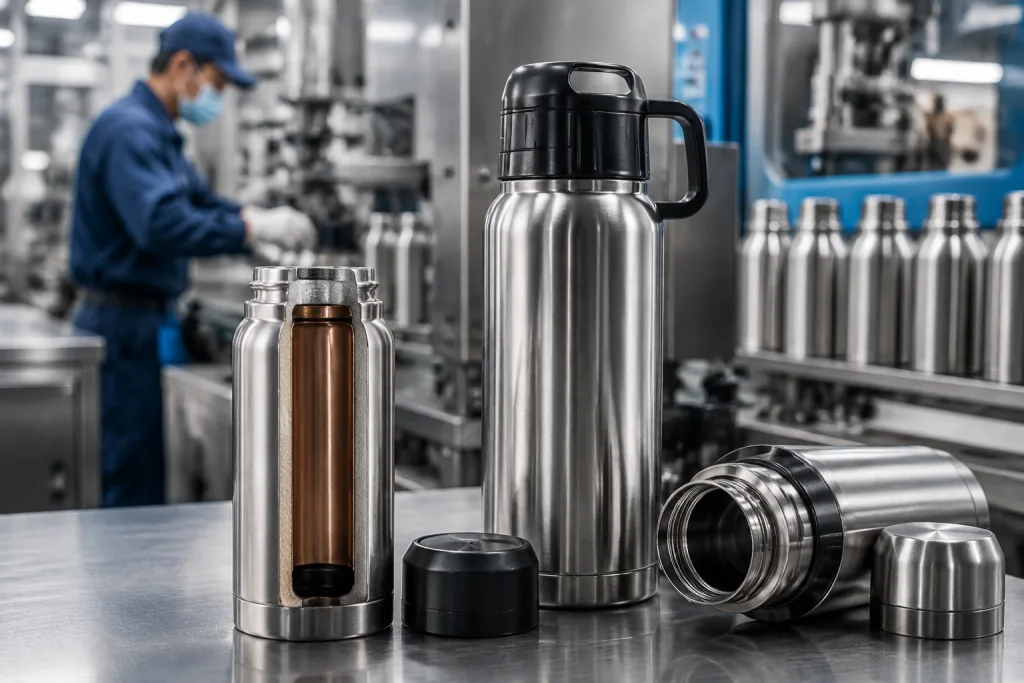
Wall thickness decides dent resistance and hand feel before the logo does. For 500 ml to 1,000 ml bottles, we usually quote 0.40-0.50 mm inner wall and 0.45-0.60 mm outer wall, checked with a digital micrometer after cutting the test body. Going thinner can shave USD 0.10-0.25 per unit, but the math doesn't work if 3 cartons in 100 come back with shoulder dents from sea freight. Cheap feel kills repeat orders. Going thicker fits a premium outdoor retail SKU, but carton weight climbs fast on thermos bulk orders, and the buyer will flag freight cost once the packed carton passes 13 kg.
Ask your thermos manufacturer to state whether the base uses separate welded construction or integrated spinning. Both can work. The buyer impact is consistency: poor welding or polishing shows up as rust complaints after salt-spray exposure, especially for coastal or winter sports customers. We've seen this go sideways when a quote listed only “304 stainless” and skipped the base process; after 48 hours in the salt-spray cabinet, QC found orange spots around the bottom seam. A serious manufacturer thermos quote should include steel grade, wall gauge, surface finish, and compliance documents before you discuss sleeve design.
Capacity, Shape, And Lid Fit
Capacity is not just a marketing call. A 500 ml custom logo thermos fits most commuter bags and works for event giveaways; 750 ml is the size we ship for light hiking sets; 1,000 ml moves better through camping, fishing, and worksite channels. The mold decides carton cube, hand feel, cup-holder fit, and whether one spare lid can cover 3 SKUs. We had a buyer flag this last April: the PO said “500 ml,” but their retail planogram allowed only 78 mm body width, so QC pulled the caliper sample before the line cut cartons.
For outdoor retail, I like 70 mm to 82 mm body diameter on 500-750 ml bottles. Above 82 mm, smaller hands complain. For promotional brands, print area often beats grip comfort, and this is where the wrong question gets asked. Don’t ask, “Can you print my logo bigger?” Ask how many mm of flat safe area the body gives. A straight-wall cylinder holds silkscreen registration cleaner and gives more logo height; a tapered body looks more like retail stock but cuts the print zone. If you need a thermos customized with a wraparound mountain graphic, don’t pick a heavy curved shoulder and then blame the factory thermos printer when the pine trees bend near the seam.
Lid fit is where cheap samples hide trouble. Specify PP or stainless outer lid, food-contact silicone gasket, thread turns, and leak test method. We run a normal leak test for 30 minutes inverted after filling with room-temperature water, then the operator does a shake test over kraft paper so one drip shows fast. For kids, vehicle, or backpack use, ask whether the lid can pass internal pressure and drop testing; one push-button lid we rejected opened after a 1.2 m corner drop. A good thermos supplier will tell you when a push-button lid is risky for hot drinks. That honesty beats a low FOB price.
Vacuum Performance Claims That Hold
Heat retention claims need numbers and test conditions. “Keeps hot 24 hours” means little unless the starting water temperature, room temperature, fill volume, and final reading are written down. For a 500 ml vacuum flask, we run the bench test with water at 95°C, ambient at 20°C, full fill, then log readings at 6 hours and 12 hours with a calibrated probe thermometer. A decent 500 ml model should stay above 65°C at 6 hours and above 45°C at 12 hours; in our last line check, QC pulled 32 samples and rejected 2 for weak vacuum after the hiss test. Bigger 1,000 ml bottles usually do better because the volume-to-surface-area math works in their favor.
The buyer impact is packaging risk. If your retail box promises too much, returns land on your desk, not on the thermos vendors in China. We have seen this go sideways: a buyer flagged “24H HOT” on a color box after their sales team tested 6 bottles at home and got 42-48°C at 12 hours. For promotional thermos programs, that kind of claim annoys corporate clients fast. Use conservative claims unless you have lab data. For EU and North American channels, keep a test report in the order file even if your customer does not ask for it on day one.
At BottleForge Industrial in Zhejiang, China, our stainless thermos line runs about 300,000 units per month across standard molds, with inline vacuum testing before packing. Typical lead time is 25-35 days after artwork and sample approval for repeat colors. New powder colors, new lids, or a fully customizable thermos mold can push that to 45-60 days; the line also needs confirmed Pantone, logo size in mm, and a clean PO, because one typo in “matte black” versus “metallic black” can cost 7 days. Do not sell a launch date before your supplier thermos partner confirms the actual production slot. The math doesn’t work.
Logo Method, Color, And Durability
The logo line decides whether your customized thermos looks like retail stock or a rushed trade-show giveaway. Laser engraving is the safe choice at 500 pcs MOQ, especially on raw stainless or powder-coated cups. We run it on a fiber laser, usually with a 0.08 mm line gap for small text. It stays clean, permanent, and avoids ink compliance questions. The trade-off is color. Laser gives metal or undercoat contrast, not a Pantone ink match, and the buyer flagged this twice last spring after expecting a bright red logo from a PDF proof.
Silkscreen works better when the brief calls for a one-color or two-color brand mark at a lower unit cost. On a straight body, a 60 mm by 80 mm logo is routine. On tapered shapes, shrink the artwork by 10-15 mm or accept more tolerance, because the screen frame does not forgive curved walls. Heat transfer handles gradients and photo-style graphics, but it adds cost and needs abrasion testing. UV print suits short-run colorful campaigns. I would not put it on a rugged outdoor SKU unless the client signs off that scratch resistance is lower than laser or baked coating. QC pulled the sample on one 1,000 pcs order after the logo edge lifted under 3M tape.
Powder coating is usually the best finish for outdoor retailers. Common coating thickness is 60-80 microns, and we check it with a coating thickness gauge before packing starts. Ask for cross-hatch adhesion testing and at least a basic rub test. For premium programs, request a 24-hour salt spray check on coated samples, especially for matte colors. A thermos promotional order often dies on small details: logo 3 mm too close to the radius, Pantone approved on screen instead of against a physical chip, or no golden sample signed. This is where the math does not work. If you want thermos custom work to repeat correctly, freeze a golden sample and keep one at the factory and one in your office.
MOQ, Pricing, And FOB Terms
MOQ should match the work we put on the line. For a standard stainless body with laser logo, 500 pcs is realistic; we run the fiber laser jig once, check logo position with a 0.5 mm tolerance card, and pack. For powder coating with one-color silkscreen, 1,000 pcs is the normal starting point because the coating booth, curing oven, and screen frame setup do not pay back on 300 pcs. For a new lid, new body mold, or private tooling, expect 3,000-5,000 pcs and tooling cost from USD 1,500 to USD 6,000 depending on complexity. Small runs get expensive fast. We had one buyer ask for 200 pcs with a custom flip lid, and the math did not work before we even opened the mold drawing.
FOB Ningbo or Shanghai is common for factories in Zhejiang, China; from Hangzhou, we usually truck to Ningbo in 1 day if the booking is clean. As a rough 2026 planning range, a 500 ml double-wall stainless thermos with 304 inner wall, powder coat, and laser logo may land at USD 3.20-5.20 FOB for 1,000-3,000 pcs. A 750 ml retail-grade model with stronger coating and better lid can sit around USD 4.80-7.20 FOB. These ranges move with steel, exchange rate, packaging, and inspection requirements, so treat any fixed online price as a starting number, not a purchase order basis. Last month QC pulled a 750 ml sample after the coating thickness read 42 μm instead of the agreed 55 μm, and that small line item changed the quote.
If you are a thermos distributor or buyer managing distributors thermos catalogs, ask suppliers thermos teams to quote the same Incoterm, carton spec, and packing method. One thermos supplier may look USD 0.30 cheaper until you notice a 5-layer carton was swapped for 3-layer, the master carton drop test is missing, and there is no pre-shipment inspection allowance under AQL 2.5. Price comparisons only work when the spec sheet is identical. We have seen this go sideways from one typo on a PO: “white box” became “brown box,” then the buyer flagged it after 86 cartons were already sealed.
Inspection, Cartons, And Retail Readiness
I’ll rewrite the section in-place, keep the HTML exactly as-is, and make the prose sound like a factory-side sales engineer wrote it.We inspect a thermos order like a finished retail item, not a metal tube with a cap on top. Set the AQL before the line starts: for retail and promo drinkware, we usually run Critical 0, Major 2.5, Minor 4.0. Critical defects are sharp edges, odor, leaking, contamination, and the wrong material. Major defects are vacuum failure, logo shift, coating peel, lid mismatch, or a wrong barcode. Minor defects are small scratches inside the agreed limit. If the buyer waits until packing day to ask for a new standard, the math does not work.
Packaging needs the same control. For retail, lock down color box paper weight, insert language, barcode position, carton burst strength, and whether FNSKU labels are needed for marketplace stock. On one PO, the buyer flagged a 2 mm barcode move and we had to reprint 5,000 boxes. For outdoor stores, you may need hang tags or shelf-ready trays. For corporate promo work, individual polybags may need to come off to meet sustainability rules. Say it early. Once mass production starts, packing changes burn days and trigger carton rework charges.
A 24 pcs master carton works for many 500 ml bottles, but 1,000 ml thermos bulk shipments often run better at 12 pcs to keep corners from crushing. We ask for a 76 cm carton drop test if the goods will move through parcel networks. Our workflow is incoming material checks, first-piece logo approval, inline leak testing, final random inspection, and loading photos. QC pulled the sample once and found a 1.5 mm lid gap before shipment. That is not glamorous. It is what keeps a with custom logo thermos program out of the claims pile.
Send Your Thermos Spec Sheet For Review
Share capacity, logo method, MOQ, market, and target FOB price. We will flag risky specs before sampling starts.
Frequently asked questions
What MOQ should I expect for a with custom logo thermos?
For a standard stainless steel model, 500 pcs is usually workable if you choose laser engraving on an existing color or raw stainless finish. If you need custom powder coating plus silkscreen printing, plan on 1,000 pcs because coating setup, screen setup, and color change waste need more volume. For a new lid, new body shape, or fully private mold, 3,000-5,000 pcs is more realistic. Some thermos suppliers will offer 100-300 pcs, but the unit price is high and color choice is limited. For distributor thermos programs, it is usually smarter to start with 1,000 pcs per SKU and test two colors rather than spread 500 pcs across too many variants.
Which logo method is best for outdoor retailers?
Laser engraving is the safest choice for outdoor retail because it does not peel, uses no ink, and works well on powder-coated or stainless surfaces. For a simple one-color brand mark, it also keeps defect rates low at inspection. Silkscreen is fine for promotional thermos orders when you need Pantone color and the artwork is not too large; expect normal print tolerance around plus or minus 1.5 mm. Heat transfer and UV printing can produce more colorful designs, but they need abrasion and adhesion checks before you approve bulk. If the bottle will be clipped to packs, tossed in trucks, or sold as rugged gear, choose durability over graphic complexity.
How do I verify insulation before placing a bulk thermos order?
Ask your thermos factory for a temperature test using defined conditions, not a marketing phrase. A useful test states starting water temperature, fill level, ambient room temperature, bottle capacity, and readings at 6 hours and 12 hours. For many 500 ml stainless models, above 65°C after 6 hours and above 45°C after 12 hours is a reasonable benchmark when filled with 95°C water in a 20°C room. You can also request sample testing from a third-party lab, especially if your retail packaging makes a strong heat-retention claim. Keep that report with the approved sample and carton artwork so sales claims match real data.
What certifications matter for EU and North American thermos buyers?
For food contact, request FDA-related documentation for the US and LFGB or EU food-contact test reports for Europe. REACH is often requested for coatings, paints, and external components. If the product is for children, ASTM and CPSIA-related requirements may apply depending on design and market. Factory-side audits such as BSCI or ISO 9001 help with retailer onboarding, but they do not replace product testing. A serious thermos manufacturer should be able to provide material declarations, coating information, and recent test reports from recognized labs. Check that reports match the actual material, lid, coating, and gasket used in your order, not an old similar model.
What lead time should promotional brands plan around?
For an existing model with laser logo, plan 25-35 days after deposit, artwork confirmation, and sample approval. Add 7-10 days if you need a new powder coating color, because color panels and line scheduling take time. A custom lid, new mold, or special retail packaging can push total production to 45-60 days before sea freight. Air freight is possible for urgent promotional thermos launches, but it can add USD 1.50-4.00 per unit depending on weight and destination. The safest buying calendar is sample approval first, then production slot, then inspection date, then vessel booking. Do not count verbal lead time from a thermos vendor as confirmed until the proforma invoice lists it.