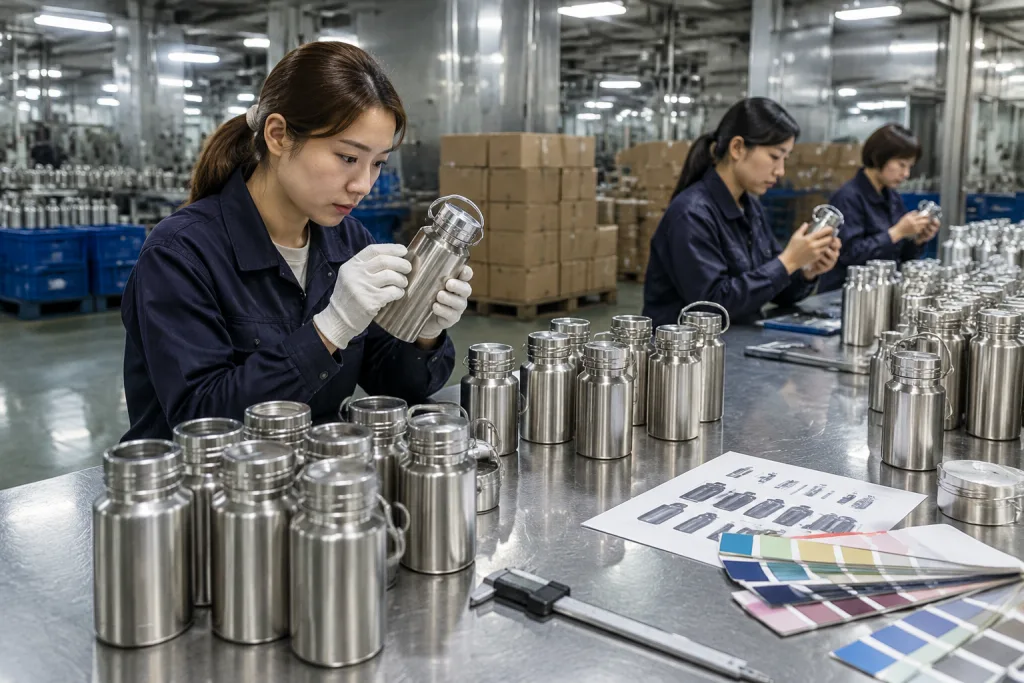
Key Takeaways
- For stainless canteens, 304 inner steel at 0.40-0.50 mm is the normal B2B range
- MOQ for a custom canteen usually starts at 1,000-3,000 pcs per color and logo
- Laser engraving lasts longer, while silk screen gives better low-cost color logos
- AQL 2.5/4.0 inspection catches most cosmetic and functional issues before shipment
A with custom logo canteen looks simple on a quote sheet: capacity, color, logo, carton size, price. Then the line gets stuck. A 32 oz bottle can use 0.38 mm or 0.50 mm steel, the same logo can be silk screen or laser engraved, and we have seen a $0.16 cheaper lid turn a 5,000 pcs promotion order into a claims file after QC pulled 12 leaking samples from the pressure test.
We manufacture custom drinkware in Zhejiang, China, and buyers send us competitor samples with no technical data almost every week. Risky shortcut. If you buy for retail, corporate gifts, outdoor channels, or distributor canteen programs, the wrong question is “can you match this price?” Read the spec sheet like a cost engineer: steel grade, wall thickness, lid structure, logo process, packing drop-test result, and the exact PO wording, because one buyer once flagged a carton mark typo after the line had already packed 186 cartons.
Capacity Is Not Just Volume
Capacity is usually line 1 on a custom canteen spec sheet, and too many buyers sign it off in 10 seconds. A 20 oz, 24 oz, 32 oz, and 40 oz canteen are not just different fill levels. They can mean a different mold, deeper steel drawing on the hydraulic press, new trimming height, larger carton cube, higher freight cost, tighter retail shelf fit, and a logo that looks stretched once it wraps around the body radius.
For North America, 32 oz is still the size we ship most for outdoor promos and corporate gift programs. For Europe, 500 ml, 750 ml, and 1,000 ml read cleaner on retail labels and tender sheets. If you ask a canteen factory in China for 750 ml, ask whether the brimful test reads 760-780 ml on the measuring cylinder. We have seen buyers flag this after QC pulled the sample, because the PO said 750 ml but the lab report listed measured volume.
The buyer impact is blunt: capacity changes landed cost faster than people expect. A 32 oz single-wall stainless custom canteen may pack 24 pcs per export carton. A 40 oz model may drop to 12 or 18 pcs per carton because the height and body diameter eat carton space. The math doesn't work if you only compare FOB price; ocean freight per unit can rise 8-15 percent even when the FOB unit price moves up only USD 0.35.
If you are a canteen distributor, do not approve a drawing just because the milliliters look right. Ask for product height in mm, body diameter, mouth diameter, net weight, gross carton weight, carton dimensions, and pallet loading based on your warehouse limit. For Amazon or retail warehouses, 1 cm can decide whether the carton scans as oversized or passes without a handling surcharge. We run this check before mass production because fixing carton size after the line starts is slow and expensive.
Steel Grade And Wall Thickness
Material choice decides whether a custom logo canteen survives retail use or comes back as a claim. For stainless steel drinkware, we normally quote 304 stainless steel on any surface touching water. Some low-end canteen suppliers use 201 stainless steel for the outer wall or for single-wall products. It cuts cost by a few cents, but corrosion resistance is weaker; QC pulled one 201 sample after a 24-hour salt spray check because rust spots showed near the bottom seam. For humid markets, sports channels, and outdoor buyers, 201 is the wrong place to save money.
A workable stainless spec is 304 inner and 304 outer for premium vacuum models, or 304 body for single-wall canteens. Wall thickness usually sits around 0.40-0.50 mm before forming. Light bodies may use 0.35-0.38 mm. Dents show faster. A 32 oz single-wall custom canteen at 0.50 mm steel feels more solid in hand, but the math changes because raw material weight rises and FOB price follows. We check this with a digital micrometer on the cut sheet before the line starts, not after 3,000 pcs are already shaped.
For aluminum canteens, we usually see food-grade 6061 or 1070 aluminum with an internal coating. That coating needs stable test results, because plain aluminum should not sit against acidic drinks for long periods. If your buyer asks for juice, electrolyte powder, or carbonated use, aluminum is not my first recommendation unless the coating system has passed the right migration test. We have seen this go sideways: one buyer flagged a metallic taste after filling lemon water overnight, and the whole carton lot had to be held for review.
Our Hangzhou-area supply chain in Zhejiang can produce about 180,000 stainless drinkware units per month across canteens, tumblers, and growlers. That does not mean every material is sitting in the warehouse on Tuesday morning. If you need 316 stainless steel, recycled stainless, or a special powder coating, plan 7-15 extra days for material booking. A serious canteen manufacturer will say this before taking your deposit. Not after the order is late. On one PO, the buyer typed “316” in the email but “304” on the order sheet; we stopped it at artwork approval because the material code did not match.
Lid, Cap, And Leak Performance
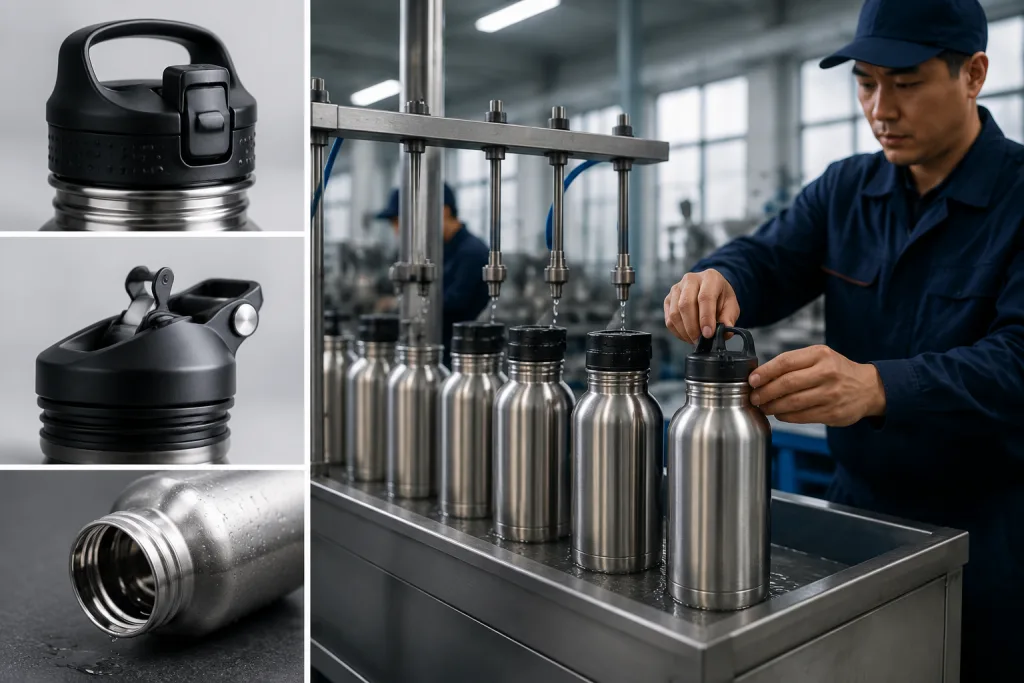
The cap is a small part, but it drives a lot of warranty claims. For a with custom logo canteen, buyers often spend 20 minutes checking the logo position and 2 minutes checking the lid. That is the wrong question to ask. In our line reviews, 7 out of 10 complaint photos are about leaking lids, cracked carry loops, rough threads, or silicone odor, not the printed body. Your spec sheet should list cap material, gasket material, thread type, torque feel, and spare gasket availability. QC pulled one sample last month with a 0.4 mm gasket mismatch; it looked fine on the table, then leaked after 12 shakes.
Common cap materials include PP, Tritan, stainless steel outer shell with plastic inner thread, bamboo cover with plastic insert, and zinc alloy carabiner attachments. For food contact, PP and silicone should meet LFGB or FDA requirements depending on your market. For Europe, buyers often ask for REACH and PAHs screening on colored plastic or rubber parts, especially black silicone and soft-touch coatings. We run these parts through a 0.01 g scale check and a simple smell check before packing, because one low-grade silicone ring can ruin a 5,000 pcs order.
Leak testing belongs in the purchase order, not in a WeChat message. A practical factory test is to fill to 95 percent, close the cap, invert for 30 minutes, and check seepage on white tissue. For vacuum canteens, we also test hot water retention and vacuum failure. A typical insulated canteen should hold hot water above 60°C for 6-8 hours under normal room temperature, though the result depends on capacity, mouth width, and lid structure. We have seen this go sideways when a PO said “leak proof cap” but the approved sample used a different thread pitch, 3.2 mm vs 3.6 mm.
If you sell canteens for promotional campaigns, look at real user abuse. A gym buyer will shake it. A school program will see bottles thrown into backpacks with keys and lunch boxes. A hiking retailer may clip it to a pack with a zinc alloy carabiner. Do not pick a decorative cap just because the rendering looks clean; the math does not work if 2 percent come back leaking after delivery. Ask for 3-5 pre-production samples and run your own 48-hour abuse test before mass production. We usually tell buyers to fill it, shake it 50 times, leave it upside down overnight, then drop it from 1 meter onto a rubber mat.
Logo Method Changes The Product
Logo application is not decoration after manufacturing; it belongs in the product spec from day one. A custom canteen can use silk screen printing for simple spot colors, pad printing for small curved areas, laser engraving for permanent marks, heat transfer or water transfer for full-body graphics, UV printing for sharp multi-color artwork, or embossing on a silicone boot. Each method changes the MOQ, the setup charge, the pass rate on the line, and the color limits. We run logo trials on 30 pcs before bulk when the artwork crosses a seam or sits within 15 mm of the shoulder.
Silk screen is the usual choice for one- or two-color logos on powder-coated bottles. It is cost-effective, often around USD 0.05-0.18 per print depending on size and color count. It works well for canteen promotional orders where price matters. The weakness is abrasion resistance. If the canteen customized surface will rub against metal gear, screen print can scratch. QC pulled the sample after a 3M tape test last month because the buyer wanted a 42 mm white logo on rough matte black coating, and the edge lift was visible under the inspection lamp. Cheap is not always safer.
Laser engraving is cleaner for stainless and powder coating. It removes the coating and reveals the metal below, so it will not peel. The cost is usually higher, often USD 0.12-0.35 per logo depending on area and machine time. It is best for distributor drinkware programs where the same bottle may be ordered repeatedly with different client names. On our fiber laser machine, a 60 mm logo takes about 18-25 seconds per canteen, so the math changes fast when the order is 5,000 pcs instead of 500 pcs. The buyer flagged this before on a rush PO; the delivery date said “12 days,” but engraving capacity needed 18 days.
Full-wrap heat transfer and UV print allow gradients and photographic graphics, but they need stricter artwork control. Curved bodies distort artwork near the edges. A good canteen supplier should request vector artwork, Pantone numbers, logo size in millimeters, placement from bottom or shoulder, and tolerance. We normally hold logo placement tolerance to ±2 mm on straight cylindrical bodies. If a canteen customizable shape has a waist or taper, accept that alignment will be less perfect. This is the wrong question to ask: “Can you match the PDF?” Ask whether the logo still looks straight after wrapping around a 78 mm body with a 6 mm taper.
Do not approve mass production from a flat PDF only. Approve a physical logo sample or at least a 360-degree sample video under daylight.
Surface Finish And Color Control
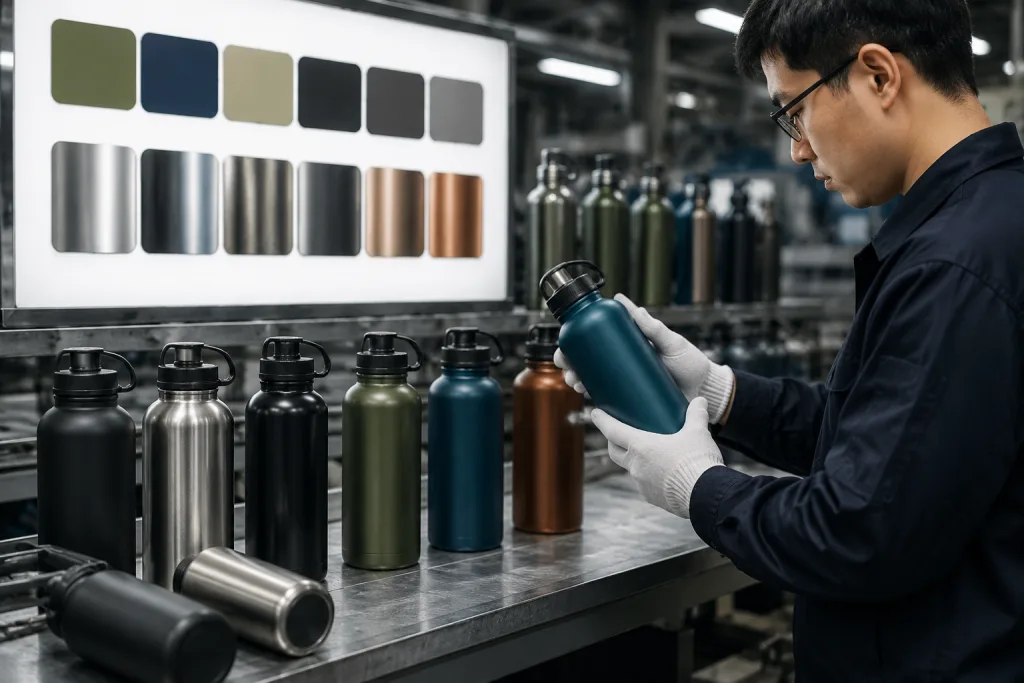
Finish drives perceived value. Powder coating, spray painting, mirror polishing, brushed 304 stainless, electroplating, and rubber coating do not just change the look; they change grip, shelf wear, and how a custom logo canteen feels after 30 days in a backpack. For most B2B canteen orders we run in Zhejiang, powder coating is the safe workhorse because it beats standard wet paint on scratch resistance and hand feel. QC usually checks the first 20 pcs off the line under a 6500K light box before we release mass coating.
Powder coating is not magic. Matte black from batch 1 and batch 2 can look off if the buyer only sends a JPG logo file and says “match this.” Use Pantone as direction, but Pantone is printed on paper and powder sits on curved metal, usually over a 0.35-0.45 mm coating layer. For brand programs, ask for a sprayed metal color chip and keep it as the master sample. For strict retail, set Delta E under 1.5-2.0; for promotional canteens, visual matching against the approved chip is often enough. We have seen this go sideways when a PO said “navy blue” and the buyer flagged 3,000 pcs as too purple.
Surface testing should be written down. Keep it simple. A cross-hatch adhesion test, 3M tape pull, 50-cycle alcohol rub, and coin scratch check catch most coating problems before cartons leave the factory. For outdoor retail, ask for heavier abrasion testing, especially on matte finishes that show rub marks fast. If the canteen uses a silicone boot, confirm the silicone does not bleed color onto the coating after heat aging or 15 days of warehouse stacking. QC pulled one sample last summer where a red boot left a faint ring on white powder coating after the carton sat near a loading door.
Zhejiang factories are strong in coating and metal forming, but loose wording still costs money. If your purchase order only says blue powder coating, each canteen vendor will fill in the blanks their own way. The math does not work when you argue color after production. Write the finish like this: powder coated, Pantone 2965C target, matte gloss 10-20 GU, logo laser engraved front center, no visible dust spots over 0.5 mm on A-grade surface. That sentence is boring. It prevents claims later.
MOQ, Price, And Lead Time
MOQ follows the part that changes on the line. For a stock shape with one standard color and one logo, a canteen supplier in China usually accepts 500-1,000 pcs; we run these through the same laser jig or screen-print fixture, so changeover is small. For custom powder color, MOQ is usually 1,000-3,000 pcs per color because the coating booth has powder purge loss, and one color swap can waste 6-12 kg before the first clean bottle comes out. For a new mold, custom growler shape, or unusual lid, expect 5,000-10,000 pcs minimum and tooling cost from USD 800 to USD 6,000 depending on complexity. Tooling is not magic. The buyer flagged this twice last month after seeing a USD 800 cap mold and asking why the body mold was not the same price; the math doesn't work.
FOB pricing moves by capacity and construction. As a working range, a single-wall 750 ml stainless canteen may quote around USD 2.20-3.80 FOB Ningbo or Shanghai. A vacuum insulated 32 oz model may sit around USD 5.20-8.50. A large customized growler with handle, 64 oz capacity, and premium coating can reach USD 9.50-15.00. These ranges shift with 304 stainless sheet price, exchange rate, 5-layer export carton spec, and compliance testing. Small detail, big cost: if the PO calls for individual white boxes with barcode stickers on two sides, our packing line slows from about 900 pcs/hour to 620 pcs/hour, and that shows up in the quote.
Lead time should be split into sample time and mass production. Digital artwork mockups can be ready in 1-2 days. Logo samples usually need 5-7 days after artwork confirmation. Pre-production samples with custom color may need 10-15 days because QC pulls the sample under a D65 light box and checks color against the Pantone chip, not a phone photo. Mass production is commonly 30-45 days after deposit and sample approval. Peak season before Q4 can add 10-20 days; we have seen a normal 32-day schedule become 48 days when the buyer changed the logo size from 42 mm to 48 mm after the pad-print plate was made.
If you are a distributor growler or distributor canteen buyer managing several end clients, consolidate colors where possible. Ten logos on one black bottle are easier and cheaper than ten bottle colors with one logo each. We ship mixed-logo cartons often, but mixed powder colors create more line cleaning, more scratch risk, and more chances for a PO typo like “matte back” instead of “matte black.” This is where experienced canteen distributors protect margin without downgrading the product.
Compliance, Inspection, And Packing
Compliance is not paperwork for later. Put it on the spec sheet before we quote, or the math goes wrong after the deposit. For Europe, list LFGB food contact, REACH for coating and plastic parts, plus the local packaging recycling mark your importer needs. For the United States, confirm FDA food contact expectations and California Proposition 65 screening. Kids canteens need tighter control: small parts, paint adhesion, age grading, and ASTM or CPSIA-related checks depending on the lid design. Last month QC pulled a painted kids cap with a 0.8 mm flake after the cross-cut tape test. That failed.
Factory audits matter too. BSCI, Sedex, ISO 9001, or customer social audits are normal requests from importers shipping 10,000 pcs and up. Not every canteen factory holds every certificate, and some trading companies pass around borrowed PDFs like price lists. Ask for the certificate holder name, address, scope, and expiry date. Check the address against the production site or at least the audited assembly facility. We had a buyer flag one audit where the address was Yiwu, but the line was running in Yongkang. Wrong question to ask is “Do you have the certificate?” Ask whose name is on it.
Use AQL inspection for mass orders. A normal drinkware inspection plan might use AQL 2.5 for major defects and 4.0 for minor defects. Critical defects get zero tolerance: sharp metal burrs on the mouth, chemical odor inside the body, leaking caps after a 30-minute upside-down test, or wrong food-contact material. Inspection should cover capacity by measuring cup, net weight on a 0.1 g scale, logo position within the approved mm tolerance, color against the signed sample, coating scratches, leak test, barcode scan, carton drop condition, and packing count. We run this before shipment because we have seen this go sideways when the buyer only checks the pretty sample.
Packing sells the product before the user touches the canteen. Bulk polybag packing is cheapest, but retail buyers often need a white box or kraft box with insert card, hang tag, FNSKU label, and master carton barcode. For e-commerce, confirm the drop-test standard and carton edge-crush strength before mass packing starts. A warehouse pallet, club store display, and Amazon FBA carton do not use the same packing logic. We ship some 24 pcs master cartons at 16 kg gross weight; above that, the buyer’s warehouse team usually complains. One PO even came in with the FNSKU one digit short, and the line had to stop while the buyer corrected the file.
Send your canteen spec for a factory quote
Share capacity, logo artwork, quantity, and target market. We will reply with practical MOQ, FOB pricing, sample timing, and compliance options.
Frequently asked questions
What MOQ should I expect for a with custom logo canteen?
For a stock canteen shape with one existing body color and one logo, a realistic MOQ is 500-1,000 pcs. If you need a custom powder-coated color, plan on 1,000-3,000 pcs per color because the coating line has setup loss and powder minimums. A new mold, special cap, or fully customized canteen body usually starts at 5,000 pcs and can require USD 800-6,000 tooling. Small trial orders are possible, but the unit price is higher and logo options may be limited.
Which logo method is best for canteen promotional orders?
For canteen promotional orders where price and color visibility matter, silk screen printing is usually the best starting point. It handles one- or two-color logos well and often costs USD 0.05-0.18 per position. For longer service life, laser engraving is better because it will not peel or rub off, but it normally costs more and gives a metal-color mark rather than a Pantone color. If your buyer wants gradients or full artwork, use heat transfer or UV printing, but approve a physical sample before production.
How long does production take for customized drinkware?
For customized drinkware using a stock canteen body, allow 5-7 days for logo samples after artwork approval and 30-45 days for mass production after deposit and sample sign-off. Custom colors usually add 5-10 days because the coating sample must be made and approved. New mold projects can take 45-75 days before mass production, depending on tooling and testing. If your delivery deadline is tied to a trade show or retail launch, build in at least 10 days for inspection, export booking, and customs documents.
Can one canteen supplier handle both canteens and growlers?
Yes, many stainless drinkware factories in Zhejiang and other parts of China produce canteens, tumblers, bottles, and growlers on related forming, welding, polishing, and coating lines. The key is whether the supplier has the right vacuum equipment, lid sourcing, and inspection process for each product. A customizable growler usually needs stronger handle testing, larger carton design, and better vacuum consistency than a small canteen. If you are building a distributor drinkware range, ask for capacity by product type, not just total monthly output.
What should I check before paying a deposit?
Before paying a deposit, confirm the full spec sheet: capacity, steel grade, wall thickness, cap material, gasket material, coating type, logo method, Pantone target, packing, compliance tests, MOQ, FOB port, sample time, production lead time, and AQL standard. Ask for product photos, factory audit documents if needed, and a written quotation that separates tooling, logo setup, unit price, and carton cost. For a first order over 3,000 pcs, I would also budget for a third-party pre-shipment inspection.