Key Takeaways
- For wine tumblers, 304 stainless steel at 0.4-0.5 mm inner wall thickness is the practical B2B baseline
- A real supplier should quote MOQ, mold cost, sample days, mass lead time, FOB port, and carton CBM in writing
- Logo method changes cost: laser is usually USD 0.08-0.20 per unit, while full-wrap print needs higher setup control
- Use AQL 2.5/4.0 inspection and test at least 32 units from a pilot lot before releasing 10,000+ units
A wine tumbler looks simple until you buy 20,000 units and QC pulls 80 samples with loose lids, carton rub marks on the powder coating, or a gift box corner split after a 76 cm drop test. The problem usually starts on page one of the spec. “12 oz stainless wine cup, custom logo” is not enough for a serious custom drinkware order, and we’ve seen this go sideways when the PO only says “black” but the approved sample was Pantone 426C.
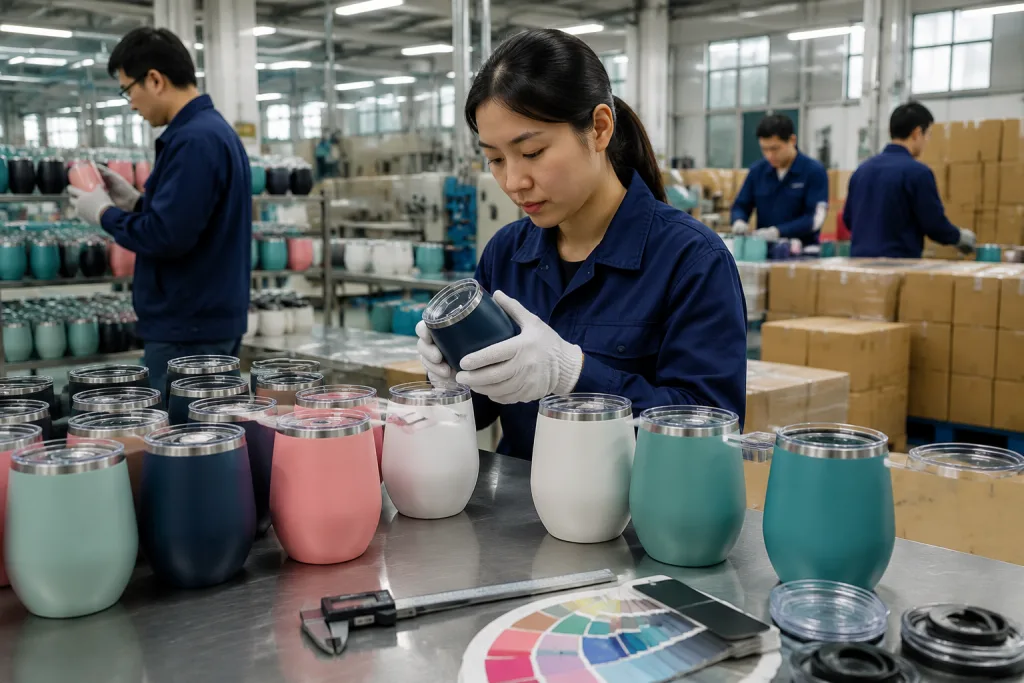
As a Zhejiang, China drinkware factory, we read 35 to 50 buyer RFQs most weeks from importers, brand owners, canteen distributors, and promotional agencies. The good RFQs are boring in the right way: capacity with tolerance, 304 stainless or stated alternative, wall thickness in mm, lid material, coating type, logo size and position, packing method, AQL, FOB port, and carton weight limit. That protects your margin. On the line, a 0.15 mm wall-thickness gap or a loose “clear lid” note can turn into 12 days of rework instead of 3 days of normal inspection.
Start with the capacity line
The first spec line should be capacity, and this is where buyers still make mistakes. A “12 oz wine tumbler” might mean 12 oz to the brim, 12 oz as a comfortable fill, or just a catalog name from an old mold list. Different cup. Different quote. For North America, we usually spec a 10-12 oz usable pour with room for 3-4 ice cubes; our QC team checks this with a 500 ml graduated cylinder, not by eye. For Europe, buyers often ask for 300 ml or 350 ml marking. Put both units on the spec sheet: “350 ml nominal, 330 ml recommended fill, 12 oz brim capacity.”
Capacity changes carton size, shipping cost, and what the buyer thinks the item is worth. A 12 oz double-wall tumbler may pack 24 pieces per export carton at about 0.060-0.075 CBM. A 16 oz version can push cartons toward 0.090 CBM, and the math gets ugly when you quote distributor drinkware programs by landed cost. We ran this on a 20 ft container last season: the buyer wanted the larger cup, then flagged the freight line because the load dropped by more than 3,000 units.
If you also source canteen custom items, custom growler SKUs, or a customized canteen range from the same supplier, keep the naming clean across the file. Do not let one item use ounces, another use milliliters, and another use “small/large.” We have seen this go sideways when a PO says “350 ml wine cup” but the FNSKU label says “12 oz tumbler”; the warehouse scans it as a separate item and nobody enjoys that call at 9 p.m.
For our Hangzhou, Zhejiang production line, standard wine tumbler MOQ is 1,000 pieces per color for stock mold and 3,000 pieces if you need a special powder color. That is a normal number for China custom drinkware. If a quote says MOQ 100 for a fully customized drinkware project, this is the wrong question to ask: do not ask only “can you do it?” Ask where the decoration is done, whether they run a Pantone chip under a D65 light box, and who signs off when QC pulled the sample and the powder coat is 2 shades off.
Steel grade is not decoration
The material line on the quote should not stop at “stainless steel.” For wine tumblers, we set 304 stainless steel on the inner wall as the floor, then choose 201 or 304 on the outer wall based on the price target. We run 304 inner / 201 outer for most mid-range promo orders at 3,000–10,000 pcs, and 304/304 when retail or hotel buyers ask for better corrosion resistance and cleaner paperwork. QC checks this with an XRF gun before cutting; last month one buyer flagged a PO that only said “SS,” and the mill cert could not be matched to the batch.
Wall thickness matters. A common build is 0.4 mm inner wall and 0.5 mm outer wall before forming. Too thin, and the rim feels light, the body dents in a 12 kg master carton during sea shipment, and vacuum yield drops on the line. Too thick, and the math does not work: steel cost rises, deep-drawing loss climbs, and polishing time stretches from 12 seconds to about 18 seconds per cup. “Thicker is always better” is the wrong question to ask. The better target is stable forming, clean polishing, and vacuum performance that repeats lot after lot.
Ask for material test reports by heat or batch when possible. For Europe, discuss REACH and LFGB food-contact expectations before sampling, not after mass production. For the US, FDA food-contact declaration and California Proposition 65 screening depend on your sales channel, so tell the supplier if the goods go to Amazon, club retail, or a distributor. If the product is for a children’s gift set, check ASTM and CPSIA implications separately; we have seen this go sideways when a buyer reused a wine tumbler report for a kids bottle, and the inspection team pulled it during document review.
The same logic applies when you compare a canteen manufacturer, canteen supplier, or canteen factory. A custom canteen for outdoor programs often needs 304 inner steel, a thicker shoulder around the neck, and a leakproof threaded cap tested upside down for 30 minutes. A wine tumbler is usually splash-resistant, not leakproof. Mixing those requirements creates bad specifications and pricing nobody can hold; we ship both types, and the line setups are not the same.
Vacuum performance needs a test
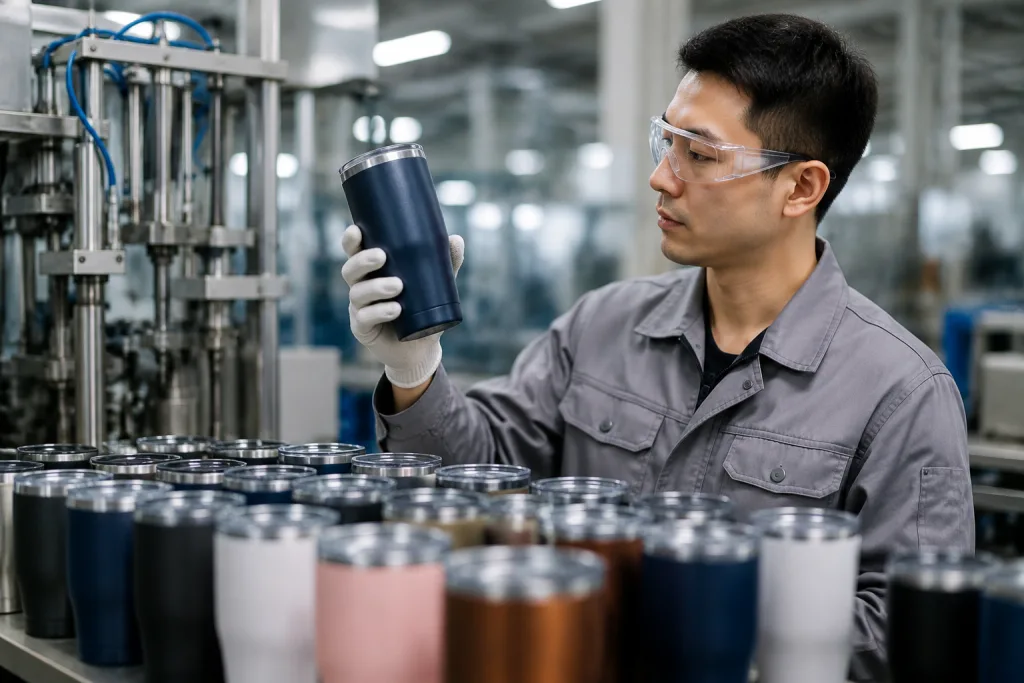
Double-wall vacuum insulation is easy to print on a spec sheet, and the first 6 showroom samples can look fine. The headache starts on the line. A proper vacuum line needs helium leak detection, vacuum hold testing, and a reject log tied to the welding batch, not a loose “NG” pile beside the packing table. At BottleForge Industrial in Zhejiang, our monthly stainless drinkware capacity is about 420,000 units across tumblers, bottles, and custom canteen projects, and we track vacuum failure by production batch because random scrap is the wrong story to tell a buyer after shipment.
For wine tumblers, buyers often ask for “6 hours hot, 12 hours cold.” The math doesn’t work the same as a travel mug. A short, wide wine cup loses heat faster than a tall travel tumbler because the lid opening is bigger and the surface area changes. We run the hot test with 95°C water filled to the recommended level, lid installed, room temperature 20-25°C, then record at 1, 3, and 6 hours with a probe thermometer. For cold testing, use 4°C water or an ice-water mix and write the method on the inspection report; QC once pulled a sample where the PO said “cold 12h” but the artwork file only said “keeps drinks chilled,” which caused a 2-day approval delay.
Vacuum acceptance needs a number, not a feeling. A simple factory check is hot water inside and external wall temperature checked after 3-5 minutes with an infrared thermometer; if the outer wall jumps fast, the cup is suspect. Better control uses vacuum detector equipment and random thermal testing from packed goods, not only fresh pieces from the polishing area. For a 5,000 piece order, we suggest at least 20 units for thermal spot checks during production and 32 units during final inspection, packed-carton sampling included, because we’ve seen this go sideways when every test cup came from the same 1 carton.
If your product family includes a customizable growler or distributor growler SKU, do not copy the same thermal claim from the wine tumbler. A 64 oz customized growler has a different volume-to-surface ratio and cap structure, and the cap gasket width alone can change the result by several degrees after 6 hours. One supplier may make both, but each item needs its own test method and claim wording. We ship both styles, and the buyer usually flags this only after marketing has already built the Amazon images.
Lids decide the complaint rate
The lid line deserves more attention than it gets on most RFQs. We run wine tumbler lids in PS or AS when the buyer wants a clear, low-cost look; both scratch and crack easier if a carton takes a corner hit. Tritan adds USD 0.12-0.25 extra per unit depending on lid size and order volume, but it survives drop handling better and gives retail buyers a cleaner story. PP is tough, but it is milky or solid color, so the cup suddenly looks less like a wine tumbler. Small part, big headache. Last month QC pulled 200 clear lids from the line because the gate area showed flow marks under a 600 mm inspection lamp.
State the lid function on the PO: splash-resistant sip lid, slider lid, straw-hole lid, or sealed travel lid. Most wine tumblers are not leakproof. Writing “leakproof” on an Amazon listing is the wrong claim to make, and we have seen that go sideways with returns after buyers shook the cup upside down. A slider lid cuts down table spills, but it is not a threaded canteen lid. A canteen customizable project usually uses screw threads, silicone rings, and torque testing; a wine tumbler depends on press-fit gasket tension. One US buyer flagged this after the sample room filled a 12 oz tumbler to 90% and tilted it over a white paper sheet.
Gasket hardness and fit look like small details until the complaint photos arrive. Too soft, and the lid pops out when the cup is squeezed. Too hard, and consumers fight to remove it. We normally check lid pull force with a digital force gauge, hot-water deformation after 95°C water contact, and 50 open-close cycles during sample approval. For mass production, colorless lids need visual inspection for flow marks and black dots; scratches over 3 mm usually get pulled before packing. The line knows this one.
If you work with canteen vendors or canteen manufacturers on outdoor bottles, you may be used to inverted 30 minutes tests or shake tests. For wine tumblers, use a practical spill test: fill to the recommended level, install the lid, tilt 45 degrees for 10 seconds, then check for excessive seepage. It is honest and measurable. The math does not work if the selling page promises bottle-level sealing on a press-fit lid. We write this test into the sample report, and QC marks the result with photos before the pre-production sample is signed.
Finish and logo are cost drivers
Finish is where a wine tumbler quote can look cheap on Monday and turn ugly after QC pulls the first carton. We run powder coating, spray painting, electro-polished steel, matte bead blast, and stainless mirror polish, but powder coat is still the safer mass-market choice for B2B custom drinkware because coverage is stable and scratch complaints stay lower. On a typical 12 oz tumbler, a standard powder coat adds roughly USD 0.35-0.60 per unit versus bare stainless, depending on color, reject rate, and whether the line needs a gun change after 3,000 pcs.
Specify the color standard. “Navy blue” is not a standard; it is a future argument. Use Pantone, RAL, or a physical sample, and for repeat orders ask the supplier to keep a signed color chip with the PO number written on the back. We have seen a buyer flag Delta E 1.8 on a reorder because their retail shelf had old and new stock side by side. Color drift of Delta E 1.5-2.0 is acceptable for 7 out of 10 promotional orders, but retail sets usually need tighter visual matching. If your order combines wine tumbler, customized canteen, and customizable drinkware SKUs, approve color across the different shapes and coating lines before bulk packing.
Logo method should follow the artwork and sales channel, not habit. Laser engraving is durable and good for stainless reveal, often USD 0.08-0.20 per position; the line checks depth with a 0.01 mm caliper when the buyer wants a clean silver cut. Pad printing is economical for small graphics, but the math does not work for wrap designs. Silk screen works for simple one-color logos on curved bodies, while registration still needs checking at the seam. Heat transfer and water transfer can handle full-color artwork, but cost, curing time, and scratch testing need tighter control.
For retail and distributor canteen programs, run cross-hatch adhesion testing, alcohol rub testing, and 3M tape pull on printed logos; we usually record the result on the same QC sheet as AQL 2.5 findings. For premium custom growler or custom canteen orders, we may add abrasion testing with 500 g load for 50-100 cycles. Do not approve decoration from a JPEG mockup alone. This is the wrong shortcut. Approve a physical pre-production sample under normal light, then check the logo at actual size with the lid fitted, because a 2 mm logo shift looks small on screen and obvious on the shelf.

Packing is part of the product
Export packing is not paperwork. It decides whether your order lands saleable or gets written up by the receiving warehouse. For wine tumblers, we usually run polybag plus white box, color box, kraft box, or egg-crate bulk packing for promotional distributors. Retail buyers often ask for 350 gsm color box or stronger; for e-commerce we quote E-flute mailers after checking the 12 oz or 14 oz sample in a drop-test corner fixture. If the order goes to Amazon FBA or a 3PL in the US, lock FNSKU placement, suffocation warning, carton labels, and master carton weight before pre-production. We have seen this go sideways when a PO said “label on box” but the buyer meant label on each unit.
We recommend keeping export cartons under 15 kg gross weight for manual warehouse handling. A typical 12 oz wine tumbler pack may be 24 pieces per carton, five-layer K=A corrugated carton, with dividers if the finish is high gloss or printed full wrap. For powder-coated pieces, individual bags cut rubbing, but the wrong PE bag can leave cloudy marks if the coating has not rested long enough after the curing oven. QC pulled a matte black sample last month with 3 small bag rubs near the rim, all from packing too early. Ask your wine tumbler supplier how many hours coated goods rest before packing; “long enough” is the wrong answer.
Drop testing should match your channel. For normal B2B distribution, an ISTA-style 1A drop sequence is a good reference. For e-commerce single-unit shipping, test the actual mailer, not only the master carton. We run the packed unit from 76 cm on corner, edge, and face, then open the box and check the lid, coating, and printed logo under a 6500K inspection lamp. A canteen distributor selling mixed drinkware kits may need inner cartons that survive repacking. Canteen promotional orders often accept simpler packing, but only when the distributor signs off on the damage risk.
Barcode quality is another boring detail that saves money. If you need UPC, EAN, or FNSKU, provide the final vector file before pre-production. Do not let a canteen vendor or tumbler factory rebuild barcodes from screenshots; the line printer will make it look acceptable, but the scanner may reject it at 30 cm. We had one buyer flag a single wrong digit on an FNSKU after carton sealing, and re-labeling 2,400 boxes killed 2 working days. Scanning failure at a warehouse can cost more than the whole packing upgrade.
Quote terms reveal supplier discipline
A disciplined quote shows the whole job, not just the unit price. We list item number, 12 oz or other capacity in ml, 304 stainless or confirmed material grade, finish, logo method, packing spec, MOQ, sample cost, sample lead time, mass lead time, Incoterm, FOB port, payment terms, and quote validity. For our China export orders, standard sample lead time is 7-10 days for stock mold with logo, and mass production is 30-40 days after deposit and artwork approval. Ningbo or Shanghai FOB both work from Zhejiang; our shipping clerk checks the CBM against the carton drawing before we send the PI.
Price needs context. A basic 12 oz stainless wine tumbler with powder coat and one-position laser logo often lands around USD 2.10-3.20 FOB China at 3,000-5,000 pieces, depending on steel, lid, packing, and color. If someone quotes under USD 1.80, ask what they removed: outer steel grade, coating thickness, lid material, carton strength, or inspection standard. The math does not work otherwise. Last month QC pulled a powder coat panel at 58 μm from the line; the buyer had flagged a cheaper quote, but that factory was coating closer to 35 μm.
Quality terms belong on paper before the PO. AQL 2.5 for major defects and 4.0 for minor defects is common for drinkware. Critical defects need zero acceptance, including sharp edges, contamination, broken glass-like plastic, major leakage where leakproof is claimed, and wrong food-contact material. For customized drinkware, first article approval and sealed golden samples are worth the extra two days. We label the golden sample with SKU, PMS color, logo position in mm, and approval date, because one typo on a PO color code can send the line in the wrong direction.
Check factory fit before you chase the lowest line item. A canteen supplier can be strong on screw-cap bottles but weak on wine tumbler coating. A tumbler specialist is not always the right canteen manufacturer for a large outdoor flask range. If you need wine tumblers, canteen customized products, and customizable growler SKUs under one program, ask for capacity by line, not total factory capacity. We have seen this go sideways: a clean pre-production sample, then 18 cartons with rubbing marks after the coating line was squeezed between bottle orders.
Send your wine tumbler spec sheet for review
Share capacity, logo, color, packing, MOQ, and target FOB price. We will flag risks before sampling starts.
Frequently asked questions
What MOQ should I expect from a wine tumbler supplier in China?
For a standard stock-mold wine tumbler, expect 1,000 pieces per color as a practical MOQ. If you need a custom powder color, full-wrap print, retail box, or special lid, 3,000 pieces is more realistic. For private mold work, the starting point is often 5,000-10,000 pieces plus mold cost. Very low MOQ offers can work for blank stock or local decoration, but they rarely give you stable coating, logo, and packing control for a B2B customized drinkware program.
Is 304 stainless steel necessary for wine tumblers?
For the inner wall, yes, 304 stainless steel is the safer baseline for wine, acidic drinks, and repeated washing. The outer wall can be 201 or 304 depending on budget. A common mid-market construction is 304 inner and 201 outer with 0.4-0.5 mm sheet thickness before forming. For premium retail, hospitality, or European importers needing stronger documentation, 304/304 is better. Ask your supplier for food-contact declarations and avoid vague material wording like “high-grade stainless.”
Which logo method is best for a custom wine tumbler?
Laser engraving is the most durable and usually costs about USD 0.08-0.20 per logo position, depending on size and order quantity. Silk screen is good for simple one-color logos, while heat transfer is better for full-color or wrap artwork. For rough outdoor use, laser or etched stainless effects hold up better than surface ink. If the project also includes custom canteen or custom growler items, test each shape separately because curve, coating, and logo size change adhesion results.
How long does production usually take after sample approval?
For stock-mold wine tumblers with one logo and standard packing, plan 30-40 days after deposit, artwork approval, and signed pre-production sample. Samples usually take 7-10 days if the mold exists. Add 5-10 days for custom color matching, special lids, or complex retail packaging. During peak China export periods before summer and Q4 gifting, lead times can stretch by 10-15 days, so confirm the production slot before you issue the PO.
Can one factory handle wine tumblers, canteens, and growlers together?
Yes, but you should verify line experience by product type. Wine tumblers need stable coating, rim finish, lid fit, and vacuum yield. A customized canteen needs cap torque, leak testing, strap hardware, and sometimes larger body forming. A customized growler needs stronger welding and thermal testing because of higher volume. Ask for monthly capacity by category, recent inspection reports, and physical samples from mass production, not only showroom samples. One capable China factory can simplify sourcing, but only if the specs are controlled.