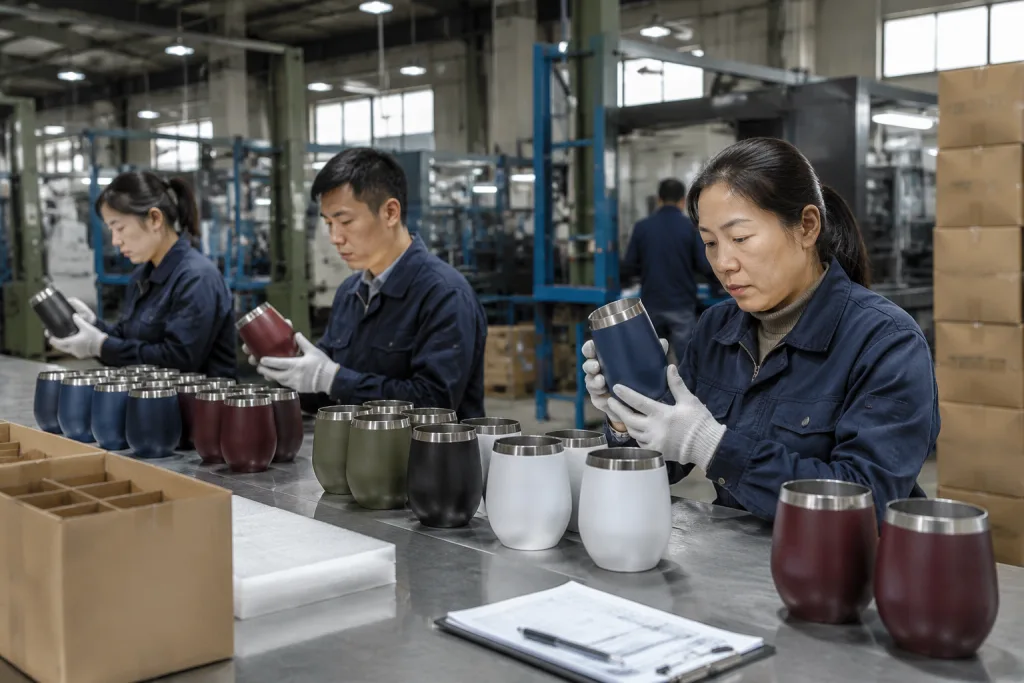
Key Takeaways
- A practical wine tumbler private label MOQ is usually 1,000-3,000 pcs per color for powder-coated stainless steel
- Ask for SUS304 inner steel, 0.45-0.55 mm wall thickness, and 6-12 hour insulation targets in writing
- Plan 25-35 days for production after artwork approval, plus 7-10 days for sampling and lab checks
- Use AQL 2.5/4.0 inspection, carton drop testing, and REACH or LFGB checks for EU retail programs
A wine tumbler private label project looks simple until the first quote sheet lands. One canteen manufacturer offers 1,000 pcs, another canteen supplier insists on 3,000 pcs, and the logo cost jumps after artwork approval because the buyer wrote “logo: yes” instead of laser, 1-color silk screen, or powder-coat mask. We see this weekly. Last month QC pulled a pre-production sample with a 0.35 mm logo offset, and the buyer flagged it after the PI was already signed. That is not always dishonesty. Most of the time, the RFQ is too loose.
From our Hangzhou, Zhejiang sales desk, the fastest buyers define capacity, 304 stainless steel thickness, lid style, coating, carton pack, and FDA or LFGB test needs before asking for price. China can build a low-cost wine tumbler and a solid retail-grade tumbler, but the math does not work if both are quoted under one vague line item. We run different costing for a 12 oz tumbler with 0.5 mm inner wall, sliding lid, 24 pcs master carton, and color box packing. Same shape, different bill of materials. Ask the right question first: what spec are we actually shipping?
Start With The Real Spec
Buyer question: “Can you quote a 12 oz wine tumbler with logo?” You can ask that, but the comparison will be messy by lunch. We saw one RFQ last month where the PO said 12 oz, the artwork file said 350 ml, and QC pulled the sample at 392 ml brim-full. A serious wine tumbler private label RFQ should read like an engineering part, not a catalog photo.
For stainless wine tumblers, start with capacity and body shape, then lock the inner and outer material, lid type, coating, decoration, packaging, and target market. A normal working spec is 12 oz or 14 oz, double-wall vacuum, SUS304 inner, SUS201 or SUS304 outer, 0.45-0.55 mm wall thickness checked by digital caliper, clear AS or Tritan-style slide lid, powder coating, and one-color logo. If you need a canteen customized look, say whether you mean shape tooling, color, logo, or retail packaging. Different bill. Different lead time.
For private label, 8 out of 10 buyers do not need new tooling. Existing molds keep cost and risk down, and we can usually move to sample in 7 days instead of waiting 27-37 days. New tooling for a tumbler body can run from USD 1,500 to USD 6,000 depending on complexity, and it adds 20-30 days before mass production. If your brand story depends on a special silhouette, fine. If not, the math works better when you spend on coating adhesion, packaging drop test, and AQL 2.5 inspection.
- Capacity: 12 oz, 14 oz, or 16 oz, with brim-full volume and usable fill line confirmed
- Material: SUS304 inner is the baseline for food-contact stainless steel; ask what the outer wall is too
- Finish: powder coating, spray paint, glitter, matte finish, or polished steel, with coating thickness checked before packing
- Logo: laser engraving, silk screen, heat transfer, or full-wrap print, matched to artwork size in mm
- Pack: white box, kraft box, color box, gift box, or e-commerce mailer, with carton weight kept under 15 kg when possible
When a canteen vendor in China sees this level of detail, the quote gets cleaner and the sample lands closer to what you meant. We ship fewer surprises that way. The buyer still may flag a lid fit or logo position, but at least the line is correcting a real spec, not guessing from a photo.
MOQ, Price, And Lead Time
Buyer question: “What is a fair MOQ?” Wrong question first. Ask what MOQ keeps the line stable and the price honest. For a wine tumbler private label order, 1,000 pcs per color is the normal floor when we run an existing mold and standard powder coating. Some canteen suppliers will take 500 pcs, but the math gets ugly: the spraying jig still needs setup, the silk-screen plate still gets made, and QC still pulls samples by AQL table. For custom PMS powder coating, plan on 1,000-3,000 pcs per color because the coating booth needs cleaning, the color card needs matching under a D65 light box, and we keep scrap allowance for shade drift.
At BottleForge Industrial in Zhejiang, a typical line capacity for stainless tumblers is about 450,000 units/month across standard bottle, tumbler, and custom canteen programs. For a regular 12 oz wine tumbler with one logo, realistic production time is 25-35 days after deposit and artwork approval. That means approved artwork on Monday, not a JPG logo sent on Friday night. A pre-production sample takes 7-10 days if the base item is available. Add 3-5 days for extra packaging proofing, and 5-7 days if a third-party lab test is required. Last month QC pulled the sample because the logo sat 2 mm too close to the lower curve. Small issue. Still cost 2 days.
FOB China pricing depends on steel grade, coating type, lid spec, logo process, and packing strength. A basic 12 oz stainless wine tumbler private label order can sit around USD 2.10-3.40 FOB Ningbo or Shanghai at 3,000 pcs. A heavier body with 0.5 mm outer wall, premium powder coating, full-wrap print, individual color box, and a 5-layer export carton can push it to USD 3.80-5.20. If a canteen factory quotes far below that, check wall thickness with a micrometer, vacuum rejection rate after the hot-water test, lid material, and carton burst strength before celebrating. We have seen this go sideways.
Cheap quotes are not automatically bad. Unexplained cheap quotes are risky.
For distributor drinkware programs, ask for price breaks at 1,000, 3,000, 5,000, and 10,000 pcs. This shows whether you should launch small or put the wine tumbler together with a custom growler or sports bottle in the same shipment. We ship mixed drinkware programs often, but the buyer needs to lock carton marks early; one PO typo on “matte sage” versus “matte sand” can slow warehouse loading by half a day.
Decoration Choices That Hold Up
Buyer question: “Which logo method should we choose?” Start with order size and use case, not the prettiest mockup. For 1,000–5,000 pcs coated 304 stainless wine tumblers, we usually steer buyers to laser engraving when they want a retail-clean mark that will not peel. The laser head burns through the powder coat and shows the steel underneath; on our line we check depth with a 10× loupe before packing. Gradients are the wrong fit here. Simple marks win. Laser also handles dishwasher abuse better than printed logos, although we still print “hand wash recommended” on the color box because retail claims can get ugly.
Silk screen printing suits one- or two-color logos, especially when the buyer wants a lower logo cost on 3,000 pcs. It looks sharp if the jig is right. On curved wine tumbler bodies, a loose fixture by even 1.5 mm can leave the logo leaning, and QC pulled samples last month where the left edge sat 4 mm higher than the right. Heat transfer and water transfer give you larger artwork space for patterns or lifestyle graphics, but the math does not work if adhesion is weak. For EU or North America retail, we run cross-hatch adhesion testing, 3M tape pull, alcohol rub, and abrasion checks before mass production.
For canteen promotional orders, buyers often ask for the biggest logo the cup can take. We push back on that. A 45 mm wide logo on a 12 oz tumbler usually looks cleaner than a 70 mm logo wrapped across the curve, especially after the cup rotates in the pad-printing jig. If you are building a wine tumbler private label line, lock the logo position into the brand standard: centered 35 mm below rim, 50 mm wide, same orientation as lid slider. One PO came in with “same as sample” but no rim distance; that small typo cost 2 days of sample approval.
Decoration checklist
- Confirm artwork as vector AI, PDF, or CDR; no JPG pulled from a website
- Specify Pantone code for printed logos and coating, with matte or gloss finish written on the PO
- Approve a physical logo sample, not just a digital mockup; QC should sign the sample bag
- Set acceptable logo position tolerance, usually ±2 mm, and define the measuring point
- Define who pays rework if production ignores approved artwork
Compliance Is Not Optional
Buyer question: “Do we need testing if the factory says food grade?” Yes, if you sell through retailers or e-commerce platforms with a compliance desk. “Food grade” is a sales claim, not a report number from SGS, TÜV, or Intertek. On our line, QC pulled a 12 oz wine tumbler last month because the silicone gasket had no matching batch label; that is exactly the sort of gap a buyer will flag. A canteen manufacturer should tell you which test fits your market, not look surprised when you ask.
For EU buyers, we normally see REACH plus LFGB food-contact testing, with BPA-free confirmation when the lid has plastic or Tritan parts. For North America, buyers often ask for FDA food-contact conformity and California Proposition 65 screening; ASTM-related checks come up when the item is for kids or has a straw, handle, or small detachable part. For wine tumblers, the main checks are 304 stainless steel composition by XRF gun, coating chemistry, lid material, and overall migration. The wrong question is “does this look safe?” The right question is whether the report covers the exact coating code and lid material on the PO.
Factory audits still matter. BSCI, Sedex, ISO 9001, or a customer audit can reduce supply chain risk, but they do not replace product testing. An audited canteen factory can still ship weak powder coating if nobody checks the production lot; we have seen 2H pencil hardness pass on the golden sample and fail after 500 pcs because the oven temperature dropped 8°C. We normally suggest a pre-shipment inspection using AQL 2.5 for major defects and AQL 4.0 for minor defects. Critical defects should be zero tolerance. For drinkware, that means sharp rim edges over 0.3 mm burr, leaking lids after an upside-down shake test, broken vacuum, contamination, wrong material, or unsafe packaging staples.
If you are a canteen distributor or distributor growler buyer bundling several SKUs, test by material family. Do not assume a passing test on a custom canteen covers a wine tumbler with a different coating and lid; we have seen this go sideways when a buyer changed from PP lid to AS lid but kept the old report in the file. China has capable testing labs, but you need to budget time and money before mass production. A basic migration and material test can take 5-7 working days; a fuller retail panel may take 10-15 working days. If your ship date is May 20, send samples by May 1, not after the cartons are already sealed with 48 mm tape.
Packaging For Retail And FBA
Buyer question: “Can the same packaging work for retail, wholesale, and e-commerce?” Sometimes, but this is the wrong question to ask. A wine tumbler private label item for a boutique gift shop usually needs a printed color box with barcode, warning text, material statement, and care instructions; an Amazon shipment needs FNSKU labeling, carton limits, drop resistance, and polybag rules based on the pack format. We had one buyer flag a 3 mm barcode quiet-zone issue after the box proof, and QC pulled the sample before mass print.
Do not leave packaging until the last week. We’ve seen customizable drinkware orders lose 5 days on box artwork while the tumbler body was already approved. A workable schedule treats packaging files like product artwork: dieline first, design next, proof next, mass print after signed approval. Color box MOQ is often 1,000-3,000 pcs, and printing lead time is usually 7-12 days after artwork approval. If your canteen suppliers quote 20 days total including color boxes, ask how they control the box line, ink drying, and final packing window; the math does not work if the PO still says “Matt Black” while the artwork says “Matte Black.”
Carton strength is not glamorous, but it affects claims. For wine tumblers, we usually run 5-layer export cartons for sea freight, inner dividers or a snug box fit, and carton weight below 15 kg where possible. Run a carton drop test if the goods will move through parcel networks; our packing line often tests a 48 x 35 x 32 cm master carton at around 14.2 kg before booking. Pretty gift box, weak carton. That is not premium. It is a chargeback waiting to happen.
Packaging checklist
- Barcode, FNSKU, SKU sticker, or distributor label requirement, including label size such as 38 x 25 mm or 100 x 150 mm
- Country of origin marking, such as “Made in China”
- Care instructions: hand wash, no microwave, lid cleaning note checked against the actual lid type
- Retail claims matched to real test data, not marketing wishes from a sales deck
- Master carton dimensions and gross weight confirmed before booking freight, with carton marks matching the PO
For distributor canteen and distributor drinkware programs, consistent carton labeling across SKUs saves warehouse time. We ship mixed-SKU pallets where the warehouse scans only the short side of the carton, so a clean 100 x 150 mm label with item code, color, case pack, and PO number prevents pick errors. Serious canteen distributors notice that detail.
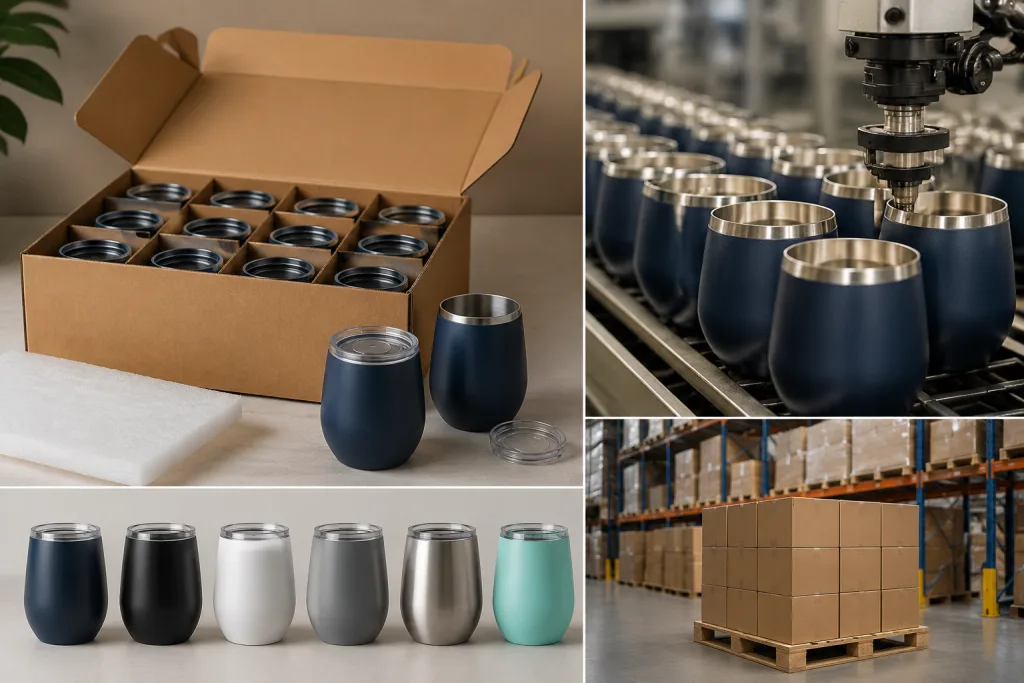
How To Choose The Factory
Buyer question: “Should we buy from a trading company, canteen vendor, or factory?” Wrong question first. Ask who will catch the 0.3 mm lid wobble before your buyer does. A trading company works for 3 or 4 mixed SKUs under one small PO. A direct canteen factory is the safer choice when you need repeat coating batches, the same laser logo position, and private label boxes that still match on the third reorder.
For wine tumbler private label sourcing, ask who controls vacuum forming, polishing, coating, printing, and packing. We run those checks on the line with a vacuum tester, film thickness gauge, and 3M tape for adhesion. About 6 out of 10 canteen manufacturers we see outsource at least one step. Outsourcing is fine. Hidden outsourcing is where we’ve seen this go sideways. If coating is off-site, ask who signs off color ΔE, scratch resistance, and adhesion. If lids come from a partner workshop, ask whether they can lock the material grade, mold number, and silicone gasket hardness for repeat orders.
Good canteen vendors answer technical questions without turning every sentence into a sales pitch. They can explain vacuum testing, coating rejection rates, carton drop tests, and AQL inspection. They can also say no. That matters. If you ask for 500 pcs, eight colors, full custom box, 15-day delivery, and the lowest FOB price in China, a serious supplier should push back. The math doesn’t work; QC pulled a sample last month where rushed powder coating failed after one cross-cut tape test.
Here is the practical shortlist we use when helping new buyers evaluate a canteen manufacturer in Zhejiang or elsewhere in China. We usually check this before deposit, not after the PI is stamped. One buyer once sent a PO with “matte black” in the item line and “gloss black” in the packing notes; that typo cost 2 days because the coating room had already mixed 18 kg of powder.
- Can they provide a real quotation sheet with material grade, packaging type, MOQ, lead time, and FOB port?
- Can they send recent test reports for similar stainless drinkware, not a 2021 report for a plastic bottle?
- Can they support repeat color matching with Pantone or physical swatches, then keep the approved panel beside the coating line?
- Can they handle custom canteen and wine tumbler orders in one program without mixing lids or cartons?
- Can they accept third-party inspection before balance payment, with AQL 2.5 checked on finished packed cartons?
If the answer is yes to 4 out of 5, you have a workable canteen supplier. If they dodge the inspection question or refuse to show packing photos with carton marks, keep looking before you pay a deposit.
Send Your Wine Tumbler RFQ For Review
Share capacity, logo method, packaging, target market, and order quantity. We will return a practical FOB quote and production timeline.
Frequently asked questions
What MOQ should I expect for wine tumbler private label orders?
For existing mold stainless wine tumblers, expect 1,000 pcs per color as a practical MOQ. Some factories accept 500 pcs, but the FOB price may rise by 15-35% because coating, logo setup, and packaging print costs are spread across fewer units. For custom PMS powder coating or retail color boxes, 1,000-3,000 pcs is more realistic. If you combine a wine tumbler with a customized canteen or custom growler program, the factory may reduce per-SKU pressure because the total order value is higher.
How long does a private label wine tumbler order take from China?
A normal schedule is 7-10 days for pre-production samples and 25-35 days for mass production after deposit, artwork approval, and sample approval. Add 5-7 working days for basic lab testing, or 10-15 working days for a broader retailer test panel. Sea freight to North America or Europe then adds several weeks depending on port and season. If a canteen factory promises 15 days for a new color, new logo, and color box, ask for a written production plan.
Is laser engraving better than printing for wine tumblers?
Laser engraving is usually the safest decoration for powder-coated stainless tumblers because it is permanent and has no ink adhesion risk. It works best for single-color logos, wordmarks, and simple icons. Silk screen printing is cheaper for larger flat-color marks, while heat transfer is better for full-wrap artwork or patterns. For any printed method, require adhesion and rub testing before mass production. A good tolerance for logo placement is usually ±2 mm, especially on curved tumbler bodies.
What compliance documents should I request before placing an order?
Ask for recent test reports on similar stainless drinkware, not a random old certificate. For EU programs, REACH and LFGB food-contact testing are common. For North America, FDA food-contact conformity, BPA-free confirmation for plastic lids, and Prop 65 screening may be needed. Also request material declarations for SUS304 stainless steel and lid components. For factory systems, BSCI, Sedex, or ISO 9001 helps, but product testing and AQL inspection still matter for each production batch.
Can I use one supplier for tumblers, canteens, and growlers?
Yes, if the supplier has the right production range and can manage specs consistently. Many canteen manufacturers also make customizable growler, travel tumbler, sports bottle, and other custom drinkware items. The advantage is consistent coating color, shared packaging standards, and better container loading. The risk is assuming every product has the same MOQ and lead time. A 12 oz tumbler may be 1,000 pcs per color, while a large customized growler may need 2,000 pcs depending on mold and finish.