Key Takeaways
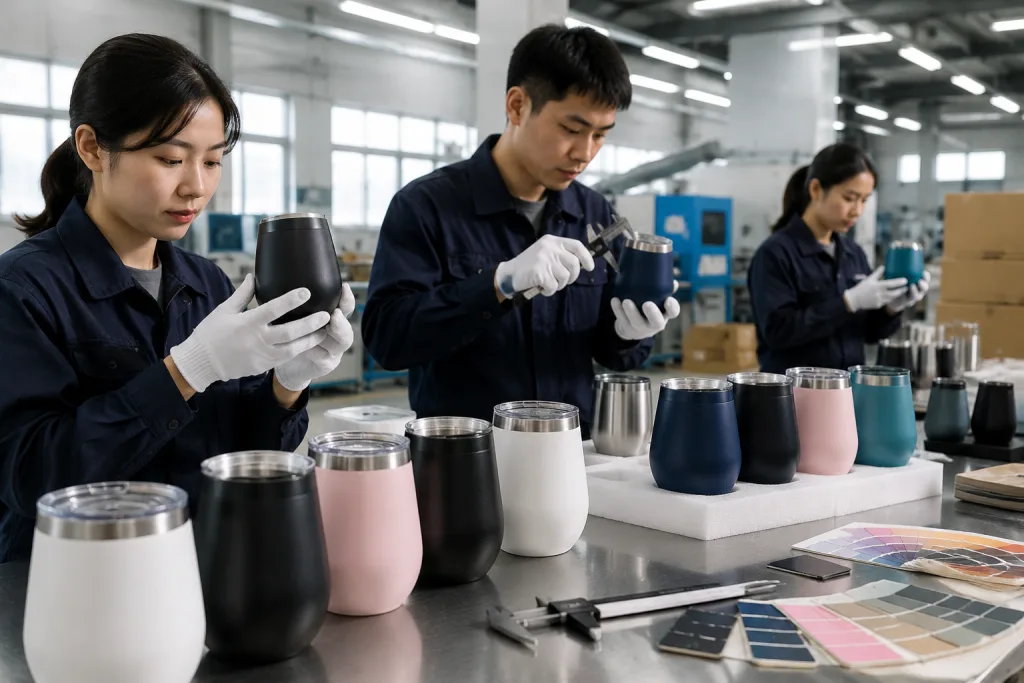
- For wine tumblers, lock 304 stainless steel, 0.4-0.5 mm inner wall, lid type, coating, and logo method before comparing prices
- A practical MOQ is 1,000 pieces per color for powder coating and 3,000 pieces for fully customized molds or lids
- Pre-production samples usually take 7-12 days after artwork approval; bulk lead time is normally 25-35 days
- Use AQL 2.5 for major defects and AQL 4.0 for minor defects on drinkware shipments
Buying from wine tumbler manufacturers looks simple until the quotes land in your inbox. One factory prices 12 oz stainless tumblers at USD 2.35 FOB Ningbo, another at USD 3.10, and both write “304 stainless, double wall, custom logo.” That line is not a spec. Before we open a purchase order, we want the wall gauge in mm, lid material, coating method, carton drop test height, logo tolerance, AQL level, and packaging layout. QC pulled a sample last month where the cup passed the magnet check, but the caliper showed a 0.34 mm outer wall against a 0.40 mm approved sample. The math does not work if you only compare the FOB price.
BottleForge Industrial is based in Hangzhou, Zhejiang, and we see this gap every week on the line. Buyers ask for custom drinkware, custom canteen, customizable growler, or distributor drinkware programs; the job is still the same: define the spec, lock the sample, write a clean PO, inspect before shipment, then scale without changing the product by accident. Small mistakes move fast. We once had a buyer flag “mat black” on a PO, and the factory read it as matte black only after 2,400 lids were already staged beside the powder coating booth.
Start With A Tight RFQ
Your RFQ decides whether we quote against real production specs or fill a spreadsheet with assumptions. For wine tumbler manufacturers, “12 oz, black, logo print” is not enough. We run the same 12 oz stemless cup with 0.4 mm or 0.5 mm inner steel, different vacuum hold targets, AS or Tritan lids, powder coat or spray paint, and single-box or bulk-pack cartons. QC pulled a sample last month where the buyer expected 6-hour ice retention, but the RFQ never said it; that missing line moved the price by USD 0.20-0.80 per unit and made the supplier comparison useless.
A clean RFQ should state capacity in ml and oz, outer diameter with tolerance such as ±1 mm, height target, cup-holder fit, 304 or 316 stainless steel, double-wall vacuum insulation target, lid material such as AS, PS, PP, or Tritan, and coating method. If you need REACH compliance for Europe or LFGB food-contact testing, put it in the RFQ before sampling, not after the first carton drop test. For North America, ask whether the factory can support FDA food-contact documentation and ASTM packaging requirements where relevant. We have seen this go sideways when a PO says “PP lid” but the approved sample used AS; the line stops while purchasing checks resin stock.
For a buyer comparing a canteen manufacturer, canteen supplier, or canteen factory against wine tumbler suppliers, use one RFQ sheet and lock the same cost drivers across both product types. The shape changes; the buying logic does not. BottleForge’s Zhejiang facility can produce about 450,000 stainless drinkware units per month, but this is the wrong question to ask if the RFQ leaves steel grade, lid resin, and carton spec open. On our production board, a 3,000 pcs wine tumbler order and a 3,000 pcs canteen order can both miss the same 18-day ship window when artwork approval arrives 12 days late.
RFQ line items you should list:
- Product: 12 oz stainless steel stemless wine tumbler, double-wall vacuum, with target hot/cold hold time stated
- Material: inner 304 stainless steel, outer 201 or 304 stainless steel as quoted separately, steel grade marked on the cost sheet
- Wall thickness: inner 0.4 mm minimum, outer 0.5 mm target, checked by micrometer during incoming QC
- Finish: powder coating, PMS color match, 1-color logo, with logo size in mm and print position from rim
- MOQ request: 1,000 pcs per color, 3 colors, total 3,000 pcs, packed by color unless mixed cartons are approved
- Trade term: FOB Ningbo or FOB Shanghai, quoted in USD, with carton CBM and gross weight shown
- Compliance: REACH, LFGB or FDA food contact, BSCI audit if required, with test report name matching the factory on the PO
Compare Quotes Without Fooling Yourself
When quotes arrive, do not sort the spreadsheet by unit price first. That is the wrong question to ask. A quote from a canteen vendor or wine tumbler factory can look lower because the lid is missing, the outer wall is 0.4 mm instead of 0.5 mm, the carton is plain 5-ply export carton, or the finish is water-transfer print instead of powder coating. We had one buyer flag this only after QC pulled the pre-production sample and found the lid gasket was not in the BOM. Normalize the quote before you judge the supplier.
Ask each factory to split the price. Separate blank tumbler cost, lid cost, coating cost, logo cost, individual box cost, master carton cost, testing cost, sample cost, mold or fixture cost, and FOB local charges. A realistic 12 oz powder-coated wine tumbler might land between USD 2.20 and USD 3.20 FOB China at 3,000 pcs, depending on steel grade, coating, logo, and packaging. On our costing sheet, a laser logo can add USD 0.08 to USD 0.18, while a retail color box can add USD 0.22 to USD 0.45 if the buyer asks for 350 gsm paper. If someone quotes USD 1.75, do not celebrate yet. Ask what changed.
This matters for buyers handling canteen promotional orders or distributor canteen catalogs because your customer may reorder the same item six months later. If the first PO was built on a vague quote, the reorder turns into an argument about assumptions: matte black or satin black, 12 days vs 18 days lead time, white box or kraft box. We have seen this go sideways over one PO typo where “lid included” became “lid excluded” on the supplier PI. That wastes time and cuts margin.
Quote comparison line items:
- Base product cost: blank tumbler with fitted lid, no logo, same 12 oz body shape
- Decoration: laser engraving depth in mm, silk screen color count, or full-wrap print coverage
- Coating: powder coat with adhesion test result, spray paint, UV print, or electroplating finish
- Packaging: polybag and white box for promo orders, or retail color box with insert card
- Testing: food-contact test, coating adhesion cross-cut, salt spray if the tumbler uses plated parts
- Commercial terms: MOQ, payment term, sample fee, lead time, FOB port, and local charge split
One practical rule from the line: compare the quote that matches your sellable product, not the cheapest version the supplier can technically make. Put the approved sample, carton mark, and PI side by side before you sign. The math does not work if those three do not match.
Approve Samples Like A Buyer
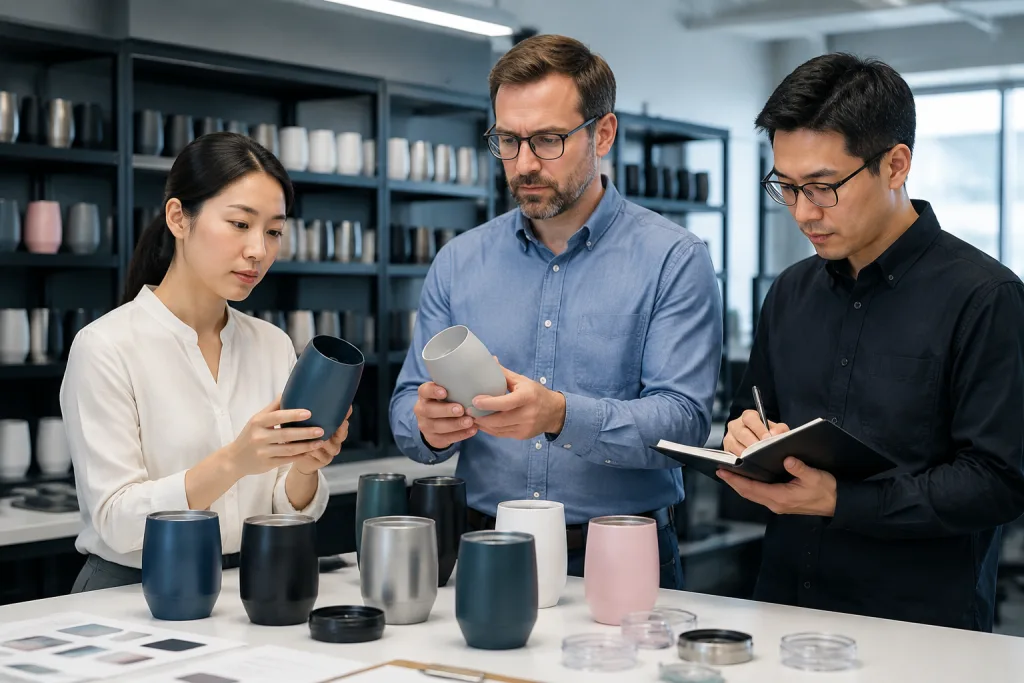
Sampling is where we see 4 out of 10 B2B buyers rush the approval. A pre-production sample is not a desk souvenir; it is the physical contract the line will follow for bulk production. Loose sample, loose PO. For customized drinkware, especially powder-coated wine tumblers with logos, approve construction, finish, and packing as separate sign-offs, not one quick “OK” in WhatsApp.
Construction means the tumbler itself. Check unit weight on a 0.1 g scale, rim smoothness by hand, vacuum performance, lid fit, slider movement, bottom wobble on a glass plate, and whether polishing dust is still inside after washing. We run a standard vacuum test with hot water at about 95°C, then record the temperature drop after 6 hours; for a 12 oz wine tumbler, we normally expect the result written as a number, not “keeps hot for hours.” This is the wrong question to ask: “Does it look fine?” Ask what the sample measured.
Finish means color and decoration. PMS color on 304 stainless steel will not match paper 1:1, especially with matte powder coating, so set a ΔE limit such as 1.5-2.0 or approve a physical color chip from the spray room. For laser engraving, check logo depth and position tolerance with a vernier caliper; for silk screen, check edge sharpness and rub resistance after 50 dry wipes. If you are ordering canteen customized products, customized growler batches, or a canteen customizable retail program, the same discipline applies because mixed SKUs make the math worse. We have seen this go sideways when the buyer approved PMS 2965C by phone and QC pulled the sample 18 days later with a blue that looked black under warehouse light.
Sample PO line items:
- Sample type: 3 pcs pre-production samples with final coating and final logo, pulled from the same tooling as bulk
- Artwork: AI or PDF vector file, logo size 45 mm wide, front center, tolerance ±1.5 mm
- Color: PMS 2965C matte powder coating, physical chip required before spray line release
- Packaging sample: 1 pc packed in final kraft box with barcode sticker, carton drop corner checked
- Sample lead time: 7-12 days after artwork and payment, not after the PO typo gets corrected
- Approval record: photos, weight, dimensions, vacuum test result, logo position, signed sample tag number
Do not approve bulk production from a photo only unless the deadline matters more than defect risk. Photos hide coating texture, lid tightness, and carton strength; a 2 mm lid gap looks harmless on screen and becomes a return claim after we ship 3,000 pcs. Ask for the packed sample. QC pulled the sample for a reason.
Write The Bulk PO Properly
The bulk PO should not be a two-line email. It needs to read like a work order that purchasing, sales, QC, and the line can follow without guessing. China time zones make this matter; one missing carton mark at 6:00 p.m. Hangzhou time can cost a full day. We have seen a PO say “black tumbler” while the approved sample tag on our shelf read “BK-02 matte black, 18 gloss units on the BYK meter.” That gap turns into rework.
For wine tumbler manufacturers, put SKU, item description, approved sample reference, quantity by color, unit price, total amount, Incoterm, delivery port, carton packing, barcode requirement, inspection standard, and shipment deadline on the PO. If you ship into e-commerce warehouses, add FNSKU, suffocation warning, carton label size, and maximum carton weight; 15 kg is a common ceiling buyers flag. Retail and distributor drinkware orders need inner box material, hangtag, insert card, and master carton marking. QC pulled one sample last month because the carton label was 100 mm x 60 mm on the PO but the artwork file was built at 90 mm x 50 mm.
A practical MOQ for BottleForge in Zhejiang is usually 1,000 pcs per color for existing wine tumbler shapes and 3,000-5,000 pcs when the order includes custom lids, custom mold changes, or special coatings. Standard bulk lead time is 25-35 days after deposit and final sample approval. Before Q4, add 7-10 days unless we have reserved production slots on the polishing and powder coating lines. The wrong question is “Can you rush it?” Ask what process is the bottleneck; for coated tumblers, it is often oven capacity, not assembly.
Bulk PO line items:
- SKU: WT12-MATTE-BLK, 12 oz stemless wine tumbler
- Quantity: 5,000 pcs total, 2,000 black, 2,000 navy, 1,000 white
- Unit price: USD 2.68 FOB Ningbo, including lid, logo, kraft box
- Payment: 30% deposit, 70% balance after passed inspection before shipment
- Lead time: 30 days after deposit and written sample approval
- Inspection: AQL 2.5 major, AQL 4.0 minor, 100% carton count
- Documents: commercial invoice, packing list, bill of lading, test reports if ordered
If a canteen distributor or distributor growler buyer sends us a PO without these details, we push back. Not paperwork theater. It is cheaper than arguing after 5,000 units are packed, sealed with 48 mm BOPP tape, and stacked on 10 pallets waiting for the forwarder.
Control Decoration And Packaging
Decoration and packaging create the complaints we should have killed before shipment. The stainless body passes vacuum and salt spray, then the buyer flags a logo sitting 4 mm too low, a powder coat rubbed through on the inner carton wall, or a UPC that our Zebra scanner cannot read at 300 dpi. For customizable drinkware, decoration is part of the product. Treating it as “just packing” is the wrong question to ask.
Laser engraving gives the cleanest repeat order result, and we run it most often on powder coating or plated surfaces where the silver cut has enough contrast. Silk screen costs less for a simple one-color logo, usually around USD 0.05-0.12 per position at volume, but QC pulled samples for a 3M tape test because weak ink adhesion shows up after the first sea shipment. Full-wrap printing looks strong in a campaign photo; the real check is a pre-production sample on the curved wine tumbler body, measured against the seam with a soft ruler. For canteen promotional programs, about 7 out of 10 distributor buyers pick laser because the same logo gets reordered across canteen customized bottles and custom growler items.
Test packaging before bulk shipment, not after the container is booked. A common export pack for wine tumblers is 1 pc per polybag or tissue wrap, 1 pc per kraft box, 24 pcs per master carton. Carton weight usually stays under 13 kg, which matters when the line is loading 600 cartons in one afternoon. If you need Amazon or third-party warehouse intake, specify FNSKU placement, carton label format, country-of-origin marking, and whether the product box must pass a 1.2 m drop test. We have seen this go sideways when the PO said “Amazon label,” but the buyer meant side-panel FNSKU, not carton mark.
Decoration and pack line items:
- Logo: laser engraving, 45 mm wide, tolerance plus or minus 1.5 mm, with position measured from the rim on the approved sample
- Coating test: 3M tape adhesion test after 24-hour curing, recorded by color and batch number
- Retail box: 350 gsm kraft box, black one-color print, UPC sticker checked by handheld scanner before packing
- Master carton: 5-layer K=A corrugated carton, 24 pcs per carton, edge-crush sample pulled before mass packing
- Carton mark: SKU, color, quantity, NW/GW, made in China, PO number, with the PO number checked against the packing list
- Warehouse labels: FNSKU or customer carton label supplied 10 days before packing, not after the line has sealed cartons
Do not leave label placement to the packing team’s judgment. Give a drawing with mm spacing, label side, and one approved photo from the first packed carton.
Inspect Before The Balance Payment
Final inspection is the last point where the buyer still has real control. After the balance is paid and the container leaves Ningbo or Shanghai, defects turn into credit notes, replacement cartons, air freight arguments, or store complaints. We have seen this go sideways over a 0.4 mm sharp rim that QC pulled from a packed master carton. Catch it before shipment.
We run AQL inspection for most B2B drinkware orders. AQL 2.5 for major defects and AQL 4.0 for minor defects is common. Critical defects should be zero. Major defects include leaking lids, sharp rims, wrong logo, severe coating peel, wrong color, damaged retail packaging, or incorrect barcode. Minor defects include 1-2 small dust points in the coating, slight print variation inside the approved tolerance, or light box scuffs under 10 mm. For food-contact items, random checks should cover odor, cleanliness, lid fit, and visual interior inspection with a flashlight; last month our line rejected 37 lids because the silicone ring sat 1.5 mm proud after assembly.
If you are buying through a canteen vendor, canteen vendors network, or several canteen manufacturers, use the same checklist for every shipment. Otherwise you are asking the wrong question: you will not know whether quality improved or the inspector simply checked different points. Third-party inspection in Zhejiang or other China manufacturing regions typically costs USD 180-300 per man-day, depending on location and scope. For a USD 15,000-30,000 order, the math works; one failed barcode label on 3,000 retail boxes can cost more than the inspection.
Inspection PO line items:
- Inspection timing: when 100% produced and at least 80% packed
- Sampling plan: ANSI/ASQ Z1.4, general inspection level II
- AQL: critical 0, major 2.5, minor 4.0
- Checks: quantity, dimensions in mm, unit weight in g, color, logo position, lid fit, leak test, packaging
- Special test: random vacuum performance check from packed goods, pulled from sealed master cartons
- Release rule: balance payment only after passed inspection report
Inspection cannot fix a weak specification. It only tells you whether the factory followed the spec you put on the PO, including the logo file name, Pantone code, carton mark, and barcode number.
Plan Reorders Before Shipment
A first order is not just about pushing cartons out of Hangzhou. It should make the second PO easier. Repeat buyers keep the production file tight: approved sample photos from the light box, Pantone chip number, artwork version, carton layout with 5 mm tolerance, AQL inspection report, test reports, and final packing list. We once had QC pull a wine tumbler sample because the PO showed “matte navy” while the AI file said “navy blue.” Small typo. Big argument.
For distributor canteen, distributor drinkware, and distributor growler programs, consistency is the product your customer is buying. The second batch cannot arrive with a brighter navy coating or a lid that clicks softer by 1 mm. Ask the supplier to keep a sealed golden sample and confirm how long material lots and tooling will be held. For existing BottleForge wine tumbler models, we normally keep approved production records for at least 24 months, but coating powder batch numbers and lid stock still need checking before each reorder. The buyer flagged this last spring on a 12,000 pc matte black run.
Shipping method changes the reorder date. A 5,000 pc wine tumbler order can move as LCL or take part of a 20 ft container, depending on carton size and insert packaging. Sea freight to Europe or North America may take 25-45 days port to port, then customs and inland trucking add more time. If your selling season starts in September, an August PO is already late. We run the CBM from the packing line carton, not from a guess in the quotation sheet.
Reorder and shipping line items:
- Golden sample: 2 sealed pcs retained by factory, 2 pcs retained by buyer, with sign-off label and PO number
- Artwork file: version-controlled AI file with date, PO number, logo size in mm, and print position
- Reorder MOQ: 1,000 pcs per color using same approved specification
- Material reservation: confirm lid stock, coating powder batch, and box paper gsm before deposit
- Shipping plan: FOB Ningbo, buyer forwarder named before booking, carton CBM shown on packing list
- Forecast: next 90-day demand shared before current goods leave China
Good wine tumbler manufacturers ask these questions early. They are not trying to slow the order down. They are trying to avoid rebuilding your product from memory, which is the wrong way to run a reorder. We have seen this go sideways when the line changed lid suppliers between batches and nobody checked the fit ring with a caliper.
Send Your Wine Tumbler RFQ For Review
Share specs, logo files, quantity, and destination market. We will flag missing PO details before pricing your custom drinkware order.
Frequently asked questions
What MOQ should I expect from wine tumbler manufacturers?
For existing stainless steel wine tumbler shapes, a realistic MOQ is usually 1,000 pcs per color and 3,000 pcs total for a clean FOB quote. Some suppliers accept 500 pcs, but the unit price may increase by USD 0.30-0.70 because coating, logo setup, and packing labor are spread over fewer units. If you need a custom lid, special mold, or a fully customized canteen-style body, expect 3,000-5,000 pcs minimum. For a new mold, tooling cost can run from USD 1,500 to USD 8,000 depending on complexity. Ask the factory to quote sample, tooling, and bulk separately so you can see the real cost.
How long does sampling and bulk production take?
For a standard wine tumbler with custom logo, pre-production samples normally take 7-12 days after artwork approval and sample payment. If you need a new coating color, retail box, or special lid, allow 12-18 days. Bulk production is usually 25-35 days after deposit and written sample approval for 3,000-10,000 pcs. During September to November peak season in China, add 7-10 days unless the factory has reserved capacity. Testing can add another 5-10 working days if you need REACH, LFGB, or FDA food-contact documentation from a third-party lab.
Should I choose laser engraving or silk screen printing?
Laser engraving is usually better for long-life distributor drinkware because it does not peel and looks consistent across wine tumblers, custom canteen items, and customized growler programs. It costs more than simple silk screen on some orders, but the defect risk is lower. Silk screen is fine for one-color logos and promotional orders, often around USD 0.05-0.12 per position at volume. The weak point is adhesion, especially on curved powder-coated surfaces. For either method, approve a physical sample and set logo position tolerance, usually plus or minus 1.5 mm. Do not approve logo placement from a flat artwork proof only.
What quality standards should I put in the PO?
Use ANSI/ASQ Z1.4 general inspection level II with AQL 2.5 for major defects and AQL 4.0 for minor defects. Critical defects should be zero. Define major defects clearly: leaking lid, sharp rim, wrong material, wrong color, wrong barcode, logo outside tolerance, severe coating damage, or retail box damage that affects saleability. Add product-specific checks such as lid fit, odor, internal cleanliness, vacuum performance, carton count, and carton drop test if required. For Europe, mention REACH and LFGB when applicable. For North America, request FDA food-contact support and proper country-of-origin marking.
Can one supplier handle wine tumblers, canteens, and growlers?
Yes, if the supplier has the right production lines and understands stainless vacuum drinkware. Many canteen suppliers also produce wine tumblers, sports bottles, travel tumblers, and custom growler products. The advantage is consistency across your catalog: coating color, logo method, packaging style, and inspection standard can stay aligned. The risk is assuming every canteen manufacturer is strong in every shape. Ask for current production photos, monthly capacity, BSCI or ISO audit documents if needed, and samples from similar orders. For a mixed program, split the PO by SKU with separate specs, MOQ, carton data, and approved samples.