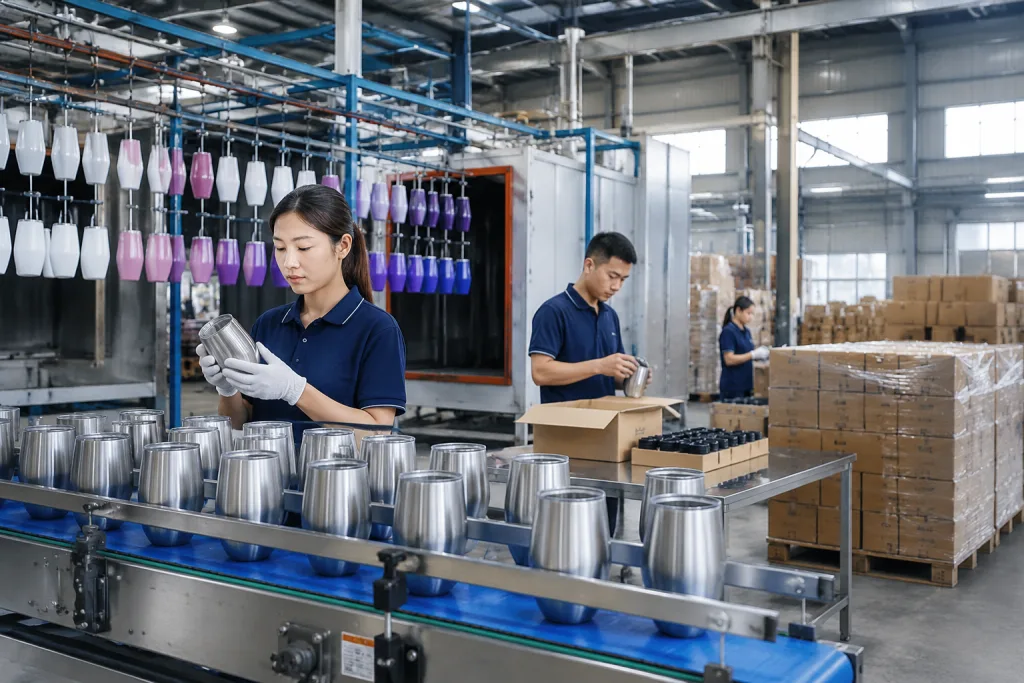
Key Takeaways
- A practical custom wine tumbler MOQ starts at 500-1,000 units per color for existing molds
- Most 12 oz stainless wine tumblers land at USD 2.35-4.80 FOB China before retail packaging upgrades
- Normal production lead time is 25-40 days after sample approval and deposit
- Logo, coating, lid, carton strength, and inspection level can shift cost by 8-25%
Wine tumblers look simple on a catalog page. The buy is not. Landed cost moves with 304 stainless thickness, lid mold choice, powder-coat yield, logo method, carton drop-test spec, and whether we ship to retail shelves, Amazon FBA, or a distributor warehouse. Last month QC pulled a 12oz sample with a 0.28mm rim burr; that tiny finding changed polishing time and pushed the quote up by USD 0.06 per unit.
As a wine tumbler manufacturer in Hangzhou, Zhejiang, we run into the same issue about 3 times a week: buyers ask for a fast quote before the product scope is locked. The math doesn't work. A PO that says “white box” but later needs 5-layer mailer cartons for FBA can turn a 12-day packing plan into 18 days, and the buyer flags it after artwork approval. You need a cost and lead-time map before you negotiate with any canteen supplier, custom drinkware factory, or tumbler vendor in China.
Start with the real specification
A serious quote starts with the specification, not with a pretty render. For a 12 oz wine tumbler, we usually price from double-wall vacuum insulated 304 stainless steel inside and 201 or 304 stainless steel outside. Wall thickness is commonly 0.4-0.5 mm before forming; QC checks it with a micrometer before the body goes to polishing. If you ask for full 304 inner and outer, the math changes fast when nickel moves.
The lid matters more than buyers expect. A basic clear AS push-on lid is cheap and we can run it fast. A Tritan sliding lid, splash-proof lid, or silicone-sealed drinking lid needs fit checks, assembly labor, and tighter reject control; last month QC pulled 37 lids for loose slider tension on one 5,000 pcs pilot run. For outdoor events, winery retail, or distributor drinkware programs, the better lid is usually worth the extra USD 0.18-0.45 per unit.
Capacity changes pricing, but “which size is cheapest?” is the wrong question to ask. A 10 oz wine tumbler uses less steel, yet polishing, vacuuming, coating, and packing labor stay close to a 12 oz cup. A 14 oz or 16 oz model may need a different body mold, a taller carton, and revised drop-test packing; we have seen cartons pass at 9.5 kg, then fail after the buyer added gift boxes. If you also source a custom growler, customizable growler, or distributor growler in the same campaign, ask the factory to quote them as one family so coating colors and cartons line up.
For BottleForge Industrial in Zhejiang, our standard wine tumbler line can run about 300,000 units per month across tumbler and canteen factory capacity, depending on season and color mix. The cleanest RFQ includes capacity, steel grade, lid type, coating, logo method, packaging, compliance market, and target ship date; if the PO says “mat black” instead of “matte black,” the buyer will flag it later and we lose 2 days on confirmation.
FOB cost drivers that move quotes
FOB is where buyers get tricked. The buyer asks for “best unit price,” but the better question is what was removed to reach that number. For an existing-mold wine tumbler, we usually quote FOB China at USD 2.35-4.80 for 500-5,000 units, depending on finish and packaging. When a quote comes in at USD 1.95, QC usually finds the cut: 0.38 mm outer wall instead of 0.45 mm, thin powder coat, B-flute carton instead of 5-ply, skipped lid pull check, or a slider lid that feels loose after two weeks.
Material moves the quote first. 304 inner with 201 outer is the normal commercial balance we run for price-sensitive programs. Full 304 construction may add USD 0.25-0.55. Copper lining for heat retention can add USD 0.15-0.35. Powder coating costs more than spray painting, but for custom drinkware handled every day, the math doesn’t work if the coating chips after 30 dishwasher cycles. On the line, we check coating thickness with a digital gauge; 55-75 μm is the range our QC team likes to see for most matte finishes.
Decoration is the second cost driver. One-color silkscreen on one side may add USD 0.08-0.18. Laser engraving often adds USD 0.15-0.35, depending on artwork size and fixture time. Full-wrap sublimation or heat transfer can add USD 0.45-1.20 and needs more sampling time, usually 5-7 extra days because the color proof has to match under a D65 light box. For canteen promotional orders, the cheapest logo method is the wrong question to ask. We have seen this go sideways: the buyer saved USD 0.06, then flagged 420 pcs for a fuzzy logo edge at incoming inspection.
Packaging is the third driver. A plain white box may be USD 0.12-0.25. A printed retail box with insert and barcode can be USD 0.35-0.80. If you are a canteen distributor, distributor canteen buyer, or retail brand owner, carton strength matters more than the box photo in the quote sheet. We normally suggest 5-ply export cartons for heavier drinkware or mixed SKUs, with carton drop testing before mass shipment; last month QC pulled a 16 kg master carton after the corner split on the second drop.
Ask your canteen manufacturer to separate product cost, logo cost, packaging cost, and testing cost. Bundled quotes hide the trade-offs, and we have seen PO line typos like “gift box included” turn into a USD 0.42 argument after sampling.
MOQ tiers and what changes
MOQ is not just a factory rule. It is the point where 304 stainless coil purchasing, powder coating booth setup, logo jig work, and carton packing labor stop fighting the cost sheet. For existing wine tumbler molds, the practical MOQ is usually 500 units for a basic stock color and 1,000 units per custom color. Below 500 units, we can sometimes run the job, but the math gets ugly: the same spray gun cleaning, fixture adjustment, and first-piece QC check get spread across too few cups.
At 500-999 units, use standard body molds, standard lids, and one simple logo method such as laser engraving on a 35 mm front area. This tier fits small brand tests or event programs; we have seen canteen vendors test 600 pcs before opening a chain-store quote. Expect fewer color choices and slower packing talks because small custom cartons often need a separate knife mold, and one buyer flagged a USD 0.18/pc box upcharge as higher than the logo cost. Fair point.
At 1,000-2,999 units, the order starts to run cleanly on the line. You can usually choose Pantone powder coating, laser engraving, one-color screen print, or a printed retail box. QC pulled the sample after coating on a recent 1,500 pcs order because the Pantone 7499C looked 1 shade warm under the D65 light box. This is the normal tier for customized drinkware buyers who need brand control without paying for custom mold investment.
At 3,000-9,999 units, material purchasing improves and line scheduling gets steadier. A canteen customizable program with wine tumblers and custom canteen bottles can often be grouped for color matching, as long as the PO does not mix “matte cream” and “cream white” by accident. Yes, we have seen that typo. At 10,000 units and above, private body shape, special lid tooling, and dedicated packaging become more practical. Tooling for a new lid or body can range from USD 1,200-8,000 depending on complexity, and tooling time adds 15-35 days before production sampling.
Do not chase an artificially low MOQ if your sales plan needs repeatable supply. This is the wrong question to ask. A clean 1,000-unit order is usually safer than forcing a 200-unit custom project that the next factory, or even the next shift, cannot reproduce reliably after 12 months.
Sampling is where time is saved
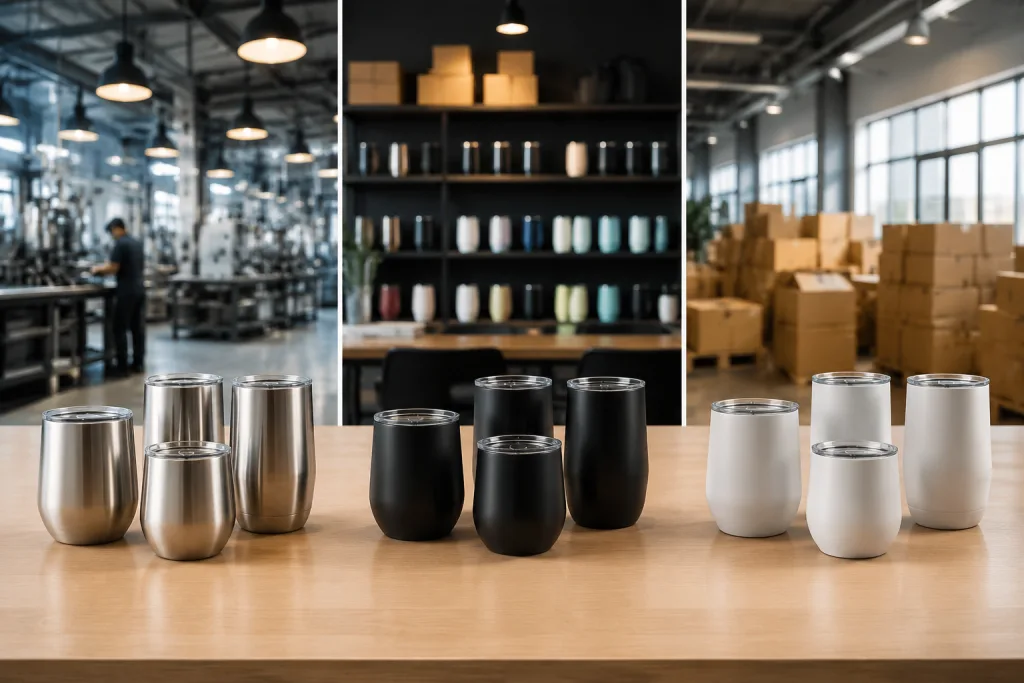
Buyers try to save 2 or 3 days by skipping proper samples. We’ve seen this go sideways. For a standard wine tumbler with a stock color and laser logo, a pre-production sample normally takes 5-10 days after artwork confirmation. For custom powder coating, expect 7-14 days because the line still has to run color matching, oven curing at the right setting, and visual approval under D65 light plus daylight by the window.
If the project includes a customized growler, customizable canteen, or matching sports bottle, sample the full set together. Don’t approve them one by one. The same Pantone chip can read differently on a 12 oz curved tumbler, a 64 oz growler body, and a small screw lid. A Pantone number is only the starting point. Powder coating batches need tolerance, usually judged against a physical color limit sample. Sensible buyers approve that limit sample and keep one sealed reference sample at the factory in China; our QC shelf has 2 tagged samples for jobs where the buyer flagged “lid looks warmer than body.”
Artwork changes the calendar fast. Vector files in AI, EPS, or PDF format move cleanly through our laser station. Low-resolution PNG files pulled from a website stop the desk before the first sample even starts. For laser engraving, thin lines below 0.2 mm may break visually, and QC pulled the sample last month because a wine glass icon lost its stem after engraving. For silkscreen, tiny text under 5 pt is risky on a curved tumbler body. If the product is for a regulated retail channel, confirm barcode size, FNSKU label placement, warning text, and country-of-origin marking during sampling, not after mass production.
Sample freight is another place where the math doesn’t work. DHL, FedEx, or UPS samples to Europe or North America often take 3-6 working days after pickup, assuming the courier scans before 17:00. If decision makers in 2 offices need to approve the same item, order duplicate samples. Waiting for one sample to travel between departments is a strange way to lose a week, and we have watched a 12-day approval become 18 days because one carton sat on a buyer’s reception desk.
Production calendar without wishful thinking
A normal production calendar for custom wine tumblers is 25-40 days after deposit and signed sample approval. That means existing molds, approved artwork, raw material booked, and no holiday shutdown. For 20,000+ units, or orders with 4 body colors and printed color cartons, 40-55 days is the safer number. Around Chinese New Year, add 20-30 days of planning buffer. We had one PO last January with the ship date typed as “Feb 8” instead of “Mar 8”; the math did not work. Zhejiang factories do not bend the calendar because a launch deck shows an earlier ship date.
The first 6-7 days usually go into raw material confirmation, 304 stainless tube cutting, forming, welding, and body preparation. Then we run vacuum insulation and temperature testing; QC pulled 32 samples from one line last month because 2 cups lost vacuum after the hot-water test. After that come polishing, surface prep, powder coating or painting, logo application, lid assembly, packing, and final inspection. Each process has its own queue. Rush orders can move, but only when the spec is simple and the buyer signs off within 24 hours.
For customized drinkware, the slow items are often not the cups. It is the printed box, instruction insert, silicone gasket, color-matched lid, or lab test report. LFGB, FDA food-contact checks, REACH screening, and heavy metal testing can add 5-12 working days when third-party lab reports are required. For kids-related drinkware, ASTM or CPSIA-related reviews can add 7-15 working days depending on lid design and mouthpiece material. We have seen this go sideways when a buyer approves the cup sample but forgets the insert size; the carton line then sits waiting for a 105 mm x 148 mm leaflet.
If you work through canteen distributors or a canteen supplier network, build time for their internal approvals. A distributor drinkware program can lose 10 days because the end customer changes logo size after sample approval. The buyer flagged one 70 mm logo as “too loud” only after we made the pad-printing plate, so the line stopped and the plate cost came back to the PO. Put a cut-off date in writing: after that date, changes mean a new timeline and often a new cost.
Inspection, compliance, and payment risk
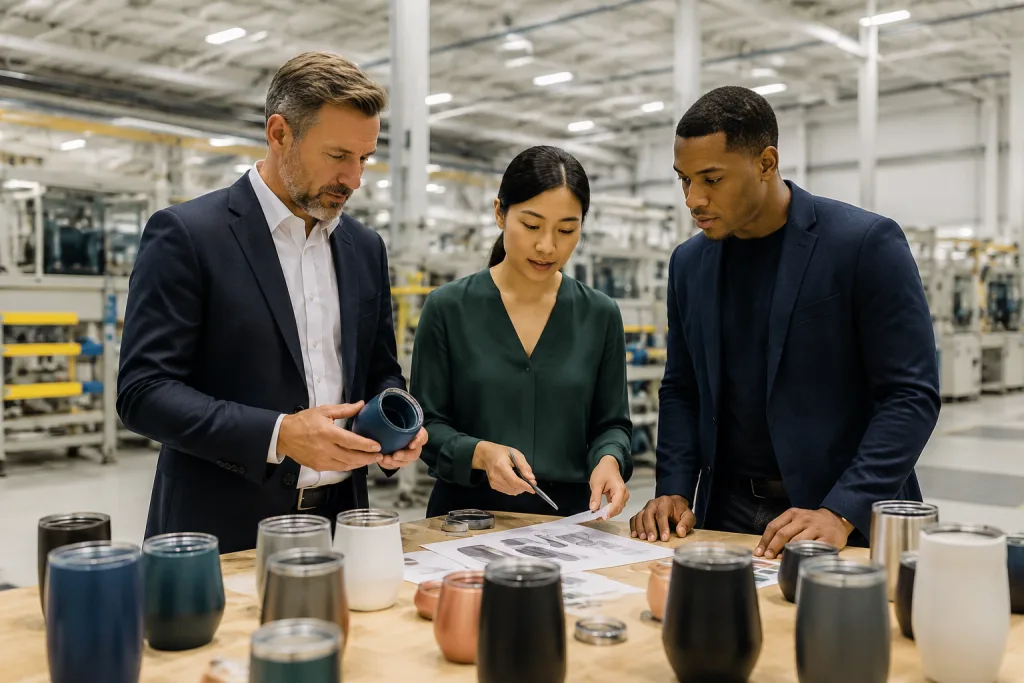
Price QC into the quote on day one. On stainless wine tumblers, we run vacuum hold checks after the curing oven, then check coating adhesion with 3M tape, logo offset with a 0.5 mm ruler, lid fit, rim burrs, odor, packing, carton marks, and random drop resistance from 80 cm. AQL inspection is normal for export orders. Most buyers we handle set AQL 2.5 for major defects and 4.0 for minor defects, with critical defects at zero tolerance.
The usual defects are plain: pinholes in powder coating, uneven laser color, rim scratches, loose lids, dented bodies, crushed cartons, and wrong barcodes. Boring checks save claims. We have seen a full pallet held because the PO showed “matte black” but the artwork file said “black matte,” and QC pulled the sample before loading. For Amazon FBA, confirm FNSKU labels, suffocation warnings on polybags, carton weight under the buyer’s limit, and carton size before shipment. For retail, match inner box artwork and master carton markings against the routing guide, not the sales mockup.
Compliance changes by market. For North America, buyers often ask for food-contact material declarations and FDA-related supplier documentation. For Europe, LFGB, REACH, and sometimes PAHs or heavy metal reports may be required. BSCI, ISO 9001, or social audit documents may be needed if you supply chain stores. This is where the wrong question is “Do you have certificates?” The better question is whether the report covers this exact coating, this ink, and this lid material; we once had a lid gasket fail because the test report covered PP plastic but not the silicone ring.
Payment terms control risk as much as inspection does. A common setup is 30% deposit and 70% balance before shipment, usually under FOB Ningbo or FOB Shanghai for Zhejiang production. For repeat buyers shipping 8,000–20,000 pcs per season with clean payment history, terms can improve. First order is different. If a new buyer asks for open account on a custom color with a 3,000 pcs MOQ, the math does not work for a responsible China factory.
How to compare supplier quotes
Compare each wine tumbler manufacturer, canteen factory, canteen vendor, or customizable drinkware supplier on the same line items. Use the same capacity, 304 stainless thickness, lid style, powder coating, logo size in mm, inner box, master carton, AQL 2.5 inspection level, and Incoterm. Small difference, big bill. If one quote says FOB Ningbo and another says EXW Zhejiang, the freight math is already off; last month a buyer flagged a USD 0.38 gap that disappeared after we added the Ningbo trucking charge from Hangzhou.
Ask for the finished tumbler weight, not just the capacity. A light 12 oz tumbler saving USD 0.20 can feel thin in the hand and pick up dents at the bottom radius after one drop test from 80 cm. Ask for coating type and adhesion test method. Cross-hatch tape testing, dishwasher claims, and salt spray claims need clear wording on the PI, because QC pulled the sample more than once after a coating passed tape but failed around the laser logo edge. Many insulated tumblers are sold as hand-wash recommended, even when the coating is good.
Ask who owns the mold, who owns the logo screens, and what happens on a repeat order. For custom canteen, canteen customized, or customized canteen programs, repeatability beats a one-time low price. We have seen this go sideways: order one ships with a 74.2 mm lid fit, order two comes back at 73.5 mm from another line, and the buyer gets complaints about loose lids. Your second and third order should match the first order’s color, lid fit, and carton dimensions closely enough that customers do not notice a change.
A practical RFQ asks for three price breaks with real costing behind them: 1,000 units for trial orders, 3,000 units for normal line setup, and 5,000 units where carton packing and coating loss start to spread better. It also asks for sample lead time, mass lead time, packaging dimensions, gross weight, HS code, nearest port, audit status, and available test reports. We run those points through a quote sheet before sales sends the offer; if a supplier cannot answer them clearly, they may be friendly, but they are not ready for serious B2B custom drinkware export work.
Get a precise wine tumbler quote before sampling
Send your capacity, logo, packaging, MOQ, and delivery market. We will return a practical FOB China quote with lead-time notes.
Frequently asked questions
What MOQ should I expect from a wine tumbler manufacturer?
For an existing 10 oz or 12 oz stainless wine tumbler mold, expect 500 units as a workable minimum for stock colors and 1,000 units per color for custom Pantone powder coating. If you need a printed retail box, 1,000 units is usually the cleaner starting point because box printing has its own setup cost. For a new body shape or new lid, 3,000-10,000 units is more realistic because tooling and trial production must be absorbed. Small 200-unit runs are possible only when you accept stock products, simple laser logos, and higher unit pricing.
How long does custom wine tumbler production take?
For existing molds, plan 5-14 days for sampling and 25-40 days for mass production after deposit and sample approval. A simple laser logo on a stock color is faster. Custom powder coating, printed gift boxes, silicone accessories, or multiple SKUs can push production to 40-55 days. Add 3-6 working days for courier sample delivery to Europe or North America. If your shipment is near Chinese New Year, add 20-30 days of buffer because Zhejiang and other China factory regions face labor travel and production congestion.
Why do quotes for the same wine tumbler vary so much?
Quotes vary because the specification is rarely identical. One supplier may quote 304 inner and 201 outer steel, while another quotes full 304. One may include powder coating, retail box, AQL inspection, and FOB Ningbo terms; another may quote EXW with a plain box and no testing. Lid quality also changes cost by USD 0.18-0.45 per unit. Ask every canteen supplier or custom drinkware vendor to separate product, logo, packaging, testing, and freight terms. Once the quote lines match, the real price gap is usually much smaller.
Can I combine wine tumblers with custom canteen or growler orders?
Yes, and it often makes sense for distributor drinkware programs. A wine tumbler, custom canteen, and custom growler can share a coating color, logo process, carton mark system, and compliance file. You may not be able to combine every SKU into one MOQ because each body uses different molds and parts, but shared purchasing helps. For example, 1,000 wine tumblers plus 1,000 customized canteen bottles may be easier to schedule than two tiny 300-unit orders. Ask for a family quote with separate unit prices and one combined shipment plan.
What quality standards should I put in the purchase order?
Put measurable standards in the PO. Use AQL 2.5 for major defects, AQL 4.0 for minor defects, and zero tolerance for critical food-contact or safety defects. Specify capacity, steel grade, coating color, logo size and position tolerance, lid fit, packing method, carton strength, barcode requirements, and approved sample reference. For Europe, list LFGB and REACH if required. For North America, request food-contact documentation and any retail routing requirements. If the order is Amazon FBA, include FNSKU placement, carton limits, and suffocation warning rules before production starts.