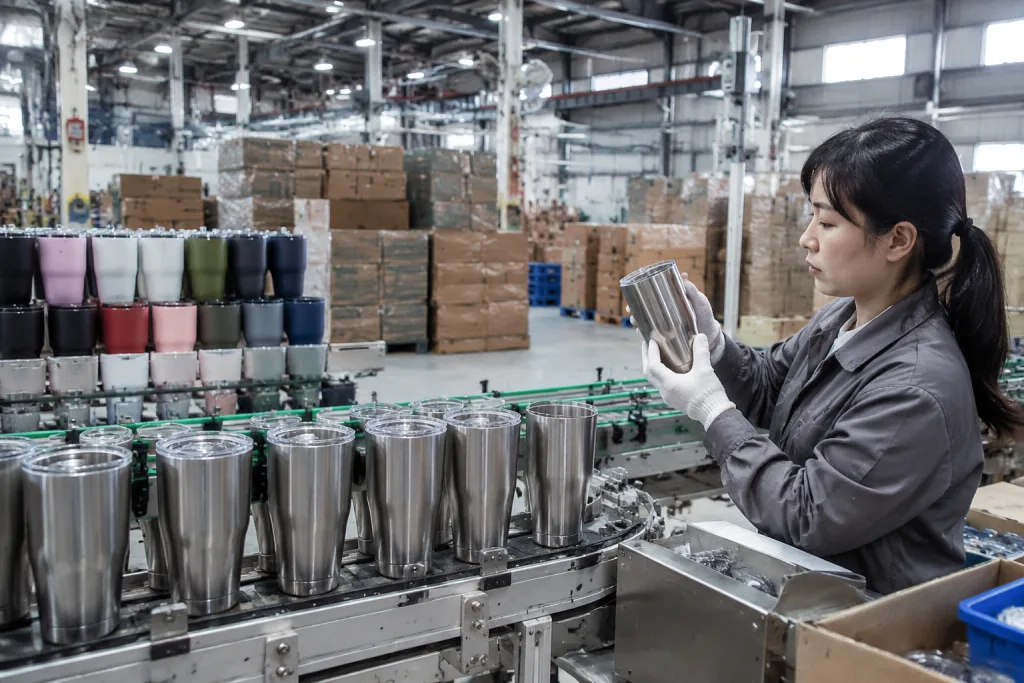
Key Takeaways
- For most wine tumbler factory orders, practical MOQ starts at 1,000 pcs per color for powder coating and 500 pcs for stock colors
- 304 stainless steel at 0.45-0.50 mm outer wall thickness is the common balance for cost, dent resistance, and retail feel
- Expect 25-35 days production after deposit and artwork approval, plus 3-7 days for pre-production sample checks
- AQL 2.5/4.0 inspection, REACH paperwork, and carton drop testing should be written into the purchase order
A wine tumbler looks simple until the PO says 5,000 pieces, 1-color logo, retail sleeve, EAN-13 barcode, and delivery before week 38. Then one loose line in the quotation costs money. “Stainless steel, vacuum insulated, powder coated” is not a spec. It is where the RFQ starts.
We run wine tumbler orders in Hangzhou, Zhejiang, and we see the same mistakes from Europe and North America: buyers chase a USD 0.18 FOB saving, approve artwork before checking the 0.3 mm coating tolerance, or assume a canteen supplier can hold the same finish on a curved tumbler body. The buyer flagged this last month on a matte black cup; QC pulled the sample and the logo edge was already breaking at the radius. China can ship strong custom drinkware, but the math does not work if you read the sheet like a consumer instead of a purchaser.
Capacity Is Not Just Volume
The first spec line usually says 10 oz, 12 oz, or 14 oz. Do not treat it as label decoration. It changes the stretch tooling, carton cube, freight cost, and how heavy the cup feels in hand. On our line, a 12 oz wine tumbler is the default retail size because it takes a 150 ml pour plus ice and still leaves lid clearance. A 10 oz size sells cleaner for winery gift shops and hotel minibars, where buyers ask for a neater shelf profile. A 14 oz cup starts to feel like a camping tumbler; we have seen buyers flag it because it overlaps with their broader custom drinkware range and the math on SKU spacing does not work.
Ask the factory whether capacity is measured to the brim or to a practical fill line. Some quotations use brim capacity because the number looks better on a spec sheet. For a buyer, the useful capacity is usually 85-90% of brim. QC pulled one 12 oz sample last month at 10.5 oz comfortable fill after we checked it with a 500 ml graduated cylinder. If your retail copy says “12 oz” and the customer cannot pour more than 10.5 oz without sloshing, you will get complaints.
Diameter matters too. A 88-90 mm top opening gives the wine tumbler its familiar shape, but a wider mouth makes lid tooling less forgiving and shows laser distortion faster on the curved wall. We check this with a digital caliper before coating, not after the cup is packed. A 68-72 mm bottom diameter usually fits standard cup holders, but short stemless wine tumblers sit worse in vehicle holders than tall travel tumblers. Small base, big wobble.
If you also buy custom canteen, custom growler, or distributor drinkware items, do not copy the capacity logic across categories. A canteen factory is watching neck finish, cap torque at 18-22 kgf·cm, and carry strap load. A wine tumbler factory is watching lip comfort, powder coating coverage, lid fit, and heat retention after vacuum testing. Same stainless steel supply chain in Zhejiang, different buyer risks. We have seen this go sideways when a PO copied a growler capacity note into a wine tumbler order.
Steel Grade And Wall Gauge
Most export wine tumblers we run use 304 stainless steel on the inner wall, with 201 or 304 on the outer wall. For Europe and North America, 304 inner is the line we do not cross. It matches LFGB, FDA food-contact expectations, and REACH-related paperwork better than cheaper steel. If a quotation only says “stainless steel,” ask for the grade split in writing; QC pulled one pre-production sample last March where the PO said 304, but the outer shell invoice showed 201 after PMI testing.
A workable wall gauge is 0.45-0.50 mm for the outer shell and 0.35-0.40 mm for the inner shell. Go thinner and the FOB price can drop by USD 0.08-0.18 per unit, but dents show up faster when cartons get re-stacked in the warehouse. We see it on the line. For giveaway campaigns, 0.40 mm may pass if the buyer accepts lighter hand feel. For retail, I would push for 0.50 mm outer wall because the tumbler feels firmer and handles carton compression better; one US buyer flagged 11 dented pcs in a 125 pcs pilot carton when the outer shell was cut too thin.
Vacuum performance comes from weld control, not steel grade alone. A normal 12 oz double-wall wine tumbler should keep hot liquid warm for roughly 3 hours and cold liquid cool for 6-9 hours under room-temperature test conditions. If a supplier claims 24 hours for a small open-mouth wine tumbler, that is the wrong number to trust. The test may be from a sealed bottle, not a wine tumbler with a press-fit lid; our vacuum tester and 95°C water check usually catch that mismatch before mass production.
For a canteen manufacturer or canteen vendors, 18/8 steel gets promoted a lot. It is basically another way to describe 304 stainless steel composition. Good for retail packaging. Not enough for a PO. Your purchase order should state 304 inner wall, then list the target gauge in mm, the passivation requirement if the market needs it, and whether the outer wall is 201 or 304. Zhejiang factories can build both levels; we have seen this go sideways when the spec box is blank and the buyer only notices after AQL 2.5 inspection finds mixed shell material.
Coating Line Determines The Finish
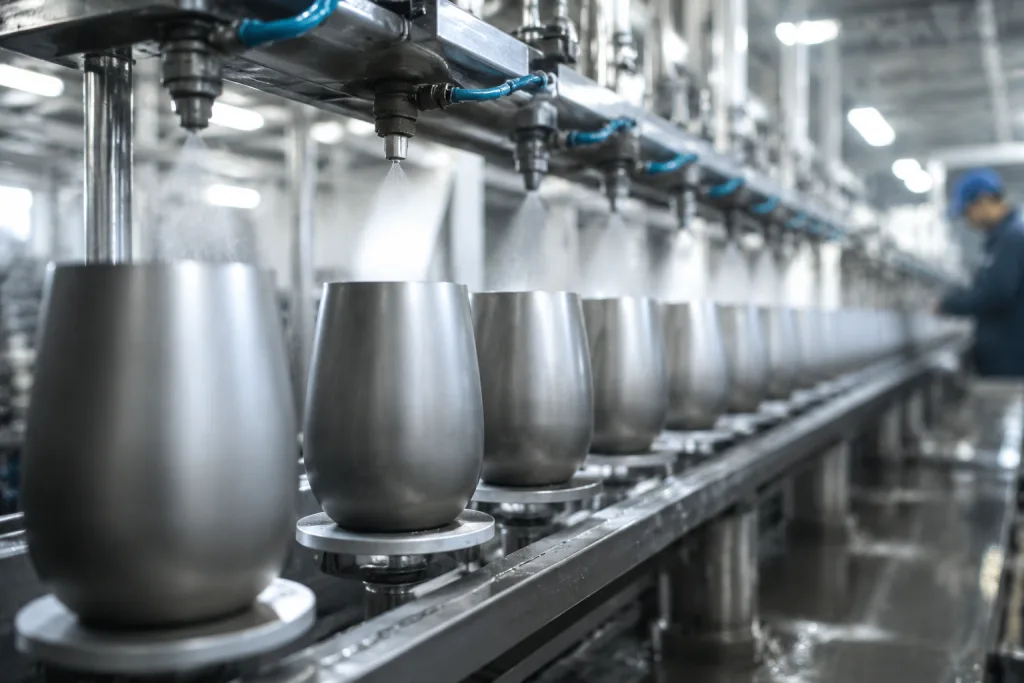
Powder coating is the normal finish we run for custom wine tumblers because it covers light forming marks from the spinning die and gives the hand a better grip. The spec should state the powder type, target film thickness, and color tolerance, not just “black powder coat” on the PO. For most orders, coating thickness lands around 60-80 microns when QC checks it with a PosiTector gauge. Below 50 microns, edge coverage at the base can go thin. Above 90 microns, lids can feel tight if rim masking is off by 1 mm.
Matte black, white, navy, and olive are safe stock colors in our line. Custom Pantone colors are possible, but MOQ changes. At our China facility, stock color MOQ is often 500 pcs per SKU, while custom powder coating normally starts at 1,000 pcs per color. If you are planning a canteen promotional set with matching tumblers and a customizable canteen, confirm whether the powder supplier can hold the same shade across both shapes. We had a buyer flag this on a 750 ml canteen and 12 oz tumbler set: same powder code, different light reflection. Curved tumblers and taller canteens do not show color the same way, even when the formula is identical.
Paint testing should stay practical. Ask for cross-hatch adhesion testing, boiling water resistance for 30 minutes if the product will be washed often, and a rub test for printed artwork using a 500 g load. Dishwasher-safe claims are where we have seen this go sideways. Many tumblers survive occasional dishwashing, but 20 repeated cycles can dull matte coating and weaken screen print. QC pulled the sample after cycle 12 on one matte white job because the logo edge started to feather.
Electro-polished, mirror, copper-plated, and gradient finishes can sell well, but they tighten the defect standard fast. Fingerprints, 0.3 mm pits, and uneven color bands stand out more than they do on matte powder coating. If you are a distributor canteen or distributor growler buyer adding wine tumblers to the catalog, start with fewer finishes. This is the wrong place to chase six colors at launch. A clean matte range with reliable repeatability beats a wide color card that your canteen suppliers cannot reproduce on reorder, especially after the line changes powder lots in month 3.
Logo Method Changes The MOQ
Logo decoration is where 6 out of 10 wine tumbler quotes start to drift. Laser engraving, silkscreen printing, heat-transfer printing, UV printing, and embossing do not sit in the same MOQ bucket, and they do not use the same artwork file. Laser is our safest choice on powder-coated tumblers because the beam cuts through the coating and shows the stainless steel below. Simple logos, short text, GPS coordinates, winery names, and corporate marks run clean. On a 12 oz wine tumbler, we usually keep laser artwork around 45 x 60 mm; past that, our fixture shows the taper and QC pulled the sample for visible stretch on the lower edge.
Silkscreen works when the buyer wants one-color logos and the order is not tiny, usually adding around USD 0.05-0.12 per unit depending on size. The line can miss hairline strokes under 0.3 mm, and wraparound artwork fights the tapered body. UV print handles multi-color artwork better, but the cost can add USD 0.25-0.60 per unit, and we still run a 3M tape test plus a 500 g rub check before calling it approved. Heat transfer gives full-color images. I would not sell it as the best answer for outdoor durability; we have seen this go sideways when a promotion promised 24-month patio use.
Embossing or debossing needs tooling. For wine tumblers, that usually means a mold change or a separate badge part, and the MOQ may jump to 3,000-5,000 pcs. The math does not work for a one-season campaign. It makes sense for a stable retail SKU, especially when the buyer can approve a 12-day tooling sample lead time instead of pushing for a 7-day logo sample like a normal laser order.
If you also source canteen customized programs, watch the wording on the PO. “Canteen customizable” may mean logo printing only on stock bottles; last month one buyer flagged this after their PO said “custom lid” but the artwork sheet showed only a 38 x 52 mm front logo. “Canteen custom” or “customized canteen” may mean new lid, new shape, new mold, or color-matched accessories. The same applies to customizable drinkware. Put the exact logo method, artwork size in mm, color count, and placement tolerance into the spec sheet. A good wine tumbler factory will lock those details before issuing the final proforma invoice.
Lid, Gasket, And Drinking Edge
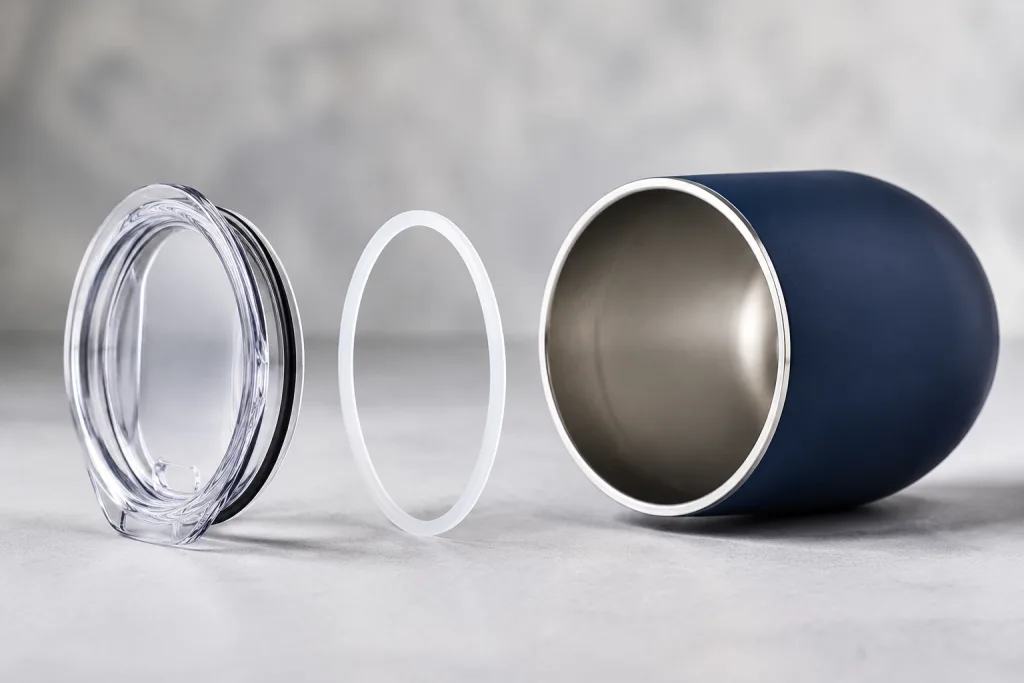
The lid is the small part that gives us 60% of tumbler complaints after shipment. We usually run AS, PS, or Tritan-style clear plastic lids with a silicone gasket, depending on target price and test requirement. For export retail, ask for BPA-free material documentation and food-contact test reports before tooling color samples, not after the PO is signed. A sliding lid costs more than a simple sip lid, but buyers see the value on corporate gift sets and outdoor programs. Expect USD 0.12-0.35 difference depending on lid structure and material; on a 5,000 pc order, that line item gets noticed fast.
Fit comes down to rim diameter, coating masking, gasket hardness, and lid mold wear. We check the mouth with a digital caliper, and a 0.3 mm drift after powder coating can change the whole feel. If the gasket is too soft, the lid feels cheap and can leak when tipped. If it is too hard, the customer needs two hands to pull it off. Leakproof is the wrong word for a normal wine tumbler. It is splash-resistant. Your packaging should not say leakproof unless the lid has been designed and tested upside down for inversion. A canteen supplier can offer leakproof caps because screw threads and silicone seals do different work; a press-fit wine tumbler lid is not the same engineering case.
The drinking edge should be rounded, not sharp, and the lip weld needs clean polishing. This matters for hospitality, winery, and premium gift buyers because people drink directly from the rim. Ask the factory to confirm whether the rim is rolled, welded, or bead-formed, then inspect samples for waviness under side light. QC pulled one sample last month where the weld polish looked fine in a photo, but the rim had a 1 mm visual wave and the buyer flagged it after one sip. A 1 mm visual wave at the rim looks small on a production photo but feels obvious on the mouth.
For private label projects, keep spare lids in the order. A practical ratio is 1-2% extra lids packed in a separate carton, marked clearly on the carton label so the warehouse does not mix them with finished sets. We have seen this go sideways when the PO typed “extra cups” instead of “extra lids,” and the line packed the wrong spare parts. For distributors selling replacement parts, a standalone lid SKU cuts after-sales claims and gives you an easy repeat-order item.
Packing, Barcode, And FBA Details
Packing is part of production planning, not a nice sleeve added at the end. Bulk pack gives the lowest unit cost, but it fails for 8 out of 10 North American or European retail programs we quote. Buyers usually pick white box, kraft box, color box, or window box, then we run the packing trial on the line with a 3M tape gun, carton scale, and drop-test corner check. A single 12 oz wine tumbler in a white box may add USD 0.12-0.20. A custom color box often adds USD 0.25-0.55, depending on 350 gsm vs 400 gsm paper, matte lamination, and order quantity.
Carton strength matters. A common export master carton for wine tumblers uses 24 or 48 pcs, often with 5-ply corrugated board. If the carton grows past the right fit, tumblers rub and coating defects show up in AQL 2.5 inspection. We have seen QC pull 7 scratched lids from one 48 pcs carton because the inner box had 4 mm extra play. For Amazon-style shipments, each unit may need FNSKU labeling, suffocation warning on polybags if used, and carton labels with correct quantity and country of origin. For EU buyers, confirm packaging waste rules, recycling marks, and importer details before artwork release.
Do not assume every canteen vendor or canteen distributors can handle retail packing. This is the wrong question to ask after goods are finished. Some canteen manufacturers are strong on bottle body production but send color boxes to a print shop that never tests barcode contrast. We use a Honeywell scanner at packing; if your goods go to retail DCs, ask for a 100% barcode scan check. One missed digit on a PO carton label can turn into a USD 150 chargeback per pallet.
At BottleForge Industrial in Hangzhou, Zhejiang, our normal wine tumbler line capacity is about 180,000 units/month, with 25-35 days mass production after deposit and approved sample. Complex packing, mixed colors, or FNSKU labeling can add 3-5 days because the line slows for color sorting, label position checks within 2 mm, and carton recounts. We ship cleaner when the packing spec is frozen early. If your launch date is fixed, lock the packing spec before you approve the production sample, not after; we have seen this go sideways when a buyer changed from kraft box to color box 6 days before loading.
Inspection Terms Belong On The PO
A quote is not enough. Put the inspection terms on the purchase order: quality standard, test items, inspection level, required documents. For custom drinkware exports, we usually run AQL 2.5 for major defects and 4.0 for minor defects under general inspection level II; critical defects stay at 0. Major defects should be named one by one: sharp rim found by the 3M tape check and hand-feel pass, vacuum failure after the 95°C water hold test, wrong logo position over 1.5 mm from the approved artwork, coating peel, lid leakage beyond the agreed splash standard, or wrong material. Minor defects cover small dust dots under 0.3 mm, light scratches inside the signed limit board, and color drift against the approved Pantone chip. Put it in writing. We have seen buyers flag “poor finish” after shipment, but the PO only said “good quality”; the math does not work when QC has no fixed reject line.
Request a pre-production sample before mass production. It should use the real steel grade, real coating, real logo method, real lid, and real packing, not a hand-polished showroom piece from the sample shelf. A digital mockup checks layout only; it cannot prove powder-coat feel, lid fit, barcode scan, or whether the logo turns gray after curing at 180°C. For repeat orders, keep a signed golden sample at the buyer office and in the factory QC room. We run the line against that sample, and QC pulled the sample more than once when a buyer changed “matte navy” to “navy matte” on the PO and the coating room mixed the wrong batch.
For compliance, common documents include FDA food-contact declaration for the U.S., LFGB or relevant EU food-contact testing where required, REACH/SVHC statements for coating and plastic parts, and California Proposition 65 review if selling in that market. If your customer asks for BSCI, ISO 9001, or factory audit reports, ask before deposit, not when 42 cartons are already packed. A capable China factory can prepare documents, but third-party lab testing may take 7-12 working days, and the lab will still ask for real color chips, plastic lid resin details, and coating supplier names. We ship faster when the document list is fixed on day 1.
The same discipline applies when buying from canteen suppliers, a canteen manufacturer, or distributor growler sources. Whether the product is a customized growler, customizable growler, canteen promotional item, or wine tumbler, the purchase order controls the argument when something goes wrong. If the spec is not written down, it is not controlled. We had one PO where “lid: black” was typed as “lid: blank”; production stopped for 6 hours while sales, QC, and packing checked the approved sample. This is the wrong question to ask: “Can the factory remember?” Ask instead: “Is the inspection point printed on the PO?”
Send Your Wine Tumbler Spec Sheet Today
Share capacity, logo, color, packing, MOQ, and target market. We will return a practical China factory quote with risks marked.
Frequently asked questions
What MOQ should I expect from a wine tumbler factory?
For stock shapes and stock powder colors, a realistic MOQ is usually 500 pcs per color, although many factories quote 1,000 pcs to keep line changeovers efficient. Custom Pantone powder coating normally starts at 1,000 pcs per color. New mold work for a special wine tumbler shape can require 3,000-5,000 pcs, plus tooling charges from USD 1,500 to USD 6,000 depending on body and lid complexity. If you need mixed colors, ask whether the MOQ is per order, per color, or per artwork. That distinction matters. A 2,000 pcs order split across 8 colors can be inefficient for a China factory and may push up unit cost by USD 0.20-0.45.
How much does a custom stainless steel wine tumbler cost FOB China?
A standard 12 oz double-wall stainless steel wine tumbler with 304 inner wall, 201 outer wall, powder coating, simple lid, and one-position laser logo often lands around USD 2.20-3.20 FOB China at 1,000-3,000 pcs. Upgrading to 304 outer wall may add USD 0.15-0.35. A sliding lid can add USD 0.12-0.35. Custom color box packaging can add USD 0.25-0.55. Multi-color UV print may add USD 0.25-0.60. Prices move with steel cost, exchange rate, and order structure, so treat any online price as a direction, not a contract quote.
Can one supplier make wine tumblers, canteens, and growlers?
Yes, but check the real production capability. A canteen factory may be excellent at screw-cap bottles, while a wine tumbler factory needs strong powder coating control, rim finishing, and press-fit lid consistency. A custom growler or customized growler also needs thread accuracy, handle strength, and larger body welding control. If you want one canteen supplier for distributor drinkware, ask for production photos, sample history, and monthly capacity by category. It is reasonable to consolidate with one China partner, but do not assume the same line makes every item. Ask which processes are in-house and which are subcontracted.
What inspection standard should I use for a retail wine tumbler order?
Use AQL general inspection level II with 2.5 for major defects and 4.0 for minor defects for most retail orders. Set critical defects at 0. Define major defects clearly: wrong steel grade, failed vacuum test, wrong logo, coating peel, sharp rim, incorrect packing, or barcode that does not scan. For function checks, inspect lid fit, coating adhesion, logo placement, carton drop condition, and capacity. On a 5,000 pcs order, a third-party pre-shipment inspection usually costs USD 250-400 in China, depending on location and scope. That cost is small compared with rejected retail stock.
How long does production take after artwork approval?
For a normal stock-shape wine tumbler order, plan 3-7 days for a pre-production sample and 25-35 days for mass production after deposit and sample approval. Custom powder color, complex retail packaging, or multi-SKU canteen customizable sets may add 5-10 days. Third-party lab tests can add 7-12 working days if not already available. Sea freight to Europe or North America may take 25-45 days depending on port and season. If you need goods for a dated campaign, approve the logo, packing dieline, and carton marks before production starts. Late artwork changes are the most common avoidable delay.