Key Takeaways
- A safe distributor MOQ is usually 1,000-3,000 pcs per color for custom wine tumblers
- 304 stainless steel at 0.4-0.5 mm outer wall is the normal baseline for retail-grade vacuum tumblers
- Powder coating needs adhesion and cross-hatch testing before approval, not just a nice photo
- FOB Ningbo or Shanghai pricing should be checked against carton size, inspection cost, and replacement allowance
If you sell to wineries, outdoor retailers, corporate gift buyers, or Amazon/FBA sellers, wine tumblers look simple until the PO gets specific. The cup is not the problem. The margin usually gets lost in the construction, coating thickness, lid fit, logo process, packaging, and compliance file after freight, AQL 2.5 inspection, and after-sales claims. Last month, the buyer flagged a 12 oz sample because the lid gap measured 0.35 mm on our feeler gauge. Small gap. Big argument.
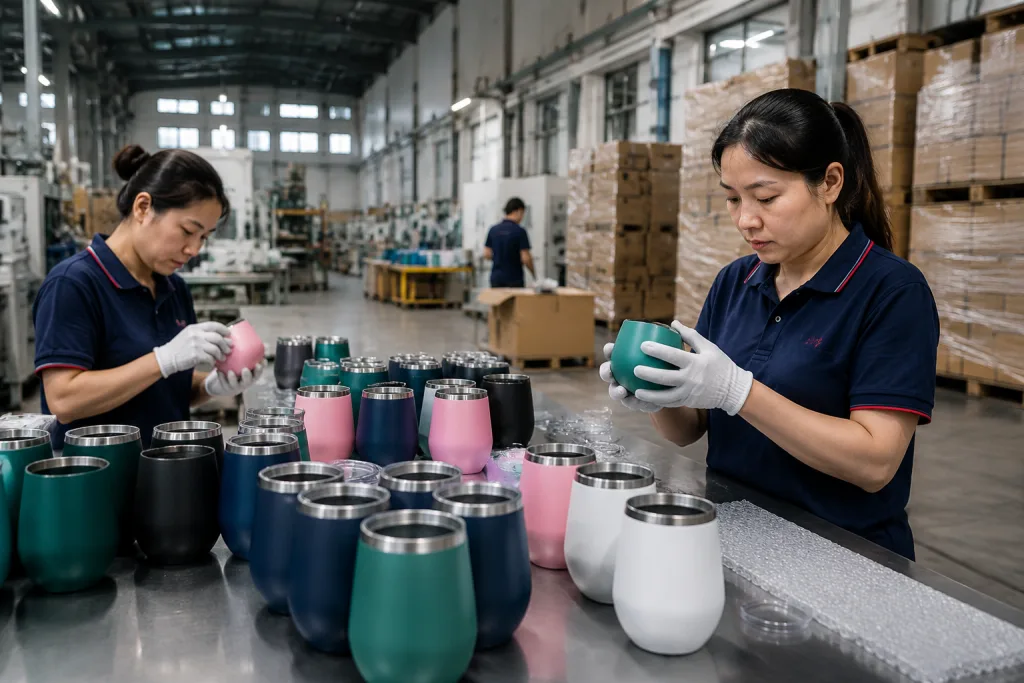
As a Zhejiang drinkware factory exporting from China, we see distributors lose money on details that sounded minor during quotation: 0.1 mm thinner steel, loose lids, weak powder coating, carton compression, or a logo method that fails after 20 dishwasher cycles. We run these checks on the line, not in a brochure. A practical sourcing plan starts with four decisions: product spec, customization depth, supplier control, and landed cost. Ask only for the cheapest wine tumbler and the math doesn't work.
Start with the selling channel
Wine tumbler distributors should not buy one “safe” tumbler for every customer. We’ve seen this go sideways. A winery tasting-room reorder, a corporate holiday gift PO, and a retail shelf program fail in different places. Start with the selling channel. That channel sets the target FOB, pack method, logo process, coating standard, and test file. Last month QC pulled 32 pcs from a 500 pc pre-production run; the sample looked clean, but the retail buyer flagged the color box because the barcode sticker was 6 mm off-center.
For corporate gifting, the buyer usually pushes us on ship date, logo position, and unit cost. A 12 oz stainless wine tumbler with slide lid, powder coating, and one-color silk screen is often enough if the logo sits within ±1.5 mm on the fixture. Retail is less forgiving. The buyer will ask for barcode labels, color boxes, drop-test packaging, and steadier coating across all colors. For online marketplace sales, plan for FNSKU labels, master carton weight under 15 kg, and tighter cosmetic sorting; customers return cups for a 2 mm dent near the base. Small marks cost money.
For distributors serving wineries and beverage brands, do not overbuild unless the customer pays for it. Double-wall vacuum insulation, 304 stainless steel, and a BPA-free lid are baseline. Copper lining, premium gift tubes, and custom molded lids add cost and lead time, and the math does not work on a low-margin tasting-room order. They add more parts too. We once held 1,200 pcs for 12 days because the custom lid gasket from the second supplier failed the pull test on the digital force gauge.
A useful rule: if the product will be resold at USD 14.99-24.99 retail, spend more on coating and packaging. Use a thicker color box, add an inner polybag, and run a stricter visual sort under the inspection lamp. If it is a canteen promotional or event giveaway item, protect the logo and deadline first; a late container kills the program faster than a plain white box. The same logic applies when you quote custom canteen, customizable canteen, or distributor drinkware programs. A canteen distributor selling to outdoor clubs may need stronger handles and larger capacities, while wine tumbler buyers usually need a refined finish and lids that do not rattle after 3 open-close cycles on the line.
Do not approve a wine tumbler only because the factory sample looks good. Approve it because the sample matches the channel that will punish you if it fails.
Lock the construction specification
The second decision is the physical specification. In our quote files, 7 out of 10 quality arguments start from the same loose line: “stainless steel wine tumbler.” That is not enough. For B2B custom drinkware, your RFQ should lock capacity in oz and ml; steel grade for inner and outer shell; wall thickness before forming; lid material and sealing ring; coating process and color code; insulation test method; packing method; inspection standard. We saw one PO typed as “12oz SS cup,” and QC had no legal basis to reject the thinner sample.
For a 12 oz wine tumbler, we run 304 stainless steel on the inner wall and 201 or 304 on the outer wall, depending on target price. Retail-grade programs should use 304/304 if the buyer cares about material claims on the listing page. Typical wall thickness is 0.4-0.5 mm before forming, checked with a digital micrometer at the rim and lower body. Thinner material cuts USD 0.10-0.25 per unit, but the math does not work if 3% of cartons arrive with dents and the product feels light in hand.
Vacuum performance needs a test, not a sales phrase. For example, fill with 95°C water, close the lid, and record temperature after 6 hours at 20-25°C room temperature. Our QC bench uses a 1.5L electric kettle and a probe thermometer, then logs the reading on the inspection sheet. Wine tumblers are not thermos bottles. Do not promise 24-hour heat retention unless the structure supports it; a realistic 6-hour hot water result is cleaner to defend when the buyer flags the claim.
- Body: 12 oz or 14 oz, double-wall vacuum, 304 inner steel, body mouth checked with go/no-go gauge.
- Lid: AS or Tritan-style clear lid, silicone sealing ring, slider if requested, fit tested on 10 pcs from the line.
- Coating: powder coat, spray paint, electro-polished stainless, or metallic finish, with color matched against the approved sample.
- Carton: individual polybag or white box, 24-48 pcs per master carton, gross weight marked before shipment.
The same discipline applies when you source canteen customized, customized growler, or distributor growler items. A canteen manufacturer can quote low by changing steel grade, cap material, or coating thickness. We have seen this go sideways when the buyer approved a photo but never signed the material sheet. A serious canteen supplier puts these details in the proforma invoice before deposit, down to the gasket material and master carton size.
Choose customization by risk
The third decision is how far you customize. Distributors ask for full custom too soon; we hear this on RFQs where the buyer wants a new body, new lid, and retail box before they have tested 1,000 pcs in the market. For most wine tumbler distributors, the safer route is an existing mold with buyer-facing changes: powder color, logo position, lid option, and box artwork. New mold development starts to make sense around 30,000-50,000 pcs a year, because tooling, sample revisions, and FDA or LFGB retesting need a real order base behind them. Otherwise the math does not work.
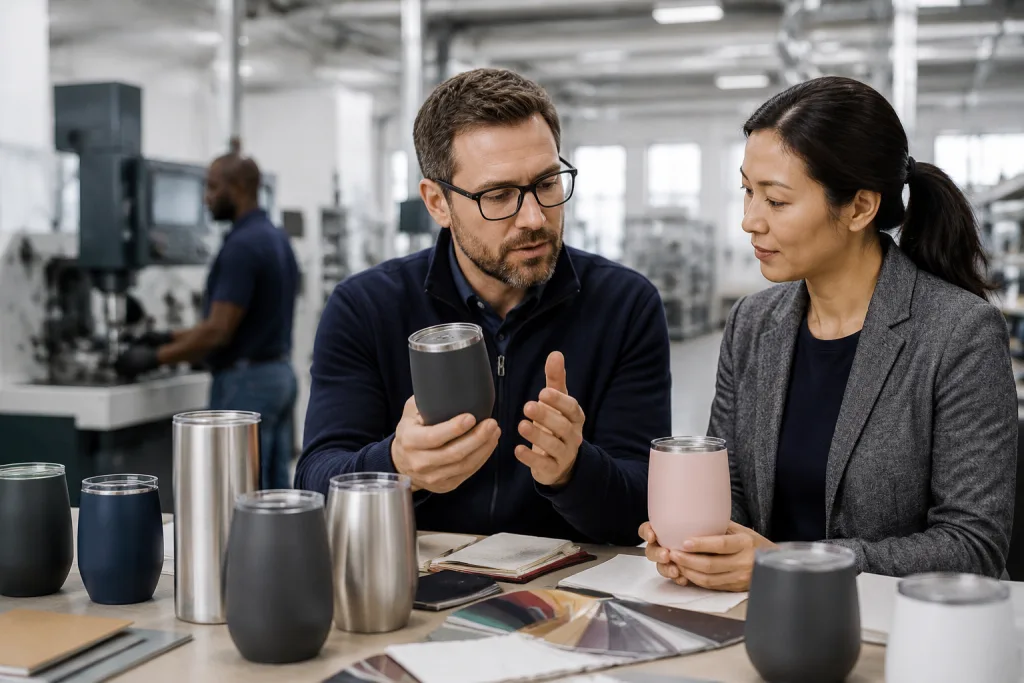
Logo method is a trade-off. Silk screen is economical for simple one- or two-color artwork. Typical MOQ is 1,000 pcs per logo and the setup charge is usually USD 40-80 per color; our print room checks the first 20 pcs against a Pantone book before the line keeps running. Laser engraving costs more per unit, but it holds up well and looks clean on powder coating or bare stainless. Heat transfer and UV printing handle gradients, but adhesion must be tested on curved walls. For a retail buyer, ask for a 3M tape test and a 65°C dishwasher simulation before mass production. QC pulled the sample for one order because the logo lifted at the rim after the second wash cycle.
Color also changes cost and timeline. Standard factory colors move faster because the powder is already in our rack and the spray booth does not need a full clean-down. Custom Pantone powder coating is possible, but expect MOQ of 2,000-3,000 pcs per color and 5-7 extra days for powder matching. If your customer asks for four colors at 500 pcs each, slow down. The quotation may look fine, but production efficiency and color-change loss make it unattractive for most canteen manufacturers in China. We have seen this go sideways when a buyer approved PMS 7527C on paper, then flagged the cup as “too warm” under warehouse LED lights.
Packaging customization is where distributors can quietly improve sell-through. A printed color box may add USD 0.18-0.45 per unit depending on paper grade and quantity, and the box die-line should be locked before the final pre-production sample. Insert cards, QR code instruction sheets, and barcode labels are low-cost pieces that prevent retailer complaints; one PO typo on an EAN code can hold a pallet at outbound inspection for 24 hours. For canteen custom or customizable drinkware programs, the same rule applies: customize the parts the buyer sees first, but do not redesign hidden parts unless there is a clear business reason.
If you need a canteen customizable shape, customized canteen cap, or customizable growler body, ask the canteen factory for tooling cost, ownership terms, mold maintenance, and expected mold life. A stainless forming mold may run thousands of dollars, and revisions are not instant. We run trial forming with calipers on the mouth diameter and a go/no-go gauge on the lid fit; a 0.3 mm miss can mean leaks after assembly. Ask who owns the mold after the first order. This question avoids arguments later.
Read factory capability correctly
The fourth decision is supplier type. Trading companies make sense for mixed trial orders, say 200 pcs each across 5 SKUs, but repeat wine tumbler programs need direct factory visibility. You do not have to walk every workshop. You do need to know who owns forming, welding, polishing, vacuum testing, coating, assembly, and packing, because one weak subcontracted coating line can turn a 30-day reorder into 48 days. We have seen this go sideways after a buyer approved a matte black sample, then the outside painter changed powder batch and QC pulled 37 scratched cups from the first 200 pcs.
BottleForge Industrial is based in Hangzhou, Zhejiang, with drinkware production partners and finishing lines in Zhejiang and nearby provinces. For standard stainless wine tumblers, our practical monthly capacity is about 300,000-500,000 units depending on coating mix, with normal MOQ at 1,000 pcs per color and mass production lead time around 30-40 days after sample approval. Peak season before Q4 can add 7-15 days, so a September holiday promotion should not be placed in late July unless the spec is already frozen. The line runs smoother when the logo file, Pantone number, lid type, and carton mark are locked before the pre-production sample; one PO typo from “rose gold” to “red gold” cost a buyer 6 days last season.
Ask every wine tumbler vendor or tumbler supplier for process photos and a production schedule, not just a catalog. A reliable tumbler manufacturer should show vacuum testing, coating inspection, logo positioning checks, and final AQL inspection. Ask for photos from the actual run: pressure gauge on the vacuum tester, 3M tape test after coating, logo jig measurement in mm, and packed carton weight in kg. For North America, ask about FDA food-contact expectations and ASTM packaging or drop-test practices where relevant. For Europe, ask about LFGB or EU food-contact documentation, REACH for coatings and inks, and packaging waste requirements if your customer requests them.
Audits matter, but read them properly. BSCI, Sedex, ISO 9001, or similar reports are useful signals, not magic shields. They do not guarantee your logo will be straight or your lids will seal. That comes from sample approval, production checkpoints, and final inspection, with AQL 2.5 written into the QC sheet before deposit. We like clear QC documents. The math does not work when a buyer sends only a logo mockup, skips the lid fit check, then asks why 12 cartons have silicone rings sitting 1 mm proud after assembly.
Build the landed cost model
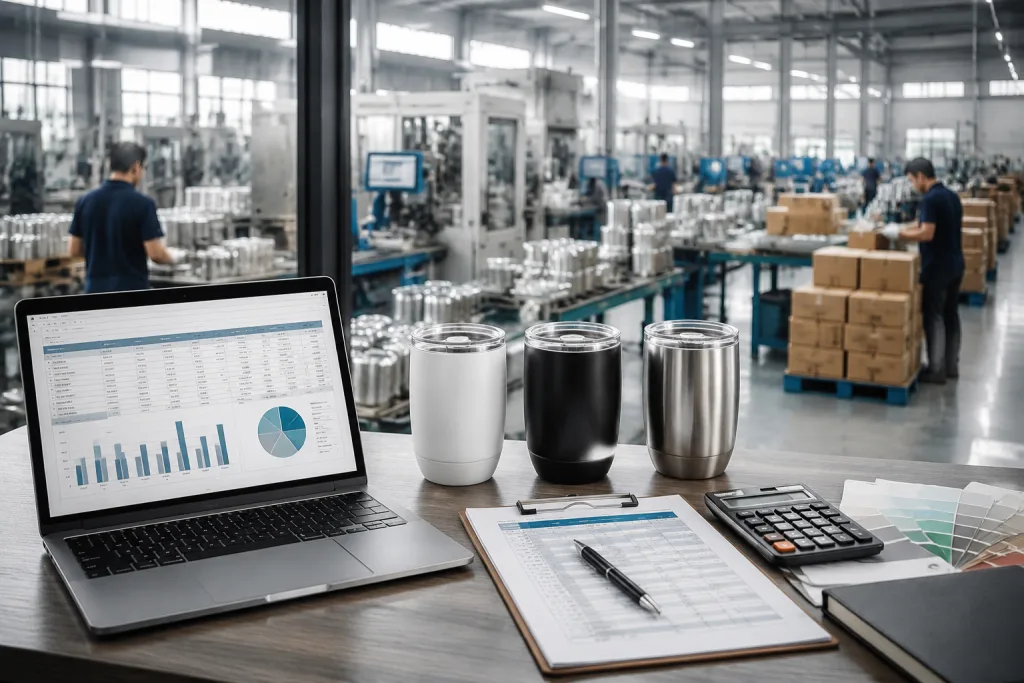
FOB unit price is just the first line on the cost sheet. For distributor drinkware, margin gets won or lost after packaging, Yiwu-to-Ningbo inland trucking, ocean or air freight, duty, customs clearance, inspection, warehouse handling, and replacements. If two factories quote USD 3.10 and USD 3.35 FOB Ningbo, the USD 3.10 offer is not automatically the better buy. We have seen a 46 x 34 x 52 cm carton and 3% rework wipe out the saving in one 5,000 pcs order.
For a typical 12 oz custom wine tumbler, a realistic FOB China price range may be USD 2.60-4.20 depending on steel grade, coating, lid, logo, and box. A plain stainless finish with a 1-position laser logo sits at the low end. Powder coat, laser engraving, individual color box, barcode labeling, and a PP lid with silicone ring push the cost up fast. Air freight hurts because tumblers ship volume, not weight; one buyer flagged this after DHL quoted more than the goods value on 36 cartons, so we ship ocean or rail-sea for planned distributor programs.
Carton engineering deserves a hard look. A master carton of 24 pcs may cut dents versus 48 pcs, but it adds handling and can increase CBM. For e-commerce customers, inner box strength matters; QC pulled one sample last year where the 350 gsm box crushed at the lid corner after a 76 cm drop test. For wholesale pallets, carton compression and pallet stacking matter more. Ask for carton dimensions and gross weight before approving the quotation. “Standard export carton” is not enough for your freight forwarder.
You also need a defect allowance. Even with AQL 2.5 for major defects and 4.0 for minor defects, cosmetic drinkware can create small disputes over dust spots, pinholes, or logo position off by 1.5 mm. Build 1-2% extra units or a spare-parts plan into the order when the launch is time-sensitive. This applies to customized drinkware, canteen distributors, and distributor canteen buyers. The wrong question is “What is the cheapest FOB?” The better question is whether the landed cost already pays for the problems we know can happen.
Control samples, inspection, and claims
Sample approval is not paperwork. It is the product spec your customer will hold in hand. For wine tumbler distributors, the approved sample needs the final body shape, coating color, logo size, logo position, lid, packaging, barcode, and carton mark. We once had a PO with “matte balck” typed in the color line; QC pulled the sample against the Pantone chip before the buyer caught it. If you approve a bare cup and add a gift box later, you have not approved the real shipment.
Run the approval sequence tight. Confirm the blank tumbler first. Then confirm logo and color. After that, approve the pre-production sample with packaging before the line starts mass production. For repeat orders, we cut the cycle from 18 days to about 12 days when the coating, lid mold, and carton artwork stay unchanged, but we still keep 1 golden sample at the factory and 1 in the buyer’s office. Photos are fine for checking a logo typo, but they do not replace a physical cup when the issue is coating texture, lid fit, or a 1.5 mm logo shift.
Final inspection belongs before balance payment. A normal check covers appearance, capacity, weight, lid fit, leakage, coating adhesion, logo position, barcode scan, carton drop, and quantity. For a 3,000 pcs order, a third-party inspection in China may cost USD 200-350, which is cheap compared with replacing a failed retail shipment. We run barcode scans with a handheld scanner and check leakage after inversion, not by shaking 2 random cups on a desk. If the order is urgent, book inspection 5-7 days before the planned vessel closing date, not the day before loading.
Claims need evidence, not long emails. Ask your customer for carton photos, batch numbers, defect photos, and quantities. A professional canteen factory or wine tumbler supplier can trace production dates and packing teams if carton marks are clear; our packing sheet normally shows the date, line number, and inspector stamp. Without traceability, 30 scratched lids become an argument about who touched the cartons after delivery, and the math does not work for either side.
This is where experienced canteen suppliers earn their place. Repeat distributor business is not built on perfect promises; it is built on fast, documented fixes when something goes sideways. We ship replacement lids, rework a logo batch, or issue a credit note only after the defect count matches the carton record. Buyers respect that process because it protects both sides.
Send your wine tumbler RFQ for factory review
Share capacity, color, logo, packaging, quantity, and target market. We will return a practical FOB China quote and production timeline.
Frequently asked questions
What MOQ should wine tumbler distributors expect from a China factory?
For standard stainless wine tumblers, expect 1,000 pcs per color as a practical MOQ. Some factories may accept 500 pcs for blank stock colors, but custom powder coating, Pantone matching, or retail packaging usually pushes MOQ to 2,000-3,000 pcs per color. Logo MOQ depends on the process: silk screen can often start at 1,000 pcs, while heat transfer or full-wrap artwork may need higher volume. If you need four colors at low quantity, ask for stock colors first. For a new mold, the real commercial MOQ is often 10,000 pcs or more, even if the factory says tooling is possible.
Which logo method is best for custom wine tumblers?
There is no single best method. Silk screen is cost-effective for simple artwork and usually adds about USD 0.05-0.15 per unit, depending on color count. Laser engraving is more durable and suitable for premium powder-coated tumblers, but it may add USD 0.15-0.40 per unit. UV printing or heat transfer works for gradients and complex designs, but you should test adhesion on the actual coating. For distributor programs, we usually recommend silk screen for promotional orders, laser engraving for retail or winery merchandise, and UV only when the artwork needs full color.
How long does production take after sample approval?
For a standard custom drinkware order from Zhejiang or other China production areas, plan on 30-40 days after the final sample is approved and deposit is received. Add 5-7 days for custom color matching and 7-15 days during peak season, especially from August to October. A simple repeat order can sometimes ship in 25-30 days if materials and lids are in stock. New lids, special packaging, or customized growler and custom canteen shapes take longer because tooling, pilot runs, and extra testing are required before mass production.
What quality standards should I put on the purchase order?
Put measurable standards on the PO. Use AQL 2.5 for major defects and AQL 4.0 for minor defects as a common inspection baseline. Define steel grade, capacity tolerance, coating color range, logo position tolerance, lid leakage test, carton drop requirement, and packaging details. For Europe, request food-contact documents such as LFGB or EU declarations where applicable, plus REACH information for coatings and inks. For North America, ask for FDA food-contact related documentation and confirm BPA-free lid materials. Also state that final inspection must pass before balance payment or shipment release.
Can one supplier handle wine tumblers, canteens, and growlers together?
Yes, but verify capability by product family. A canteen manufacturer may be strong in outdoor bottles but weak in wine tumbler polishing or retail packaging. A customized growler needs different welding, handle, cap, and pressure considerations than a 12 oz tumbler. If you are sourcing wine tumblers, custom canteen items, and distributor growler programs in one order, ask for separate samples and separate QC checklists. Mixed-container sourcing can reduce freight cost, but it also increases coordination risk. Keep each product’s MOQ, lead time, packaging, and inspection standard clearly separated on the quotation and PO.