
Key Takeaways
- A practical wine tumbler customized MOQ is usually 1,000 pcs per color for powder coating
- 304 stainless steel at 0.4-0.5 mm outer wall thickness is the safest default spec
- Laser engraving is cleaner for 1-color logos; silk screen is cheaper above 3,000 pcs
- Normal production lead time is 30-40 days after sample approval and deposit
A wine tumbler customized for retail, corporate gifting, or distributor programs looks clean on a mood board. On our spec sheet, it gets messy fast. Capacity tolerance, lid fit, wall thickness, powder coating, logo method, carton drop strength, and compliance paperwork all change price and defect risk. QC once pulled a 12 oz sample with a 0.7 mm rim gap under the PP lid; the photo looked fine, but the buyer flagged leaking in the first video call. Approving only a photo is the wrong question to ask.
We manufacture custom drinkware in Hangzhou, Zhejiang, and 8 out of 10 buyer problems we see are not from bad design taste. They start with loose specs. A 12 oz tumbler can land as a gift item, a premium wine cup, or a low-cost canteen promo piece depending on 15 small decisions: 304 stainless grade, body weight in grams, coating thickness, logo position in mm, lid material, inner carton count, and even whether the PO says “matte black” or “mate black.” We run into that typo more than you’d think. Here is how to read the sheet before you place a China production order.
Capacity Line: 10 oz, 12 oz, 14 oz
Capacity is the first spec we check because it changes the cup, not just the pour. A 10 oz wine tumbler feels neat for gift sets, but the logo area is tighter; on our pad-print jig, the safe print window is usually about 45-55 mm high before the curve starts fighting the artwork. A 12 oz model is the workhorse for B2B custom drinkware: decent hand feel, manageable shipping weight, and enough shelf presence for retail packs. A 14 oz cup feels closer to a short travel tumbler, so we use it when a distributor wants one line to cover wine, cocktails, and outdoor coffee.
Do not approve capacity from the catalog name alone. This is the wrong question to ask. Ask for brim-full volume and working fill volume with the lid on. We have seen a “12 oz” tumbler measure 355 ml to the rim on the graduated cylinder, then only 300-320 ml once QC fitted the slide lid and left a clean drinking gap. That gap matters when the buyer’s label says wine, spritz, iced coffee, or festival drinkware, because a 30 ml shortfall gets flagged fast in retail sampling.
Capacity changes carton math too. We usually pack a 12 oz double-wall stainless wine tumbler at 24 pcs per master carton, around 11-13 kg gross weight depending on lid type and inner box. A heavier gift box adds USD 0.18-0.45 per unit, and one buyer flagged the carton after their warehouse scale showed 14.2 kg against a 13 kg preference on the PO. If you are a canteen distributor or distributor growler buyer adding tumblers to an existing program, match the carton cube to your current pallet standard. Boring spec. Real money. We have seen FOB savings disappear when the carton grew by 18 mm and cut one full layer from the pallet.
Material Line: Steel Grade And Thickness
For a wine tumbler customized order, we quote food-grade 304 stainless steel for the inner liner as the normal spec. Some low-cost factories will put 201 stainless steel in the first quote just to get the buyer to reply. I would not put 201 on a wine or beverage contact surface. Wrong place to save money. Its nickel content is lower, and we have seen it stain after 48 hours with lemon water, red wine residue, or dishwasher detergent sitting inside the cup. For North America and Europe, 304 is the baseline we run, and QC should be able to check it with an XRF gun before bulk packing.
Common construction is double-wall vacuum insulated stainless steel: 304 inside, 201 or 304 outside. If your brand sits in the premium shelf, write 304 inner and 304 outer on the PO. If the target price is tight, 304 inner with 201 outer can work, but spell it out line by line, because one buyer once flagged a PO where “304 body” meant inner only to the factory and full body to the importer. Wall thickness usually sits around 0.4-0.5 mm for the outer shell and 0.3-0.4 mm for the inner shell. Dropping thickness can cut USD 0.10-0.25, but the math does not work if 3 cartons arrive with dented shoulders after ocean freight and warehouse handling.
As a canteen manufacturer in Zhejiang, we also watch rim forming on the line. A rolled rim feels safer and cleaner than a sharp thin edge, but it needs tighter tooling control; our forming die gap is usually checked in 0.05 mm steps when the rim starts feeling rough. Ask for a cut sample or pre-production sample from the same line planned for bulk production. Catalog samples lie. For canteen suppliers, custom canteen projects, and customizable growler programs, the same rule applies: steel grade on paper must match material used in mass production, and your QC terms should allow random material verification from bulk cartons, not only from the golden sample.
Lid Line: Sliding, Press-Fit, Or Splash-Proof
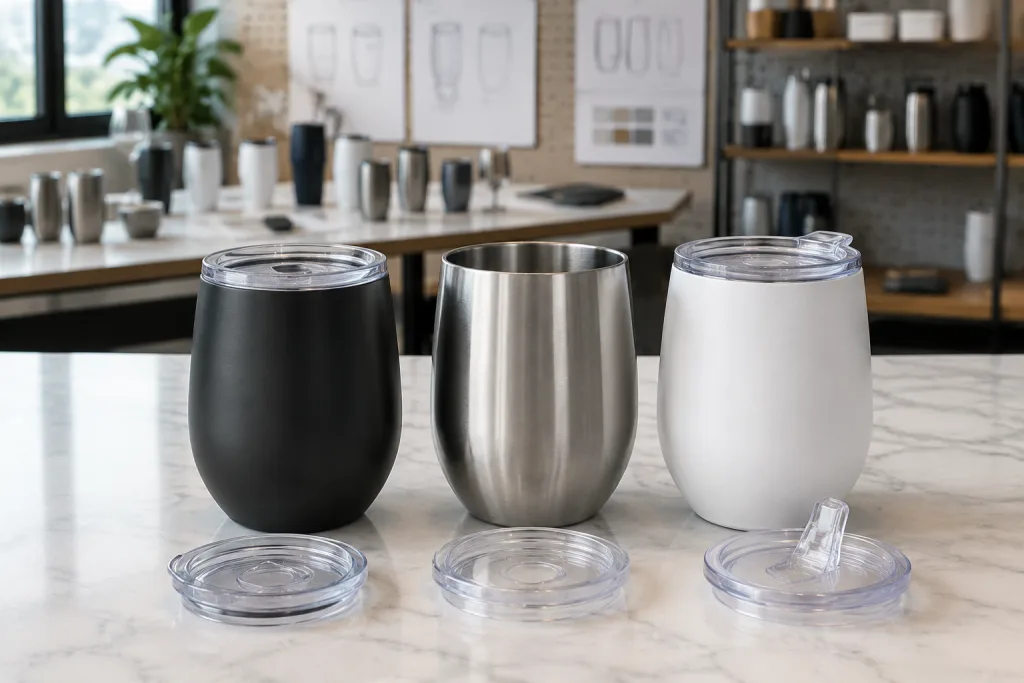
The lid is where a good-looking tumbler turns into a complaint ticket. We see it on the packing table: QC pulls 32 pcs from a carton, presses the lid by hand, and 3 lids sit proud by 1.5 mm. A standard wine tumbler lid is clear AS or Tritan plastic with a silicone gasket. The budget version is press-fit with a sip hole. The better version has a sliding closure. Do not sell either one as leakproof unless it passes a written inverted leak test, such as 30 minutes upside down with colored water. Most wine tumbler lids are splash-resistant, not leakproof. Simple as that.
Write the lid material on the PO. We have had buyers flag this after samples because the quote said “clear lid” and their retail team expected Tritan, while the factory sample used AS to meet the target price. Tritan costs more than AS, but it gives cleaner clarity, stronger drop performance from about 1 meter, and fewer questions in BPA-free programs. Silicone should be food grade and removable enough for cleaning, not glued into the groove. For EU buyers, ask your canteen supplier to provide LFGB or EU food-contact migration test options. For US buyers, FDA food-contact compliance and, where relevant, California Prop 65 review should be discussed before artwork approval.
Fit tolerance decides whether the lid feels right. Too tight, and users fight it at the tasting room counter. Too loose, and the lid pops in transit or when hot liquid expands. We normally target gasket compression that allows hand insertion without lip deformation, then we run hot water at 90°C and check expansion behavior with a 0.1 mm feeler gauge. If you are a canteen vendor selling to hospitality, wineries, golf clubs, or corporate gift channels, do not overpromise leak resistance. The math does not work when a buyer wants a 12,000 pcs gift order, a press-fit lid, and “no spill claims” on the insert card. Use accurate language such as splash-proof lid or press-fit lid. It protects you from claims and keeps the product honest.
Finish Line: Powder, Paint, Polish
Surface finish controls perceived value and reject rate. Powder coating is the finish we run most for customized wine tumblers because the matte grip feels solid in hand, small fingerprints do not jump out, and laser engraving bites cleanly through the coating. Standard powder coating MOQ is normally 1,000 pcs per color at our Hangzhou, Zhejiang facility. For special Pantone matching, plan for 7-10 days to approve color chips before production starts; last month QC pulled 3 chips under a D65 light box because PMS 7421C looked brown after curing at 185°C.
Spray paint gives a glossy shelf look, but the math doesn't work if the buyer expects powder-coat scratch resistance at the same price. It needs a strong primer and a proper curing window, or the 3M tape test will fail before the goods leave the line. Polished stainless steel is durable and cost-effective, but fingerprints show after 5 seconds of handling on a showroom sample. Electroplating and gradient finishes are sellable, but we've seen this go sideways: reject rate can move from 2% on solid powder to 8% on gradient, and setup takes 18 days vs 12 days for a normal single-color run.
For procurement, define acceptable coating defects before the PO is released. AQL inspection should not simply say “surface OK.” Split defects by severity: critical means safety or contamination, major means visible damage on the selling face, and minor means small marks in low-visibility areas. For example, exposed metal larger than 0.5 mm on the front logo area should be major. Dust dots under 0.3 mm on the bottom area may be minor. For canteen promotional buyers and canteen distributors handling repeat programs, this detail avoids arguments at final inspection. A canteen factory can fix process problems early if the tolerance is defined before the first powder booth run, not after 20,000 pcs are packed; we once had a PO typo saying “0.05 mm scratch allowed,” and the buyer flagged it only after 16 cartons were sealed.
Logo Line: Laser, Screen, Heat Transfer
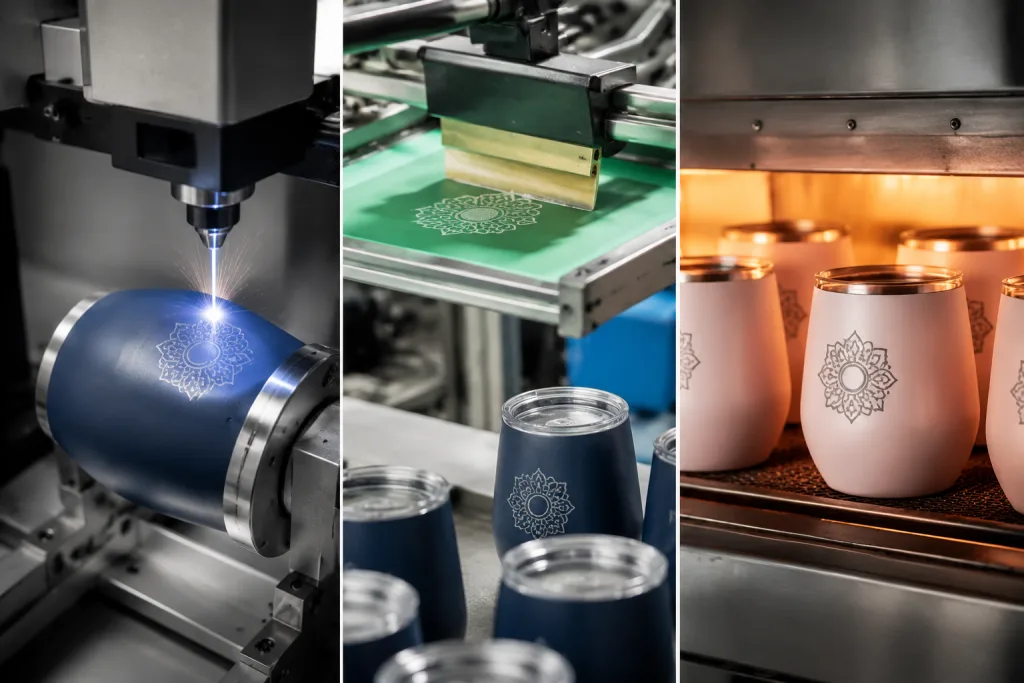
Pick the logo process by artwork, surface finish, and PO quantity. Laser engraving is our safest call for a wine tumbler customized with powder coating; the fiber laser burns off the coating and shows the 304 stainless underneath. No peeling. Clean retail look. The trade-off is color: laser gives metal contrast, not Pantone matching. On a 12 oz tumbler, we usually run a 40 x 40 mm laser mark, and we can go taller if the jig controls cup rotation and the logo does not wrap too close to the curve.
Silk screen printing makes sense for simple one-color artwork once the order gets near 3,000 pcs, because the setup cost spreads out. It likes smooth walls and straight logo shapes. Fine text below 1 mm stroke width is where we’ve seen this go sideways; QC pulled the sample last month because the “R” in a 6 pt slogan filled in after oven curing. Heat transfer handles full-color graphics, but it needs tape testing, 60°C wash testing, and a real adhesion check on the same coating. For cups that buyers expect to wash every day, it is not my first recommendation.
If you are buying for distributor canteen or distributor drinkware programs, ask your canteen manufacturer for a logo proof on the exact finish, not a clean PDF only. PDF mockups help with layout, but they do not show edge sharpness, coating contrast, or white ink opacity. We’ve had buyers flag this at pre-shipment inspection when the black logo looked strong on screen but weak on matte navy powder coat. For private label work, specify logo position from the top rim and centerline, not just “front logo.” A 3 mm placement drift may pass for a promotional run, but the math does not work for retail packaging when the tumbler sits in a window box and the logo must face forward.
Packaging Line: Bulk, Gift Box, FBA
Packaging is not decoration; it is part of the product spec. A bulk-packed wine tumbler in a 0.03 mm polybag with an egg-crate divider works for corporate gift decorators who repack locally. Retail buyers usually reject it. A white box keeps cost down, but the buyer flagged crushed corners when we used a weak 5-layer master carton at 18 kg gross weight. A printed color box gives better shelf presence, and it needs tighter artwork control, usually with a dieline check at 1:1 scale before the line starts. For e-commerce, we run a mailer box or reinforced gift box when units ship one by one after import.
Typical packaging costs move fast once the insert, box board, and carton test are fixed. A plain white box may add USD 0.12-0.20. A printed 350 gsm color box may add USD 0.25-0.55. A heavy magnetic gift box can add more than USD 1.00, which often makes no sense for a mid-price tumbler unless the order is premium gifting. The math doesn't work on a USD 4.20 cup with a USD 1.10 box. If you need Amazon FBA preparation, send FNSKU labels, suffocation warning rules if polybags are used, and carton limits before quotation. We have seen this go sideways: QC pulled the sample, the FNSKU was 32 mm wide instead of the requested 50 mm, and re-labeling 3,000 pcs in China after packing cost 2 extra days.
For canteen vendors and canteen manufacturers serving 4 or 5 markets, packaging compliance gets messy fast. EU recycling marks, UK importer details, US choking warnings for accessories, and French sorting information are not interchangeable. Give your factory the destination country, not just “Europe.” Our China packing line can handle barcode application with a Zebra label printer and carton labeling by SKU, color, and PO number, but the buyer must own the legal content. Small thing, big delay: one PO came in with “Fance” instead of “France,” and the buyer flagged it only after carton marks were printed. A good canteen supplier will warn you; a careless one will print whatever file you send.
Commercial Line: MOQ, Price, Lead Time
A realistic FOB Ningbo or FOB Shanghai price for a 12 oz double-wall stainless wine tumbler customized with powder coating and one laser logo often lands at USD 2.40-3.80 at 1,000-3,000 pcs. The swing comes from 304 stainless thickness, press-on or slider lid, powder brand, carton spec, and whether the logo is marked on our 20W fiber laser or outsourced for special placement. Cheap quotes usually cut one line item. We have seen USD 2.18 offers come back with 0.38 mm inner wall, a loose PS lid, coating that failed the 3M tape pull, or a PO that only says “gift box” with no paper weight. Ask what changed before you celebrate the price.
Our monthly output for stainless drinkware in Zhejiang is about 450,000 units across 12 oz wine tumblers, 20 oz travel tumblers, and 64 oz growlers. For this product type, normal MOQ is 1,000 pcs per color, sample time is 7-12 days after artwork confirmation, and bulk lead time is 30-40 days after deposit and sample approval. We run color checks with a handheld spectrophotometer, and QC pulled the sample last month when the buyer’s Pantone 7501C looked 2 shades too warm after curing. Peak season before Q4 gifting can add 10-15 days, especially for custom color powder coating, so booking 45-55 days is safer if the line is already full.
Payment terms for new buyers are commonly 30% deposit and 70% before shipment. Repeat buyers with stable volume may negotiate better terms after 3-5 clean orders, but asking for open account on the first 1,000 pcs order is the wrong question to ask. The math doesn't work. For quality control, use AQL 2.5 for major defects and AQL 4.0 for minor defects unless your retail channel requires stricter limits; our inspectors usually measure rim roundness with a 0.02 mm caliper and check 32 pcs per color on a small trial order. If you also source custom growler, customizable canteen, customized growler, or canteen customized items from the same canteen factory, align inspections and packaging standards under one QC checklist. That is where a China supplier relationship cuts emails instead of creating them.
Send Your Wine Tumbler Spec For Review
Share capacity, finish, logo, packaging, and target price. We will return a practical China factory quote with MOQ and lead time.
Frequently asked questions
What MOQ should I expect for a wine tumbler customized order?
For a standard 12 oz stainless wine tumbler with powder coating, expect 1,000 pcs per color as a practical MOQ. If you use an existing stock color and laser logo, some factories may accept 500 pcs, but the unit price usually rises by USD 0.30-0.70. Pantone-matched coating, custom lid color, or retail packaging normally pushes the MOQ back to 1,000-3,000 pcs. For distributor drinkware programs, it is better to start with 1,000 pcs in one strong color than split 2,000 pcs across four weak colors.
Is 304 stainless steel necessary for wine tumblers?
Yes, for the inner wall it is the sensible standard. Wine, cocktails, juice, and coffee are mildly acidic, and 304 stainless steel gives better corrosion resistance than 201. A cost-saving construction can use 304 inside and 201 outside, but it should be written clearly on the spec sheet. For premium customized drinkware, 304 inside and outside is cleaner. The price difference depends on steel market cost, but for a 12 oz tumbler it may add roughly USD 0.15-0.35 per unit compared with a lower-grade outer shell.
Which logo method is best for a customized wine tumbler?
For powder-coated tumblers, laser engraving is usually the best balance of durability and appearance. It will not peel, it handles small runs well, and it looks professional for corporate gifting. Silk screen printing works when you need a specific color logo, especially above 3,000 pcs, but adhesion testing matters. Heat transfer is useful for full-color artwork, yet it adds more risk around washing and abrasion. Always approve a physical logo sample, not only a digital mockup, because curvature and coating texture change the final look.
Can one canteen supplier handle tumblers, bottles, and growlers together?
A capable canteen supplier can usually manage wine tumblers, sports bottles, custom canteen items, and custom growler projects together, but check production lines and tooling first. A factory strong in vacuum stainless products is a better fit than a general trading company with scattered vendors. Ask for monthly capacity, in-house coating capability, inspection process, and sample history. Consolidating with one supplier can reduce freight and inspection cost, but only if the factory can maintain the same AQL standard across each product family.
What documents do European and North American buyers need?
For Europe, ask about food-contact testing such as LFGB or EU 1935/2004 migration, plus REACH considerations for coatings and packaging where relevant. For North America, FDA food-contact compliance and California Prop 65 review may be needed depending on your sales channel. If the product is for children, additional standards can apply, but wine tumblers are usually adult drinkware. Also request BSCI or social audit information if your retailer requires it. Confirm documents before deposit because testing can take 7-15 working days.