Key Takeaways
- A practical wine tumbler bulk MOQ starts around 1,000 pcs per color for standard 12 oz and 14 oz models
- 304 stainless steel at 0.4-0.5 mm wall thickness is the normal baseline for double-wall tumblers
- Plan 25-35 days for mass production after logo, color, and pre-production sample approval
- FOB Ningbo or Shanghai pricing can hide 6-12% cost differences if packaging is not defined
Buying wine tumbler bulk is not difficult because the cup has 40 parts. It gets expensive because small choices multiply at 5,000 or 20,000 units: lid fit at ±0.3 mm, powder coating thickness, 5-layer carton strength, logo position, and whether the supplier actually controls welding and vacuum testing on the line.
From our Hangzhou, Zhejiang export desk, we see the same mistake about 8 times a month. A buyer asks for drinkware wholesale pricing, gets 3 cheap China quotes, then finds out the price excludes inner boxes, FDA-grade lids, and a real AQL inspection. QC pulled the sample, the lid smelled like recycled plastic, and the math stopped working. Compare the checklist first, not the unit price.
What should your RFQ include?
A useful RFQ for wine tumbler bulk should read like a production brief, not a chat message to five suppliers. If you send “12 oz wine cup, logo, best price,” the factory will price the thinnest acceptable cup, and your real problems show up later in dents, lid fit, color mismatch, or claim photos from the buyer. We have seen QC pull 32 samples from a pilot carton and find 5 lids sitting loose by 0.3 mm. Cheap quote. Expensive fix.
Start with capacity, material, finish, lid style, logo method, packaging, compliance market, and target delivery date. For a common 12 oz stemless wine tumbler, we run quotes based on 304 stainless steel inner and outer walls, 0.4-0.5 mm sheet thickness checked by digital caliper, double-wall vacuum insulation, AS plastic slide lid or Tritan press lid, powder coating, and individual kraft box. If you want a giftable retail box, write it in the RFQ, because it can add USD 0.18-0.45 per unit depending on paperboard grade, insert type, and print coverage. The math does not work if retail packaging appears after the PI is confirmed.
For procurement managers comparing bulk drinkware or drinkware bulk programs, include your annual forecast with the first PO. A 1,000 pcs trial order and a 50,000 pcs annual program should not be engineered the same way. Zhejiang factories can often support a lower first MOQ when the color is standard and the body uses existing tooling, but custom color matching usually needs 1,000-2,000 pcs per color to cover spray line changeover, powder loss, and rejected panels from the first color plate. We’ve seen this go sideways when a PO typo said “matte sage” and the approved Pantone was “matte sand.” The buyer flagged it after packing.
- Capacity: 10 oz, 12 oz, 14 oz, or 16 oz; state brim capacity or usable fill, because a 12 oz brim cup may only hold about 10.5 oz comfortably.
- Logo: laser for stainless exposure, silk screen for simple 1-2 color marks, heat transfer or UV print for full-color artwork, or embossed sleeve when tooling cost is accepted.
- Packing: white box, kraft box, color box, mailer box, master carton, or pallet; include carton drop-test needs and any FBA or retail barcode rules.
- Market: EU REACH/LFGB, US FDA, California Prop 65 if applicable; tell the supplier the selling country before testing is quoted.
- Trade term: EXW, FOB Ningbo, FOB Shanghai, CIF, or DDP; name the port or delivery address so freight is not guessed.
Which specifications actually matter?
Specs are not equal. We have seen buyers argue for 3 mm less cup height, then skip the cross-cut powder coating test; that is the wrong question to ask. For wine tumbler bulk, we check steel grade, vacuum hold time, lid fit, coating adhesion, and carton strength with actual line data, not brochure wording.
304 stainless steel is the normal choice for wine tumblers sold in Europe and North America. 201 stainless steel saves a little, but we do not recommend it for beverage-contact branded programs; one rust complaint on a gift set can wipe out the saving. For standard models, a 0.4 mm wall can be fine. For heavier retail positioning, 0.5 mm gives a stronger hand feel when the buyer picks it up at shelf review. On our line, QC fills samples with 95°C water and logs the temperature after 6 hours, then pulls vacuum leak samples during mass production, not only from the golden sample.
Lids create more after-sales work than the cup body. A loose slide lid leaks in the master carton, and a lid that is too tight rubs the coating near the rim after 20 open-close cycles. Ask for lid material and gasket material in writing. Tritan and food-grade PP are common; silicone gaskets should pass relevant food contact requirements. If you sell in the EU, ask for REACH declarations and, where required, LFGB food contact testing. For the US, FDA food contact documentation is the minimum; if you ship to California, discuss Prop 65 risk before artwork lock. We once had a PO typo calling for “PS lid” while the approved sample used Tritan, and the buyer flagged it only after pre-production samples arrived.
Cheap wine tumblers usually fail quietly: weak coating, color shade mixed between cartons, light cartons crushed at the bottom layer, or lids that feel acceptable on 10 samples but fail at 10,000 units.
Packaging needs engineering. A 12 oz tumbler in a thin white box inside a 5-ply export carton is usually acceptable for palletized wholesale drinkware. For e-commerce or club shipments, use stronger mailer-style packaging and drop-test the packed unit from 76 cm on corners, edges, and faces. We run this with a simple drop tester and then open the carton; if the rim dented or the gift box corner split, the math does not work for direct-to-door shipping.
How do MOQs and pricing work?
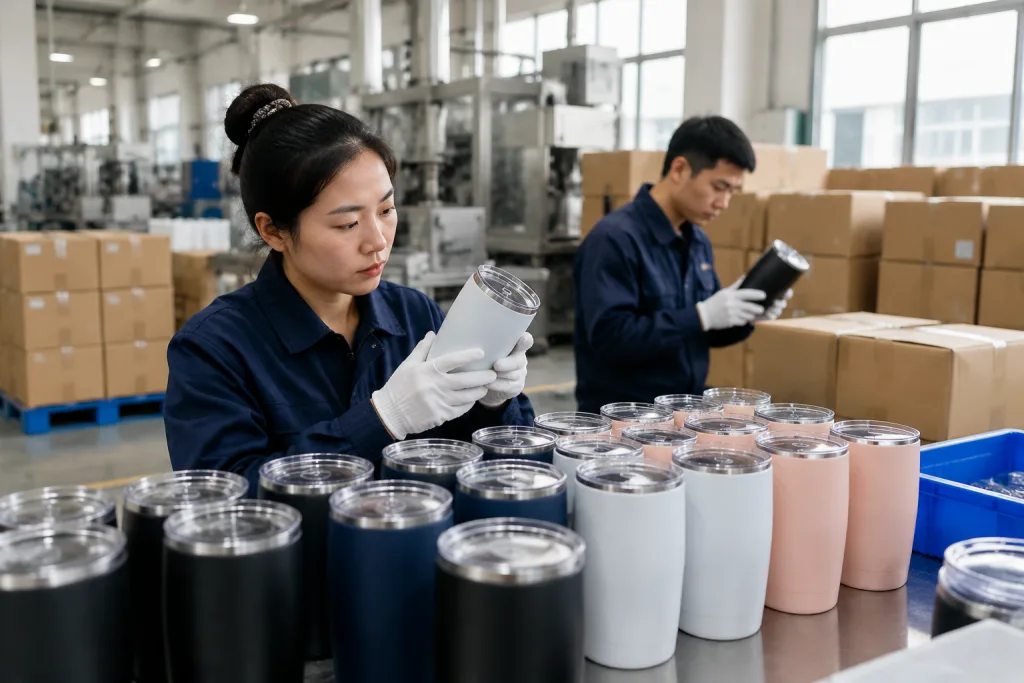
For existing tooling, our normal MOQ in Zhejiang is 1,000 pcs per color for wine tumblers, and we can run mixed carton artwork if the cup color and logo process do not slow the line. At BottleForge Industrial, stainless drinkware output is about 450,000 units per month across 6 production lines for tumblers, bottles, canteens, and growlers. In peak season, a clean wine tumbler PO usually needs 25-35 days after pre-production sample approval; add 7-12 days for a new color box proof or Pantone powder coating match. QC pulled a 12 oz sample last week because the powder coat was 0.4 mm heavy at the rim. Small issue. Big delay if caught after packing.
As a rough FOB China range, a standard 12 oz double-wall wine tumbler may land at USD 2.10-3.20 FOB Ningbo, driven by lid type, powder coating, logo position, and box spec. Laser engraving works well for one-position logos because there is no ink curing and the reject rate stays low. Silk screen suits simple one- or two-color marks. Full-wrap heat transfer or UV print adds setup cost and reject risk on a tight surface curve; we run a 3M tape test and a 20-cycle rub check before we let that print move to bulk.
When you compare drinkware wholesale quotations, ask what is inside the unit price. Individual box? Barcode label? Inner polybag? Spare lids? FOB or EXW? The math does not work if a USD 0.08 saving comes back as FNSKU labels, 5-ply cartons instead of 3-ply cartons, or a 2% spare parts requirement after the PO is signed. We have seen this go sideways over one missing barcode line on a Walmart PO.
The same pricing logic applies if you are sourcing adjacent categories such as bulk canteen, canteen wholesale, wholesale canteen, bulk growler, growler bulk, or wholesale growler. Larger items like a 64 oz beer growler bulk program consume more 304 stainless and carton volume, so MOQ flexibility is easier, but freight cost per unit gets worse fast. A 64 oz growler carton can hit 14-16 kg before the buyer even asks for a gift box. For a beer tumbler bulk or beer tumbler wholesale order, the cost structure is closer to wine tumblers, though lid fit and rim polishing need separate checks on the line.

Can one supplier handle related drinkware?
Brand owners rarely stop at one SKU. A wine tumbler launch often turns into a 3,000 pcs beer tumbler in bulk reorder, a camping bulk growler gift set, or a 5,000 pcs alcohol flask bulk promo for Q4. One factory group handling related stainless items makes color control, logo placement, carton marks, and compliance files easier to police. We run the same Pantone chip under the D65 light box, then QC checks logo height with a 0.5 mm tolerance before the line packs. Bigger combined volume also gives you better room on price when the PO is split across 2 or 4 shapes.
Do not assume one good wine tumbler supplier can build every shape well. This is where we have seen projects go sideways. A wine tumbler and a 750 ml alcohol flask need different forming dies, welding control, polishing wheels, and leak-test setups. A beer growler wholesale order, especially 32 oz or 64 oz, needs proper thread design and cap sealing; if there is a handle, we ask for a pull test before mass production. QC pulled one 64 oz sample last year with slow leakage after 18 minutes upside down. These are beverage storage containers, not pressure-rated brewery vessels unless the supplier engineers and tests them that way.
If your catalog includes alcohol flask wholesale, alcohol flask wholesale bulk, beer growler in bulk, beer growler wholesale bulk, beer tumbler wholesale bulk, or a seasonal canteen bulk campaign, build one shared specification sheet before sampling starts. Use the same Pantone reference and logo artwork version, then lock barcode format, carton side mark rules, and AQL level for the whole program. Small errors cost time. We once caught a PO typo where “matte black” became “matt back,” and the packing team almost printed 120 master cartons before the merchandiser flagged it.
For a buyer searching for the best wholesale drink bottle, the cheapest bottle is often the wrong question to ask. The better supplier keeps color and logo quality stable across wine tumblers, sports bottles, travel tumblers, canteens, and growlers while still hitting the delivery window. If one SKU ships in 12 days but the matching growler slips to 18 days, the math does not work for a retail launch. Boring answer. Usually profitable.
What samples should you approve?
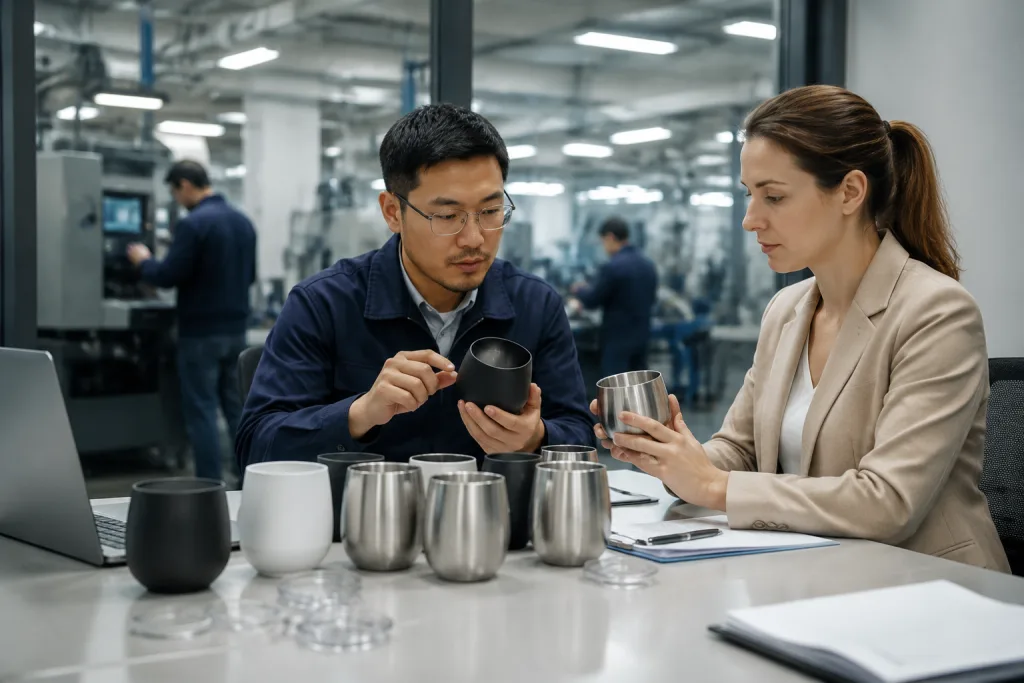
Do not approve mass production from a blank catalog sample. For wine tumbler bulk, we ask for three sample stages on a new order: an existing sample to lock the shape, a logo sample to check the branding method, and a pre-production sample to confirm final color, lid fit, box, and carton marks. Tight schedule? We sometimes combine the logo sample and pre-production sample, but only if the same cup body and lid have already passed our line checks; last month QC pulled a 12 oz lid that looked fine on the desk but rocked 0.8 mm on the rim gauge.
Check the sample like a customer and like an inspector. Fill it with hot water and touch the outer wall after 3 minutes. It should not heat up fast. Open and close the lid 20 times. Rub the logo with a wet cloth, then with mild alcohol if that logo process allows it. Look at the rim under a strong inspection lamp. Put five samples side by side and compare the shade. One nice sample proves little; we have seen beige powder coating shift half a Pantone step after the oven operator changed the hanging density on the line.
For powder coating, ask the factory which adhesion check they run. Cross-hatch tape testing is common, and we use a 1 mm cutter on coated samples before tape pull. For printed logos, request artwork position tolerance, usually within ±2 mm on curved tumbler surfaces such as an 88–92 mm upper diameter cup. For capacity, define whether 12 oz means brim capacity or practical fill capacity. This is the wrong question to leave open. Consumers complain when a cup advertised as 12 oz only comfortably holds 10.5 oz with lid space, and the buyer flagged exactly that issue on a PO that only said “12OZ wine cup” with no fill drawing.
Your sample approval should be written. A simple email saying “approved” is weak compared with a signed sample checklist with photos, Pantone code, logo size, lid type, box dieline, barcode, and carton mark. We ship by documents, not memory. In export production, the math does not work if sales, printing, packing, and QC each remember a different version of the approved sample.
How should inspection be set?
AQL inspection is where 6 out of 10 bulk drinkware buyers get too relaxed. For wine tumblers, we run ANSI/ASQ Z1.4 or ISO 2859-1 sampling, usually General Inspection Level II. A common setting is AQL 0 for critical defects, 2.5 for major defects, and 4.0 for minor defects. For a premium retailer, set major defects at 1.5; the math doesn't work if the buyer wants luxury-store appearance but accepts mass-channel defect limits. QC pulled one 12 oz sample last month with a 0.8 mm burr on the rim, and that is not a “minor scratch.”
Define defects before inspection day. Critical defects include sharp edges, unsafe contamination, wrong material, and serious leakage found during the 24-hour water hold test. Major defects include failed vacuum insulation, wrong logo, wrong color, lid not fitting, severe dents, exposed metal after coating damage, and incorrect barcode. Minor defects include 1-2 small dust points under the coating, slight color variation inside the approved Pantone tolerance, and small carton print defects such as a missing space in “Made in China.” Put this in the PO. We have seen this go sideways when the buyer flagged “champagne gold” after packing, but the approved sample already had that tone.
For Amazon or marketplace supply, add FNSKU scanning, carton weight check, drop test, and master carton dimension confirmation with a tape measure, not a guess from the packing list. If cartons exceed warehouse limits or barcodes scan poorly, the factory made a good tumbler but a bad shipment. That still becomes your problem. One buyer rejected 480 cartons because the FNSKU scanned on the phone app but failed on the handheld Zebra scanner in QC.
We recommend during-production inspection for first-time orders above 10,000 pcs, especially with 4 or more colors on the line. Final random inspection should happen when at least 80% is packed and 100% is finished. In Zhejiang and other China manufacturing hubs, third-party inspection is easy to arrange, but book it 3-5 working days ahead. Do not wait until the vessel closing date to find a lid gasket issue; a 2 mm gasket mismatch can turn a 12-day buffer into an 18-day delay.
Pre-order checklist before deposit
Before you send the 30% deposit, spend 60 minutes checking the commercial details line by line against the PI and artwork. This is where we see the dumb mistakes: one PO last month had “matte black” in the item description and “gloss black” in the packing note. The cup was fine. The paperwork was not. A capable supplier, a clean sample, and a fair price still do not protect you from a missed lid spec or a carton mark mismatch.
- Product: capacity in ml/oz, 304 stainless grade, inner and outer wall thickness in mm, powder coating or plating finish, lid type, silicone gasket color, straw or brush accessory, plus spare parts ratio such as 1% lids and 2% gaskets confirmed.
- Branding: AI or PDF logo file, logo size in mm, print or laser position from rim and base, Pantone color, and allowed tolerance checked on the artwork proof before the line opens.
- Packing: white box or color box structure, barcode size and scan test, warning text, master carton dimensions, pallet height limit, and drop-test requirement confirmed with a taped carton sample.
- Compliance: FDA, LFGB, REACH, Prop 65, BSCI, ISO 9001, or retailer forms requested before production, not when QC pulled the sample from finished stock.
- Inspection: AQL 2.5 standard, major/minor defect list, inspection date, and reinspection cost agreed in writing if the first check fails.
- Shipping: FOB port, carton CBM, gross weight per carton, HS code, forwarder contact, and delivery deadline confirmed; for Hangzhou orders we usually quote Ningbo, unless the buyer’s forwarder pushes Shanghai.
If you mix wine tumblers with wholesale drinkware items such as sports bottles, canteens, travel tumblers, growler wholesale, or beer tumbler wholesale, ask for a loading plan before balance payment. We run into this on mixed-SKU containers: 12 kg growler cartons stacked on 6 kg tumbler cartons, then the buyer flags crushed color boxes at destination. The math does not work. Carton marks also need one format, one SKU code rule, and readable side labels, or the warehouse will lose half a day sorting pallets.
Good sourcing is not chasing the lowest quote. It is removing surprises while changes still cost USD 20 in tape, labels, or a new proof, instead of USD 2,000 in air freight, chargebacks, or customer refunds. We have seen this go sideways after deposit; fixing it before deposit is cheaper.
Send your wine tumbler bulk brief for review
Share capacity, logo, color, MOQ, and delivery market. We will respond with practical FOB pricing and production notes within 24 hours.
Frequently asked questions
What is a realistic MOQ for custom wine tumbler bulk orders?
For an existing 12 oz or 14 oz stainless wine tumbler, 1,000 pcs per color is a realistic MOQ for many Zhejiang factories. If you need a custom Pantone powder coat, full-wrap print, or retail color box, expect 1,000-2,000 pcs per design. Below 500 pcs, the unit price rises quickly because logo setup, coating line change, and export packing labor are spread over too few units. For mixed-SKU wholesale drinkware programs, a factory may accept 500 pcs per SKU if the total PO reaches 3,000-5,000 pcs and uses standard materials.
How much should I budget per unit FOB China?
A common 12 oz double-wall 304 stainless wine tumbler usually falls around USD 2.10-3.20 FOB Ningbo or Shanghai, depending on lid, coating, logo method, and packaging. A basic laser logo and kraft box are near the lower side. A custom powder color, Tritan slider lid, retail box, barcode label, and stronger carton can add USD 0.30-0.80 per unit. Always compare quotes line by line. One supplier may include individual boxes and AQL support, while another quotes only a bare cup in bulk export cartons.
Is laser engraving better than screen printing for wine tumblers?
Laser engraving is usually the safer choice for small logos, corporate gifts, and outdoor drinkware because it does not peel and has low setup complexity. It works best on powder-coated stainless tumblers where the laser reveals the metal underneath. Silk screen is better when you need a solid brand color, but it requires ink adhesion control and may have more visible tolerance issues on curved bodies. For orders above 3,000 pcs with one-color artwork, both methods can be economical. Ask for a logo sample and rub test before mass production.
Can I ship wine tumblers together with growlers or canteens?
Yes, mixed shipments are common, especially for brand owners building a full drinkware range. You can combine wine tumblers with canteen wholesale, beer growler wholesale, or beer tumbler bulk items in one FOB shipment. The main controls are carton strength, side marks, loading sequence, and SKU separation. Heavy 64 oz growlers should not be stacked on light tumbler cartons. Ask for a loading plan and carton list before shipment. For marketplace deliveries, each SKU also needs correct FNSKU or barcode labeling to avoid warehouse receiving problems.
What inspection standard should I use for bulk drinkware?
Use ANSI/ASQ Z1.4 or ISO 2859-1 with General Inspection Level II for normal wine tumbler bulk orders. A practical AQL setting is 0 critical, 2.5 major, and 4.0 minor. Critical defects include sharp edges, unsafe contamination, or severe leakage. Major defects include failed insulation, wrong logo, wrong color, poor lid fit, or unreadable barcode. For first orders above 10,000 pcs, add during-production inspection when 20-40% is completed, then final inspection after at least 80% is packed.