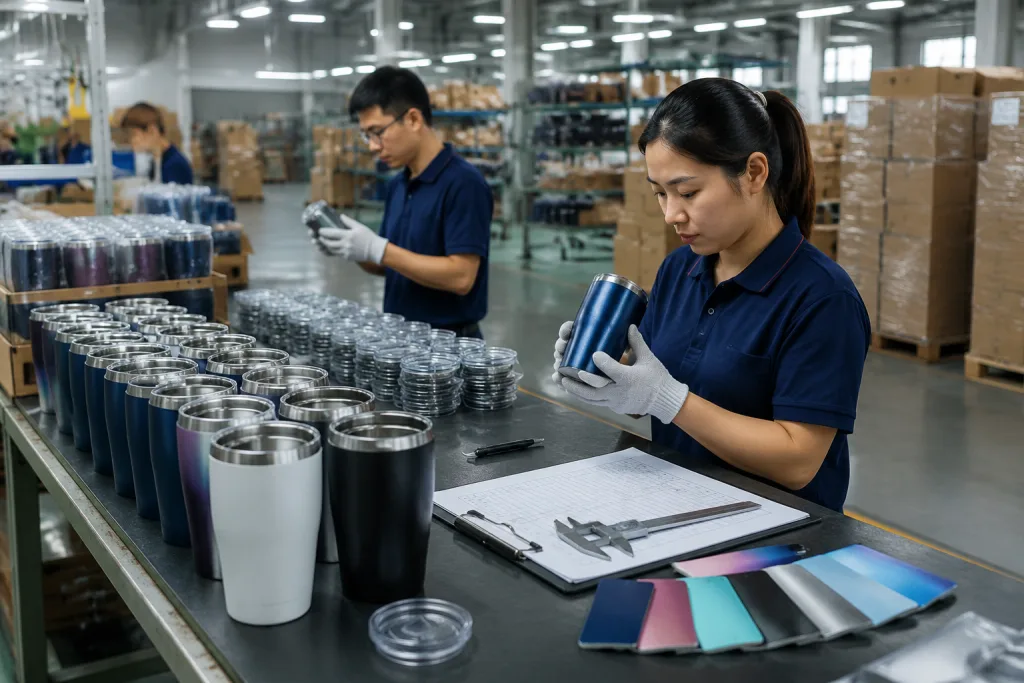
Key Takeaways
- Set 304 stainless steel, 0.45-0.55 mm wall thickness, and AQL 2.5/4.0 before quoting
- MOQ for custom wholesale wine tumbler projects usually starts at 1,000-3,000 pcs per color
- Lid fit, coating adhesion, vacuum retention, and carton drop tests catch most costly failures
- Normal lead time from approved sample is 30-45 days in Zhejiang, China
A wholesale wine tumbler looks simple until the first container lands with 600 lids weeping at the sip hole, logos failing a 3M tape test, or master cartons crushing at the bottom layer. Then the cheap quote is not cheap. You are paying for rework, claims, a 12-day launch delay, and those awkward retailer emails nobody wants to send.
At BottleForge Industrial in Hangzhou, Zhejiang, we see the same failures across bulk drinkware programs: drawings missing a 0.3 mm lid tolerance, sampling signed off too fast, incoming steel thickness not checked with a micrometer, and packaging left to the last week. If you are buying drinkware wholesale from China for a brand, distributor, or promotion, chasing the lowest FOB price is the wrong question to ask. We run cleaner orders when the spec makes bad production harder to ship.
The quote hides the first failure
The first failure often happens before the line sees steel. A buyer asks for a wholesale wine tumbler quote, sends one lifestyle photo, then compares three FOB Ningbo prices: 2.35 USD, 2.70 USD, and 3.20 USD. The spreadsheet picks 2.35 USD. Then QC pulls the pre-production sample and finds a 0.38 mm body wall on the digital thickness gauge. We have seen this go sideways.
Price means something only after the specification is locked. For a 12 oz or 14 oz stainless wine tumbler, write down the steel grade and whether it covers inner only or inner and outer; confirm body wall thickness in mm; name the coating type and minimum film thickness; specify lid material, logo process, carton strength, AQL 2.5 inspection level, and test standards. Leave those blanks open and the supplier can quote a thinner cup, a lower-grade lid, a 5-ply carton instead of a 7-ply carton, or a coating that looks fine in photos but chips after the cross-cut tape test. That is not cheating. Vague RFQs reward it.
For most wholesale drinkware programs, we run a practical baseline: 304 stainless steel inner and outer, 0.45-0.55 mm body wall, BPA-free AS or Tritan-style lid, powder coating above 60 microns, and individual polybag plus white box or kraft box. On the coating line, our inspector checks film build with a Yuwen meter before packing, because one buyer once flagged 42 microns after a warehouse drop test. For EU buyers, add LFGB or REACH-related checks where applicable. For North America, ask about FDA food-contact compliance and any ASTM requirements for kids or promotional sets.
Do not throw every drinkware shape into one RFQ. A bulk canteen, bulk growler, alcohol flask bulk order, and wine tumbler carry different sealing structures and different failure points. Canteen wholesale projects live or die on cap threading and shoulder impact; beer growler wholesale bulk programs need the pressure expectation written before sampling. A wine tumbler fails more often at coating, lid fit, and rim finish. The wrong question is “who is cheapest?” The better question is “what did they remove to get there?”
Lids leak because tolerances drift
Wine tumblers are not built for upside-down backpack duty, but buyers still push back when coffee splashes out in a car cup holder. The leak usually starts with tolerance drift. We have measured cup mouths 0.3 mm wider after mirror polishing on the lip. A silicone ring that was 55 Shore A on the approved sample comes in at 48 Shore A on bulk. The lid vendor switches from mold cavity 2 to cavity 5 and nobody tells the tumbler line. Each gap looks harmless on the caliper. Put them together and QC pulls a leaking sample from carton 17.
Spec the lid as a matched set, not as a cheap accessory. Your drawing should call out cup mouth inner diameter, lid outer diameter, silicone ring hardness, sipping hole geometry, and the leakage test you expect. We run a simple bench test: fill to 80% capacity, close the lid, tilt at 45 degrees for 60 seconds, then check for continuous dripping on kraft paper. If you want no leakage when fully inverted, write it on the RFQ before tooling. Otherwise the math does not work, because that usually means a different lid structure and a higher unit cost.
For bulk drinkware, approve a golden sample and keep 2 sealed pieces: one at the factory and one with your team. During mass production, inspectors should compare lid insertion force, rotation, and pull-out feel against that sample, not just stare at the color card. On one 5,000 pcs wine tumbler run, the buyer flagged lids that “felt loose,” and our QC found the pull-out force had dropped after the silicone ring batch changed. AQL can catch scratches, dents, and dirty packing. Lid performance needs its own functional checklist.
This carries over to nearby ranges. A wholesale canteen with a screw cap needs thread gauge checks on the go/no-go gauge. A beer tumbler bulk order needs splash-control testing after the PP lid cools for 24 hours. A growler wholesale project needs gasket compression and cap torque control, often checked with a torque meter in kgf·cm. If you are sourcing canteen bulk, beer growler in bulk, or wine tumblers from the same China supplier, using one generic lid test for every SKU is the wrong question to ask.
Coating problems show up late
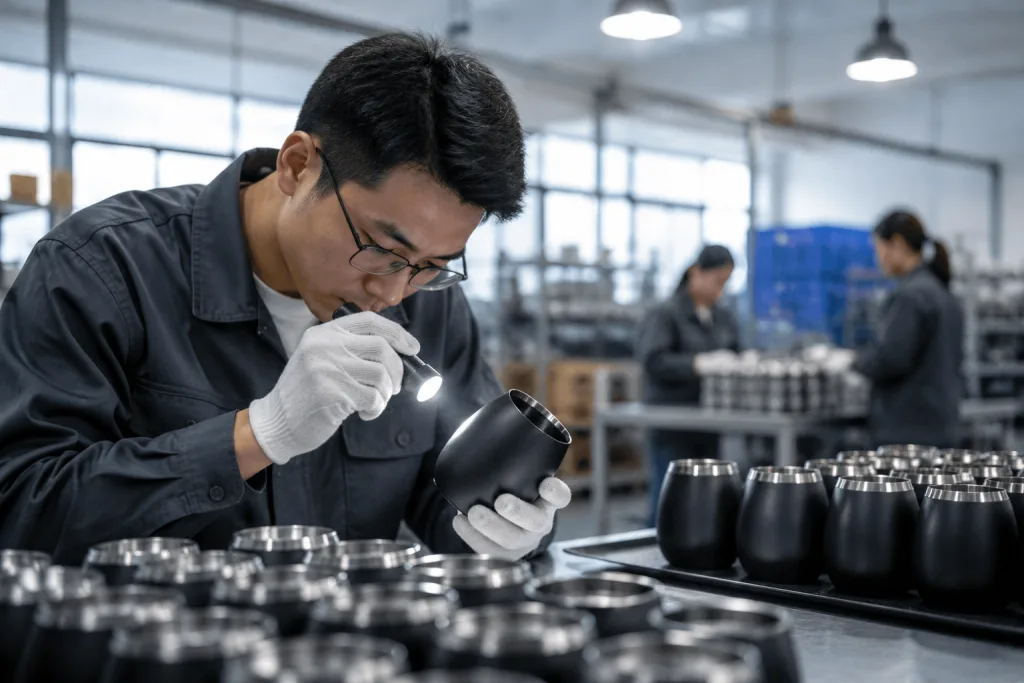
Powder coating and spray painting make a wine tumbler easier to sell, but they also cause late failures after 6 or 7 process steps are already finished. We see pinholes, orange peel, uneven gloss, dust spots, weak adhesion around the rim, and batch-to-batch color drift. QC pulled the sample once after vacuum testing and found 14 dust nibs on 50 matte black cups under a 6500K inspection lamp. Bad timing. At that stage the body has passed forming, welding, polishing, vacuuming, and alkaline cleaning, so rework means stripping the coating or scrapping the cup. The math does not work.
Your purchase order should name the surface process clearly. Matte powder coating holds up better than cheap spray paint on most wholesale wine tumbler orders, but only if the line does proper pre-treatment and curing. Ask for a cross-hatch adhesion test, 3M tape pull test, and alcohol rub test on printed areas; we run these before packing, not after the buyer flags peeling rims in the warehouse. For powder-coated tumblers, we normally use 180-200 degrees Celsius curing temperature depending on powder supplier guidance, checked with an oven temperature logger, not a casual “bake until dry” approach.
Color control needs numbers. If your brand color matters, use Pantone references and approve pre-production color chips under D65 light. Set the tolerance before mass production, such as ΔE under 1.5 for tight retail programs or a signed limit sample for normal wholesale orders. We have seen a PO say “navy blue” while the artwork file said Pantone 2965C; that typo cost 12 days vs 18 days after repainting and repacking. Without a fixed standard, the factory may call a visible shade difference acceptable because the cup sits in the same color family.
Logo method changes the coating risk. Laser engraving is durable and clean on powder coating, but it exposes stainless color and can look too bright on dark matte finishes; buyers often push back after seeing the first carton sample. Silk screen is cheaper for simple one-color logos, often from 0.06-0.12 USD per print, but needs curing and rub testing with a cotton cloth and 75% alcohol. Heat transfer handles gradients, yet it adds film edge, heat pressure, and peeling risk. Pretty mockups are the wrong target. A good wholesale drink bottle is the one whose decoration survives cartons, hands, and dish-sink abuse.
Vacuum claims need real testing
About 7 out of 10 wine tumbler inquiries we see include the line “keeps wine cold all day.” This is the wrong question to ask. It is not a production spec. For insulated stainless wine tumblers, the vacuum layer needs testing after welding and vacuum sealing; QC can pull a sample that looks clean under the 600-lux inspection lamp, then fail it because the vacuum is weak, the weld ran too hot, or the base seal picked up a 0.3 mm ding during transfer.
A usable heat retention or cold retention test must fix the liquid temperature, room temperature, fill volume, lid status, and test hours. We run it like this: fill with 95 degrees Celsius water to rated volume, close lid, hold the room at 20-25 degrees Celsius, then record temperature after 6 hours with a calibrated probe thermometer. For a wine tumbler, buyers usually care more about cold retention: fill with 4 degrees Celsius water, define the ice ratio, then measure after 6 or 12 hours. Same method, or no comparison. We have seen this go sideways when one buyer’s lab tested with the lid open and our line tested with the slider lid closed.
At our Zhejiang facility, monthly drinkware capacity is about 450,000 units across tumblers, bottles, canteens, and growlers. Scale only works when the testing discipline stays boring. We run vacuum screening during production and random performance checks before packing; last month QC pulled 32 pcs from a 5,000 pcs wine tumbler lot and rejected 2 pcs after the hot-water hold test. For a new wholesale wine tumbler mold, we prefer a pilot run of 100-300 pcs before full PO release when timing allows, because fixing a base-tooling issue at 200 pcs is cheaper than sorting 20,000 pcs at the packing table.
These lessons also apply to nearby categories. Bulk growler and beer growler bulk orders need tighter insulation claims because the user expects cold beer transport, often in a car trunk or outdoor cooler bag. Alcohol flask wholesale projects usually do not need vacuum, but they still need leak and weld checks; we pressure-check the cap thread and inspect the laser weld line before carton packing. Beer tumbler wholesale and beer tumbler in bulk programs sit between wine tumblers and growlers: insulation matters, but lid fit and coating defects still drive most complaints, especially when the buyer flags scratches around the rim after AQL 2.5 inspection.
Cartons fail before customers complain
Packaging is where good tumblers get killed by bad guesses. We have seen a wine tumbler pass leak test, coating tape test, and rim gauge check, then arrive with 38 dented rims in one pallet because the master carton used thin B flute and the inner box had 4 mm of play. The buyer flagged it after warehouse receiving, not during production. Unit price is the wrong question to ask if the carton cannot survive ocean freight, two forklift moves, and a courier hub belt.
For export drinkware bulk shipments, define packaging by board grade and test result, not by the phrase “standard export carton.” We run a common pack like this: one tumbler in a polybag, one individual box, then 24 pcs per master carton with a measured gross weight on the carton mark. Carton thickness should be agreed, such as K=K or five-layer corrugated board for heavier items. For fragile finishes, add dividers or tighten the inner box tolerance to 1-2 mm so the cup does not rattle when QC shakes the box by hand. For e-commerce or FBA-style handling, require a carton drop test from 76 cm on faces, edges, and corners, adjusted to carton weight.
If you need FNSKU labels, suffocation warnings, carton barcodes, or mixed-color carton rules, put them in the packing instruction before mass production. We had one PO where “matte balck” was typed on the carton artwork, and nobody caught it until the label roll was already printed. Retrofitting labels in a China warehouse costs time and money. A 20,000 pc order can lose 3-5 days just from unclear carton marking and repacking, and the math does not work when the booking date is already fixed.
The same logic applies when you source wholesale growler, beer growler wholesale, canteen wholesale, or alcohol flask in bulk. A 64 oz growler needs stronger partitioning than a 12 oz wine tumbler; our line usually checks partition height with a steel ruler before sealing the pilot carton. A slim alcohol flask wholesale bulk carton can fail because units shift sideways, even when the outside carton looks clean. Packaging is not decoration. It is insurance you can specify before the first carton is taped.
Inspection must match the risk
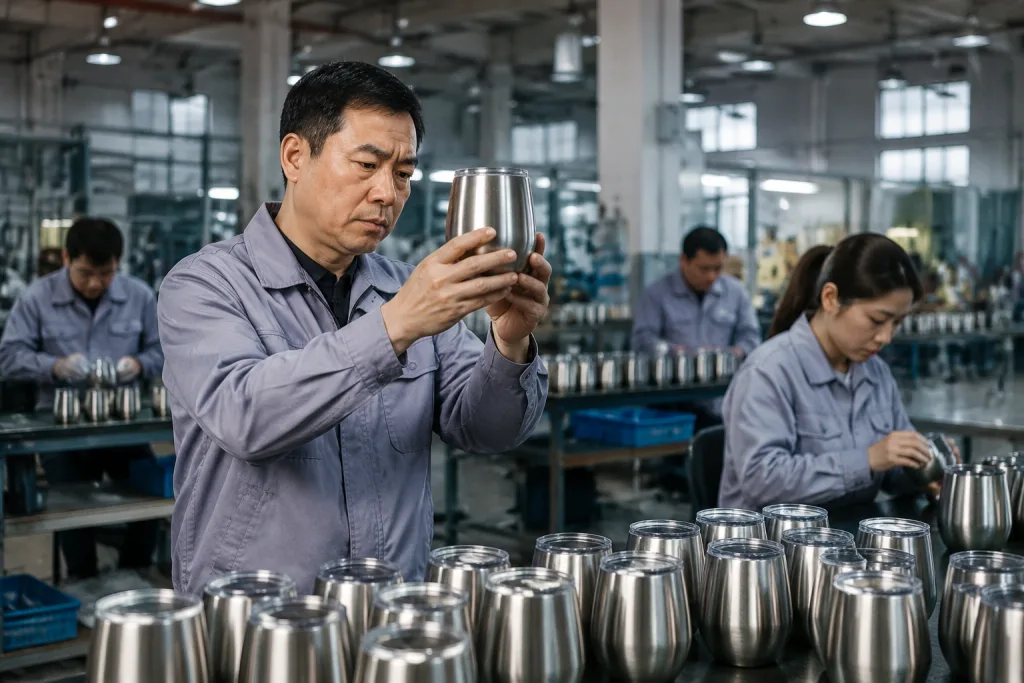
A final random inspection helps, but it is not magic. We have seen a shipment pass on paper because logo skew was marked “minor,” then the buyer flagged 18 cartons of front-facing cups that looked crooked on shelf. For wholesale wine tumbler projects, your QC checklist should split critical, major, and minor defects in plain wording, with a 2 mm ruler, 3M tape test, and approved golden sample on the QC table.
Critical defects include unsafe sharp edges, foreign material inside the cup, wrong material, severe leakage where the lid is claimed leak-resistant, and any food-contact compliance failure. Major defects include visible dents, poor coating adhesion, logo misplacement over 2 mm from approved position, color outside approved tolerance, vacuum failure, and carton quantity errors. Minor defects may include dust points below the agreed size, say under 0.5 mm on the powder coat, or light box scuffing that still passes a retail-shelf check. QC pulled the sample last month for one burr at the rim; that is not a cosmetic issue.
Most buyers use AQL Level II with 0 critical, 2.5 major, and 4.0 minor. For new molds, new factories, or retail launches tied to a fixed promo date, tighten inspection or add during-production inspection at 20-30% completion. A pre-shipment inspection at 80-100% packed is too late to fix coating peel or lid-fit drift without pushing the vessel from 12 days to 18 days. The math does not work.
Ask your supplier in Zhejiang or elsewhere in China for real inspection records, not just a certificate wall. BSCI, ISO 9001, and audit reports help, but they do not replace batch-level QC data with defect photos, carton numbers, and the inspector’s caliper reading. Whether you buy wholesale drinkware, growler bulk, beer tumbler wholesale bulk, or alcohol flask wholesale, the inspection plan should follow the product’s real failure points, not a generic template copied from another category. We run different checkpoints for a powder-coated wine tumbler than for a stainless flask, because the line fails in different places.
Sampling is not production approval
A good-looking sample can fool a buyer. We see it every month. In the sample room, one worker may spend 45 minutes on a tumbler, use a fresh silicone jig, and pick the cleanest lid from a tray of 200 pcs. On the line, the same cup moves through coating, laser, assembly, and carton packing with 6 to 12 operators touching it. Close that gap before you send a deposit, because the math does not work if the sample was built like a showroom piece.
For custom projects, we run three sample stages, but each one has a different job. A reference sample checks the body shape, rim comfort, base diameter in mm, and hand feel. A decoration sample uses the real logo method, actual coating, correct lid, and printed packaging, so QC can rub the logo with 3M tape and check color under a D65 light box. A pre-production sample must come from mass-production materials and the line process, not the sample bench. Only that pre-production sample should release bulk production.
For custom wholesale wine tumbler orders, a reasonable MOQ is 1,000 pcs for stock color with logo, 3,000 pcs per custom color, and 5,000 pcs or more if you need private mold adjustments. Normal sample time is 7-12 days for logo samples and 15-25 days for custom color or modified tooling. Production lead time after sample approval is typically 30-45 days, depending on order size and season. One buyer once pushed for 18 days on a 3,000 pcs custom color order; after coating rework and carton drop testing, it shipped in 33 days, which was the honest schedule from the start.
If your assortment includes wholesale canteen, canteen bulk, beer growler wholesale bulk, beer tumbler in bulk, and alcohol flask wholesale bulk, do not approve from one photo deck. Hold physical samples. Test lids. Wash them. Rub the logo. Drop the carton from 80 cm and open it like QC does during AQL 2.5 inspection. Procurement is not about trusting nobody; it is about catching the loose straw brush, the leaking slider lid, or the PO typo that says matte black while the artwork says gloss black before your customers find it.
Send your tumbler spec before you place the PO
We will review MOQ, coating, lid, packaging, and QC risks for your wholesale wine tumbler or wider drinkware bulk program.
Frequently asked questions
What MOQ should I expect for a custom wholesale wine tumbler?
For a stock-shape wholesale wine tumbler with your logo, a realistic MOQ is 1,000 pcs per design. If you need a custom powder-coated Pantone color, plan on 3,000 pcs per color because coating lines need setup time and powder control. Private mold changes usually start around 5,000-10,000 pcs depending on the structure. Mixed cartons can be possible, but they slow packing and inspection. If your first order is a market test, use an existing mold and spend budget on better coating, lid fit, and packaging instead of tooling.
What is a normal FOB price range for stainless wine tumblers from China?
For 12 oz to 14 oz stainless insulated wine tumblers, a practical FOB China range is about 2.20-4.20 USD per piece, depending on steel thickness, coating, lid, logo method, packaging, and order quantity. A very low quote may use thinner material, lower-cost paint, or weak cartons. Laser engraving may add 0.10-0.25 USD per unit, while a retail color box can add 0.15-0.40 USD. Always compare quotes against the same specification, not just the same product photo.
Can one supplier handle wine tumbler, canteen, growler, and flask orders together?
Yes, but you should treat them as related products, not identical products. A wholesale canteen needs cap thread and impact checks. A wholesale growler or beer growler wholesale order needs gasket, capacity, and insulation testing. Alcohol flask bulk projects need welding, leak, and food-contact checks. Wine tumblers need coating, rim, lid, and vacuum control. Combining bulk drinkware in one PO can improve freight efficiency, but the QC checklist should be product-specific. Ask for separate samples and separate inspection criteria for each range.
Which logo method is safest for drinkware wholesale orders?
Laser engraving is usually the safest for stainless wine tumblers because it does not peel, has no ink migration risk, and handles washing better than low-cost printing. It works especially well on powder coating, but the mark color is the exposed metal tone, not a printed Pantone color. Silk screen is economical for simple one-color logos, often suitable above 1,000 pcs, but it needs rub and tape testing. Heat transfer is better for gradients or full-color art, yet it adds adhesion risk and should be tested after 24 hours curing.
How do I reduce defects before the shipment leaves Zhejiang?
Lock the specification before deposit, approve a true pre-production sample, and run inspection before everything is packed. For a first order in Zhejiang, China, use during-production inspection at 20-30% completion and final inspection at 80-100% packed. Set AQL at 0 critical, 2.5 major, and 4.0 minor unless your retailer requires stricter limits. Include functional checks: lid tilt test, vacuum test, coating adhesion, logo rub, carton drop, barcode scan, and quantity count. Most serious claims are preventable if these checks are written into the PO.