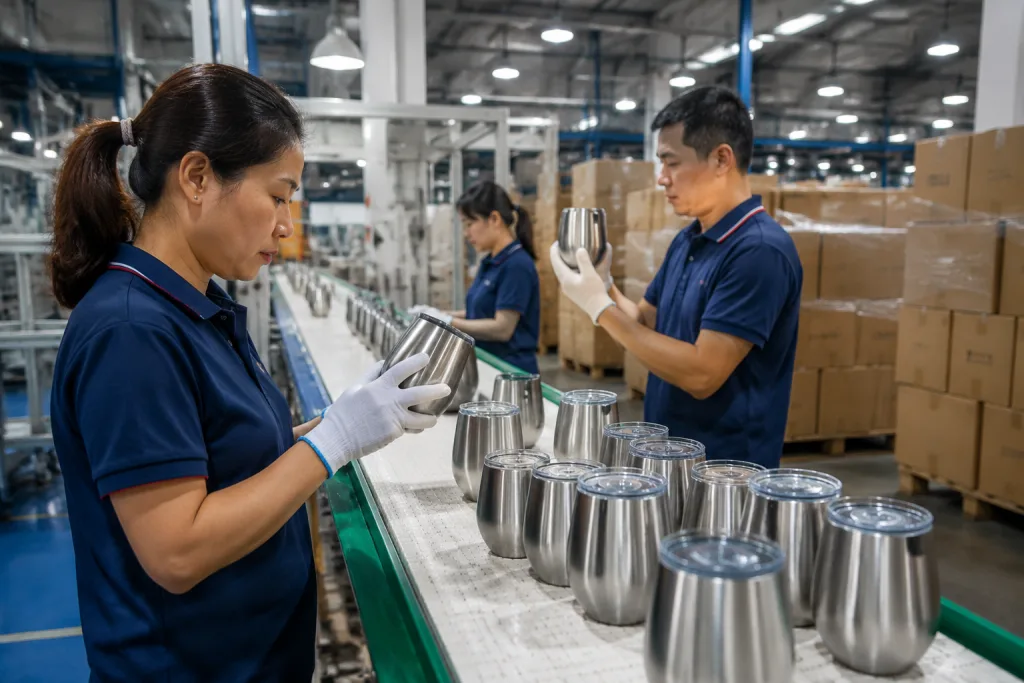
Key Takeaways
- A 12 oz stainless wine tumbler custom order usually starts around 1,000 pcs MOQ and USD 2.10-4.20 FOB China
- Normal bulk lead time is 25-35 days after deposit and approved pre-production sample
- Powder coating, laser engraving, gift boxes, and REACH testing can add 3-12 days
- AQL inspection at 2.5/4.0 is realistic for promotional and retail drinkware orders
A wine tumbler custom project looks simple until you ask for landed cost and a ship date. The 12 oz or 14 oz cup body, sliding lid tolerance, powder coat color
Start with the real unit cost
For a standard 12 oz double-wall stainless wine tumbler custom project, a workable FOB China range is USD 2.10-4.20 per piece at 1,000-5,000 pcs. We price that on 304 stainless steel inner wall, 201 or 304 outer wall, clear push-on lid, one-color logo, and export carton packing. If a supplier quotes USD 1.45 for the same build, this is the wrong question to ask: “Can you match it?” Ask what got removed. Steel grade, wall thickness, vacuum hold, coating thickness, or lid material. Last month QC pulled the sample on a low quote and the inner wall tested 201, not 304 stainless, on the PMI gun.
The cup body is not always where the money moves. Finish and packaging often change the quote faster than buyers expect. A plain stainless body with pad print can sit near the low end. Powder coating can add USD 0.25-0.55. Full carton gift packaging can add USD 0.35-0.90 depending on board thickness, insert, and print coverage. Laser engraving is usually USD 0.12-0.35 per position, but deep engraving or wrap artwork costs more because the line slows from about 900 pcs/hour to 520 pcs/hour on our rotary laser. The math doesn’t work if the artwork needs two passes and the PO still says “standard logo cost.”
At our Zhejiang production network, practical monthly capacity for this format is about 450,000 units/month across tumbler and canteen factory lines, but booked capacity is the number that matters. September to November retail orders and January pre-holiday China schedules fill fast. If you need 20,000 pcs with four colors and individual boxes, treat it as a production slot to reserve, not a small reorder. We run color-change cleaning on the powder line for each shade, and one buyer flagged 3 days of delay after changing “cream white” to Pantone 7499C after the deposit.
For a canteen supplier or canteen manufacturer quoting similar stainless items, the same pricing logic applies: steel specification, coating, lid complexity, and packaging set the floor. Whether you call it custom drinkware, customized drinkware, or promotional drinkware, the BOM still has to make sense. We’ve seen this go sideways when a PO typo listed 0.5 mm outer wall instead of 0.4 mm; on 30,000 pcs, that small line item changed the steel weight enough to reopen the quote.
MOQ tiers change more than price
MOQ is half purchasing math, half line setup. For wine tumblers, 1,000 pcs is the clean MOQ for a custom logo on an existing mold; our laser jig and pad-print fixture are already sized for that run. Some China factories take 500 pcs, but FOB usually jumps 15-30% because the powder coating booth, print screen, carton die-cut, and QC time are spread over fewer cups. For a new powder coat color, 1,000 pcs per color runs smoother. For PMS-matched coating, 2,000-3,000 pcs per color is more realistic because the coating shop needs one stable batch, not two small drums mixed by eye at 7 p.m.
Here is the tier logic we use when advising B2B buyers:
- 500 pcs: workable for testing one market, but expect higher FOB pricing, plain carton limits, and a buyer pushback we hear often: “Why is the sample order almost the same setup cost as 1,000?”
- 1,000 pcs: normal entry point for a wine tumbler custom order with logo and standard carton packing; QC can pull 20 pcs per color without starving the line.
- 3,000 pcs: better pricing and steadier color control, with room for a gift box because the box supplier can run one 3,000-sheet lot instead of hand-feeding short stacks.
- 5,000-10,000 pcs: this is where custom lid tint, retail sleeve, barcode labeling, and mixed carton plans become worth negotiating; below this, the math often does not work.
The same MOQ pattern applies when you source a custom canteen, customized canteen, or customizable canteen from a canteen vendor. A canteen customized with a new cap, silicone handle, or molded logo needs a higher MOQ than one using existing tooling, especially if the mold insert has to be cut 0.2 mm deeper for the logo. If you are a canteen distributor or distributor canteen buyer, do not build a catalog around 12 colors at 500 pcs each unless you can live with split shipments. We have seen this go sideways: color A passes inspection on Monday, color F waits 12 days for recoating, and the PO still says “ship complete.”
MOQ is not a punishment. It is the point where production becomes repeatable. Below that, you are paying for exceptions, extra line cleaning, and the small mistakes QC pulled the sample for before packing.
Decoration choices and setup charges
Logo method changes the piece price and the ship date. For wine tumblers, we run silk screen or laser engraving on most repeat orders; pad print handles small curved marks, while heat transfer, water transfer, or UV print fits full-color artwork. One-color silk screen is still the cleanest choice for a 5,000 pc canteen promotional order or a basic wine tumbler program. It prints fast on the line, and the cost stays low if the coating passes the thumbnail scratch test after oven curing. Expect USD 0.05-0.18 per position at volume, plus a screen setup charge of about USD 30-60 per artwork; our screen room usually checks the 120-mesh screen and squeegee edge before the first 20 pcs go to QC.
Laser engraving gives a cleaner premium look and avoids ink adhesion problems on curved powder coating. It usually adds USD 0.12-0.35 per piece and 1-3 days for normal quantities. If you need individual names, the workflow changes. Variable data engraving works, but the math doesn't work if the buyer sends a messy Excel file at 6 p.m. with “Micheal” on line 47 and asks us to ship tomorrow. We import the name sheet into EZCAD, QC pulled the sample against the spreadsheet, and the checking step takes longer because one spelling error turns a finished tumbler into scrap.
Full-color wrap graphics look good on a shelf, but they carry more production risk. Heat transfer and water transfer need artwork proofing, agreed color tolerance, plus abrasion testing with the same coated body used in bulk production. Add 5-10 days if the design is new. We have seen this go sideways when a buyer approved a PDF on screen, then flagged the red as “too orange” after the PP sample came out at Pantone 186C plus 8% gloss shift. For North American retail, 6 out of 10 buyers also ask for UPC labels, FNSKU labels for marketplace programs, or suffocation warning bags. Those are small costs, usually USD 0.02-0.08 each, but they add handling steps at the packing table.
A serious canteen manufacturer or canteen manufacturers group should ask where the logo sits, the logo size in millimeters, and whether the surface is coated, brushed, or mirror polished. Small detail. Big result. If a canteen supplier accepts a complex logo without checking a 42 mm curved print area with calipers, you may get a pretty quote and an ugly pre-production sample.
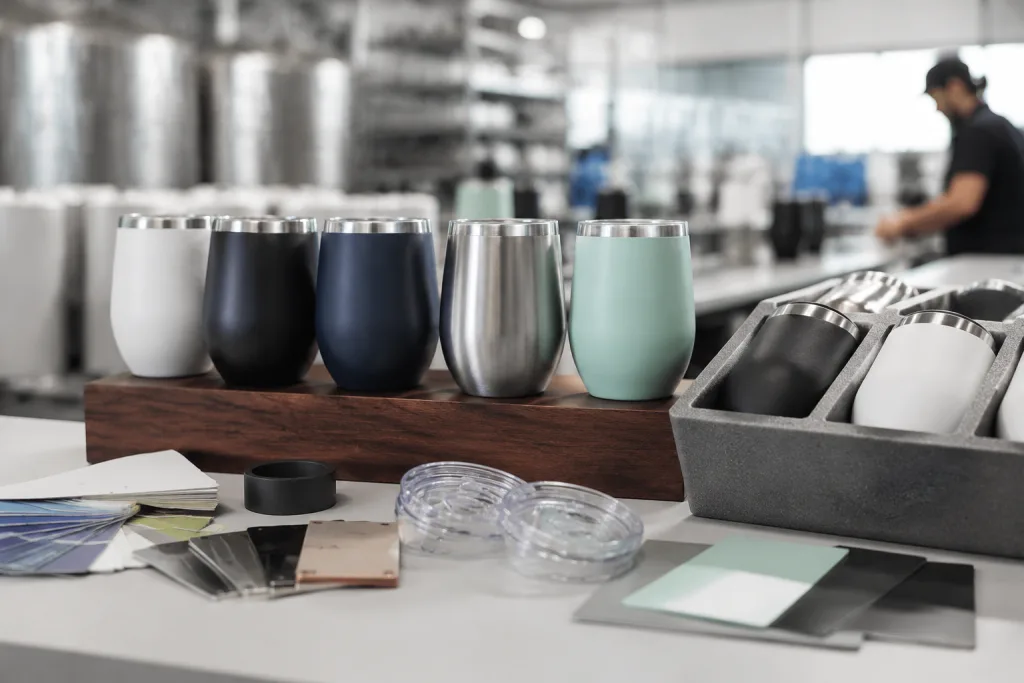
Sampling is where time disappears
Buyers budget bulk production time, then sampling eats the calendar. We see it every March. A stock sample can ship from Zhejiang in 2-4 days if that color is sitting on the sample rack; our clerk checks the color sticker against the ERP before booking SF or DHL. A logo sample normally takes 5-8 days after artwork approval, because the laser jig or silk-screen film has to be set up. A new powder coat color or full packaging mockup can take 10-15 days. Courier transit to Europe or North America is another 3-6 days, and customs clearance can add a day or two if the invoice says “cup” while the PO says “wine tumbler.”
For a wine tumbler custom order, we normally run 3 sample paths. First, approve a stock body sample to confirm size, lid feel, and weight; QC pulled one 12 oz cup last week because the lid snap felt loose by 0.4 mm. Second, approve a logo sample on the nearest available color, not a perfect color if timing is tight. Third, approve a pre-production sample from the actual bulk line before mass production. Skipping samples saves 7 days on paper. The math does not work if the lid fit or print position is wrong and 8,000 pcs are already packed in export cartons.
Sample charges are usually not the problem. A plain sample might be free with freight collected. A logo sample can cost USD 50-120. A full retail packaging sample may cost USD 80-200, especially when the buyer asks for a magnetic box and EVA insert. The real cost is decision delay. If your brand team takes 9 days to approve a 12 oz cup, the factory cannot protect your requested ship date forever; the line may move to a 30,000 pcs Stanley-style tumbler run before your email comes back.
This applies across customizable drinkware, custom growler, customizable growler, and customized growler programs too. Bigger items mean heavier freight and pricier packaging samples; a 64 oz growler sample box can hit 1.2 kg after corner protectors. The approval sequence stays the same. Lock size, surface, logo, and packaging before production. Do not approve by phone. Approve by signed sample photo, Pantone code, and written spec sheet, because we have seen “matte black” become three different blacks between the buyer, designer, and PO.
Production calendar from deposit to port
For 1,000-10,000 pcs of custom wine tumblers, we normally quote 25-35 days after deposit lands and the pre-production sample is signed off. The stainless body line is rarely the slow part on standard 304 stainless models; our 200T hydraulic press and 0.6 mm sheet setup can keep up. Powder coating, logo work, lid assembly, carton packing, and AQL 2.5 final inspection decide the real ship date.
A working calendar looks like this: 1-3 days for PI confirmation and deposit receipt, 5-8 days for a pre-production sample if the buyer asks for one, 7-12 days for body forming and polishing, 5-8 days for powder coating, 3-6 days for logo decoration, 2-4 days for inner box and master carton packing, plus 1 day for inspection and loading. Some steps can overlap. Not all. If the buyer sends logo AI on day 1 but the carton mark on day 9, the line waits; we had one PO last month with “matte sage” typed as “matte saga,” and QC pulled the sample before coating because the Pantone callout did not match.
For FOB Ningbo or FOB Shanghai, trucking from Hangzhou or nearby Zhejiang production areas takes 1-2 days, depending on container yard cut-off. A 40HQ loading plan for 10,000 wine tumblers is checked by carton CBM, not just piece count, and the warehouse team measures master cartons with a tape before booking. In normal weeks, we book vessel space 7-10 days before cargo ready; before Canton Fair season, Christmas orders, or China public holidays, we push buyers to confirm 14-18 days ahead. Air freight works for urgent promo launches, but the math often hurts. Stainless tumblers are bulky, and dimensional weight can make 800 pcs cost more than the goods margin.
If you are a distributor growler or distributor drinkware buyer handling 6-12 SKUs, line up the dates SKU by SKU. This is where we’ve seen shipments go sideways. One late customized growler color can hold the whole container if the PO says “ship complete,” and the buyer flagged this exact issue after a 300-carton retail promo missed the store window. Split shipment costs more, but it can be cheaper than losing a launch and reprinting a second set of shelf labels.
Compliance and inspection budget
For Europe and North America, compliance belongs in the first quotation, not at the end after artwork is approved. Food-contact stainless drinkware can involve LFGB, REACH, California Proposition 65, FDA food-contact expectations, and ASTM-related safety checks for children’s items if the design crosses into kids use. A wine tumbler is not a toy. Still, we control the coating powder batch, PP lid resin code, silicone ring hardness at 50-60 Shore A, ink MSDS, and even the PE bag warning text before the line starts.
Testing cost depends on the market and the parts touching lips, hands, or liquid. A basic material migration or food-contact test can run USD 180-500 per material group. A fuller EU test set covering powder coating, plastic lid, silicone seal, and 304 stainless contact surface can cost USD 700-1,500. If the same supplier, same material grade, and same coating code already have current reports, retesting every PO is usually the wrong question to ask; large retailers still often require reports within 12 months, and QC pulled one sample last May because the PO said “matte black” while the coating card showed BK-17 sand texture.
Inspection should sit in the landed-cost sheet, not in a panic email 3 days before vessel closing. A third-party pre-shipment inspection in China usually costs USD 250-350 per man-day. For most wine tumbler custom and canteen customizable orders, AQL General Inspection Level II with Critical 0, Major 2.5, Minor 4.0 is a practical baseline. We run vacuum checks with 95°C water for 6 hours, cross-hatch the coating with 3M 600 tape, measure logo shift in mm, scan the barcode on 10 cartons, and open cartons to confirm the buyer’s 24 pcs/carton packing instruction.
BSCI, ISO 9001, and social audit files matter when you sell into larger retailers. Ask early. A canteen vendor may have good production capability but no current audit. A canteen factory may have the audit but limited coating capacity, which is where we have seen orders go sideways: 30,000 pcs approved on paper, then the spray line can only finish 6,000 pcs/day because two booths are already booked for another buyer. Matching the factory profile to your sales channel is sourcing work, not paperwork.
How to brief suppliers properly
The fastest quote comes from a complete brief on day one. For a wine tumbler custom project, send capacity in ounces and milliliters, steel grade preference, target weight, lid type, finish, Pantone color, logo file, logo size, packaging style, test requirements, delivery term, destination port, and order quantity by color. Give us 12 data points and the quote is usable; send only a photo and “best price” and the number will look cheap on paper but fail on the line. We had one PO last month with “350ml” in the title and “12oz” in the artwork note, and QC pulled the sample before laser marking because the logo position was already off by 6 mm.
For custom canteen or canteen suppliers, add cap material, carrying loop type, leakproof requirement, opening diameter, and whether the bottle must fit standard cup holders. For custom growler or customizable growler programs, add carbonation expectations, wall thickness target, handle load, and cap seal structure. Catalog pictures hide too much. We run a 24-hour inverted leak test on canteen caps, and for growlers the buyer usually flags cap pressure first, not the body shape.
Be direct about your commercial role. A brand owner, canteen distributor, distributor canteen buyer, or promotional agency is not buying the same risk. Brand owners usually need packaging and compliance. Canteen distributors ask about margin, reorder stability, and mixed SKU cartons, often 6 colors in one master carton. Promotional buyers care about event dates and logo accuracy because one wrong Pantone can kill a 5,000-piece campaign. This is the wrong question to ask: “What is your standard model?” A good China supplier should quote around your selling channel, not push one default configuration.
At BottleForge Industrial in Hangzhou, Zhejiang, we prefer to quote with a written specification table and a timeline attached. It prevents the common argument later: buyer thinks the price included gift boxes, factory quoted bulk cartons. We have seen this go sideways over a 0.38 USD gift box, which turned a 12-day packing plan into 18 days after carton artwork approval. Clear specs are not bureaucracy. They are how we keep your FOB price, lead time, and inspection result under control.
Send your wine tumbler brief for a firm quote
Share quantity, artwork, packaging, market, and deadline. We will return FOB pricing, MOQ, sample cost, and a realistic China production timeline.
Frequently asked questions
What is the normal MOQ for a wine tumbler custom order?
For an existing 12 oz or 14 oz stainless wine tumbler mold, the practical MOQ is usually 1,000 pcs per order and often 1,000 pcs per color for powder coating. Some China suppliers will accept 500 pcs, but expect a 15-30% higher unit price and less flexibility on PMS color, gift box printing, and mixed carton packing. If you need a new lid shape, private mold, or unusual coating, MOQ can move to 3,000-5,000 pcs. For a first test order, 1,000 pcs with one body color and one logo method is the cleanest balance of cost, quality control, and delivery risk.
How much should I budget per unit FOB China?
A realistic FOB China range for a standard double-wall stainless wine tumbler custom order is USD 2.10-4.20 per piece at 1,000-5,000 pcs. The low end usually means standard lid, standard color, one-color logo, and export carton. The high end may include 304 stainless inside and outside, powder coating, laser engraving, individual gift box, barcode label, and stronger carton packing. Testing, third-party inspection, and freight are normally separate. If your target retail price is fixed, tell the supplier early so they can adjust packaging or decoration before quoting an unrealistic build.
Can one supplier handle wine tumblers, canteens, and growlers?
Yes, but you should check whether the supplier is only a trading desk or has direct control of production lines. A capable canteen manufacturer or canteen factory can often manage wine tumblers, custom canteen items, and customized growler projects because the processes overlap: stainless forming, polishing, vacuum insulation, coating, and logo decoration. Growlers may need stronger caps and different leak testing, while canteens may need sport caps or handles. Ask for monthly capacity, recent AQL reports, and photos of the actual production line. One supplier can simplify QC, but only if the technical range is real.
What lead time should I plan for a promotional deadline?
Plan 45-60 calendar days from final brief to cargo ready if you need sampling, logo approval, production, inspection, and port delivery. The factory production window may only be 25-35 days, but sampling can take 5-15 days and courier transit another 3-6 days. If you are shipping by sea to Europe or North America, add 25-45 days depending on port and season. For a fixed event date, approve artwork within 24-48 hours and avoid changing packaging after sample approval. Air freight can save time, but stainless drinkware is heavy and expensive to fly.
What quality checks matter most before shipment?
For wine tumblers and customizable drinkware, check vacuum insulation performance, coating adhesion, lid fit, rim smoothness, inner wall cleanliness, logo position, color tolerance, carton strength, and barcode scan if retail packed. AQL General Inspection Level II with Critical 0, Major 2.5, Minor 4.0 is a common inspection standard. For 5,000 pcs, a third-party inspector will usually sample according to ANSI/ASQ Z1.4 tables and spend one man-day on site. If the order includes gift boxes, add carton drop testing and packaging appearance checks. Defects in packaging can hurt sell-through as much as defects on the cup.