Key Takeaways
- Start with 1,000 pcs per color as a realistic MOQ for powder coated wine tumblers
- 304 stainless steel and 0.45–0.55 mm wall thickness cover most B2B programs
- Budget 7–10 days for samples and 25–35 days for mass production after approval
- Use AQL 2.5/4.0 inspection and confirm REACH, LFGB, or FDA needs before deposit
Wine tumbler private labeling looks simple until the RFQ hits our desk. The cup is small, the logo sits on a curved wall, and a 0.2 mm artwork shift is easy to see after powder coating. Packing surprises buyers too. Last month a U.S. gift buyer flagged the insert cost because the color box added USD 0.42 per set, which wiped out most of the promo margin. If you buy for a wine club, outdoor brand, hotel group, event distributor, or seasonal gift program, the wrong assumptions turn into late cartons, weak decoration, or freight math that does not work.
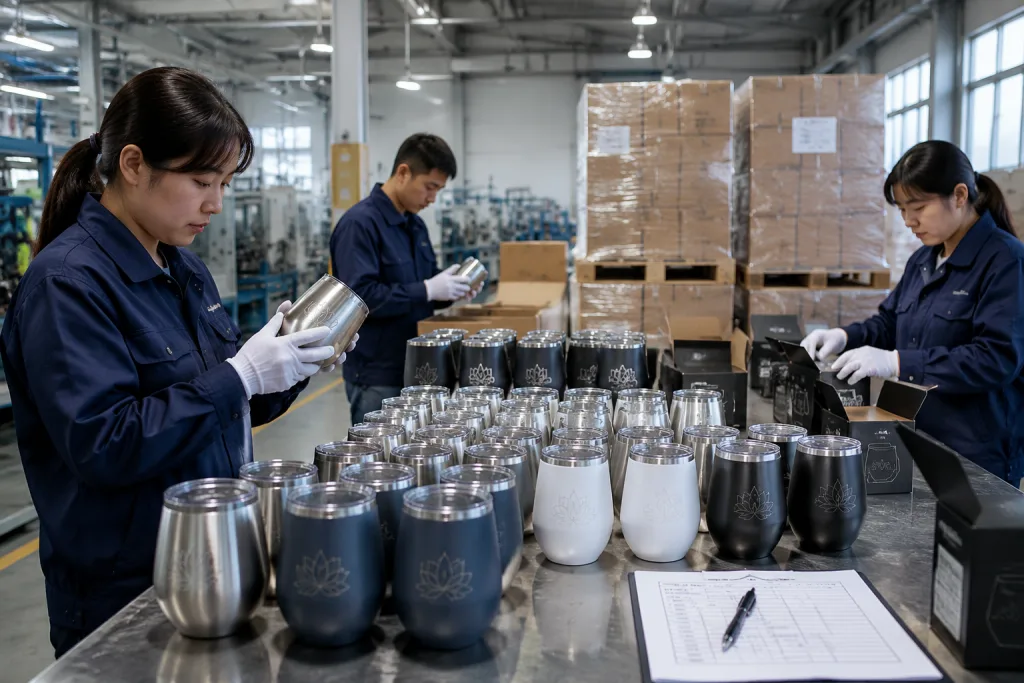
We manufacture custom drinkware in Zhejiang, China, so I will be direct. A wine tumbler order is not just a cup order. You are choosing steel grade, coating method, logo process, test standard, and retail packing before the line can run. Our normal MOQ is 1,000 pieces per color, sample time is 7–10 days, and mass production is usually 25–35 days after artwork approval. QC pulled a sample this week with a dull laser mark on black powder coating; that is exactly the kind of issue we want fixed before 36 cartons are sealed.
What are you actually buying?
A private label wine tumbler is usually an 8 oz, 10 oz, 12 oz, or 14 oz vacuum insulated stainless steel cup with your logo, Pantone color, lid choice, gift box, master carton mark, and barcode system. We normally run double-wall 304 stainless steel inside with 201 or 304 stainless steel outside. For European and North American retail, 304 inside is the wrong place to save USD 0.18. QC checks this with an XRF alloy analyzer before mass packing, not after the buyer flags rust spots in week 6.
The buyer mistake I see is treating wine tumblers like a cheap canteen promotional item. Bad math. They are not hard to make, but they go sideways fast when the body wall is thin, the vacuum rate is weak, the coating booth has dust, or the lid tolerance is loose by 0.4 mm. Last month QC pulled a 12 oz sample with powder specks near the rim after the line changed from matte black to cream; that kind of small defect makes a distributor program look bargain-bin. A proper canteen manufacturer or wine tumbler factory should give you the body gauge, coating method, lid material, carton drop-test result, and AQL defect allowance without acting surprised.
Procurement question: “Can I use one supplier for wine tumblers, custom canteen lines, and a custom growler?” Usually yes, if the factory keeps stainless steel forming, vacuum insulation, powder coating, and logo decoration under one quality system. At BottleForge Industrial in Hangzhou, Zhejiang, we ship about 450,000 units per month across stainless drinkware, with 1,000 pcs MOQ for 18 standard wine tumbler colors. That scale matters when your wine tumbler private labeling order is only one SKU in a larger customized drinkware launch, especially when a PO typo changes “rose gold” to “rose god” and the carton artwork still has to catch up before packing.
Checklist before asking for pricing
Do not send “Please quote wine tumbler with logo.” We see that message 30+ times a month, and it usually produces a cheap-looking number that falls apart after artwork review. The right question is not “how much?” yet. Send a brief that lets the supplier cost the real job: steel grade, lid, coating, logo position, packing, carton marks, and target ship date. On our line, QC pulled a 12 oz sample last week because the logo file was 42 mm wide on the PO but 48 mm wide in the AI artwork.
- Capacity: 10 oz and 12 oz are the safe sizes for wine programs. 14 oz fits cocktail sets, camping channels, or outdoor retail packs.
- Material: Use 304 stainless for the inner wall, then choose 201 or 304 for the outer wall based on budget. Ask for food-contact test reports if selling into the EU or US.
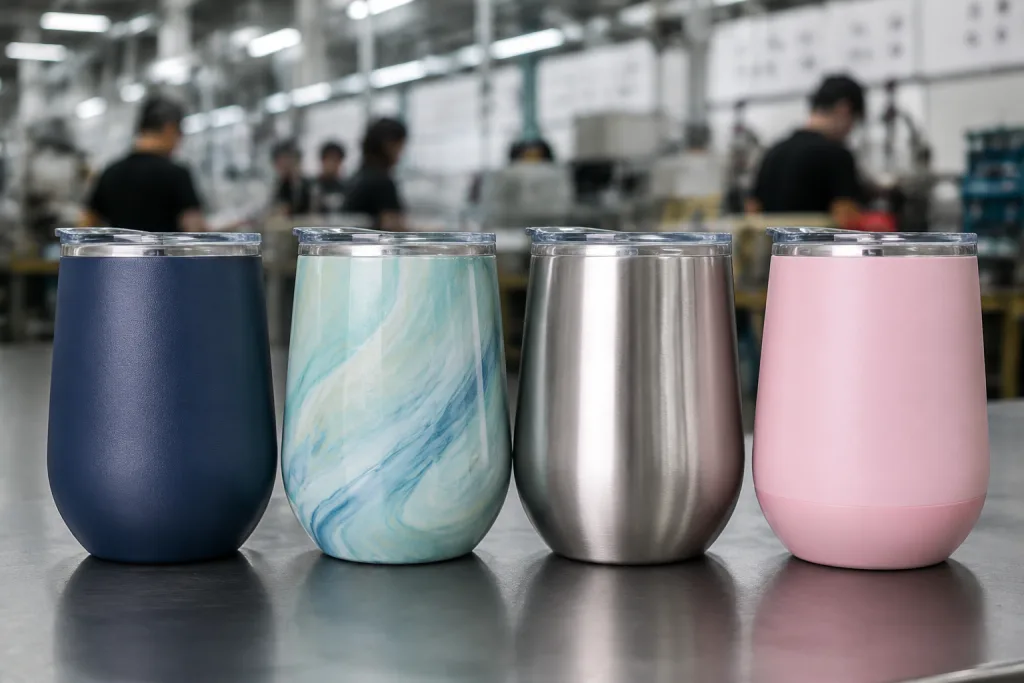
- Finish: Powder coating is the standard durable choice; spray painting is cheaper but scratches faster in a cross-hatch tape test. Electro-polished steel, glitter, gradient, and rubber paint need separate sampling because color drift shows up fast under a D65 light box.
- Logo method: Laser engraving works well on powder coating. Silk screen and pad print suit simple 1-color marks, while heat transfer, water transfer, and 3D UV print need artwork limits agreed before sampling.
- Lid: Clear AS, Tritan, and PP all price differently. For sliding lids, press lids, or straw-friendly lids, confirm the gasket fit and only use BPA-free wording when the resin sheet supports it.
- Packing: White box and kraft box work for standard wholesale. Color box, gift box, or mailer box needs a dieline, drop-test target, and barcode placement. For Amazon or distributor canteen programs, lock FNSKU labeling and carton marks early.
- Compliance: FDA, LFGB, REACH, California Proposition 65, BSCI, ISO 9001, and food-contact migration tests should match the sales market, not just the buyer’s template.
If you are comparing canteen suppliers in China, make every quote show FOB port, carton quantity, gross weight, production lead time, sample fee, mold fee if any, and artwork limits. A 12 oz powder coated wine tumbler might quote around USD 2.35–3.80 FOB Ningbo or Shanghai depending on steel grade, lid, decoration, and packaging. We ship 24 pcs per export carton for most wine tumblers, about 13–15 kg gross weight, but gift-box packing changes that fast. If one price comes in 25% lower than the other 3 quotes, the math does not work; we have seen this go sideways when the missing item was a Tritan lid, not a PP lid.
Which decoration method holds up?
For wine tumbler private labeling, decoration is where a brand either looks retail-ready or like a 2,000 pcs rush promo. The right choice comes down to MOQ, logo colors, artwork line width, and how the cup will be used. Laser engraving is clean and permanent, so we run it often for corporate gift sets and hotel welcome packs. The laser burns through the powder coat and shows the 304 stainless underneath; on our line, QC checks the exposed logo edge with a 10x loupe because fuzzy edges mean the power setting is off. It is the wrong choice for full-color artwork. For daily use, though, it beats most printed logos in rub resistance, even if we still tell buyers to hand wash to protect the coating.
Silk screen printing costs less for simple one- or two-color logos, especially above 1,000 pcs. It prints well on straight walls, but tapered wine tumblers need a proper jig; we once rejected 180 pcs because the logo drifted 2 mm from top to bottom. Pad printing handles curved areas better, but the printable zone is smaller, so big winery crests often get squeezed too hard. Heat transfer and water transfer work for wraparound art or full-color labels, but ask for abrasion testing and 3M tape testing, not sample photos taken under soft light. UV printing can look sharp when the surface is wiped clean with alcohol and the curing lamp is controlled; skip that step and the math does not work.
Ask for a decorated pre-production sample using the actual coating color, not a blank stock cup with a similar logo.
For a wine club, hotel retail shelf, or canteen promotional campaign, I normally recommend powder coating with laser engraving for conservative designs, or powder coating with one-color silk screen when the target price is tight. We ship both setups often, and the buyer usually flags mismatch first when the carton sample lands on their desk. If you are building a customized canteen or customized growler family beside the wine tumbler, keep the decoration system consistent across the set. Buyers notice when the growler logo is laser engraved, the tumbler logo is printed, and the canteen customized finish misses by half a Pantone shade.
How should you judge factory claims?
Every canteen factory says it has “strict QC.” On its own, that phrase means nothing. Ask what they inspect, at which station they inspect it, and who signs the reject report when defects pass the agreed limit. For stainless wine tumblers, we run checks on 0.5 mm body thickness, rim welding, polishing marks, vacuum performance, powder coating adhesion, logo position, lid fit, odor, carton crush strength, and barcode readability. Last month QC pulled 32 pcs from a black matte order because the laser logo drifted 1.8 mm left after the jig screw loosened.
A workable inspection plan is AQL 2.5 for major defects and AQL 4.0 for minor defects. Critical defects should be zero. For vacuum insulated items, we use hot water testing or temperature retention sampling by batch, usually 5 pcs per color before carton sealing. A common retail expectation is that a double-wall wine tumbler keeps warm drinks acceptably hot for about 3 hours and cold drinks for 6–9 hours, but performance changes with lid design, volume, and test conditions. “Keeps cold all day” is the wrong claim to approve unless the supplier gives the test method, start temperature, room temperature, and reading time.
Audit documents matter, but they are not magic. BSCI helps if your retailer asks about social compliance. ISO 9001 shows a quality management framework. REACH, LFGB, and FDA reports matter for material safety. Still, a canteen manufacturer with certificates can ship a bad order if the approved sample, production specification, or inspection checklist is loose. We have seen this go sideways: the PO said “cream white,” the sample tag said Pantone 7499C, and the line sprayed 3,000 pcs before the buyer flagged the shade under a D65 light box.
If you work with canteen manufacturers in Zhejiang or other regions of China, ask for a production control sheet before deposit. It should state SKU, color Pantone or finish chip, logo size in mm, packing method, carton size, units per carton, net weight, gross weight, and tolerance for visible defects. Push for numbers, not adjectives: logo tolerance ±1 mm, lid gap under 0.3 mm, carton drop test height 76 cm, and MOQ by color written on the same sheet. If a factory refuses this before the 30% deposit, the math does not work for private label orders.
What does private label cost include?
Private label cost is not just the cup. We price the base tumbler, coating, logo process, lid, retail box, insert card, barcode label, export carton, inland truck to Ningbo or Shanghai, testing, and sometimes 100% re-sorting when QC pulled the sample for dust spots or mixed lids. If you buy for a canteen channel or growler distributor program, the wrong question is “what is the cheapest unit price?” We have seen USD 0.18 added just because the buyer’s PO said “UPC sticker on each box” but the artwork file arrived 6 days after coating started.
For planning, a standard 12 oz stainless wine tumbler from a China canteen supplier usually sits in these FOB ranges: plain stainless with simple packing, about USD 1.95–2.60; powder coated with laser logo and white box, about USD 2.55–3.40; powder coated with color box, insert card, and barcode labeling, about USD 3.00–4.20. These are working ranges, not promises. Steel price, exchange rate, lid style, finish yield, and order volume move the quote. On the line, we check coating thickness with a film gauge at 60–80 μm; if the matte finish yield drops from 96% to 91%, the math changes fast.
Tooling is usually not needed if you use an existing mold. A new body shape, new plastic lid, or proprietary sip mechanism changes the job. Expect mold costs from USD 1,500 to USD 8,000 for simple components, and more for assemblies with sliders, silicone rings, or two-shot parts. MOQ goes up too. A standard wine tumbler private labeling order may start at 1,000 pieces, but a fully custom lid can require 5,000–10,000 pieces per run. We run trial shots on the injection machine first; one buyer flagged a 0.4 mm gap at the lid rim, and that small gap killed the leak-test result.
Payment terms for new buyers are normally 30% deposit and 70% before shipment after inspection. FOB Ningbo or FOB Shanghai is common for Zhejiang factories. For smaller test orders, EXW looks simple, but we have seen this go sideways with pickup booking, export declaration, and carton handling. One 320 kg trial order sat 3 extra days because the forwarder’s pickup note had “Hangzou” instead of “Hangzhou,” and the warehouse gate would not release the cartons.
When do timelines go wrong?
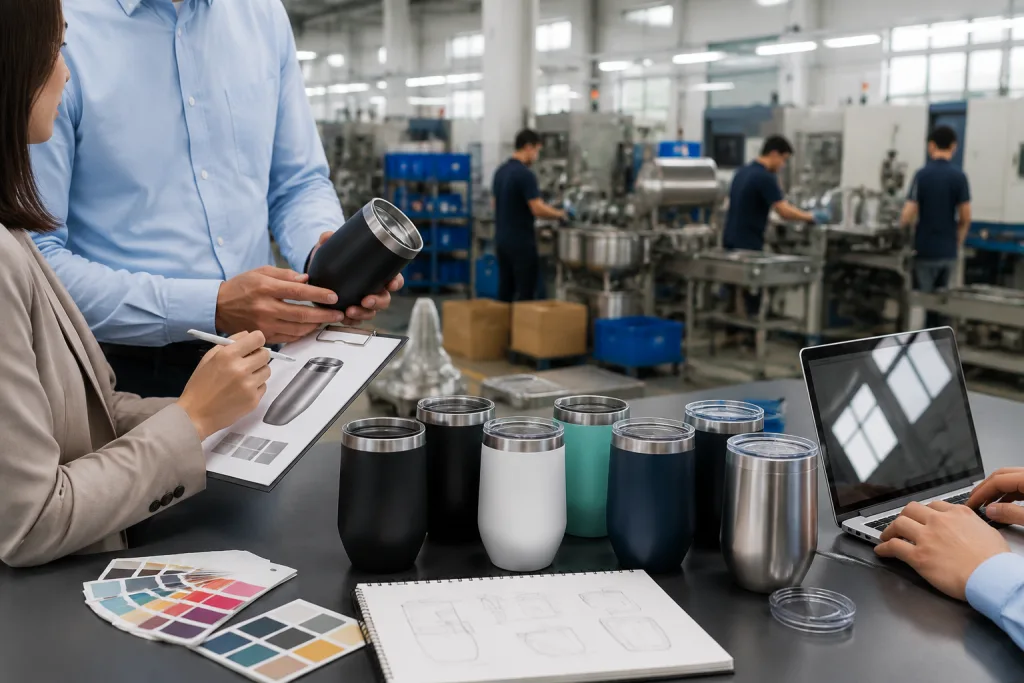
Most delays start before the line opens. The AI file arrives without a 1:1 logo size, the Pantone number is missing, the buyer changes the gift box after the sample, or the retailer sends a Prop 65 request 14 days late. We see this every season. A practical timeline is 2–3 days for quotation clarification, 7–10 days for logo sample, 3–5 days for approval and revisions, 25–35 days for mass production, and 3–7 days for inspection, booking, and loading. Ocean freight to Europe or North America then adds 28–42 days in a normal season; LA, Rotterdam, and Hamburg all behave differently when vessel space gets tight.
For a seasonal wine tumbler private labeling order, build the schedule backward from the retail delivery date. If your warehouse needs goods by October 1, a late-August PO does not work. The math doesn’t work. For Q4 gifts, 7 out of 10 experienced buyers we deal with confirm artwork in June or July, then leave August for samples, PO cleanup, and deposit payment. Zhejiang factories can push, but coating capacity is still coating capacity; one matte powder line may run 8,000–12,000 wine tumblers per shift, and carton printing queues jump fast before September.
Buyer checklist for schedule control:
- Approve artwork before sampling, with logo width in mm, exact placement from rim or base, and Pantone code written on the proof.
- Confirm the sample type: functional sample for structure, decoration sample for logo finish, or pre-production sample pulled from the approved materials.
- Freeze packaging before mass production starts; changing a 350 gsm gift box to an E-flute mailer after printing is where schedules slip.
- Book third-party inspection at least 7 days before expected completion, so QC can pull packed cartons instead of loose pieces from the assembly table.
- Tell the factory if cartons need Amazon FBA labels or distributor routing labels with mixed-SKU pallet plans.
For canteen vendors and distributor canteen buyers handling 6–12 SKUs, combine shipping only when production dates are close. Holding finished wine tumblers for 20 days while waiting for a custom growler can save 300–600 USD on freight, but we have seen this go sideways: warehouse corners get tight, outer cartons soften in July humidity, and the buyer flags crushed master cartons during AQL 2.5 inspection.
Questions to ask before deposit
A solid supplier will not get annoyed by practical questions. A shaky one says “yes” to everything and never gives thickness, lead time, or carton data. Before you pay the deposit, ask for steel grade, inner wall thickness in mm, outer wall thickness in mm, lid material, logo process, MOQ by color, sample lead time, mass lead time, packing specification, and inspection standard. We had one buyer flag a 0.38 mm outer wall after QC pulled the sample with a micrometer, so get the number before the PI is signed. If the order includes canteen customizable products, custom canteen extensions, or a customizable growler in the same program, ask whether the line uses the same powder coating booth and the same color chip approval method.
Here is the short version I would send to any canteen manufacturer in China: “Please quote 12 oz vacuum wine tumbler, 304 inner, 201 outer, powder coating Pantone 5535C, laser logo 35 mm wide, clear sliding lid, kraft box, 24 pcs per carton, AQL 2.5/4.0, FOB Ningbo, 1,000/3,000/5,000 pcs pricing, sample lead time, production lead time, and available FDA/LFGB reports.” This gets a cleaner answer than three pages about brand story. The math is simple: a merchandiser can price this in 20 minutes because the line, carton count, logo width, and test request are already clear.
Ask who owns the artwork files. Ask whether the factory keeps your logo out of other customer sample rooms. Ask if reorders can match the previous batch, and make them write down the control sample number. Color repeatability is commercial tolerance, not a lab promise; we have seen Pantone 5535C shift under different gloss levels after baking at 180°C. If your brand color is strict, buy one approved color chip and require the canteen supplier to keep it inside the production file, not in a sales drawer.
The best private label projects are not the ones with the thickest spec sheet. They are the ones where the buyer, factory, and inspector work from the same document before the stainless sheet is drawn, welded, vacuum tested, coated, printed, packed, and loaded. Simple beats clever here. We ship fewer claims when the PO, artwork, carton mark, and AQL 2.5/4.0 inspection sheet all match before the first carton reaches the sealing tape machine.
Send your wine tumbler spec for a factory quote
Share capacity, color, logo, packing, and target quantity. We will reply with MOQ, FOB pricing, sample timing, and compliance options.
Frequently asked questions
What is the normal MOQ for wine tumbler private labeling?
For a standard stainless steel wine tumbler using an existing mold, 1,000 pcs per color is a realistic MOQ from many Zhejiang and China factories. Some suppliers advertise 300–500 pcs, but the unit price is higher and color choices are usually limited to stock. For custom powder coating, retail box printing, or a canteen customized program with matched colors across several items, plan on 1,000–3,000 pcs per SKU. If you need a new lid mold, new body shape, or custom growler and wine tumbler set, MOQ can move to 5,000–10,000 pcs because tooling and setup waste must be covered.
Which logo method is best for private label wine tumblers?
Laser engraving is the safest choice for durability and a premium look, especially on powder coated tumblers. It is good for one-color logos, names, hotel marks, and corporate programs. Silk screen printing is cheaper when the logo is simple and the order is 1,000 pcs or more, but it depends heavily on ink adhesion and curing. For full-color artwork, use heat transfer, water transfer, or UV printing, and request a tape test plus abrasion test before mass production. If your line also includes customizable canteen or customized growler items, use one decoration method across the range when possible.
How long does a private label wine tumbler order take?
A normal schedule is 7–10 days for a decorated sample after artwork confirmation, then 25–35 days for mass production after sample approval and deposit. Add 3–7 days for final inspection, booking, and container loading. Printed retail packaging can add another 5–10 days if artwork changes late. During peak season in China, especially before Q4 gift shipments, coating and packing lines get crowded. For a distributor drinkware launch, confirm purchase orders at least 75–90 days before your required warehouse date if ocean freight is involved.
What compliance documents should I request for Europe or North America?
For Europe, ask for LFGB or EU food-contact migration testing and REACH documentation for coating and printed surfaces when relevant. For the US, FDA food-contact compliance is common, and some buyers also request California Proposition 65 review. If children may use the product, additional ASTM or CPSIA considerations can apply, even if the item is marketed as a wine tumbler. For retailer programs, BSCI or similar social compliance audits may be requested. Do not rely on old reports blindly; check product description, material, test date, and whether the report matches stainless steel drinkware.
Can one factory handle wine tumblers, canteens, and growlers?
Yes, if the factory has the right stainless steel drinkware capability, not just trading experience. A proper canteen factory should handle vacuum insulation, polishing, powder coating, lid assembly, laser engraving, printing, inspection, and export packing. For a program combining wine tumbler private labeling, custom canteen, canteen promotional items, and distributor growler SKUs, the advantage is color consistency and fewer communication gaps. Ask for monthly capacity, current lead time, MOQ by item, and photos or videos of the coating and inspection areas. A factory making 300,000–500,000 units per month is usually better suited to multi-SKU B2B orders than a small workshop.