Key Takeaways
- Set MOQ expectations early: 1,000 pcs per color is practical for most powder-coated wine tumblers
- Ask for 304 stainless steel, 0.45–0.55 mm wall thickness, and vacuum retention test data
- Approve a pre-production sample before mass printing, especially for Pantone powder coating
- Use AQL 2.5 for major defects and define carton drop test, lid fit, and logo tolerance in the PO
Wine tumblers look simple on a catalog page: stainless cup, lid, logo, color box. Trouble shows up in cartons: 7 chipped powder-coated rims in a 200-piece PSI pull, lids that spin loose on the thread gauge, logos sitting 2 mm off center, or a matte black that misses the approved swatch. Then the FOB price is the wrong question to ask. The rework, claims, and air freight eat the savings.
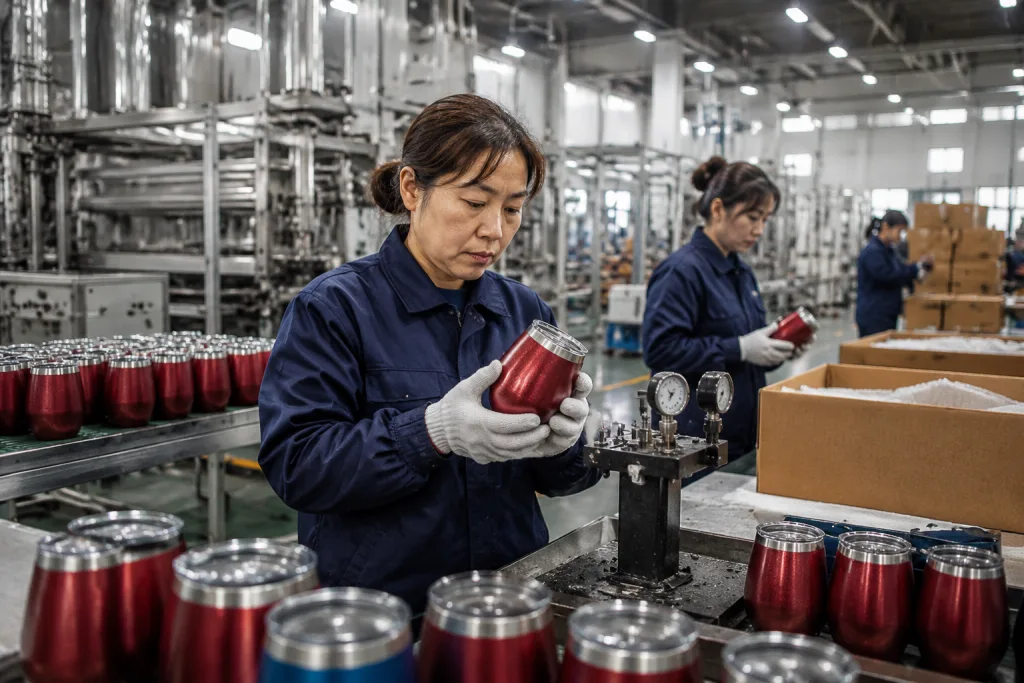
If you are comparing wine tumbler vendors in China, buy the production process, not just the cup. At our Zhejiang factory, a typical custom drinkware order starts at 1,000 pieces per color, with 25–35 day production after artwork approval. We run artwork checks, coating adhesion tests, lid fit checks, and carton drop tests before shipment; QC pulled one sample last month because the PO said “Pantone 186C” but the artwork file showed 185C. The failures below are the ones we see most often, and the spec controls that stop them before the line packs the first master carton.
Failure one: vague steel specification
The first failure looks boring, so buyers skip it. The quote says “stainless steel wine tumbler,” but it does not lock the grade, wall thickness, or vacuum structure. That is too loose. For a retail wine tumbler, we run food-grade 304 stainless steel on the inner wall as the default. Some price-sensitive jobs use 201 stainless outside, and that is acceptable only if it is written before price approval. For premium distributor drinkware, 304 inner and 304 outer makes the compliance file cleaner and avoids the buyer asking for a revised spec sheet 2 days before shipment.
Wall thickness matters because wine tumblers have a wide body and short height. Thin outer walls dent during polishing, powder coating, or carton transit; QC pulled 17 dented samples from one 3,000 pcs trial run after the polishing wheel pressure was set too high. A practical range is 0.45–0.55 mm per wall for most 10 oz and 12 oz vacuum tumblers. Below 0.40 mm, the unit price looks good on the PO, but the math doesn't work when dent claims start eating the margin.
Ask your wine tumbler vendors to write the construction into the proforma invoice: “double-wall vacuum insulated, 304 stainless inner, 304 stainless outer, 0.50 mm nominal wall.” We have seen this go sideways when a buyer’s PO said “SS tumbler” and the factory booked 201 outer without telling anyone. If you are also sourcing custom canteen, customizable growler, or distributor growler lines, use the same discipline and require the grade on the PI, artwork approval sheet, and carton mark file. A canteen manufacturer that cannot state material grade clearly is not ready for North American or European retail programs.
Practical spec: require a random incoming material check with a handheld XRF tester and keep mill certificates on file for 304 stainless steel coils used in your batch.
Failure two: weak vacuum performance
A wine tumbler does not need to keep coffee hot for 12 hours, but weak vacuum insulation is still easy for a buyer to spot. If the outer wall sweats after 20 minutes, or the base has one cold patch you can feel by hand, the product reads cheap. We usually trace this back to a pinhole at the laser weld, a loose vacuum plug, or a semi-finished body dented in the transfer basket before vacuum pumping. QC pulled 37 dented bodies from one 12 oz line last month before they reached coating.
For production control, set a retention test that fits the tumbler instead of writing “keeps hot and cold” on the inspection sheet. That is the wrong standard. For example, fill the tumbler with 95°C water, close the lid, and measure after 3 hours at 20–25°C room temperature using the same probe depth each time. A reasonable 12 oz wine tumbler should still hold about 55–65°C depending on lid design. For cold testing, fill with 4°C water and check for condensation after 30 minutes at 25°C and 60% relative humidity. We run this with a calibrated digital thermometer and a humidity meter; if the PO says “vacuum OK” with no test method, the math does not work.
In our Hangzhou, Zhejiang production flow, vacuum testing is done before powder coating because failed bodies should not move into finishing. Scrap them early. That saves time and avoids decorated waste with logo printing already paid for. Our monthly output for stainless vacuum drinkware is about 450,000 units, but capacity only protects the buyer when defective semi-finished cups stop at the vacuum station. On the line, failed bodies are marked with a red oil pen and held in a separate bin before the coating team scans the work order.
The same testing logic applies to canteen customized projects and custom growler orders. Larger bodies punish weak welding faster, especially around the bottom seam where a 1.0 mm gap becomes a customer complaint after filling. A canteen factory should show how it tests vacuum performance before decoration, not just send a catalog claim. We have seen this go sideways: the buyer flagged condensation after the logo was silk-screened, and nobody wanted to pay for 3,000 pcs of finished scrap. Good canteen suppliers treat insulation as a production checkpoint, not a sales line.
Failure three: lids that almost fit
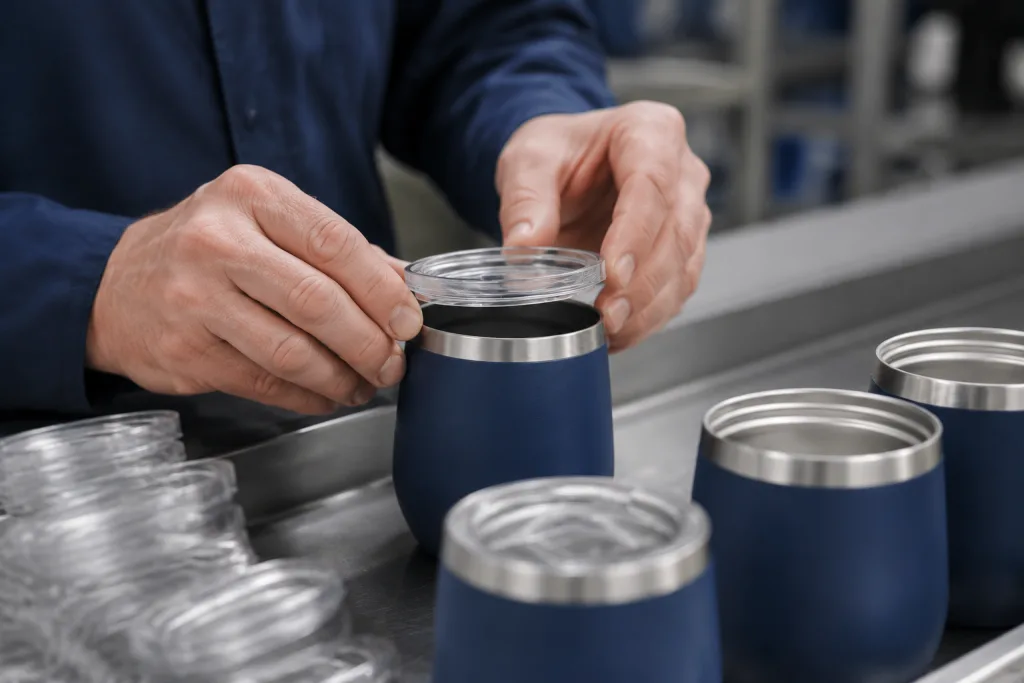
Lid issues trigger complaints fast because the buyer checks them in five seconds. A lid can look clean in a photo but feel loose, squeak, leak around the silicone ring, or sit 1 mm high on one side of the rim. We see this most on 12 oz and 14 oz wine tumblers after the line changes from raw stainless to coated bodies. Slide lids, sip lids, and push-on clear AS lids each need separate tolerance control. One lid spec for all three is the wrong question to ask.
The cup mouth diameter should be measured after forming, polishing, and coating. Powder coating can add around 60–90 microns per side, which affects lid fit. If your vendor tests lids only on uncoated bodies, the mass production result can shift by the time QC pulls the coated sample from carton 3. Use a go/no-go gauge for the coated mouth diameter and a pull-force check for the lid. For push-on lids, a common target is firm hand insertion without rocking, with no lid pop-out when the tumbler is tilted empty for 10 seconds.
Define lid material on the PO, not just “clear lid.” AS, PS, PP, and Tritan-style copolyester are not the same in clarity, impact resistance, or dishwasher behavior. We once had a buyer flag a lid because the PO said “Tritan” but the factory packing list showed AS. Small typo. Big argument. Silicone rings should be food-grade and removable for cleaning. For Europe, ask for LFGB or EU food-contact documentation where required. For the United States, about 7 out of 10 buyers ask for FDA food-contact compliance statements and, when relevant, Prop 65 review.
If you buy from a canteen supplier or canteen vendor for a broader hydration range, do not assume the lid team is the same as the tumbler team. Canteen vendors can be strong in screw caps and carry handles but weak on sip lids for wine tumblers. The math does not work if the first real fitting test happens after 3,000 pcs are coated. Ask for actual fitting samples, not only renderings, and have the vendor test them on coated cups from the same line.
Failure four: coating that fails retail handling
Wine tumbler returns rarely come back for insulation. In our after-sales logs, about 7 out of 10 appearance complaints start at the finish: powder chips on the rim, paint rubs inside the carton, matte black catches fingerprints, or the approved Pantone shifts under warehouse LED light. Customizable drinkware lives or dies by finish consistency. QC pulled one sample last month with a 0.8 mm bright line on the rolled lip, and the buyer flagged it before we even packed the inner box.
For powder coating, ask the vendor to write down coating thickness and adhesion testing, not just “good quality coating” on the PI. A normal powder layer may be around 60–90 microns. Too thin, and the stainless shows through at edges. Too thick, and lid fit or mouth feel can suffer; we have seen a 0.3 mm rim build-up make a slide lid feel tight. Use a cross-hatch adhesion test, tape pull test, and one basic abrasion check before shipment. If the product is dishwasher-safe, specify the test cycle count. If it is hand-wash only, print that clearly on packaging and instruction inserts. The wrong question is “will the coating pass?” Ask what test the line will run, on how many pcs, and who signs the report.
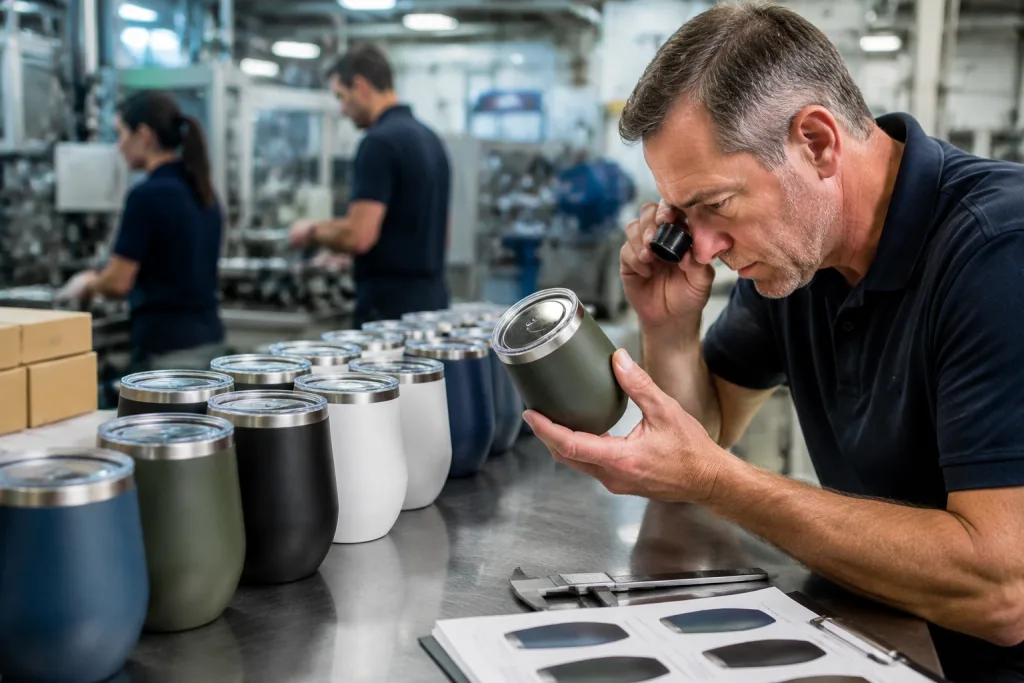
Pantone matching needs a real surface standard. A paper Pantone chip is not enough because stainless substrate, powder texture, gloss level, and curing temperature change the final look. Approve a coated metal color chip or pre-production sample under D65 lighting if color is critical. For multi-color orders, keep a golden sample per color at the factory and one with your inspection agent. We mark ours with the PO number, color code, and date on masking tape; one typo on a PO can turn “warm grey” into a full carton of cold grey cups.
For canteen promotional campaigns, buyers often push for low prices and bright colors. That is where shortcuts happen. Whether you are buying customized canteen, canteen customizable bottles, or wine tumblers, write the coating requirement into the PO. A canteen distributor can survive a 3% shade variation on a low-cost giveaway; a retail shelf program usually cannot. We ship both types, and the math doesn’t work if a USD 0.06 coating saving creates 18 cartons of rework at final inspection.
Failure five: decoration drift and logo surprises
Logo problems hurt because they should be caught before the line starts. The artwork was approved, then QC pulled the sample and found the mass production logo 3 mm too low; on another order the laser engraving looked shallow because the operator used the setting from a black tumbler on a champagne powder coat. Screen print pinholes, weak heat-transfer edges, and wraparound seams that miss by 2 mm all create the same buyer email: “Why does the shelf sample not match the
Failure six: packaging built for price only
I’ll rewrite the section in-place, keep the HTML tags unchanged, and tighten the prose so it reads like a factory-side sales engineer wrote it.Packaging is where FOB savings disappear fast. A wine tumbler in a thin white box may look fine in a showroom, then fail in ocean freight, parcel sortation, or Amazon FBA. We’ve pulled cartons off the line with dented rims, scratched coating, crushed color boxes, and missing barcode labels. That was packaging, not the tumbler.
For wholesale, an egg-crate inner carton or an individual box with a protective bag is usually enough. For e-commerce, test harder. Run a 1.2 m carton drop test on one corner, three edges, and six faces with the master carton fully loaded. If the item ships as a single unit, test the mailer too. For Amazon-style programs, lock down FNSKU placement, the suffocation warning on polybags if it applies, carton weight limits, and barcode grade. The buyer flagged one PO where the barcode was printed 8 mm off-center; QC pulled the sample and it failed on the scanner.
Master cartons need to match the shipping lane, not the brochure. A 12 oz wine tumbler usually ships 24 or 36 pieces per master carton, depending on box size. Keep gross weight workable, often under 15 kg when warehouse handling is manual. Use 5-ply export cartons for heavier sets or gift packs. We’ve seen this go sideways in wet winter routes to Europe and North America, so ask for moisture-resistant outer cartons or stronger pallet wrap if the lane is rough.
A capable canteen manufacturer should quote packaging by channel: retail shelf, distributor warehouse, club pack, or direct-to-consumer. This is the wrong question to ask if someone says “standard export carton” and leaves it there. Ask for the carton spec, size, drop test result, and loading quantity. We ship better when the buyer pushes for those numbers upfront.
Failure seven: QC starts after shipment
I’ll keep the HTML intact and rewrite only the prose with a more field-tested sales tone, tighter language, and a few concrete factory details.The worst QC plan is opening cartons after they land. By then, the factory has been paid, the vessel has sailed, and your sales team is stuck explaining a 14-day delay to a buyer who already booked shelf space. For wine tumbler vendors, we run checks before production, during the line, and again before loading.
Use AQL sampling for final inspection. A common setup is AQL 2.5 for major defects and 4.0 for minor defects, with critical defects set to 0. Major defects include leaking lids, visible dents, wrong logo, wrong color, poor coating adhesion, and barcode failures. Minor defects cover small dust spots, tiny print marks outside the logo area, or carton scuffs inside the agreed limit. Write that down before inspection day. We’ve seen this go sideways on a 12 mm logo shift that the buyer flagged only after the report came back.
Ask for a QC checklist that covers material grade, capacity check, vacuum performance, lid fit, coating appearance, logo position, barcode scan, carton drop test, and packing quantity. For regulated markets, add REACH, LFGB, FDA food-contact, BSCI, Sedex, or ISO 9001 documents based on the customer brief. One missing certificate can stall the whole PO; QC pulled a sample once and found a 0.3 mm lid gap, which was enough to fail the shipment. Not every order needs every certificate, but every claim needs paper behind it.
BottleForge Industrial ships from Zhejiang, China, and we push buyers to use third-party inspection on first orders or any high-risk channel. It protects both sides. Whether you source from canteen manufacturers, canteen distributors, or a direct canteen factory, the rule is the same: if the defect definition is not written, it gets argued later, and that is the wrong question to ask.
Send your wine tumbler spec before quoting
Share capacity, color, logo method, packaging, MOQ, and destination market. We will flag production risks before you place the PO.
Frequently asked questions
What MOQ should I expect from wine tumbler vendors in China?
For powder-coated stainless wine tumblers, 1,000 pieces per color is a realistic MOQ at many China factories. Plain stainless or existing colors may sometimes start at 500 pieces, but custom Pantone coating, retail packaging, or new lid colors usually push the MOQ higher. If you need 4 colors, budget as 4 separate color runs, not one mixed order. For custom drinkware programs with laser logo only, setup is easier than full-color screen printing. Ask whether the MOQ is per model, per color, or per artwork before comparing FOB prices.
How long does a custom wine tumbler order take?
A normal timeline is 7–10 days for pre-production samples after artwork confirmation, then 25–35 days for mass production after sample approval and deposit. Add 3–5 days if you need custom color boxes, inserts, or barcode label approval. Ocean freight to Europe or North America usually adds 25–40 days depending on port and season. Air freight is faster but often too expensive for stainless drinkware unless the order is small or urgent. Build your launch calendar around approved samples, not the first quotation date.
Which decoration method is best for logo wine tumblers?
For most B2B orders, laser engraving is the safest choice because it resists scratching and does not add ink compliance concerns. It works especially well on powder-coated tumblers. Silk screen printing is cheaper for simple one-color logos and can look sharp, but it needs adhesion testing on curved surfaces. Heat transfer is useful for gradients or multi-color artwork, but the unit cost is higher and QC risk increases. For small text, keep lettering above 6 pt and approve a physical sample before mass production.
What certifications should I ask a canteen supplier or tumbler factory for?
Start with food-contact compliance for the selling market. For Europe, buyers often request LFGB or EU 1935/2004 related documentation, plus REACH where coatings or pigments are involved. For the United States, ask for FDA food-contact statements and Prop 65 review if required by your customer. Factory audits such as BSCI, Sedex, or ISO 9001 may be needed for retail chains. Do not ask for every certificate blindly; match the documents to your channel, material, and destination country.
How do I compare FOB prices without choosing the wrong vendor?
Put each quotation into the same spec sheet. Compare steel grade, wall thickness, capacity, lid material, coating type, decoration method, packaging, carton quantity, MOQ, sample cost, and production lead time. A USD 0.18 cheaper tumbler may use thinner steel, weaker packaging, or no coating adhesion test. Ask each vendor to confirm AQL level, defect definitions, and whether the quoted price includes retail box and logo setup. The lowest FOB price is useful only when the construction and QC standard are identical.