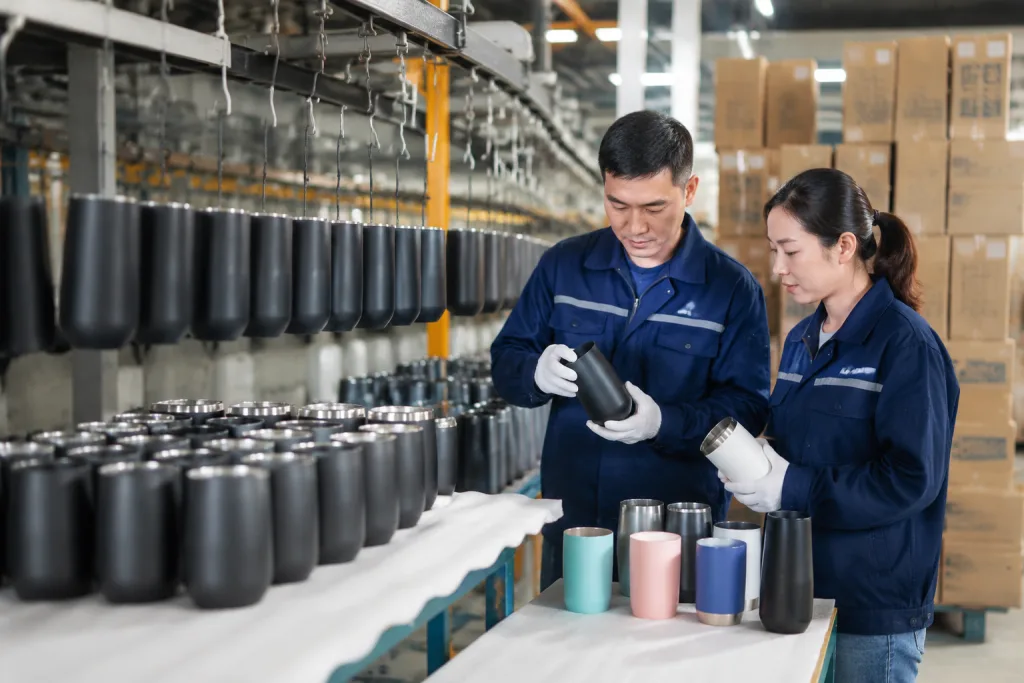
Key Takeaways
- Start with 3 core specs: capacity, insulation target, and decoration method before asking for prices
- A realistic custom wine tumbler MOQ is usually 500-1,000 pieces per color for factory-direct orders
- Use AQL 2.5/4.0 inspection and require lead time confirmation in writing before paying a deposit
- Supplier lists should separate factories, trading companies, and distributors because their pricing and control are different
A wine tumbler looks simple until you buy 5,000 pieces and QC pulls the sample because the lid fit is off by 0.6 mm. Then every small choice hits cost and lead time: 304 or 316 stainless steel, powder coating or spray paint, laser logo or full-wrap print, 500 pieces or 5,000 pieces, FOB Ningbo or delivered to your 3PL. A weak wine tumbler supplier list can cost more than a bad unit price.
If you are building a custom drinkware range for retail, gifting, hospitality, or distributor drinkware programs, asking for “best price” first is the wrong question to ask. We manufacture in Zhejiang, China, and we’ve seen this go sideways: one buyer sent 12 RFQs with no artwork size, no AQL 2.5 requirement, no carton drop test, and a PO typo listing 10 oz instead of 12 oz. Define the product, inspection standard, packaging, and reorder plan before you collect quotations.
Define the tumbler before the supplier
The first decision is not which name goes on your wine tumbler supplier list. It is the exact cup you are buying. A 12 oz stemless wine tumbler with vacuum insulation, PP sliding lid, 304 stainless steel inner wall, powder coating, and laser engraving runs through a different line setup than a single-wall party cup with one-color silkscreen printing. Different tooling. Different rejects. On our line, the vacuum model needs leak testing and a coating thickness check; the party cup usually goes straight to print registration and carton packing.
For B2B orders, a workable starting spec is 10-14 oz capacity, double-wall vacuum insulation, 304 stainless steel inner and outer shell, 0.4-0.5 mm wall thickness, BPA-free lid, and 6-12 hours cold retention. If your end customer is in the EU, ask about LFGB or EU food-contact testing. For the US, FDA food-contact compliance is usually expected, and some retail channels ask for CA Prop 65 statements. REACH matters when you sell into Europe with coated surfaces, silicone gaskets, or printed packaging. QC pulled one sample last month where the lid passed fit but the silicone ring had the wrong hardness, 45 Shore A instead of the buyer’s 55 Shore A spec.
Do not copy a retail sample and send blurry photos to ten canteen suppliers or wine tumbler vendors. You will get ten quotations because each factory will guess the lid, coating, carton structure, and logo process in its own way. The math does not work. A better RFQ states capacity, stainless steel grade, coating finish, lid style, logo size with placement in mm, packaging, target MOQ, destination port, and required certifications. We once saw a PO typo list “matte black” in the item line and “gloss black” in the artwork file; the buyer flagged it only after the pre-production sample was sprayed.
There is a portfolio question too. If you need wine tumblers plus a custom canteen, custom growler, or sports bottle in the same shipment, choose a canteen manufacturer that can coordinate multiple molds and shared packaging standards. That cuts handoff risk between drawings, color chips, inserts, and master cartons. Our Zhejiang factory handles about 480,000 stainless steel drinkware units per month across tumblers, bottles, canteen customized programs, and growler orders. We still prefer buyers to lock the product brief before price negotiation, because we have seen this go sideways when price is agreed first and the lid drawing changes 6 days before sample approval.
Sort suppliers by business model
Your second decision is who gets onto the list. A useful wine tumbler supplier list is not a dump of 80 company names from Alibaba. Sort each supplier by business model: direct canteen factory, stainless tumbler factory with its own vacuum line, export trading company, promotional canteen vendor, or regional distributor holding local stock. Same product name, different risk. We usually check the business license, workshop photos, and one packing video before we even ask for a PI.
A factory is strongest when you need custom drinkware, repeat orders, private label packaging, and control over 304 stainless, coating, lids, and cartons. Ask direct questions about laser welding, vacuum testing, powder coating line capacity, AQL inspection, and lead time. Good sales will answer in numbers: inner wall thickness 0.4 mm, outer wall 0.5 mm, 6-hour heat test record, 24-hour vacuum leak hold, 12 cartons pulled for pre-shipment inspection. The catch is MOQ. For a new wine tumbler color, expect 500-1,000 pieces per color. For fully custom molded lids or unique shapes, tooling may start around USD 800-3,000, depending on complexity. If a buyer wants 120 pieces in four Pantone colors with logo box, the math does not work.
A trading company can move faster when you need mixed categories, such as wine tumblers from one line, glass bottles from another plant, and accessory kits packed into one shipment. Pricing can be 5-15% higher, but that fee makes sense if you do not have sourcing staff in China and need someone to chase samples, cartons, and export documents. We have seen this go sideways when the PO says “matte black” but the trader’s factory runs glossy black because nobody checked the approved sample. A canteen distributor in Europe or North America works for urgent small orders. You pay for inventory and domestic handling. A landed price 25-60% above FOB China is normal if you need 100 pieces next week, not 3,000 pieces in 45 days.
Be careful with the words canteen supplier, canteen suppliers, canteen vendor, and canteen vendors on marketplace pages. Some are real canteen manufacturers; some only resell stock and borrow factory photos. Ask for factory audit documents such as BSCI, ISO 9001, or social compliance reports if your customer requires them. Then ask one boring production question: how many cups per tray enter the coating oven, and what temperature do they run? If a seller cannot explain the production line, coating process, or packing method, put them in the reseller column, not the manufacturer column. QC pulled the sample for a reason.
Choose decoration with real constraints
Decoration is where 3 out of 10 custom drinkware orders get late or pick up extra cost. Wine tumblers ship into hotel welcome sets, wedding gifts, beverage brand promos, retail private label runs, and corporate orders with strict brand manuals. Each buyer judges logo wear and Pantone drift differently; last month QC pulled a 12 oz powder-coated sample because the gold logo shifted by Delta E 3.1 under the light box.
Laser engraving is the safer choice for premium stainless or powder-coated tumblers. It does not peel. We run a 30 W fiber laser for logos up to about 50 x 50 mm on a curved body, and the result is clean if the artwork has enough line weight. The catch is color: laser exposes the base metal or leaves a tonal mark, not a full-color logo. Silkscreen printing is cheaper for one or two colors on smooth coated surfaces. A typical setup cost may be USD 40-80 per color, and MOQ is usually 500 pieces. Heat transfer or water transfer can cover the full body, but the line needs cleaner vector files, 1-2 extra sampling rounds, and tighter control at the seam.
If you are building a canteen customizable program, do not assume the same decoration works across every shape. A wine tumbler has a broad curved wall, so a 45 mm logo can sit well without distortion. A customized canteen may have flatter panels, strap hardware, or a narrow print zone; we once had a buyer flag a logo because the strap rivet cut 18 mm into the planned print area. A customizable growler may require larger artwork, thicker coating, and stronger carton protection because the unit weight is higher. One decoration standard across tumblers, canteens, and growlers sounds efficient, but the math does not work if the print area and coating system are not matched.
Ask for a pre-production sample before mass production. A digital mockup is not enough. For distributor canteen or distributor growler programs, we usually recommend one physical logo sample and one blank color sample before the full run. Sampling takes 7-12 days in Zhejiang, China, if the base model is available; that includes film output, fixture setup, oven test, and a tape test on the coated surface. If a supplier promises full custom artwork approval in two days, they are probably skipping a step.
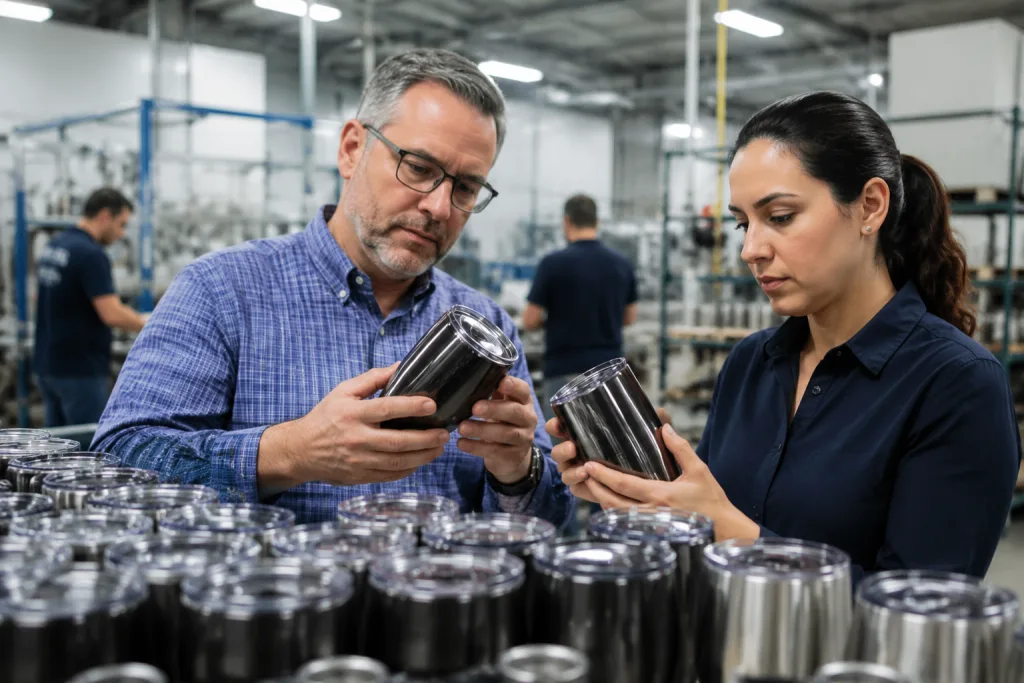
Check price beyond unit cost
The lowest unit price often carries the most expensive supply chain. When you compare a wine tumbler supplier list, build landed cost from the same trade term. We usually ask buyers to line up FOB Ningbo or FOB Shanghai first, then add sea freight, duty, customs entry, trucking, and warehouse handling. EXW against DDP? The math doesn't work. Last month one PO showed “FOB Hangzhou port,” which is a typo our merchandiser caught before the PI, because Hangzhou is not the loading port for this cargo.
For a standard 12 oz double-wall stainless steel wine tumbler, factory-direct FOB China pricing often falls around USD 2.10-4.20 depending on material weight, coating, lid, logo, packaging, and order quantity. A heavier 18/8 stainless body, rubberized finish, individual color box, and laser logo sits near the top of that range. A bulk-packed promotional tumbler runs lower. If a quote lands at USD 1.68, ask what was removed: steel thickness down from 0.50 mm to 0.38 mm, cheaper AS lid, skipped vacuum test, 5-layer carton changed to soft 3-layer, or coating with no compliance file. QC pulled one sample from the line with a loose slider lid after the drop test, and that “cheap” lid became the real cost.
MOQ changes the price fast. At 500 pieces, you pay more because setup, coating, logo alignment, and packing are spread over fewer units. At 3,000 pieces, the line runs cleaner with fewer color changes. At 10,000 pieces, you can push on raw material and packaging, but only if the factory has open production space and enough powder-coating capacity. Our normal MOQ for custom wine tumblers is 500 pieces per color, with 30-40 days mass production after sample approval and deposit. Peak season orders before Q4 should be placed 60-75 days before your required ship date. We run into this every September: a buyer asks for 5 colors, 1,000 pieces each, then flags the surcharge after we already set the spray gun changeover plan.
Payment terms matter. A common structure is 30% deposit and 70% balance before shipment after inspection. For repeat buyers with stable volume, some factories will discuss 20/80 or balance against bill of lading. Be careful with any canteen vendor asking for 100% upfront on a standard model unless it is a small sample order. On our side, finance checks the bank slip before stainless steel sheet cutting starts; one buyer once missed USD 27 in bank charges, and the job sat half a day before accounting released it.
Audit quality before problems ship
Quality control for wine tumblers is not just scratch checking. The bigger rejects we see are vacuum failure, weak powder-coat adhesion, lid leakage, solvent odor, logo shift, soft cartons, and batch-to-batch color drift. Set the standard before the line starts. Last month QC pulled 32 pcs from a 1,200 pcs matte-black run, and the buyer flagged the same issue we had warned about: Pantone color was approved on a flat chip, not on curved stainless.
For insulated wine tumblers, ask the supplier how they check vacuum performance. We run vacuum pumping first, then a hot-water temperature hold test, and failed cups are rejected before coating. Surface inspection should be written clearly: normal light, 30-40 cm viewing distance, cup rotated by hand on the inspection table. Tiny dust points and inside polishing marks need a practical tolerance; dents, sharp rims, coating bubbles, and a logo tilted 2 mm off-center should not pass.
Use AQL inspection terms in your purchase order. A lot of B2B drinkware buyers set AQL 2.5 for major defects and AQL 4.0 for minor defects, with critical defects set to 0. Critical defects include unsafe sharp edges, wrong material, strong odor, contamination, and leakage that affects use. If you sell through online retail, add packaging drop-test rules; the math does not work when a 4.20 USD tumbler gets returned because one color box corner collapsed after a 76 cm drop test.
Compliance documents must match your market. For Europe, ask for REACH and LFGB or EU food-contact reports from a recognized lab. For North America, ask for FDA food-contact documentation and any channel-specific tests. If children may use the product, ASTM or CPSIA considerations can show up, even when the item is sold as a wine tumbler, not a kids bottle. A reliable canteen manufacturer in China should have recent test reports or arrange new testing at buyer cost; we have seen this go sideways when a PO typo listed 304 stainless, but the attached old report was for a different lid material.
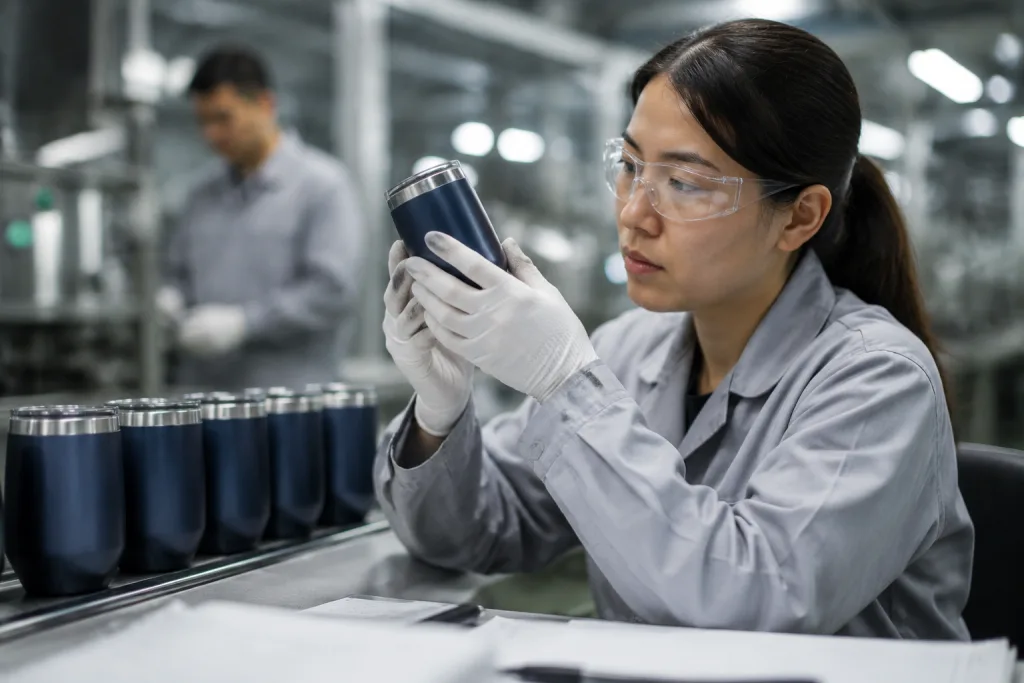
Plan logistics and reorder control
A supplier decision is not finished when the first purchase order is placed. The real test comes on order two and order three. We see this problem about 6 times a year with distributor drinkware buyers, brand owners, and canteen distributors: the first PO runs on one powder batch, the reorder runs on another, and the “same” matte black comes back a little blue under the D65 light box. QC pulled one 12 oz wine tumbler last May where gloss was 18 GU higher than the approved sample. The buyer flagged it immediately.
Keep a golden sample at the factory and one in your office. Record Pantone numbers where possible, but powder coating on stainless steel will not match ink on paper, so don’t treat the book as the final judge. For key colors, approve a sprayed metal chip or an actual tumbler body from the line. Lock packaging dielines, barcode placement, FNSKU labels for Amazon-style fulfillment, carton marks, and master carton dimensions in the same file pack; we once saw a PO typo change 48 pcs/carton to 40 pcs/carton, and nobody liked that call. A 2 cm carton change can affect pallet efficiency and freight cost.
For sea freight, wine tumblers are light by volume, so CBM beats weight in the freight math. Individual color boxes protect the product and look better on a shelf, but they raise carton volume; bulk packing cuts cost for promotional jobs, but it can fail for retail or gifting. If you are combining wine tumblers with canteen custom projects, a customized growler, or a customizable canteen line, ask the supplier to calculate container loading before artwork approval. We run the loading sheet in Excel with carton L x W x H in mm, and a 40HQ plan should not be guessed from photos. Mixed cartons can reduce empty space, but receiving gets messy when carton labels only say “drinkware” instead of SKU, color, and lid type.
Reorder control also includes spare parts. Lids cause the most after-sales noise: lost sliders, cracked AS plastic, missing silicone rings. If you are a canteen distributor or promotional agency, order 1-2% extra lids and 0.5-1% extra units when the program has strict event deadlines. The math doesn’t work if you save USD 35 on spare lids and then pay air freight from Zhejiang 18 days before an event. Put the spare parts on the first production run, label them clearly, and have QC count them before carton sealing.
Build your final shortlist
After you define specs, supplier type, decoration, landed cost, quality standards, and logistics, your wine tumbler supplier list should shrink from 15 names to 3 or 4 workable factories. Three serious suppliers are better than twenty vague contacts. The math does not work if your team spends two weeks chasing contacts who cannot confirm lid diameter in mm or carton weight in kg. Use a simple scoring sheet with weighted criteria: 25% product fit based on capacity, shape, lid, and finish; 20% quality system with AQL 2.5 records or real inspection photos; 20% price and terms including tooling, sample charge, and payment split; 15% communication speed measured by same-day technical replies; 10% compliance readiness with current FDA or LFGB files; and 10% reorder capability based on mold ownership, spare lid stock, and line capacity.
Send the same RFQ pack to each supplier. No shortcuts. Include product photos or drawings, target capacity, stainless grade, logo file, packaging request, order quantity, destination, inspection requirement, and delivery date. Ask them to quote FOB, sample cost, sample lead time, mass production lead time, carton details, and available test reports. We usually attach a 1-page spec sheet with mouth diameter, body height, wall thickness, powder coating Pantone, and master carton limit, because one PO typo like “matte black” versus “gloss black” can stop the line for 3 days. If you need a broader range, say it in the first email: wine tumbler plus canteen customized models, customized growler options, and other customizable drinkware for the same retail program.
Read the reply like a buyer, not like a price hunter. A good supplier will ask uncomfortable questions: exact lid style, coating finish, whether the logo can be laser engraved, whether your packaging needs drop testing, and whether the deadline means ex-factory date or arrival at your warehouse. That is a good sign. Last month QC pulled the sample because the slider lid gap was 0.8 mm wider than the approved sample, and the buyer flagged leakage after a 45-degree tilt test. A weak supplier says “yes, no problem” to everything and sends a one-line price with no carton size, no sample timing, and no test file date.
If you are new to sourcing from China, start with one controlled order rather than ten SKUs. A 1,000-piece wine tumbler order with one color and one logo teaches you more than a complicated launch with six colors, three lids, a custom canteen, and a distributor growler in the same first shipment. We have seen this go sideways: too many variants, mixed lids at packing, and a buyer asking why 18 cartons had the wrong barcode sticker. Once the factory proves communication, inspection results, and on-time shipping, expand the program.
Send us your wine tumbler RFQ today
BottleForge will review specs, MOQ, logo method, packaging, and FOB pricing so you can compare suppliers with cleaner numbers.
Frequently asked questions
What should I include when asking for wine tumbler quotations?
Send one clear RFQ to every supplier. Include capacity, usually 10 oz, 12 oz, or 14 oz; stainless steel grade such as 304; double-wall or single-wall structure; lid type; coating finish; logo method; quantity per color; packaging; destination port; and required compliance documents. Also state your inspection standard, for example AQL 2.5 for major defects and AQL 4.0 for minor defects. If you also need a custom canteen, custom growler, or other customized drinkware, separate those lines in the RFQ so pricing does not get mixed. Ask for FOB China pricing, sample lead time, mass production lead time, carton size, gross weight, and available test reports.
Is it better to buy from a factory or a distributor?
For 500-10,000 pieces of customized drinkware, a direct factory is usually better because you get more control over material, logo, packaging, inspection, and reorder consistency. A canteen factory or stainless drinkware manufacturer can also help if you plan to expand into canteen customizable or customizable growler products later. A distributor is better for urgent small orders, local delivery, or low quantities under 200 pieces. The trade-off is cost. Domestic distributor pricing can be 25-60% higher than FOB China, but you avoid long production and ocean freight timing. Many serious buyers use distributors for testing and switch to factory-direct once demand is proven.
What MOQ should I expect for custom wine tumblers?
For a standard factory model with your logo, expect 500 pieces per color as a realistic starting MOQ. Some suppliers may accept 300 pieces if the tumbler is in stock and the logo is simple, but the unit price will be higher. For powder coating, special colors, or retail color boxes, 1,000 pieces per color is more common. For custom lid tooling or a unique body shape, MOQ can move to 3,000-5,000 pieces, plus tooling charges of about USD 800-3,000. If you need several SKUs, start with fewer colors and higher depth per SKU. It makes production cleaner and inspection easier.
How long does a custom wine tumbler order take?
For an existing mold, allow 7-12 days for logo or color sampling, then 30-40 days for mass production after deposit and sample approval. Add ocean freight time based on destination: roughly 25-35 days to many European ports and 18-30 days to North American west coast routes, longer for inland delivery. Air freight is possible for urgent promotional orders, but it can cost more than the tumbler on low-value items. If your launch is tied to Q4, trade shows, or beverage season, place the purchase order 60-75 days before your required warehouse arrival date.
Which tests and documents should I request?
For Europe, request LFGB or EU food-contact testing, REACH information for coatings and accessories, and packaging compliance if required by your importer. For the US, ask for FDA food-contact documentation and CA Prop 65 statements where relevant. If the product might be used by children, check CPSIA or ASTM requirements even if it is not a kids product. For factory reliability, BSCI and ISO 9001 are useful but do not replace product testing. Also request an inspection checklist covering vacuum performance, leakage, odor, coating adhesion, logo position, carton strength, and AQL levels. Documents should match the actual model and materials, not only a similar old product.