Key Takeaways
- A serious wine tumbler quote should specify 304 stainless steel, wall thickness, packing, Incoterm, lead time, and AQL level
- For most custom wine tumblers, 1,000-3,000 pieces per color is a realistic China factory MOQ
- Powder coating usually adds 3-6 days versus plain stainless steel, and logo methods change cost by USD 0.08-0.45 per unit
- Supplier directory listings are only a starting point; you still need audit files, samples, capacity proof, and pre-shipment inspection
A wine tumbler supplier directory looks useful until 30 listings read like they came from the same sales template: food-grade stainless steel, fast delivery, OEM logo, competitive price. For a procurement manager, that is the wrong question to ask. Ask who is a trading company, who owns the polishing line, who checks vacuum loss with a water-bath tester, who can hold powder-coat ΔE under 1.0, and who still replies after the 30% deposit lands.
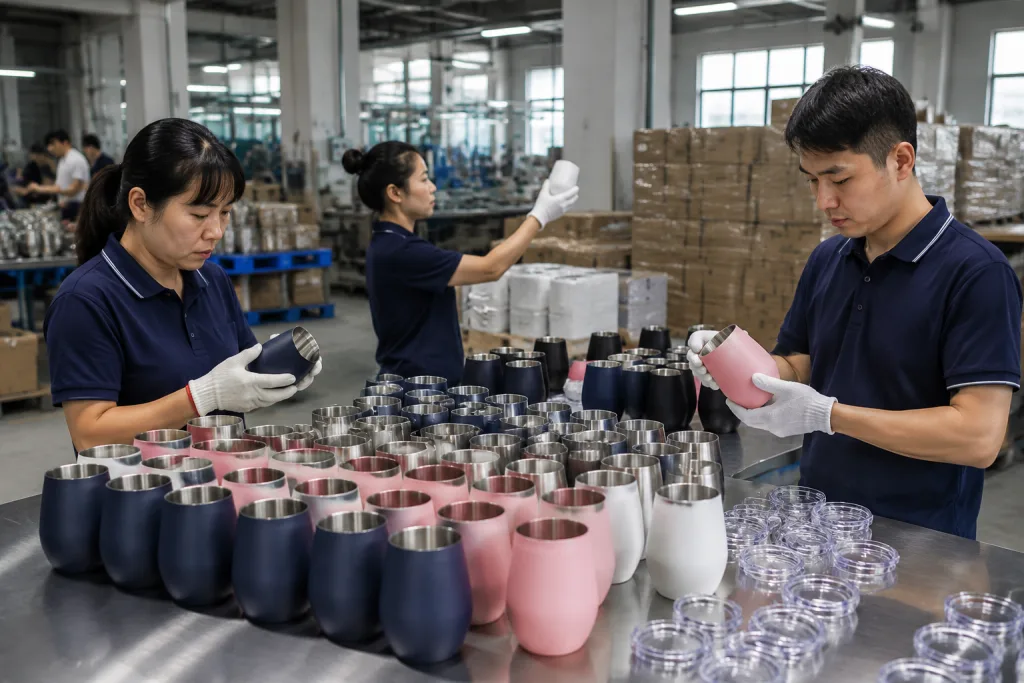
At BottleForge Industrial in Hangzhou, Zhejiang, we sell custom drinkware from China to distributors, retailers, and brand owners in Europe and North America. Our monthly output is about 450,000 stainless steel units, with wine tumbler MOQ starting at 1,000 pieces per color for standard shapes. We run 304 stainless shells through in-house forming, polishing, coating, and final packing; last month QC pulled 42 samples from a matte black 12oz batch because the buyer flagged rim thickness at 0.62 mm instead of the approved 0.70 mm. Use this guide as a buyer-side checklist, not a brochure.
What should a directory prove?
Buyer question: “If I use a wine tumbler supplier directory, what information should I trust?”
Trust what you can check with a PO, an audit file, or a video call from the line. A useful listing should show factory location, export markets, product range, certifications, average lead time, MOQ, and one named contact who can answer B2B production questions without forwarding every detail to “the manager.” If the page only shows lifestyle photos and “best quality,” that is marketing copy, not sourcing proof. We had one buyer flag a directory page last year because the “factory address” was a Hangzhou showroom, while the welding line was 180 km away in Yongkang.
For wine tumblers, the supplier profile should say whether they are a canteen factory, canteen manufacturer, or trading office. Around 7 out of 10 China listings we see bundle wine tumblers, custom canteen products, custom growler programs, sports bottles, and travel tumblers into one catalog. That part is normal. The better question is who controls the hard steps: stainless steel forming, welding, vacuum insulation, polishing, coating, printing, and packing. If QC pulled the sample and the laser weld seam is uneven by 0.4 mm, a trading office can only push the real factory; they cannot fix the line.
A practical directory entry should answer these points before you even request a quote:
- Factory type: manufacturer, vendor, exporter, or mixed trading operation, with the real production address shown on the business license.
- Main materials: 304 stainless steel inner wall, 201 or 304 outer wall, PP lid, silicone gasket, plus material thickness if the buyer asks for a 0.5 mm body.
- MOQ: for example, 1,000 pieces per color for existing wine tumbler molds, 3,000-5,000 pieces for a new color or lid combination.
- Lead time: usually 25-35 days after artwork approval and deposit for standard custom drinkware; coating rework can turn 28 days into 34 days fast.
- Compliance: LFGB, FDA, REACH, Prop 65, and food-contact test reports when needed, matched to the exact lid and coating used on the order.
- Audit status: BSCI, ISO 9001, Sedex, or customer audit records if available, not just a cropped certificate screenshot.
Be careful with directories that rank suppliers without showing verification criteria. A top slot can be paid advertising. We have seen this go sideways on retail chain orders when a buyer trusted the ranking, skipped the pre-production sample, and found 23 cartons with barcode label errors during final inspection under AQL 2.5. For promotional campaigns and distributor drinkware programs, missed delivery dates do not just annoy the buyer; they create chargebacks, air-freight bills, and uncomfortable 11 p.m. calls.
Specs that change your quote
Buyer question: “Why do two suppliers quote different prices for the same 12 oz wine tumbler?”
Most times, they quoted two different cups. We see a 12 oz wine tumbler move by USD 0.30-1.20 per unit once the drawing calls out steel grade, net weight, coating, lid design, logo method, packaging, inspection level. One buyer sent a PO with “12oz win tumbler” typed in the item line and no gram weight; the math doesn’t work when three factories fill in the blanks their own way.
Start with the body. A standard double-wall vacuum wine tumbler uses 0.4-0.5 mm stainless steel sheets before forming, and our line checks sheet thickness with a Mitutoyo caliper before deep drawing. Inner wall 304 stainless steel is the normal food-contact spec. Outer wall 201 stainless steel costs less and fits some promotional runs, while 304 outer wall makes more sense for premium retail and coastal markets where rust complaints show up faster. The price gap can be around USD 0.15-0.35 per unit depending on market steel costs.
The finish changes both cost and schedule. Plain stainless steel runs fastest; we can usually keep it closer to 12 days, while powder coating often pushes the job to 15-18 days because the cups need washing, spraying, curing, and cooling before packing. Powder coating gives better grip and color range. Gloss spray paint looks bright, but we’ve seen this go sideways when a weak inner carton lets cups rub during a 28 kg master carton drop. For customized drinkware, ask for coating thickness and adhesion testing. A cross-hatch test to ASTM D3359 is a fair request, especially for dark matte colors.
Logo choice also changes the job. One-color silk screen may add about USD 0.08-0.15 per unit, and QC pulled the sample more than once because a 45 mm logo sat 3 mm off center after the jig loosened. Laser engraving is clean and durable, often USD 0.12-0.25 depending on logo size. Full-wrap heat transfer or water transfer can reach USD 0.35-0.80 per unit and needs more reject allowance because wrinkles near the bottom radius are common. If you are buying canteen promotional items, the cheapest logo is the wrong question to ask; rework and late shipment cost more.
Packaging should be written into the quote. Bulk polybag packing, white box, color box, kraft box, insert card, barcode label, FNSKU label all change labor time and carton cube; one FNSKU sticker can add 6-9 seconds per unit when the packing table scans every code. A canteen vendor may quote FOB Ningbo with simple white boxes, while another canteen supplier quotes FOB Shanghai with retail color boxes. Those are different landed costs, and the buyer flagged it only after the carton measurement jumped from 52 cm to 61 cm on the shipping mark.
How to screen factory claims
Buyer question: “How do I know if a canteen supplier or wine tumbler vendor is real?”
Ask for boring proof with dates on it. A real factory should send a business license, export license, audit summary, machine photos, a 30-second line video, test reports, and 2 recent shipment references with buyer names masked. Last month QC pulled a wine tumbler sample from our packing table and checked the laser-marked capacity line at 355 ml; that kind of detail is hard for a trading desk to fake. A weak supplier dodges the address question or sends the same shiny showroom photo 6 times.
For a wine tumbler supplier directory shortlist, send the same screening form to 5-8 suppliers. Do not start with a 15-SKU RFQ. That is the wrong question to ask on day one. Start with one standard 12 oz or 14 oz wine tumbler and lock the same specs: 304 stainless inner wall, powder coat color, lid type, logo size in mm, carton pack, and target MOQ. We run this check often; the price gap matters, but the reply quality tells you who will still answer after the PO has a typo in the pantone code.
Your screening checklist should include:
- Factory address in Zhejiang, Guangdong, or another known drinkware manufacturing area in China, with a street name that matches the business license.
- Monthly capacity by category, not just total capacity. “450,000 bottles per month” is more useful than “large capacity,” but ask how many are wine tumblers on the actual line.
- Number of vacuum testing machines and leak testing stations, including whether they use a vacuum chamber gauge or only a water-fill bench test.
- In-house or outsourced powder coating and printing, plus the curing oven length in meters if they claim coating is in-house.
- Standard AQL level, usually AQL 2.5 for major defects and 4.0 for minor defects, and who signs the final inspection report.
- Sample lead time, normally 5-10 days for logo samples using an existing mold, with the logo file format confirmed before artwork starts.
- Mass production lead time, normally 25-40 days depending on coating and packaging, not counting 3-5 days for carton drop-test changes.
Watch whether the supplier asks useful questions. A serious canteen manufacturer will ask about sales market, FDA or LFGB needs, logo artwork format, carton drop-test standard, and shipping method before quoting. A simple reseller often replies “yes, we can do” to everything. Sounds easy. We have seen this go sideways when the buyer flagged a 1.2 mm logo offset after 3,000 pcs were already packed.
For distributor canteen and distributor growler programs, you need continuity more than a cheap first quote. Ask how long the mold has been running and whether the lid will remain available for 12-24 months. A one-off promotional tumbler can live with small lid changes. A retail replenishment program cannot, because mixed lids create return claims fast; our packing team once found 38 mismatched sip lids in a 2,000 pcs repeat order from an outside lid supplier, and the math did not work after rework labor.

What MOQ is realistic?
Buyer question: “Can I get 300 pieces with my logo from a China factory?”
Yes, sometimes. It is not the number the line likes. For existing wine tumbler shapes, a realistic MOQ from a Zhejiang canteen factory is 1,000 pieces per color. We run 500 pieces for laser logos on in-stock blank tumblers when the warehouse has the color ready, but the unit price usually jumps USD 0.35-0.80 and the buyer gets 2-4 color choices, not a full PMS card. If you need custom PMS powder coating, plan on 1,000-3,000 pieces per color because the coating booth setup, 20 kg powder purchase, and first-pass rejects need volume. QC pulled 37 scratched cups from a 1,000-piece matte black run last month. That is normal math, not factory drama.
For a canteen customized project with a new lid, new mold, special handle, or odd capacity, MOQ usually moves to 3,000-10,000 pieces. Tooling for small plastic lid parts may start around USD 800-2,500. Stainless steel body tooling can be much higher if the shape is not close to an existing mold. A custom growler or customizable growler with a new cap system often needs 18-25 days of drawing, sampling, and leak testing before mass production even starts. We test caps on a pressure fixture and a 24-hour upside-down rack. A simple wine tumbler does not need that work.
Here is the practical split:
- 500 pieces: possible for stock color, laser engraving, simple packing, higher unit cost.
- 1,000 pieces: normal MOQ for existing mold, one custom logo, one standard color.
- 3,000 pieces: better pricing, custom color, retail box, stronger production priority.
- 5,000 pieces and above: useful for distributor drinkware, chain retail, or multi-SKU canteen distributor programs.
If your order is below MOQ, be direct. Ask whether the supplier has overrun stock, a shared coating batch, or a canteen promotional production slot you can join. Do not pretend a 300-piece test is a 30,000-piece annual program unless it is true. We hear that every week, and the math does not work. A better email says, “We need 500 pieces for market validation, then 3,000 pieces if sell-through reaches 70% in 60 days.” One buyer once sent a PO with “30000” in the quantity box, then corrected it to “300” after PI approval. The line was not amused. Give the factory a clean commercial reason to help.
Compliance buyers should not skip
Buyer question: “Which certificates matter for wine tumblers in Europe and North America?”
For stainless steel wine tumblers, start with the sales country and the retailer’s checklist, not with whatever PDF the supplier has on hand. For the EU, buyers usually ask for LFGB food-contact testing, REACH screening for restricted substances, and migration testing under EU food-contact rules when plastic lids or coatings touch the drinking area. For the United States, FDA food-contact conformity is the normal baseline, and California-bound orders need a Prop 65 review before artwork approval. Children’s items are different: ASTM and CPSIA requirements may apply, but 95% of wine tumbler POs we run are adult drinkware. On our line, QC pulled a 12 oz stemless sample last month because the silicone gasket was listed as “PP” on the test request form. Small typo. Big delay.
Do not accept a certificate just because the file has a lab logo. Check product description, material, model number, test date, applicant name, and whether the report covers the exact coating, lid, gasket, and printing ink. A report for a plain 304 stainless tumbler does not cover a matte black powder-coated tumbler with a 1-color printed logo and a sliding AS lid. We see this go sideways on customized canteen and customized growler projects when the buyer changes from silver body to powder coating after deposit, then assumes the old report still works. The math does not work. Our lab form has 18 fields, and if the model number on the report says WT-350 but the PO says WT-350B, the buyer’s compliance team will flag it.
For B2B orders, write compliance into the purchase order. A clean clause can say: “Supplier must provide food-contact test reports for stainless steel body, lid, silicone gasket, coating, and ink before shipment.” If your retailer requires SGS, Intertek, TÜV, or Bureau Veritas, say it before deposit, because changing labs after the line starts can turn a 30-day order into 42 days. Testing after mass production can delay shipment by 7-14 days, and if something fails, you have a real problem. We had one PO where “LFGB lid” was typed as “LFGD lid”; the factory merchandiser missed it, and the buyer pushed back during pre-shipment document review.
Factory audits are a separate issue. BSCI, Sedex, ISO 9001, and customer audits do not prove food safety; they show management discipline, document control, worker records, and how the factory handles corrective actions. If you are buying from canteen vendors for a European distributor, BSCI may be required before the retailer will onboard the supplier. For Amazon FBA-style projects, compliance still matters, but the warehouse will also reject bad carton labels, weak 5-ply cartons, poor barcode scan rate, or FNSKU labels placed 8 mm too close to the carton edge. We ship these orders every month, and the boring label check at packing is what saves the chargeback.
Cheap testing is the wrong target. Correct testing before production is what protects the order.

Sampling and inspection checklist
Buyer question: “What should I check before approving mass production?”
Sample approval is where we stop about 80% of later arguments. Check the real tumbler in hand, not only a 3D mockup. We put the sample on a 0.1 g scale, measure brim and drinking capacity with a graduated cylinder, run a finger around the rim, then open and close the lid 20 times. Simple work. Check gasket smell, coating drag, logo height from the base, logo width in mm, and carton packing. Fill the tumbler to the level a customer will actually drink from and confirm the stated capacity. Some factories quote brim-full capacity; retail buyers usually push back when a “12 oz” cup only drinks like 10.5 oz.
For vacuum insulated tumblers, ask for temperature test data from the line, not a nice PDF copied from another SKU. A wine tumbler does not need to act like a 1 L thermos, but the vacuum still has to be stable from piece to piece. We run hot water at 95°C, close the lid, and record the drop after 2-3 hours with a probe thermometer. For cold use, QC pulled the sample if water beads on the outer wall after 30 minutes at room temperature. That usually means weak vacuum sealing or a bad weld near the bottom disc.
Before production starts, lock these items in writing:
- Approved sample photos with front, back, lid, base, and signed sample tag.
- PMS color or agreed color range checked under D65 light in the QC room.
- Logo artwork in AI, PDF, or EPS format, with the final file name written on the PO.
- Print position tolerance, for example ±2 mm from the approved sample mark.
- Carton quantity, gross weight, and drop-test requirement, including 5-side carton photos.
- AQL inspection level and defect classification, with leakage and sharp rim listed as major defects.
Pre-shipment inspection should happen when at least 80% of goods are packed. For a 5,000-piece order, the inspector checks around 200 units depending on inspection level, then opens cartons from the top, middle, and bottom pallet layers. We have seen this go sideways when the first 30 cartons looked clean but QC found coating peel in cartons packed after lunch shift. Major defects include leakage, sharp rim, wrong logo, severe dents, poor lid fit, and coating peel. Minor defects include tiny dust points, slight color drift, or small carton scuffs within agreed limits.
If you are buying through a canteen distributor or distributor canteen program, spell out who owns inspection. This is the wrong question to ask after the goods reach the warehouse. Some buyers assume the distributor checks every carton; some distributors assume the canteen manufacturer already did it. We once saw a PO with “inspetion by seller” typed wrong, and both sides argued for 12 days before release. Put the inspection duty, timing, cost, and rework rule in the order contract, not in a WeChat message nobody can find three months later.
Questions to send shortlisted suppliers
Buyer question: “What should I actually ask after finding suppliers?”
Send a short RFQ with no guessing. Good suppliers answer faster when the buying intent is clear; vague “send catalog” emails usually sit in the sales inbox. If you are using a wine tumbler supplier directory, pick 5 suppliers and send the same questions to each by Tuesday, then compare price, reply time, spec accuracy, and whether they push back on weak assumptions. We have seen buyers ask for matte white powder coating with loose bulk packing, and QC pulled the sample after 30 minutes on the abrasion tester because the cups rubbed each other in transit. A capable canteen manufacturer should flag that before you pay the deposit.
Use this message structure. Keep it tight.
- Product: 12 oz double-wall vacuum wine tumbler, 304 inner wall, powder coating, PP lid.
- Quantity: 1,000 / 3,000 / 5,000 pieces, one color, one logo.
- Logo: laser engraving or one-color silk screen; ask for both prices and state logo size in mm.
- Packing: individual kraft box, 24 pieces per export carton, Amazon label optional.
- Market: EU, US, Canada, or mixed; list required compliance.
- Trade term: FOB Ningbo or FOB Shanghai, quote in USD.
- Timeline: sample date, production date, inspection date, vessel closing date.
Ask one more question: “Which process is outsourced?” This is not a trap. About 7 out of 10 canteen suppliers we audit outsource at least one step, usually coating, printing, or gift-box packing. Outsourcing is not the problem; blind outsourcing is. Ask who checks the outsourced work, what AQL level they use, and whether the quoted lead time is 28 days including coating queue or 28 days after coating is done. We have seen this go sideways when a PO said “Pantone 186C” but the coating shop received “186U” on a handwritten work ticket.
For broader customizable drinkware programs, mention related items early: custom canteen, canteen customizable bottle, customizable canteen, customized canteen, custom growler, customized growler, or distributor growler range. A factory that can run a family of products can cut supplier follow-up from 6 email threads to 2. Still, do not overload the first order. Start with the wine tumbler, prove the process, then expand the line after the first carton drop test and lid-fit check pass. The wrong question is “Can you make everything?” Ask whether the same line, mold room, and QC team will handle the next SKU.
At BottleForge Industrial in Hangzhou, Zhejiang, we usually recommend a paid pre-production sample before any new retail or promotional order above 1,000 units. It costs less than a bad container. Our sample room checks rim diameter with a digital caliper, confirms logo position within 1.5 mm, and sends photos before we release the line. That is not drama. It is responsible sourcing from China.
Send your wine tumbler RFQ for factory review
Share quantity, logo method, target market, and delivery date. We will reply with practical MOQ, lead time, and FOB China pricing.
Frequently asked questions
What price should I expect for a custom stainless steel wine tumbler?
For a standard 12 oz double-wall stainless steel wine tumbler from China, FOB pricing often sits around USD 2.20-4.20 per unit at 1,000-5,000 pieces. The low end usually means simple stainless finish, basic lid, bulk or white box packing, and one small logo. Powder coating, 304 outer wall, retail color box, barcode labeling, or laser engraving can each add cost. Always compare quotes using the same Incoterm, same packing, same steel grade, and same inspection requirement.
Is a trading company always worse than a canteen factory?
No. A good trading company can be useful if you are buying mixed custom drinkware across wine tumblers, custom canteen bottles, and custom growler items. The risk is when a trader pretends to be the factory and cannot control production details. Ask for the production address, audit documents, sample source, and who handles AQL inspection. If they are transparent and technically competent, they may be fine. If every answer is vague, move on.
How long does a custom wine tumbler order take?
For an existing mold, plan 5-10 days for logo sample and 25-40 days for mass production after sample approval and deposit. Powder coating, retail packaging, and third-party testing can add 7-14 days if not arranged early. Sea freight to Europe or North America may add 25-45 days depending on port and season. If you need goods for a fixed event date, work backward from delivery, not factory completion.
Can one supplier handle wine tumblers and canteen promotional products?
Often yes, especially in Zhejiang and other China drinkware clusters where factories run multiple stainless steel categories. A canteen manufacturer may produce wine tumblers, sports bottles, travel mugs, and canteen promotional items using similar forming, polishing, coating, and logo processes. Still, check each product separately. A factory strong in simple bottles may not be strong in leakproof lids or premium retail packaging. Ask for recent production photos and test reports by category.
What should I put in my purchase order to avoid disputes?
Your PO should include item number, capacity, material grade, wall construction, color, logo method, packaging, carton size, compliance reports, approved sample reference, AQL level, Incoterm, payment terms, lead time, and inspection rules. For example, state “AQL 2.5 major / 4.0 minor, inspection before balance payment.” Include penalties or remedies for wrong logo, failed leak test, or late shipment if your business needs them. A clear PO is stronger than a long email chain.