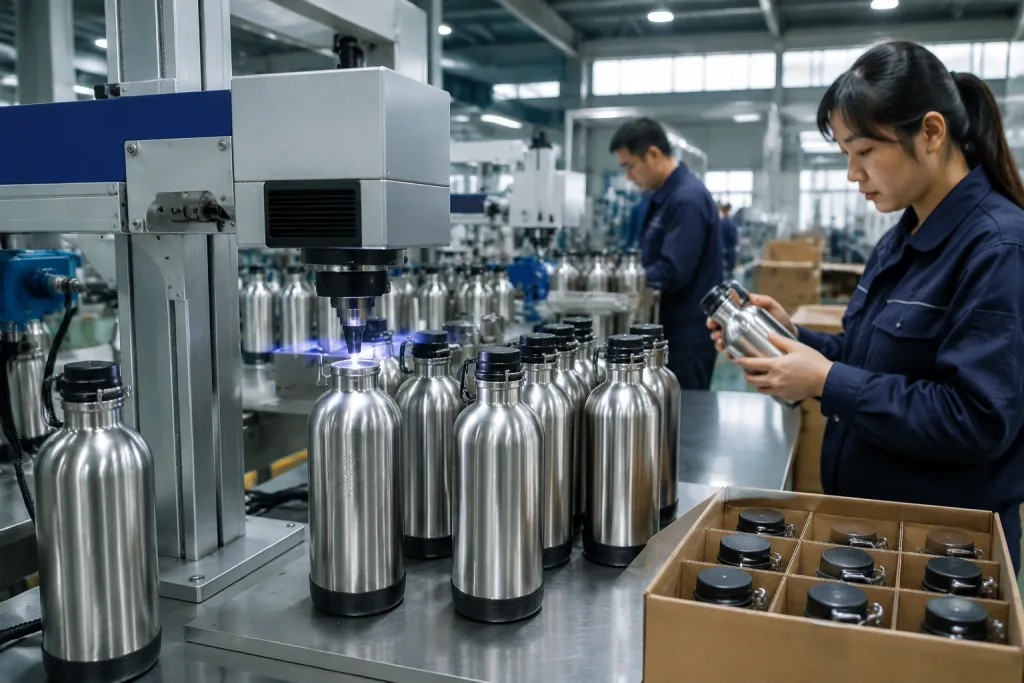
Key Takeaways
- A 64 oz stainless custom growler usually needs 0.6-0.8 mm body thickness for a solid B2B retail feel
- Typical MOQ for a custom logo growler is 500-1,000 pcs per color, depending on finish and packaging
- Laser engraving is durable but less visible on dark powder coating than one-color screen printing
- Plan 25-35 days production after artwork approval for standard China export orders
A with custom logo growler looks simple until the quote lands on your desk. Then the real questions start: 64 oz or 32 oz, powder coat or bare 304 stainless, laser logo or 1-color screen print, retail box or 24 pcs bulk carton, FOB Ningbo or delivered duty paid? On our line, even a 0.2 mm change in body thickness can move the price and dent rate. Each choice changes unit cost, failure risk, and how your customer judges the product.
If you buy custom drinkware for a retail brand, brewery, outdoor label, or distributor drinkware program, treat the growler like an engineered container, not a cheap giveaway. This is the wrong question to ask first: “What is your lowest price?” Our Hangzhou, Zhejiang team has seen this go sideways more than 30 times in quote reviews: the buyer approves the cheapest lid, QC pulls the sample, then we find seepage after a 45-minute upside-down leak test, coating marks after the tape test, or a 5-ply export carton that crushes before it clears China handling.
Start With The Use Case
The first decision is not the logo. It is where the growler will be used and sold. We see this on RFQs every week: a brewery merch program and a distributor stock line look similar in a photo, but the spec sheet is not the same. Last month QC pulled a 64 oz sample from the line because the buyer wanted retail shelf finish, while the PO only said “custom logo growler” with no box type or scratch standard.
For beer, kombucha, cold brew, or refill stations, buyers usually ask for 32 oz or 64 oz stainless steel. The product needs a seal that passes a 24-hour inverted leak check and enough body rigidity to avoid dent complaints after courier handling. For camping and outdoor channels, we run more handle caps, wide-mouth designs around 55 mm, powder coating, and 5-layer export cartons because single-wall cartons fail too often. For a canteen distributor selling to schools or public-sector buyers, decoration is usually quieter, but FDA or LFGB files and batch photos matter more than a shiny mockup.
Use this simple split before requesting pricing:
- Retail shelf: better finish with scratch limits under AQL 2.5, individual color box, barcode label, and tighter packing inspection.
- Promotional campaign: controlled budget, 18-day production target after artwork approval, one-color logo, bulk pack or simple white box.
- Distributor stock: repeatable colors across 2 or 3 replenishment runs, neutral cartons, stable MOQ, and logo options that do not slow the line.
- Hospitality or brewery: seal performance, cleaning access, logo durability after 50 hand-wash cycles, and caps packed so staff do not lose parts.
A canteen supplier or canteen vendor may quote a cheaper bottle-style container and call it a growler. Be careful. This is the wrong question to ask if the buyer only says “can you make it cheaper?” A true custom growler normally has larger capacity, a tighter lid system, and a body shape built for carry and refill use. If you need customized drinkware for a premium channel, specify capacity, mouth diameter, cap type, and test requirements before asking for the final FOB price; we once had a PO typo showing 45 mm mouth diameter, and the buyer flagged it only after the pre-production sample was already welded.
Choose Material Before Decoration
Most B2B growler orders we ship are stainless steel, and there is a reason: it survives warehouse handling and still looks like a gift item. For a with custom logo growler, the usual build is single-wall 304 stainless steel or double-wall vacuum insulated stainless steel. Single-wall saves about 18-25% on unit cost and drops weight by around 120 g on a 64 oz body, but it sweats with cold beer and will not hold temperature. Vacuum insulated costs more. The line also needs a 24-hour vacuum check, and QC pulled 3 pcs last month after the base showed weak suction.
A workable spec for a 64 oz customized growler is 304 stainless steel inside, 201 or 304 stainless outside depending on target price, and 0.6-0.8 mm wall thickness before forming. For premium programs, we run 304 inside and outside; the math fits better when the buyer is selling at USD 29.99 or above. For price-sensitive canteen customized projects, 304 inner plus 201 outer can work if the salt spray result, coating adhesion, and rim polishing are locked before mass production. We check the mouth with a 0.02 mm feeler gauge because a sharp lip gets complaints fast.
Plastic growlers and aluminum options exist, but they are not plug-in replacements for stainless. Tritan works for a transparent custom canteen or customizable canteen program when the user needs to see the fill level, and our usual MOQ starts at 3,000 pcs because the mold setup is the cost driver. Aluminum is light, but it needs an internal lining for acidic drinks, so lining quality becomes the risk, not the metal. Glass looks clean for some beverage brands, but we have seen this go sideways when a buyer asked for a 5-ply export carton after the drop test had already failed at 76 cm.
For Europe and North America, ask your canteen manufacturer for food-contact paperwork before you approve the logo file. Depending on destination, that means FDA/LFGB-grade material declarations, EU 1935/2004 support, REACH screening for coatings, or BPA-free statements for plastic parts. Documentation is not decoration. We once had a PO typo list “LFGB coating” instead of “LFGB silicone gasket,” and the buyer flagged it during pre-shipment document review, 6 days before vessel closing.
Match Logo Method To Finish
Logo choice is where 6 out of 10 custom drinkware projects start leaking margin. The artwork can look perfect on a PDF and still look weak on a curved, powder-coated growler after the line sets the cup in the rotary jig. A customizable growler has limited printable area, radius distortion, and surface texture; on a 64 oz body we usually keep the main logo inside a 90 mm wide safe zone before the edges start to stretch.
Laser engraving is our safest long-term option for brushed stainless and most powder-coated bottles. It does not peel, and it holds 1.2 mm small text better than pad printing when the lens is clean and the focus gauge is set right. The trade-off is contrast. On dark matte coatings, QC pulled samples where the laser mark looked more charcoal than silver. If the brand owner expects a white logo on black coating, one-color screen printing is the better call.
Screen printing gives solid color and clean branding at moderate cost. It works for simple logos and brewery graphics, but 0.25 mm fine lines can break after the squeegee pressure is adjusted for a curved growler. Multi-color printing adds setup cost and registration risk; we have seen a 2-color badge shift 0.6 mm and the buyer flagged it at pre-production. Heat transfer can reproduce complex artwork, but ask for abrasion and dishwasher simulation testing before approving mass production. Skipping that test is the wrong question to ask if the item is going into retail.
For a 500-1,000 pc order, typical decoration choices are:
- Laser engraving: best durability, low color impact, good for premium stainless looks.
- One-color silk screen: strong visibility, economical, good for canteen promotional orders.
- UV print: wider color range, higher cost, needs careful adhesion testing with 3M tape pull after curing.
- Embossed or debossed metal badge: premium feel, but usually needs higher MOQ, tooling, and about 12 days added sample time.
Send vector artwork in AI with outlined fonts, PDF with 1:1 logo size, or EPS if your designer works from older packaging files. Send a Pantone code if printing is required; “same as picture” on a PO is how color disputes start. A serious canteen factory in China should provide a digital mockup, then a pre-production sample for approval before bulk production. We run that sample through the same fixture the mass order will use, not a loose hand-positioned print.
Read The Quote Like A Buyer
A low unit price often means someone left work out. Check the quote line by line, not just the final USD figure. From Zhejiang factories, FOB Ningbo or FOB Shanghai pricing usually covers the growler body, standard logo process, export carton, and local export handling. It often excludes retail boxes, FNSKU or EAN barcode labels, 1.2 m drop testing, third-party inspection, and trucking to an Amazon prep warehouse. We had one buyer flag a USD 0.18/pc barcode sticker charge after the PO was issued; the math looked small until it hit 6,000 pcs.
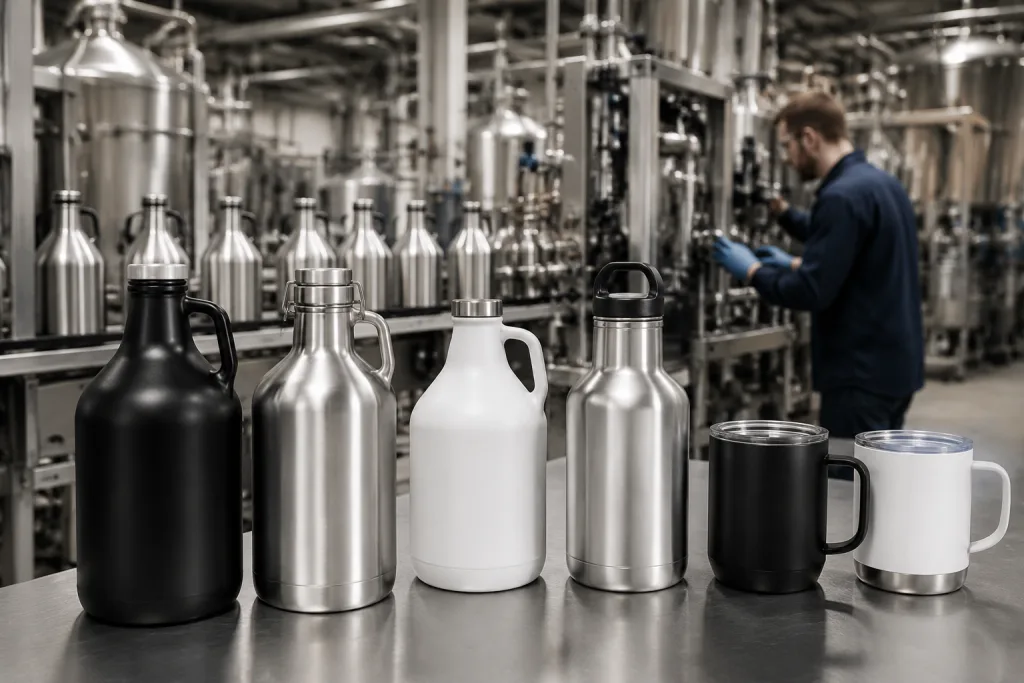
For reference, a stainless 64 oz custom growler can range roughly from USD 5.20-9.80 FOB China depending on insulation, steel grade, coating, cap design, logo method, and packaging. A single-wall item with simple laser logo sits at the lower end. A vacuum insulated customized growler with powder coating, handle lid, retail box, and color insert moves toward the higher end. QC pulled one 64 oz sample last month where the powder coat measured 68-72 μm on the Elcometer gauge, which was fine, but the buyer’s artwork had a 0.4 mm thin line that did not hold cleanly after laser marking.
MOQ also matters. At BottleForge Industrial in Hangzhou, Zhejiang, a standard custom logo growler program usually starts from 500 pcs for stock body and stock color, or 1,000 pcs per custom color. New mold shapes, special caps, or private tooling can require 3,000-5,000 pcs because forming tools, cap molds, and fixture setup must be amortized. This is where buyers sometimes ask the wrong question. “Can you do 200 pcs custom PMS color?” sounds simple, but the line still has to clean the spray booth, mix powder, set fixtures, and scrap the first 12-18 pcs during color adjustment.
Ask for the quote in a line-by-line format:
- Base product price by capacity and material, such as 304 stainless single-wall or vacuum insulated construction.
- Logo setup charge and per-unit decoration cost, with laser, screen print, or UV print stated clearly.
- Packaging cost: bulk carton, white box, color box, or gift box, including barcode label if needed.
- Carton specification and units per master carton, with carton size, gross weight, and drop-test requirement.
- Sample cost and sample lead time, including whether the pre-production sample uses real coating and final logo.
- Mass production lead time after approval, stated as calendar days from signed sample and deposit.
This makes it easier to compare a canteen vendor, canteen manufacturers, and a distributor canteen source without getting trapped by incomplete pricing. We ship enough growler orders to say this plainly: a USD 0.25/pc cheaper quote can lose money fast if it skips inspection, inner box strength, or the correct carton mark. One PO even came in with “64 oz grower” instead of “64 oz growler,” and QC caught it before the master carton artwork went to print.
Set Quality Rules Early
Set the QC rules before the first sheet of 304 stainless goes into forming, not after the buyer flags leaking caps in the destination warehouse. A growler is judged by hand feel, seal, coating, and inside cleanliness. We run a 300,000-unit drinkware month, but your PO still needs a written inspection standard; last April, QC pulled 12 samples because the approved logo height said 68 mm on the artwork and 65 mm on the PO.
For most B2B custom drinkware shipments, AQL inspection is the normal method. A practical setting is AQL 2.5 for major defects and AQL 4.0 for minor defects, with critical defects set to 0. Critical defects include sharp edges, leaking caps, wrong material, contamination, or unsafe parts. Major defects include visible dents, logo drift over the approved tolerance, coating chips, and failed leak tests. Minor defects include small cosmetic marks inside the signed limit, such as one 0.5 mm speck on the lower body. The wrong question is “will the factory check quality?” Ask who signs the inspection sheet, which caliper or torque tool is used, and what happens when 8 out of 200 cartons fail.
Useful tests for a with custom logo growler include:
- Leak test: fill, invert, shake, and hold for a set time, normally 3-5 minutes; on the line we use room-temperature water and check the cap thread before blaming the silicone gasket.
- Vacuum performance test: for insulated models, check temperature retention over 6-12 hours, with the start temperature written on the QC sheet instead of guessed from memory.
- Coating adhesion: cross-hatch or tape pull test on powder coat or paint; QC should cut the grid with the same blade spec approved in pre-production.
- Drop test: carton drop from 60-80 cm depending on carton weight and buyer requirement, then open the master carton and inspect the bottom row, not only the top layer.
- Logo position check: tolerance such as ±2 mm for standard screen or laser placement; measure from the bottom seam or handle centerline, and write that reference point into the spec.
If you are a canteen distributor or distributor drinkware buyer, keep a golden sample at your office and one at the factory. Photos help, but a physical signed sample stops a lot of arguments; we have seen this go sideways when a buyer approved “dark navy” by email and the factory matched a different monitor. For repeat orders from China, the golden sample is the fastest way to hold color, logo size, and cap fit steady across seasons. Put the signed sample in a sealed bag with the date, PO number, and buyer signature.
Packaging Is Part Of The Product
Packaging is not a cost line only. It decides how many pieces arrive sellable. A 64 oz growler weighs around 0.75-1.05 kg before liquid, so it can crush its own E-flute box if the divider, polybag, and 5-layer master carton are too light. We have seen QC pull 3 dented samples from one drop-test carton because the buyer approved a thin inner box to save USD 0.06 per unit. Bad math.
Bulk packing works for event giveaways where 1,000 growlers sit on a table and get handed out the same day. For retail or wholesale, use individual white boxes or color boxes. If the growler has a powder-coated surface, add a 0.03 mm polybag or tissue wrap so the shoulder does not rub during truck vibration. For premium customized canteen projects, molded pulp or inner dividers may be worth the extra USD 0.15-0.45 per unit, especially when the buyer flagged “no scuff marks on black coating” on the PO.
For North American marketplace programs, plan FNSKU labeling, suffocation warnings on polybags, carton labels, and carton weight control before the line packs the first case. We run into buyers asking for 24 large units per carton to shave freight cost, then the outer carton hits 22-26 kg and the corners fail in handling. That goes sideways fast. A safer carton often holds 12 units, depending on capacity and packaging style, and QC can check it with a 1.2 m drop test before mass packing.
European distributors often ask about carton recyclability and packaging waste rules before they confirm artwork. If sustainability is part of your product claim, specify recycled paper content and soy-based inks where possible, then cut unnecessary foam. Do not let a canteen supplier choose packaging by habit. Send the sales channel, pallet requirement, and handling route; one German buyer once rejected a packing plan because the pallet height was 18 mm over their warehouse limit.
For FOB China shipments, check carton dimensions early. A 6 mm change in box height can reduce container loading efficiency by 5-10%, and that landed-cost hit is bigger than the USD 0.02 most teams argue about on a polybag. We ship from Ningbo or Shanghai most weeks, and the container loading sheet catches these issues before the forwarder starts asking why 40 cartons no longer fit.
Plan Sampling And Production Timing
The safest schedule is boring: lock the spec sheet, sign the artwork, approve the pre-production sample, then open mass production. Skip one step and we have seen it go sideways: QC pulled the sample and the logo measured 62 mm wide, while the PO said 52 mm. Wrong question to ask is “can you rush it?” Better question: “which approval is still missing?”
For a standard stock-body growler from Zhejiang, sampling usually takes 5-10 days after artwork confirmation. For a custom powder coat, add 3-7 days because we run coating panels first and check them under a D65 light box, not just under office lamps. A new lid, custom mold, or unusual body shape can push prototype timing to 20-30 days before mass production starts. Tooling drawings matter here; one 0.3 mm thread mismatch is enough to make the cap feel loose.
Normal production lead time is 25-35 days after deposit and sample approval for standard orders. Before summer promotions or Q4 gift programs, plan on 40-50 days; the coating line and carton suppliers both get crowded. Sea freight to the US or Europe can add 25-45 days port-to-port, plus customs clearance and inland trucking. If your launch date is fixed, count backward with a 10-14 day buffer instead of asking the canteen factory to “try faster” after the schedule is already broken.
A professional canteen manufacturer should confirm production milestones: material arrival with 304 stainless coil records, forming, polishing, coating, logo decoration, assembly, inspection, and packing. You do not need daily photos. You do need a warning when coating yield drops below 92% or caps arrive 3 days late, because those two problems hit the line before anyone sees a packed carton.
The buyer who gets the best result is not always the biggest buyer. It is the buyer who sends complete specifications, approves within 24-48 hours, and keeps quality criteria measurable. We ship smoother when the PO says “logo 55 mm, centered ±1.5 mm, AQL 2.5,” not “make it look premium.”
Send Your Growler Spec Before You Request Pricing
Share capacity, material, logo file, packaging, target market, and order quantity. We will return a practical China factory quote and timeline.
Frequently asked questions
What is the normal MOQ for a with custom logo growler?
For a stock growler body with a standard finish, a practical MOQ is 500 pcs per logo design. If you need a custom Pantone powder coating, expect 1,000 pcs per color because the coating line has setup loss and color-change cleaning time. New shapes, special caps, or private molds usually start at 3,000-5,000 pcs. Some canteen vendors offer 100-300 pcs, but they often use local engraving on ready stock, which limits color, packaging, and consistency. For B2B retail or distributor canteen programs, 500-1,000 pcs is usually the point where factory pricing and controlled QC begin to make sense.
Which logo method is best for a customized growler?
Laser engraving is the most durable choice for stainless steel and many powder-coated growlers. It is hard to scratch off and works well for small text or simple marks. Screen printing is better when you need strong visual contrast, such as a white logo on a black bottle, but it can wear faster if the coating and ink are not tested. UV printing works for more colorful artwork, though it costs more and should pass adhesion testing. For a 64 oz custom growler order of 500-1,000 pcs, most buyers choose laser for premium programs and one-color silk screen for canteen promotional campaigns.
How long does production take from a China canteen factory?
For a standard stock-body custom logo growler, allow 5-10 days for sampling and 25-35 days for mass production after sample approval and deposit. Custom powder coating, retail packaging, or multiple logo positions can add 5-10 days. If you need a new mold or special cap, development may take 20-30 days before bulk production starts. From China to Europe or North America by sea, freight often adds another 25-45 days depending on port, season, and customs clearance. For fixed retail launches, we suggest planning at least 90 days from confirmed artwork to warehouse arrival.
What compliance documents should I request for custom drinkware?
At minimum, ask for food-contact material declarations for the stainless steel and plastic or silicone parts. For the US, buyers often request FDA-related food-contact support and BPA-free statements for lids and seals. For Europe, ask about LFGB testing, EU 1935/2004 food-contact compliance, and REACH screening for coatings or surface treatments. If the product is for children, additional standards may apply, such as CPSIA or ASTM-related testing depending on design and market. A serious canteen supplier should also support AQL inspection reports, material records, and packaging specifications, not just a product photo and FOB price.
Can one factory supply both growlers and custom canteen products?
Yes, but check whether the factory actually produces both categories or only trades them. A capable canteen manufacturer may handle stainless growlers, sports bottles, travel tumblers, and customizable canteen projects in one production system. The advantage is consistent coating, logo control, and carton labeling across a distributor drinkware range. The risk is assuming every product uses the same testing. A growler needs stronger leak and capacity checks, while a kids bottle may need stricter safety review. Ask for monthly capacity, main equipment, inspection process, and sample references before combining several customized drinkware SKUs in one order.