Key Takeaways
- A 10,000 pc wine tumbler wholesale order usually needs 35-45 days after sample approval
- 304 stainless steel at 0.5 mm inner wall and 0.6 mm outer wall is a sensible retail baseline
- Use AQL 2.5 for major defects and AQL 4.0 for minor defects before final payment
- Powder coating and laser engraving are safer than cheap decals for repeat drinkware wholesale programs
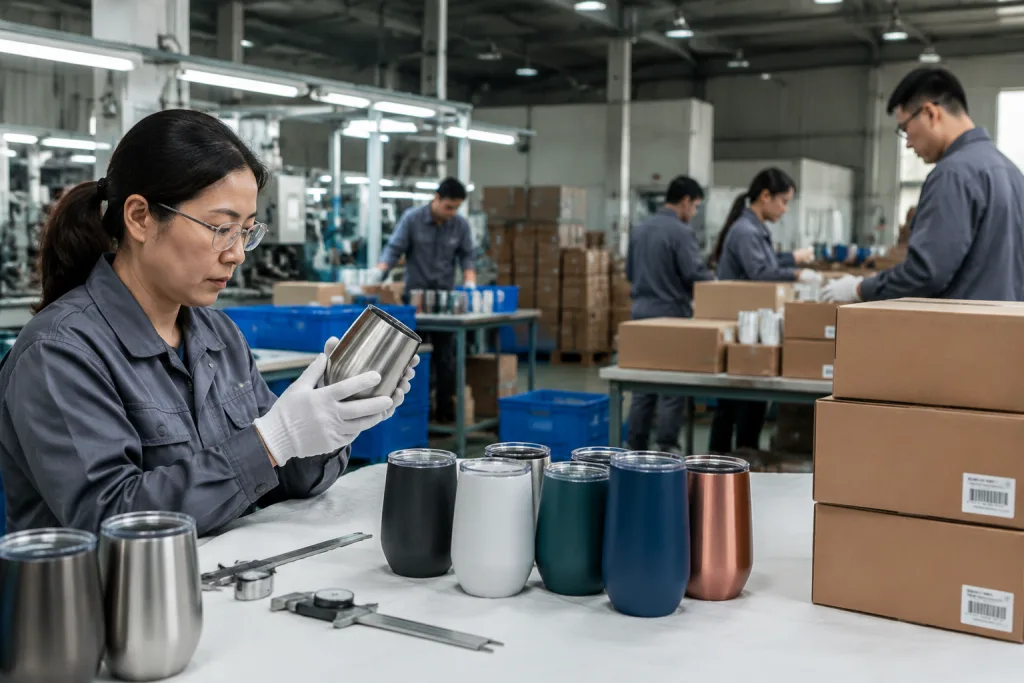
You are not buying a nice cup. You are buying a retail SKU that has to survive 1.2 m carton drops, match the approved shelf sample, pass importer checks, and land before the promo window closes. A wine tumbler wholesale order looks easy until the buyer flags a loose PP lid, QC pulls 18 pcs with thin powder coat near the rim, or the master carton splits 14 days before vessel cut-off.
Let’s run one real-style order from RFQ to shipment: 10,000 stainless wine tumblers for a North American lifestyle brand, produced in Zhejiang, China. We use the same checks our Hangzhou export team runs on the line: MOQ, AQL, logo tolerance within 0.5 mm, packaging stack tests, and the small choices that decide whether your wholesale drinkware program makes margin or burns it. We’ve seen this go sideways.
Start With The Selling Scenario
The first mistake is asking for “best price 12 oz wine tumbler” before telling us where it will sell. Wrong question. Send the sales channel, target retail price, delivery season, logo method, packaging type, and compliance market on the first RFQ. If QC pulled the sample from a vineyard gift shop order, we would check the rim polish and box presentation harder than we would on a 30,000 pcs event distributor job.
For this walkthrough, assume you need 10,000 pcs of 12 oz double-wall stainless wine tumblers, matte powder coating, laser logo, clear sliding lid, individual kraft box, master carton for export, FOB Ningbo. Target landed cost must support a USD 14.99-19.99 retail price. That is a normal wine tumbler wholesale project, not a luxury build. On our line, a 0.3 mm coating thickness shift can change the hand feel and also make the lid fit look sloppy.
At BottleForge Industrial in Zhejiang, China, our practical MOQ for custom color and logo wine tumblers is usually 1,000 pcs per color, with sharper pricing from 5,000 pcs. For mixed bulk drinkware programs, you can combine wine tumblers with beer tumbler bulk, canteen wholesale, or wholesale growler SKUs, but do not assume every item can share the same coating line schedule. Shape matters. Color changeover matters. We run powder coating by fixture and oven window, and a squat wine cup does not always sit well beside a tall growler body.
If you also source bulk canteen, bulk growler, or alcohol flask wholesale items for the same campaign, build one spec sheet per product. Do not hide five products inside one email thread. We have seen this go sideways when the buyer flagged “black lid” in the PO, but the email trail showed clear sliding lids for the wine tumbler and screw caps for the canteen. A canteen bulk order needs leak testing at the cap. A beer growler wholesale order needs a cap seal check. A wine tumbler lives or dies on coating, rim finish, vacuum performance, and lid fit.
Lock The Product Specification Early
A clean RFQ kills guessing before the line starts. For a 12 oz wine tumbler, we ask buyers to lock 304 stainless steel on the inner body and outer body, 0.5 mm inner wall, 0.6 mm outer wall, double-wall vacuum insulation, powder coated exterior with 60-80 μm coating thickness, polished rim checked by a cotton-wipe test, BPA-free AS or Tritan-style lid, plus a silicone gasket. If you sell in Europe, write LFGB or REACH into the PO. If you sell in the United States, ask for FDA food-contact documentation and, when relevant, California Proposition 65 risk review. QC pulled one sample last month because the PO said “Trian lid” instead of Tritan-style lid. Small typo. Big argument.
Do not chase the thinnest wall to save USD 0.08. That is the wrong question to ask. A body that is 18-22 g lighter dents in the drop carton and feels cheap when the buyer’s team handles it at the booth. On a typical FOB China quotation, a 12 oz stainless wine tumbler may sit around USD 2.10-3.20 depending on steel grade, finish, lid, packaging, order quantity, and exchange rate. A premium coating or custom gift box can move that by USD 0.25-0.70 per unit. We have seen this go sideways when a buyer approved a 0.4 mm outer wall from a photo, then flagged 37 dented pieces during AQL 2.5 inspection.
Your spec sheet should include dimensions with mm tolerance, capacity tolerance, finish, Pantone color, logo size, logo position, lid material, gasket color, retail box artwork, barcode position, carton pack, and test requirements. For drinkware bulk orders, missing details become production arguments later. The line needs numbers, not “same as sample.” We run carton packing by inner box count, master carton weight under 15 kg where possible, and barcode placement checked with a handheld scanner before mass packing.
Here is the blunt rule: if a feature affects your Amazon listing, distributor catalog, retail shelf, or compliance file, put it in the purchase specification. That covers wine tumbler wholesale, beer tumbler wholesale bulk, alcohol flask in bulk, and the best wholesale drink bottle for a private-label range. We ship based on the signed spec, not the buyer’s memory from a WeChat chat 12 days earlier. If the catalog says matte sage green, give us the Pantone code before pre-production sample approval.
Sampling Is Not A Beauty Contest
Sampling is where buyers get pulled into color and logo, then miss the parts that cause claims. Approve the cup build first: body weight, weld line, lid fit, and rim feel. Approve the finish on a separate signed sample with the actual powder code. Packaging needs its own sample too, with insert, polybag, barcode label, and master carton marks. A nice-looking sample with a lid that rattles 0.8 mm is not approved. A perfect tumbler in a blank box tells us nothing about whether your retail carton survives a 1.2 m drop test or a wet warehouse floor.
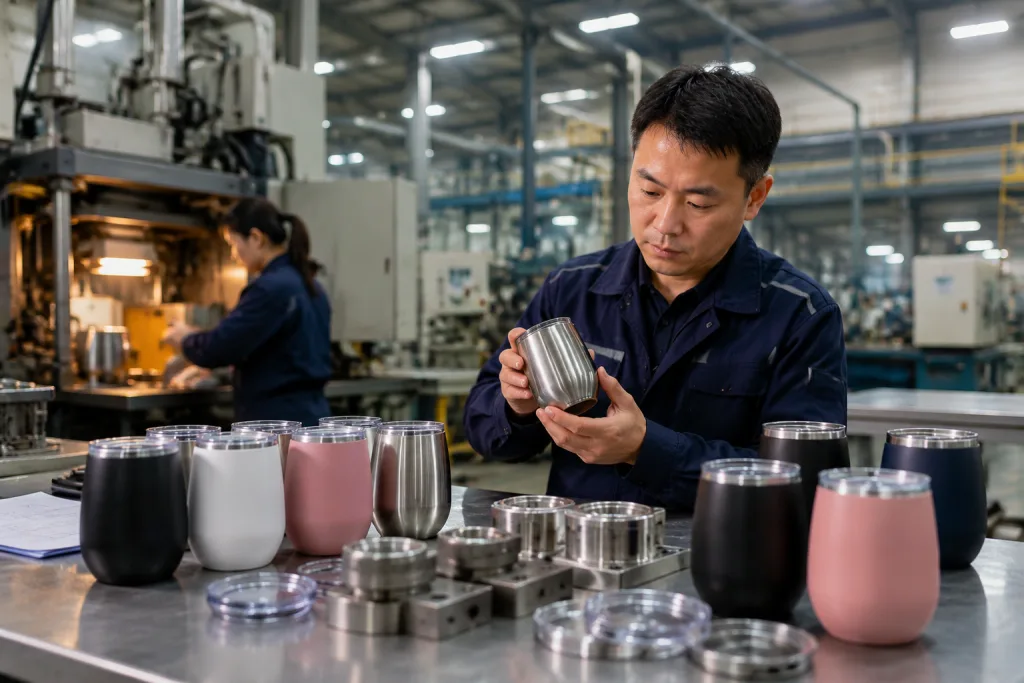
For this order, request 2-3 pre-production samples in the production powder color, the real logo process, and the final lid mold. We run this check on the bench with a digital scale, caliper, and IR thermometer before the line is released. Measure capacity with water to the practical fill line, not only to the brim. Check rim smoothness by touch; QC pulled one sample last month with a tiny burr at the rolled lip, and the buyer flagged it before we did. Fill with hot water at 95°C, close the lid, and check outer wall temperature after 10 minutes. For vacuum wine tumblers, the outer wall should not turn hot like a single-wall cup. Test cold retention with ice water over 4-6 hours if your carton or Amazon copy claims insulation performance.
Logo approval needs numbers, not “looks OK.” For laser engraving, specify position tolerance within ±1.5 mm and logo size tolerance within ±2%. For silk screen, ask for 3M tape adhesion testing and check whether the ink edge bleeds on powder coating under a 10x loupe. If your brand uses a small serif font, laser is safer than printing in most cases; the math does not work when a 0.3 mm ink spread fills the inside of a letter. Cheap decoration is one reason drinkware wholesale projects get rejected by brand owners after delivery.
Packaging samples matter more than buyers expect. For a 10,000 pc order packed 24 pcs per master carton, you are handling roughly 417 cartons. If the insert is weak, the product rubs during inland trucking in China, then again during ocean freight and final delivery. We ship matte black often, and one rubbed corner near the base ring looks like a defect even when the cup still works. Ask for the actual E-flute or corrugated insert, carton size in mm, gross weight, and drop-test photos before mass packing starts.
Price The Whole Program
FOB unit price is one line on the costing sheet, not the landed cost. Price the tooling, sample cost, logo setup, packaging plates, inspection, freight, duty, insurance, warehousing, and retailer chargebacks before you compare suppliers. A USD 0.12 cheaper tumbler is not cheaper if QC pulled the sample and found a 3% defect rate waiting to hit your fulfillment center. We have seen this go sideways.
For the sample order here, a workable commercial structure might read like this: MOQ 1,000 pcs per color, production order 10,000 pcs, sample lead time 7-10 days, mass production 35-45 days after artwork and deposit, payment 30% deposit and 70% before shipment after passed inspection, FOB Ningbo or Shanghai. Our Hangzhou export team typically plans 300,000-500,000 stainless drinkware units per month across tumblers, bottles, canteens, and growlers, depending on season and coating complexity. On the line, coating changeover can add 1 shift if the buyer changes Pantone after the golden sample is signed.
If you are buying a family range, compare cost by product group, not by average cup price. Wine tumblers, beer tumbler in bulk, alcohol flask wholesale bulk, wholesale canteen, and growler bulk orders carry different risks. A leak issue in alcohol flask bulk is a claim problem; a small cosmetic scratch on a promotional tumbler is usually an AQL 2.5 discussion. A beer growler in bulk needs pressure and seal checks, and a bulk growler with a swing top has more parts for QC to measure with the torque gauge. Same factory, different math.
Ask the supplier to quote options, not soft discounts. Example: standard kraft box at USD 0.18, custom color box at USD 0.36, EVA gift insert at USD 0.55, laser logo included above 3,000 pcs, powder coating surcharge USD 0.22 for special Pantone. The buyer flagged this last season after a PO had “gift box” typed with no dieline number, and the packaging plate was made for the wrong window size. Let the shelf requirement decide the package, not the factory’s leftover stock.
Control Color, Coating, And Logo
Around 70% of wine tumbler wholesale complaints we see are visual: color mismatch, uneven coating, scratches, logo drift, or dusty inner bags. Fix this before the line starts. We run Pantone codes on the PO, then ask for a sprayed stainless color panel, because Pantone 186C on paper will not match powder on a curved 304 stainless cup under a D65 light box.
Powder coating thickness is commonly controlled around 60-90 microns depending on finish. Too thin, and QC pulled the sample for silver showing at the rim or base. Too thick, and the slider lid starts fighting the mouth area by 0.3-0.5 mm. Matte looks clean in photos, but fingerprints and rub marks show fast, so we add PE foam or paper sleeves inside the master carton. Gloss hides some handling marks, but poor spraying leaves orange peel; the buyer will flag it in the first video call.
For logos, laser engraving is the safest choice for premium wholesale drinkware because it does not peel. Silk screen works for large one-color logos, but we still run a 3M tape test and alcohol rub before bulk printing. Heat transfer gives brighter graphics, but the math does not work for long-term dishwasher exposure unless the film, temperature, and pressing time are locked down. If your buyer wants a dishwasher-safe claim on the box, test 20-30 cycles before that wording goes on packaging.
Set a golden sample and keep one at the factory, one at your office, and one with the inspection company if you use third-party QC. For beer tumbler wholesale, canteen wholesale, alcohol flask wholesale, and wine tumblers, the golden sample is your argument stopper. We have seen this go sideways over a PO typo like “mat black” instead of “matte black.” Without a sealed sample, “acceptable color difference” becomes an opinion, and opinions get expensive during final inspection.

QC The Order Before Balance Payment
Do not wait for cartons to land in your warehouse before finding a production issue. On a 10,000 pc wine tumbler order, we normally book final random inspection after 100% production is finished and at least 80% is packed, with sealed cartons stacked by SKU on the pallet line. Use ANSI/ASQ Z1.4 sampling or the equivalent ISO 2859-1 approach. A common setting is General Inspection Level II with AQL 2.5 for major defects and AQL 4.0 for minor defects. Critical defects should be 0. Simple rule: no pass, no balance.
Major defects for wine tumblers should cover failed vacuum insulation, sharp rim, wrong material, serious coating peel, wrong logo, cracked lid, contaminated interior, and incorrect barcode. Minor defects can be small dust specks under the clear coat, cosmetic marks within an agreed 1.5 mm limit, or carton printing variation that does not affect scanning or retail shelf presentation. Define these before inspection. If you do not, QC has to guess, and we have seen that go sideways when the buyer flagged “champagne gold” as too yellow after the cartons were already taped.
Functional checks should include capacity by scale, lid fit, gasket seating, leakage simulation for the lid design, vacuum check, coating adhesion, logo rub test, carton count, barcode scan, and drop test. On our line, QC pulled the sample with a 500 ml measuring cylinder, 3M tape for the cross-hatch test, and a handheld scanner for UPC and FNSKU labels from 5 outer cartons. For retail programs, scan labels from several cartons, not only the top master carton. A correct cup with the wrong barcode still creates chargebacks and receiving delays.
If the order includes drinkware bulk mixed with beer growler wholesale bulk, wholesale growler, or canteen bulk items, inspect each SKU separately. Do not let a clean tumbler result hide a weak growler cap; the math does not work when 1 SKU passes and another has 18% lid leakage. We ship mixed-container orders from Hangzhou and Ningbo often, and the buyer pushback is usually the same: “Why did the tumbler pass report cover the growler?” For China exports, holding the 70% balance until inspection passes is normal. A serious factory will not be offended by this; it is standard B2B practice.
Plan Freight Like A Buyer
QC pass is not the finish line. Before we release cartons, we confirm carton size in mm, gross weight, net weight, HS code, shipping marks, pallet requirement, plus Amazon or retailer label rules. FBA orders need FNSKU placement checked against the carton content file; one wrong label can freeze a whole inbound shipment. Distributor orders need clean outer cartons and the same master carton count from first pallet to last. QC pulled a sample for one UK buyer last month because the PO said “matte black” but the shipping mark file still showed “matt black.” Small typo. Big delay.
A 12 oz wine tumbler packed in a retail box commonly ships 24 pcs per master carton. Carton weight may sit around 8-11 kg depending on packaging. For 10,000 pcs, you may use roughly 18-25 CBM. That usually means LCL or partial container space, depending on your full assortment. If you combine wine tumblers with beer growler bulk, wholesale canteen, and alcohol flask bulk items, send the forwarder the actual carton data from the line, not a sales-sheet estimate. We run carton measurements with a tape and scale after packing trial, because 1 cm extra height across 420 cartons changes the CBM bill.
FOB Ningbo is often practical for Zhejiang factories because inland trucking is predictable. From Hangzhou, we usually plan 3-4 hours to Ningbo port if the truck leaves before the afternoon traffic. FOB Shanghai can also work if your consolidator needs Shanghai CFS. The right port is not about prestige; that is the wrong question to ask. Check trucking time, sailing schedule, document cut-off, and total landed cost. We have seen buyers save USD 80 on ocean freight, then lose two days on trucking and warehouse handling.
Before shipment, request commercial invoice, packing list, bill of lading draft, test reports if applicable, inspection report, and product photos of loaded cartons. If your customer needs BSCI, ISO 9001, or social compliance documents, ask during RFQ, not after production. China factories can provide 6-10 standard export documents on a normal order, but not every workshop holds every audit. The buyer who asks early gets fewer surprises. We ship smoother when the document checklist is locked before mass production, not while the container is waiting at the gate.
Send Your Wine Tumbler Spec For Review
Share quantity, logo, color, packaging, and market. We’ll check feasibility, MOQ, lead time, and FOB pricing before you commit.
Frequently asked questions
What is a realistic MOQ for wine tumbler wholesale with custom logo?
For a custom logo wine tumbler wholesale order, 1,000 pcs per color is a realistic starting MOQ in Zhejiang, China. If you need a custom Pantone powder coat, 3,000 pcs per color is cleaner because coating line setup and powder loss become easier to control. For mixed wholesale drinkware programs, you may combine wine tumblers with beer tumbler bulk or canteen wholesale items, but each SKU still has its own MOQ. Logo-only stock color orders can sometimes start at 500 pcs, but the unit price is higher and color choice is limited.
How long does a 10,000 pc wine tumbler order take?
Plan 7-10 days for pre-production samples after artwork confirmation, then 35-45 days for mass production after sample approval and deposit. Add 3-5 days for final inspection, booking, and China export handling. Ocean freight to North America or Europe then adds roughly 25-45 days depending on port pair and season. If your order includes drinkware bulk assortments such as beer growler wholesale, alcohol flask wholesale bulk, and wholesale canteen products, allow extra time for component matching and separate QC.
Which logo method is best for stainless wine tumblers?
Laser engraving is usually the safest choice for stainless wine tumblers because it is permanent, clean, and does not peel during normal use. It works especially well on powder coated bodies because the laser exposes the stainless base below the coating. Silk screen can be cheaper for large one-color graphics, but you need adhesion testing. Heat transfer is better for full-color artwork, but it needs stricter durability testing. For wholesale drinkware sold as retail merchandise, I would choose laser unless the artwork requires color.
Can I combine wine tumblers with growlers, canteens, and flasks?
Yes, but treat them as separate SKUs under one purchase program. A wine tumbler, bulk canteen, bulk growler, and alcohol flask in bulk have different tooling, components, leakage risks, and inspection criteria. A beer growler wholesale bulk order needs cap seal checks. A wholesale canteen order needs stronger leakage testing. Alcohol flask wholesale requires attention to welding, polishing, and cap threading. Combining them can help shipping efficiency, but it should not blur specifications or QC sampling.
What QC standard should I use before shipment?
Use ANSI/ASQ Z1.4 or ISO 2859-1 sampling, typically General Inspection Level II. For drinkware wholesale, a practical AQL is 0 for critical defects, 2.5 for major defects, and 4.0 for minor defects. For 10,000 pcs, the inspector will pull a statistically defined sample size, then check appearance, capacity, logo, coating, lid fit, carton count, barcode, and packaging. Add function tests for vacuum performance and coating adhesion. Do this before paying the 70% balance, not after the goods leave China.