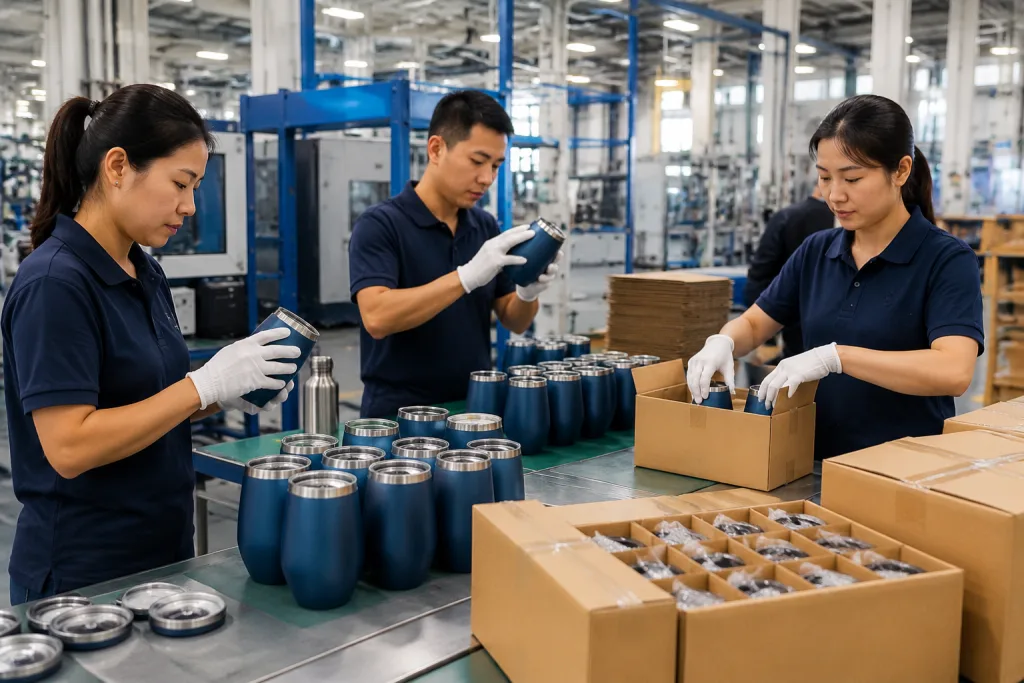
Key Takeaways
- A useful RFQ should include capacity, steel grade, lid type, logo method, packaging, target FOB price, and quantity such as 3,000 or 10,000 pcs
- For stainless wine tumblers, 304 inner steel and 0.4-0.5 mm wall thickness are common for stable retail quality
- A pre-production sample should be approved before deposit; typical custom sample lead time is 7-10 days
- Bulk PO line items must state AQL level, carton marks, barcode or FNSKU needs, and allowed quantity tolerance
Buying wine tumbler wholesale bulk looks easy until the quotation sheet shows 6 steel grades, 3 lid options, 2 carton methods, and still no straight answer on leakage. At 5,000 pieces, a wrong early call hurts. Last month QC pulled a 12 oz sample from the line, filled it to 8 mm below the rim, and the buyer flagged seepage around the slider lid after a 30-second tilt test.
From our factory in Hangzhou, Zhejiang, we see the pattern almost every week: buyers ask for drinkware wholesale pricing first, but the cost is decided earlier by capacity, finish, logo method, packaging, inspection level, and shipping terms. This is the wrong question to ask first. We run RFQ checks with a digital caliper, gram scale, and carton drop notes on the sample table, then move to bulk PO only after the buyer signs off the actual tumbler, not a pretty PDF.
Start with a usable RFQ
A weak RFQ says, “Please quote 12 oz wine tumbler with logo.” You will get a price back in 20 minutes, but it will not support a safe buying decision. For wine tumbler wholesale bulk sourcing, the RFQ has one job: make every supplier quote the exact tumbler you plan to sell. We see this go sideways when the buyer’s PO says 12oz, the artwork file says 350ml, and the carton mark says 355ml.
State capacity, material, finish, lid style, logo method, packaging, test requirements, order quantity, and trade term. Be exact. A normal 12 oz vacuum wine tumbler uses 304 stainless steel inside and 201 or 304 outside. If you sell premium retail in Europe or North America, write 304 inner and 304 outer in the RFQ. For price-sensitive promotional bulk drinkware, 304 inner with 201 outer can work, but declare it clearly. On our line, QC checks material grade with an XRF analyzer before mass production; one wrong steel grade can kill the margin on a 5,000-piece order.
Your RFQ also needs to say whether the lid must be splash-resistant or leak-resistant. This is the wrong question to leave open. A slide lid is made for sipping at a desk, not for rolling inside a tote bag. We had a buyer flag this after 12 sample sets arrived: the lid looked fine, but 3 samples leaked during a simple upside-down shake test. Do not assume “with lid” means leakproof.
RFQ line items to include:
- Capacity: 12 oz / 350 ml or 14 oz / 420 ml
- Construction: double-wall vacuum insulated stainless steel
- Material: 304 inner, 304 or 201 outer, BPA-free lid
- Finish: powder coating for grip, spray painting for low-cost color matching, electro-polished interior, or mirror polish for a retail display look
- Logo: laser engraving for stainless finish, silk screen for simple one-color marks, heat transfer for gradients, or full-wrap print for retail graphics
- Packaging: white box, color box, kraft box, or mailer box
- Quantity breaks: 1,000 / 3,000 / 5,000 / 10,000 pcs
- Terms: FOB Ningbo or FOB Shanghai, not just “delivered price”
Our Zhejiang production line runs about 450,000 stainless drinkware units per month, but planning still depends on color count and packaging work. A 5,000-piece order in one powder coat color is simple. A 3,000-piece order split across six colors needs more masking, more line changeovers, and more carton-label checks. The math does not work if the buyer expects the same lead time for both; we usually plan 12 days for one color versus 18 days for six colors, assuming artwork is approved before the first powder coat batch.
Compare quotes without fooling yourself
Once suppliers answer, do not sort by unit price alone. A USD 3.20 FOB tumbler and a USD 3.55 FOB tumbler may look close on a spreadsheet, but they are often different builds. The cheaper one may be 0.4 mm body steel instead of 0.5 mm, a lighter AS lid, or powder coating that fails after 30 tape-pull checks on the line. We have seen this go sideways: the buyer saved USD 0.18, then QC pulled the sample for rim dents and scuffed retail shelves.
Ask for a quotation table that breaks out product cost, logo cost, packaging cost, mold or setup charge, and sample fee. No lump-sum quoting. This matters if you are comparing wine tumblers with related items such as beer tumbler bulk, canteen wholesale, alcohol flask wholesale, or a bulk growler line for the same catalog. A growler cap thread gauge, a flask laser jig, and a wine tumbler powder rack are not the same factory setup, so the math does not work when every item is pushed into one blended price.
A sensible quote for wine tumbler wholesale bulk should include gross weight, carton size, pieces per carton, MOQ, lead time, and validity period. For example, 24 pcs per master carton, 51 x 35 x 38 cm, 9.8 kg gross weight gives your freight forwarder something real to calculate. Without carton data, your landed-cost worksheet is guessing with prettier formatting. We ship enough cartons to know the difference between 12 days of clean costing and 18 days of back-and-forth because somebody forgot to weigh the master carton after adding color boxes.
Quote comparison line items:
- FOB unit price at each quantity tier, with the steel thickness and lid material written beside the price
- MOQ per model and MOQ per color, often 1,000 pcs/model and 500 pcs/color; ask if mixed colors share one production batch
- Logo setup cost, usually USD 50-120 per artwork, and whether it covers laser, silk print, or heat-transfer film
- Custom color surcharge or minimum powder purchase, including the powder code and kg requirement
- Retail packaging cost, often USD 0.18-0.45 per piece, with egg-crate, white box, or color box named clearly
- Production lead time, commonly 30-45 days after deposit and sample approval; confirm if that means ex-factory or vessel closing
- Compliance documents: LFGB, FDA, REACH, CA Prop 65 if required, matched to the exact material and coating on the quote
If you also source wholesale growler, beer growler wholesale bulk, or alcohol flask wholesale bulk items, keep them in separate RFQ tabs. One buyer once sent us a PO with “wine tumbler/growler same carton” typed in the remarks, and the buyer flagged it two days later because the dimensions made no sense. This is the wrong question to ask. Use separate tabs, separate carton data, and separate accountability.
Lock the sample before deposit
Sampling is not a courtesy step. It is where the spec stops being a PDF and becomes a cup on the QC table. For wine tumbler wholesale bulk orders, approve a sample that matches mass-production material, finish, lid, logo size, and packaging. We have seen buyers sign off on a nice blank tumbler, then reject the shipment because the laser logo looked grey and fuzzy on matte black powder coating. The blank sample did not answer that question.
Custom samples usually take 7-10 days after artwork confirmation. If you need a standard blank sample from stock, we can normally send it in 2-3 days from Hangzhou, Zhejiang, but that only confirms shape and basic hand feel. Fast, but limited. For a brand order, we run a pre-production sample with the real decoration method, real lid, and real carton mark. Last month a PO had the logo size typed as 45 mm instead of 35 mm; QC pulled the sample before deposit, and that 10 mm mistake did not reach the line.
Test the sample like your customer will. Fill it with water and ice, check hand feel, sip from the lid, wash it, drop the empty tumbler from 760 mm table height onto cardboard, then inspect the coating at the rim and base with good light. If you sell to outdoor, winery, hotel, or event channels, the surface finish matters. Powder coating is usually more durable than basic spray painting, but it costs more and needs proper curing; the math does not work if the buyer wants powder-coat durability at spray-paint pricing. We check curing with a cross-hatch cutter and tape pull when the finish looks suspicious.
Sample approval line items for your PO file:
- Approved sample code and approval date, for example WT-12-PP-0318 signed by buyer
- Logo artwork version, Pantone color, and placement size in mm, with the print position measured by ruler
- Finish sample, such as matte white powder coat, matched against the retained factory sample
- Lid material and gasket color, because clear AS and smoke PS lids do not look the same in retail photos
- Packaging dieline and barcode position, checked against the carton sticker before bulk packing
- Photo record of front, back, lid, base, and carton, saved with the PO number for QC reference
If you are adding canteen bulk, beer tumbler wholesale, or alcohol flask in bulk to the same range, sample them separately. One approval email is not enough. A canteen has leakage risk, and we usually run a 24-hour upside-down water test. A flask has weld and cap-thread risk. A wine tumbler has coating, rim, and lid-fit risk. We have seen this go sideways when a buyer approved the wine tumbler sample and assumed the same lid tolerance covered the beer tumbler.
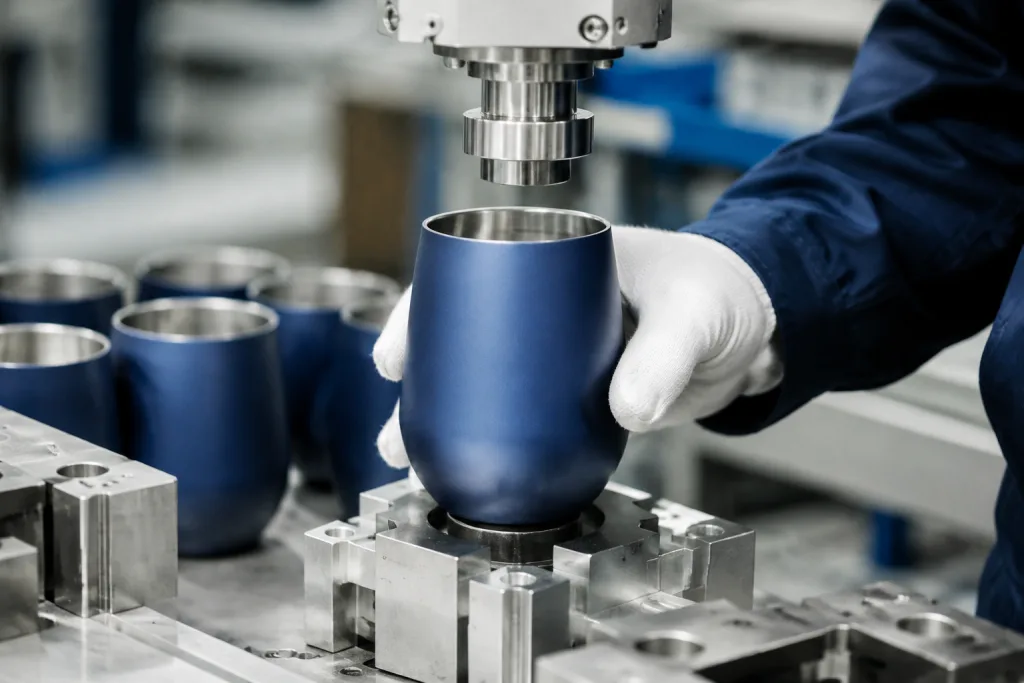
Write the PO like a control document
Your purchase order is not just a price confirmation. Treat it as the control document for the production planner, QC inspector, carton supplier, and export clerk. Short is fine. Loose is not. On our line, the planner prints the PO beside the work order; if the lid material or carton mark is missing, someone will guess, and guessing creates claims.
For a 5,000-piece wine tumbler wholesale bulk order, put every commercial and technical point in writing. If your sales channel needs Amazon FBA labels, club store cartons, distributor SKU labels, or mixed-color inner cartons, put those words into the PO. We have seen a buyer write “navy” on the email but “blue” on the PO, then QC pulled the sample and nobody could approve the carton label. Verbal notes disappear during peak production.
Bulk PO line items to include:
- Item name: 12 oz double-wall vacuum wine tumbler
- SKU and color split: 2,000 black, 2,000 white, 1,000 navy
- Material: 304 stainless steel inner, 304 outer, BPA-free AS lid
- Wall thickness target: 0.4-0.5 mm body sheet before forming
- Logo: laser engraved, 45 x 28 mm, centered opposite seam
- Packaging: 1 pc/color box, 24 pcs/master carton
- Carton mark: buyer SKU, color, quantity, gross/net weight, made in China
- Inspection: AQL 2.5 major / 4.0 minor, Level II unless otherwise agreed
- Payment: 30% deposit, 70% before shipment after passed inspection
- Trade term: FOB Ningbo, China
- Allowed quantity tolerance: plus or minus 3%
This matters even more when you run a wider wholesale drinkware program with wholesale canteen, growler wholesale, beer growler in bulk, or alcohol flask bulk. Do not copy one defect list across all items. The math does not work. A 0.3 mm pinhole in vacuum insulation is a critical defect because it kills heat retention; a small print shade shift can pass as minor if it stays inside the signed color tolerance. We run different QC check sheets for tumblers and growlers for exactly this reason.
Do not pay a deposit against a quotation alone. Pay against a PO that repeats the approved sample and the inspection standard.
Plan production and inspection windows
Once the deposit lands and the pre-production sample is signed off, the schedule stops being a sales estimate. For a standard stainless wine tumbler order, we run 30-45 days for bulk production. Add 5-7 days for custom color boxes, insert cards, warning labels, or retailer carton marks. Before summer promo season and Q4 gifting, coating lines in China fill fast; last May one 10,000 pcs matte-black order waited 4 days because the powder room had 6 colors ahead of it.
Production is not one straight push. The line moves through steel forming, welding, vacuuming, polishing, coating, logo work, lid assembly, packing, and final inspection. One blocked station blocks the next. A powder coating delay stops logo printing; a late barcode file holds the color box supplier; a PO typo like “Mat Balck” can waste half a day while sales, artwork, and QC confirm the approved color chip. Put approval deadlines on the calendar, not just the ship date. This is where we’ve seen orders go sideways.
Production control line items:
- Deposit received date
- Final artwork lock date
- Color box artwork approval date
- Material preparation start date
- Inline inspection target at 20-30% completion
- Final inspection booking when 100% packed and at least 80% sealed cartons
- Forwarder booking deadline
- ETD Ningbo or Shanghai
Use AQL inspection, not “please check carefully.” That sentence is not a QC plan. For bulk drinkware, we check capacity with a measuring jug, vacuum insulation after hot-water testing, coating adhesion by cross-hatch tape, logo position in mm, lid fit, odor, sharp edges, barcode scan, carton drop, and count accuracy. QC pulled the sample on one 3,000 pcs order because the logo sat 4 mm lower than the approved PPS. For EU and North American buyers, request the right food-contact documents: LFGB, FDA, REACH, and BPA-free test reports when your market asks for them.
If the same shipment includes beer tumbler wholesale bulk or beer growler bulk, inspect them by SKU group. A growler fails in different ways from a stemless wine tumbler: cap thread, handle weld, leak test, and carton weight matter more. Treating all drinkware bulk as one category saves one line on an inspection sheet, but the math doesn't work when a 1.9L growler and a 350 ml wine tumbler share the same checklist.

Ship with landed cost in mind
FOB price is only one line in landed cost. A wine tumbler is lighter than ceramic, but carton volume still bites. A 12 oz tumbler in color box may ship at 24 pcs per carton; a gift box with foam insert may cut that to 18 pcs and push ocean freight per unit up fast. We run carton checks with a tape measure on the packing table, not from a PDF. If your retail price is tight, ask for carton dimensions, CBM, gross weight, and drop-test packing photos before you approve packaging.
For North America, around 7 out of 10 trial buyers start with ocean LCL, then move to FCL once repeat orders reach stable MOQ. For Europe, routing through Ningbo, Shanghai, or sometimes Shenzhen depends on where the forwarder consolidates cargo. If you are sourcing from Zhejiang, FOB Ningbo is usually the cleanest route. Air freight is for urgent event orders or small samples only. Sending 3,000 metal tumblers by air is the wrong math; we have seen a buyer save 12 days vs 18 days on transit and lose the full promo margin.
Shipping and document line items:
- Commercial invoice and packing list matching PO SKU names, including spelling and color codes
- HS code confirmation before shipment, checked against the importer’s broker note
- Carton count, CBM, gross weight, and net weight from the final packed cartons
- Export carton marks and pallet requirement if any, printed on two sides unless the buyer says otherwise
- FNSKU or retailer label placement photos if required, with one close-up and one full-carton photo
- Certificate of origin if your importer needs it
- Final inspection report and loading photos, including container seal number
If you are building a wider assortment, combine compatible items with care. Wine tumblers, beer tumbler in bulk, canteen wholesale, and alcohol flask wholesale can share a container when carton strength and carton height match. Large wholesale growler cartons can crush lighter color boxes if pallet stacking is planned only in the office. QC pulled a sample last month where the bottom color box had a 6 mm corner dent after a simple stack test. Tell the factory if cartons will go straight into distributor warehouses, e-commerce prep centers, or retail DCs. The carton design should match the real handling route, not just survive the trip out of China.
Send your tumbler RFQ for a real factory quote
Share capacity, quantity, logo, packaging, and target market. We will return a structured FOB quote and sampling plan.
Frequently asked questions
What MOQ should I expect for wine tumbler wholesale bulk orders?
For a standard stainless wine tumbler, a realistic MOQ is usually 1,000 pcs per model and 500 pcs per color. If you need a custom powder coating color, custom lid color, or full-wrap artwork, the practical MOQ can move to 3,000 pcs because coating and setup losses are higher. For mixed programs including beer tumbler bulk, canteen bulk, or alcohol flask wholesale, do not assume all items share one MOQ. Each shape has its own tooling, material, and production planning. At BottleForge Industrial in Zhejiang, we normally quote quantity breaks at 1,000, 3,000, 5,000, and 10,000 pcs so you can compare unit price against inventory risk.
What is a normal FOB price for a custom stainless wine tumbler?
A typical 12 oz double-wall stainless wine tumbler may range from about USD 2.80 to USD 4.50 FOB China, depending on steel grade, coating, lid, logo, and packaging. A simple 304 inner/201 outer tumbler with one-color logo and white box sits near the lower end. A 304/304 construction with powder coating, laser logo, color box, and stronger lid costs more. Prices also move with stainless steel cost and exchange rate. When comparing drinkware wholesale quotes, ask suppliers to separate product cost, logo cost, and packaging cost. That makes the comparison much cleaner than looking at one blended number.
Should I choose laser engraving or printing for my logo?
Laser engraving is durable and works well on powder-coated stainless wine tumblers because it removes the coating and exposes the metal below. It is a good choice for wineries, outdoor brands, and corporate programs where the logo should survive washing and handling. Silk screen printing is cheaper for simple one-color artwork, but it can scratch faster if the coating and ink are not matched. Heat transfer or full-wrap printing is better for colorful artwork, but setup cost and rejection risk are higher. For a 5,000 pcs wine tumbler wholesale bulk order, request a decorated sample before deposit and check logo size, position, edge sharpness, and rubbing resistance.
Can I ship wine tumblers with growlers, canteens, and flasks?
Yes, you can combine wine tumblers with wholesale growler, wholesale canteen, beer growler wholesale, and alcohol flask bulk items in one shipment if carton strength and loading plan are managed. The risk is not the product category; it is carton mismatch. Heavy growler bulk cartons can crush lighter tumbler gift boxes if loaded badly. Ask for carton dimensions and gross weight by SKU, then let your forwarder calculate CBM and loading. For mixed-container orders, we recommend final inspection by SKU group and loading photos that show carton sequence. If the shipment goes to a retail distribution center, specify pallet height, label format, and carton orientation before production.
What quality tests should be included before shipment?
For stainless wine tumblers, pre-shipment inspection should include visual defects, capacity check, vacuum insulation test, lid fit, odor, sharp edge check, logo position, coating adhesion, barcode scan, carton count, and packaging drop check. Use AQL Level II with 2.5 major and 4.0 minor as a common baseline. Critical defects, such as leaking vacuum, food-contact contamination, broken lids, or unsafe edges, should have zero tolerance. If your order includes beer tumbler wholesale, beer growler in bulk, or alcohol flask wholesale bulk, add product-specific checks such as cap threading, seal compression, and internal cleanliness. Always inspect after goods are packed, not halfway through production only.