Key Takeaways
- Specify 304 stainless steel, 0.4-0.5 mm inner wall, 0.5 mm outer wall, and vacuum retention targets before quotation
- For powder coating, require 60-80 micron film thickness and cross-hatch adhesion testing on pre-production samples
- Use AQL 2.5 major / 4.0 minor for standard orders, with 100% leak testing for lids when practical
- Carton strength matters: request 5-ply export cartons and a 76 cm drop test for e-commerce or distributor shipments
A wine tumbler looks simple until 20,000 pieces land with loose slider lids, powder coating thin on the bottom radius, and K=K cartons crushed after the first 76 cm drop test. The problem is rarely one big mistake. It is usually 6 small specs missing from the PO: lid material, coating thickness, carton grade, logo tolerance, AQL level, and who pays for rework. We’ve seen this go sideways when the buyer wrote “matte black” but never approved a 60° gloss reading.
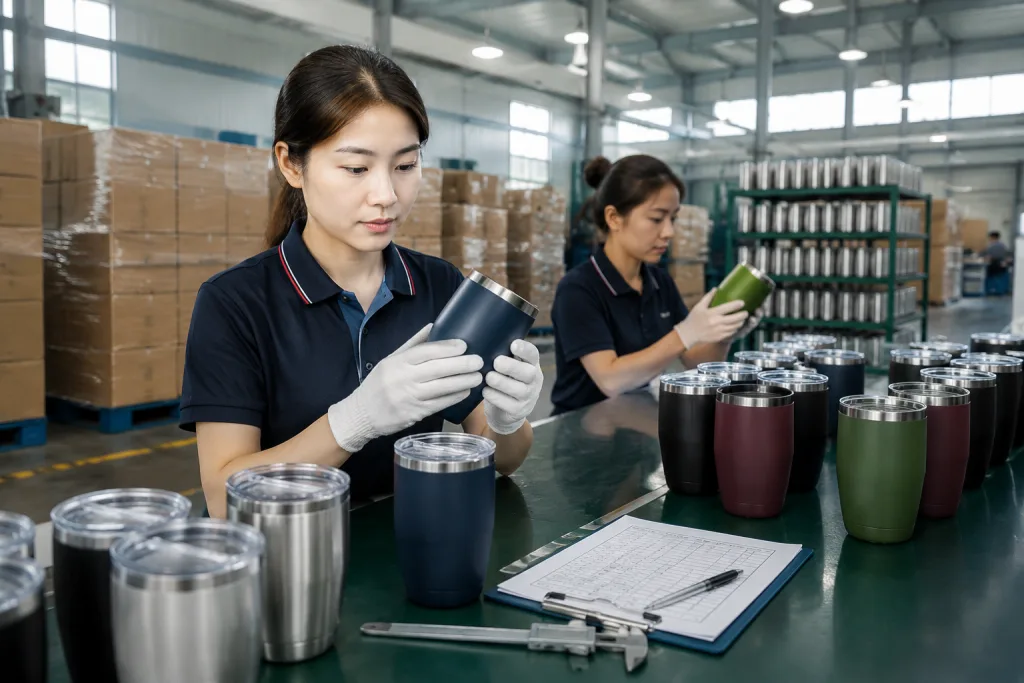
As a Zhejiang, China drinkware factory, we see the same failure modes across custom drinkware, custom canteen, and distributor drinkware programs. The buyer asks for a “12 oz insulated wine tumbler.” That is not enough. The line needs a controlled drawing, approved golden sample, and inspection checklist with measurable points like mouth diameter in mm, lid pull force, and logo position tolerance. Our Hangzhou line can run about 300,000 stainless steel units/month, with typical MOQ from 1,000 pcs per color and 25-35 days mass production after sample approval. QC pulled one sample last month because the PO had “Pantone 186C” while the artwork file showed 185C; small typo, expensive delay.
Failure one: vague stainless steel specs
The costliest mistake with a wine tumbler vendor is treating “stainless steel” as one fixed spec. It is not. We see quotes every month for 201 stainless steel, 304 stainless steel, 0.35 mm wall stock, rougher internal polishing, or a lighter PS lid, all sold as a stainless tumbler. The landed price looks good on the sheet, then the distributor canteen or distributor drinkware customer comes back with metallic taste, weak insulation, or dents after carton drop handling. QC pulled one 12 oz sample last season with a visible flat spot near the bottom radius after a 60 cm drop test. That savings disappeared fast.
For B2B export orders to Europe and North America, we run food-contact 304 stainless steel for the inner wall and 201 or 304 for the outer wall depending on the buyer’s target price. For a serious retail or promotional program, put the material directly into the PO: Inner: SUS304, 0.4-0.5 mm; outer: SUS201 or SUS304, 0.5 mm; BPA-free lid; silicone gasket, food-contact grade. If the item is meant to sit in a gift set at a higher price point, specify 304/304 construction and ask for material declaration documents before mass production. Small detail, big difference. We once saw a PO typo that said “SUS304 outer” in the buyer email but “SUS201 outer” in the signed PI; the line followed the PI.
Vacuum performance needs a number. A 12 oz wine tumbler will not behave like a 40 oz travel tumbler, but it should hold cold for 6-9 hours under reasonable test conditions. Ask the canteen manufacturer or canteen supplier to state the test method: starting water temperature, ambient temperature, fill volume, and time interval. In our lab we check with a digital thermometer probe at 23°C room temperature and record at 1-hour intervals, because “keeps cold all day” is packaging copy, not a spec. This is the wrong place to accept soft wording.
For REACH, LFGB, FDA food-contact, or California Prop 65 concerns, confirm the sales markets before sampling. A Zhejiang canteen factory can build to these requirements, but the lab test must match the actual material, coating, lid, and gasket. Do not rely on a 2-year-old report from a similar SKU. We have seen this go sideways when a buyer approved the steel cup body report, then the buyer flagged the black powder coating and TPE gasket after arrival; retesting 3 components added 12 days vs 18 days with re-sampling and courier time.
Failure two: lids that leak or crack
Wine tumbler lids cause a lot of returns because buyers stare at the cup body and treat the lid like an accessory. We see 3 failure points on the line: a loose slider, gasket fit moving by 0.3-0.5 mm, or plastic cracking after dishwasher cycles or cold-truck transport. QC pulled one sample last winter after a carton sat near the dock door at -6°C, and the clear lid split at the sipping slot. For canteen promotional use, a small lid issue might pass. For subscription boxes, retail shelves, or Amazon FBA, the buyer flags it as a chargeback.
Ask your wine tumbler vendor to write the lid material on the PI, not just “clear lid.” AS, PS, PP, and Tritan-style materials do not behave the same: AS looks clean but can be brittle, PP is tougher but cloudy, and Tritan-style options cost more. For a clear lid with better impact resistance, the cost may increase by USD 0.08-0.18 per piece compared with a basic clear plastic lid. That is usually cheaper than replacing 3% of an order after delivery. The math doesn’t work if the buyer saves USD 900 on lids and loses USD 2,400 in replacements.
Leak testing has to match how the cup is sold. Most wine tumblers are splash-resistant, not fully leakproof, because the drinking opening is wide and usually uses a sliding cover. Short test: shake it. If your product page says leakproof, the cup needs to survive a clear test, such as 10 seconds upside down with 250 ml water inside and no drip from the slider. If it is splash-resistant, say that on the listing and carton label. During QC, we normally recommend checking lid fit on at least 80-125 pieces per lot under AQL sampling, plus additional functional checks after carton drop testing. We also run a simple thumb-pressure check on the slider because a caliper reading alone does not catch a weak snap.
For customized canteen and canteen customizable programs, lid color matching creates another headache. A black lid from one injection batch can look brown next to a black powder-coated cup under 4000K store lighting. We had a PO typo once that said “matte black lid” while the approved sample was glossy black, and the buyer caught it only after pre-production photos. If color consistency matters, approve a physical limit sample, not just a Pantone reference on a PDF.
Failure three: coating that chips early
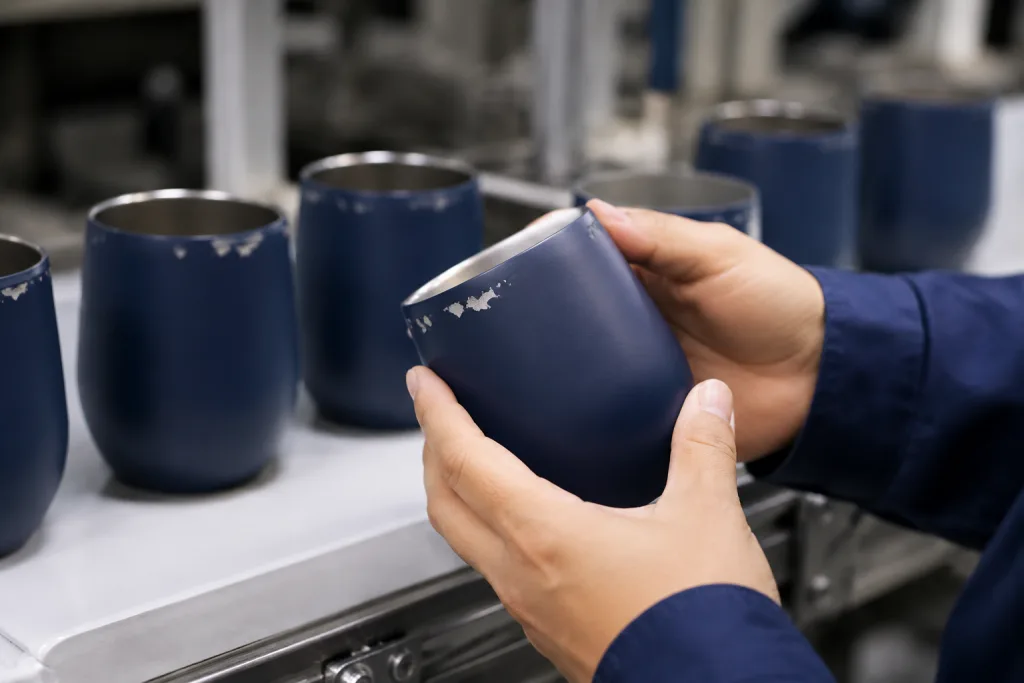
Powder coating sells the wine tumbler. It also gets the complaint email when chips show after 3 weeks on a retail shelf. The usual causes are weak degreasing before spray, film below spec, curing that misses the time-temperature window, and carton rub during a 12-day sea leg plus 6 days in a truck warehouse. We have seen QC pull samples from the line with nice color on the outside, then find bare steel on the bottom edge after a 3M tape pull. A canteen vendor can send a perfect hand-picked sample, while mass production runs 1,200 pcs per hour with less stable oven temperature and too much part-to-part contact.
Put coating numbers in the spec. For standard matte or gloss powder coating, request 60-80 microns film thickness, cross-hatch adhesion test, and a curing profile checked with an oven recorder, not just “baked enough” on the worksheet. For textured finishes, thickness can run 90-110 microns, but the buyer still needs to sign one production sample from the actual spray booth. If your brand uses cream, beige, or light pastel colors, ask for stain resistance against coffee, lipstick, and carton dust. Light colors look premium. They also show fingerprints faster than navy or black, and we have had buyers flag gray smudges from kraft dividers during incoming inspection.
Logo decoration changes the coating risk. Laser engraving through powder coat is durable and clean, but the final mark color depends on the 304 stainless surface and whether the coating is 60 microns or closer to 80 microns. Silk screen printing can match bright brand colors, but it needs ink adhesion testing on the curve; flat-panel test results do not tell the full story on a wine tumbler body. Heat transfer and UV print look strong for complex artwork, but we run rub testing with a 500g weight and control any dishwasher claim tightly. For canteen customized and customized drinkware projects, we usually ask buyers to approve one blank coated sample and one decorated sample before mass production. Skipping that step is the wrong saving.
Do not approve coating by photo only. A phone camera hides orange peel, dust points, uneven gloss, and the 0.5 mm dents QC catches under a side light.
If the order is for canteen distributors or a distributor growler line extension, buyers will compare finishes across several SKUs on the same shelf. Your wine tumbler, custom growler, and customizable canteen should not look like three unrelated factories made them. We ship matched color panels for repeat programs, and the line keeps one signed panel at spray inspection so “matte black” does not drift into charcoal by the second PO.
Failure four: logos placed by guesswork
Logo problems usually start before the factory touches the cup. The buyer sends a PNG, writes “centered” on the PO, and expects the decorator to read the brand book from one word. Curved drinkware is not flat paper. On a tapered wine tumbler, a logo that looks centered in the PDF can sit 2 mm low once the cup is in the photo box. We have had QC pull 32 samples from the line because a 1 mm shift showed up when six tumblers were shot as a set.
For custom drinkware, ask for a decoration drawing with dimensions: logo width, logo height, distance from rim, distance from bottom, and centerline orientation. No guessing here. For a 12 oz wine tumbler, common logo widths are 45-65 mm for front placement, but taper angle, artwork shape, and fine text change the safe size. Lines below 0.2 mm may break in laser engraving or fill in during printing. Small legal text can pass on a flat proof and fail on the cup; our operator checks this with a 10x loupe before we run bulk.
Each decoration method fails in its own way. Laser engraving is the safer choice for long-life corporate programs and 5,000-piece canteen promotional orders. Silk screen is cost-efficient for one or two colors, often adding around USD 0.05-0.12 per print position depending on quantity. UV print handles gradients and full color, but define rub resistance and state clearly whether dishwasher safety is claimed. Embossing or metal badges look premium, then the math changes because tooling cost and lead time move; we have seen buyers flag this only after the badge mold is already cut.
If you are sourcing a canteen customized family, such as a 12 oz wine tumbler for events, a custom canteen for outdoor retail, and a customized growler for brewery gift sets, build one logo standard across the range. A canteen manufacturer in China can keep placement controlled, but only if you freeze artwork, approve a golden sample, and stop last-minute logo file changes after production tooling is prepared. This is the wrong place to be flexible. One typo in a logo file name, like “final_v3_new,” has delayed a shipment 12 days vs 18 days when the buyer asked us to recheck every SKU.
Failure five: carton design treated as afterthought
A tumbler can pass final QC and still arrive with dents because the carton was treated like artwork, not load-bearing engineering. We see this on distributor canteen runs and retail programs: the buyer asks for color boxes with 4C print, belly bands with a 3 mm glue overlap, kraft sleeves, FNSKU labels, warning stickers, and master cartons, then pushes back on every RMB 0.18 of packing cost. Dents are only the first problem. QC has pulled samples with scuffed powder coating, crushed gift boxes, barcodes that our scanner could not read at 20 cm, and carton marks mixed between two SKUs after a PO typo.
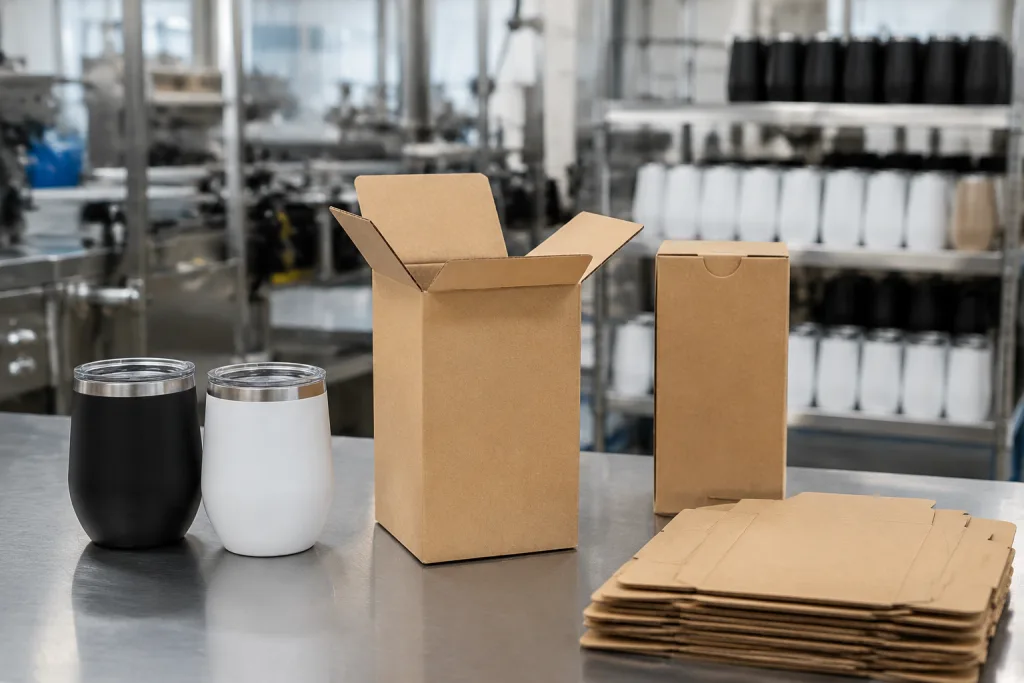
For North American or European distribution, lock the packing method before the carton die-line is approved: polybag or tissue wrap; egg-crate divider with flute direction checked; individual color box if shelf display matters; units per master carton; carton size in mm; gross weight limit; pallet pattern for the forwarder. For heavy drinkware, keep master cartons under 15-18 kg when possible. The line packs faster with a 3-ply carton, but the math often fails after LCL handling. We run 5-ply export cartons for safer stacking, especially when cartons will sit under mixed cargo in a Ningbo warehouse for 2 days before loading.
Drop testing should match the sales channel. For standard wholesale, a 76 cm drop test on one corner, three edges, and six faces gives a decent first screen; our QC team marks the tested carton with red tape so it does not slip back into good stock. For e-commerce, use stricter ISTA-style testing, because one loose tumbler inside a mailer can destroy the coating before the customer opens the box. If your order ships to Amazon FBA, confirm FNSKU placement, suffocation warnings for polybags, carton weight limits, and label size before production packing starts. Re-labeling 10,000 pcs in Zhejiang after packing is slow and expensive. We have seen this go sideways.
Packaging also changes MOQ. A plain white box can start at lower quantity, while custom color boxes often need 1,000-3,000 pcs per design depending on the print supplier and paper stock. If you are a canteen distributor testing a new SKU, do not spend like a retail launch before the shape, coating, and price point are proven. This is the wrong question to ask: “How cheap can the box be?” Ask whether the carton can protect 24 loaded tumblers through warehouse stacking, courier sorting, and one careless forklift hit.
Failure six: QC starts after production
QC should start before the PO, not at the final inspection table. If the inspection plan is weak, you find defects after steel, powder, cartons, and labor are already burned. Too late. For a wine tumbler vendor, we run control points at incoming 304 stainless sheet check, welding and vacuum test, polishing inspection under a 600-lux lamp, coating thickness check, decoration approval, lid fit testing, packing check, and final AQL inspection. QC once pulled a sample with a 0.6 mm lip burr before coating; after coating, that same burr becomes a buyer complaint.
Put AQL in writing. For 10,000-30,000 pcs B2B drinkware orders, AQL 2.5 for major defects and 4.0 for minor defects is a practical baseline. Critical defects, such as sharp edges, contamination, unsafe material, or severe leakage where leakproof is claimed, should be zero tolerance. Define defects in plain words. A 0.3 mm dust point on the bottom may be minor. A scratch across the front logo is major. A cracked lid is major. Rust on the inner wall is critical. We have seen this go sideways when the PO says “good quality” and nothing else; the math does not work at inspection time.
Ask for production photos, but do not treat photos as inspection. A good supplier can share line photos within 3-5 days after mass production starts, including welding trays, powder-coated bodies, and printed logo samples beside a ruler. Final inspection still needs sampling, measurements, function tests, barcode scans, carton drop checks, and packing verification. If you use a third-party inspector in China, send them the approved sample, artwork file, packing specification, and defect list. Without those, they inspect against their own assumptions. Last year an inspector rejected 2 cartons because the PO had “matte balck” while the approved sample was matte black with a soft-touch finish.
Our Hangzhou operation typically needs 7-10 days for new mold or complex sample preparation, 5-7 days for standard logo samples, and 25-35 days for mass production after deposit and sample approval. Bigger canteen suppliers may quote similar lead times, but this is the wrong question to ask. Ask whether the line is booked, whether coating capacity is locked, and whether lids, straws, inserts, and export cartons have arrival dates. A factory saying “30 days” without confirming the line schedule, coating oven slot, and packaging material arrival is guessing. We ship better when capacity is reserved before the deposit hits.
Failure seven: price compared without terms
Two wine tumbler quotations can sit USD 0.40 per piece apart and both can be honest. We see this every week. The cheaper sheet may be 0.4 mm steel instead of 0.5 mm, PP lid instead of Tritan-style material, plain white carton, no lab test, EXW terms, and no final inspection booking. The higher sheet may already cover FOB Ningbo or Shanghai, 304 inner wall, stronger powder coating, printed color box, barcode labels, and pre-shipment QC under AQL 2.5. If you compare only unit price, the math doesn't work. Last month QC pulled the sample from a low-price lot and found the lid flash was cutting the silicone ring.
Ask each canteen vendor or canteen supplier to quote in the same format: unit price, MOQ by color, logo cost, setup charge, sample cost, packaging cost, lab test cost, Incoterm, port, production lead time, and payment terms. Put it in one sheet. For a typical 12 oz stainless wine tumbler from China, a realistic FOB price may range from roughly USD 2.20-4.20 depending on material, lid, finish, logo, packaging, and quantity. Pricing below that usually has a reason. We once had a buyer flag a USD 0.18 “free” color box line after the PO showed EXW Hangzhou instead of FOB Ningbo.
For canteen manufacturers handling broader ranges, such as customizable growler, customized growler, custom canteen, and canteen promotional products, consolidation can cut email time and keep Pantone matching under control across repeat orders. One supplier, fewer arguments. Still, do not assume one factory is right for every SKU. A strong vacuum tumbler line may run 18,000 pcs per day, while its glass bottle line is outsourced to another workshop with different MOQ and a slower 30-day lead time. A professional canteen manufacturer should say where it is strong and where it subcontracts; if the answer is “we make everything,” we push back.
The best vendor relationship is not soft. It is specific. You define the spec, the factory confirms what the line can hold, both sides sign the sample, and QC measures against written standards with calipers, tape test, color card, and carton drop check. That is how you avoid paying for the same mistake twice. We have seen this go sideways when a buyer approved a logo by photo only, then rejected 5,000 pcs because the artwork on the PO had one letter typo.
Send your wine tumbler specification for factory review
We will check material, logo method, MOQ, packaging, and QC points before you commit to sampling or mass production.
Frequently asked questions
What MOQ should I expect from a wine tumbler vendor in China?
For a standard stainless steel wine tumbler, expect MOQ around 1,000 pcs per color for factory-direct production. If you need custom powder coating, custom lid color, or retail color box, 2,000-3,000 pcs per SKU may be more realistic because coating and packaging suppliers have their own minimums. For a mixed custom drinkware program with wine tumblers, custom canteen, and custom growler items, some factories can combine total order value but still require each color to meet a minimum. Sample orders are different: 1-5 pcs with logo are usually possible, but the sample cost may be USD 50-150 depending on decoration.
How long does a customized wine tumbler order usually take?
For an existing mold, plan 5-7 days for a logo sample and 25-35 days for mass production after sample approval and deposit. Add 3-7 days if the packaging is a custom color box, and longer if lab testing is required before shipment. New molds, special lids, or unusual surface finishes can add 15-30 days. Zhejiang and other China production hubs are fastest when specifications are frozen early. Artwork changes, Pantone changes, and packaging revisions after sample approval are the main reasons a 30-day schedule becomes 45 days.
Which logo method is safest for corporate wine tumblers?
Laser engraving is usually the safest for corporate and distributor drinkware orders because it is durable, clean, and hard to scratch off. It works especially well on powder-coated stainless steel. Silk screen printing is better when you need exact brand colors, but it requires ink adhesion checks and has more risk on curved surfaces. UV printing is useful for full-color artwork, but you should define rub testing and dishwasher claims. For a 12 oz wine tumbler, keep fine lines above 0.2 mm and approve a physical decorated sample before mass production.
Can the same supplier make canteen, growler, and wine tumbler products?
Often yes, if the supplier is a real canteen factory or stainless drinkware manufacturer rather than only a trading office. Many canteen vendors can produce wine tumblers, customizable canteen items, and distributor growler orders using similar welding, vacuum, polishing, coating, and decoration processes. The risk is assuming every product line has the same quality level. Ask for production photos, capacity, sample history, and inspection standards by SKU. A customized growler has different leak, handle, and cap requirements from a wine tumbler, so each item still needs its own specification sheet.
What inspections should I require before shipment?
Use a written final inspection based on AQL 2.5 major and 4.0 minor, plus zero tolerance for critical safety defects. The checklist should cover material appearance, dimensions, capacity, coating defects, logo position, lid fit, gasket condition, barcode scanning, carton markings, and packaging quantity. For splash-resistant wine tumbler lids, test a defined sample size for fit and functional closure. If you sell through e-commerce, add carton drop testing and FNSKU verification. For orders above 5,000 pcs, a mid-production check is also useful because it catches coating or decoration drift before the full batch is finished.