Key Takeaways
- A practical wine tumbler MOQ starts at 1,000 pcs for stock colors and 3,000 pcs for custom powder coating
- 304 stainless steel at 0.5 mm outer wall and 0.4 mm inner wall is a sensible baseline
- Plan 35-45 days production after artwork approval, plus sea freight time
- Use AQL 2.5/4.0 inspection with lid leak, vacuum, logo adhesion, and carton drop checks
You are not buying a “wine tumbler.” You are buying 38–55% retail margin, a fixed delivery date, a logo that must pass 3M tape testing after washing, and a five-layer export carton that should not arrive crushed after 35 days at sea. Good wine tumbler suppliers talk about 304 stainless thickness, lid fit, AQL, and packing drop tests before they talk discount. Weak suppliers send the lowest unit price and go quiet when QC pulled the sample and found a 0.6 mm lid gap.
From our Hangzhou, Zhejiang factory desk, the cleanest orders start with one clear use case: corporate gift, retail shelf, club merchandise, distributor drinkware program, or seasonal promotion with a hard ship window. We run the order differently for each one. A 3,000 pcs logo gift order with laser engraving is not the same job as a 12,000 pcs retail set needing barcode stickers and shelf-ready cartons. The wrong question is “who is cheapest?” Ask who can hold color, logo position, carton strength, and ETD without changing the spec after the PO. Below is how we would specify and QC one real B2B wine tumbler order from RFQ to shipment in China.
Start with the selling channel
Start with the sales channel before you ask wine tumbler suppliers for a price. Also write down who takes the complaint when a lid leaks or a carton arrives with the wrong barcode. A distributor canteen order for outdoor events is a different job from a premium retail wine tumbler set. For a canteen distributor, we check repeatable carton labels with a barcode scanner, lock mixed SKU control by carton mark, and keep replacement lids in the same mold family. A brand owner will push harder on surface finish under a 6500K light box, PMS color drift on powder coating, and whether the color box looks clean after a 60 cm drop test. Different fight.
For this walkthrough, assume you need 5,000 pcs of 12 oz double-wall stainless steel wine tumblers for a North American promotional program. The target landed retail positioning is mid-market, not luxury. Do not over-specify the job, but do not chase bargain parts either. We have seen this go sideways when a buyer saves USD 0.08 on a thin lid, then QC pulled the sample because the sip opening flashed at 0.4 mm and scratched the lip.
A sensible RFQ to a China canteen manufacturer or wine tumbler factory should include these details before we run costing on the line:
- Capacity: 12 oz, tolerance plus or minus 5%
- Material: food-grade 304 stainless steel inner and outer body
- Finish: matte powder coating, one PMS color, with target Delta E agreed before pre-production sample
- Logo: one-position laser engraving or 1-color screen print, with artwork size in mm
- Lid: clear AS or Tritan-style sip lid, BPA-free, matched to the existing mold if possible
- Packing: white box or custom color box, 24 pcs per master carton, with carton mark layout approved before mass packing
- Compliance: FDA food contact, LFGB or REACH if selling in Europe
- Incoterm: FOB Ningbo or FOB Shanghai
Our BottleForge facility in Zhejiang can produce about 420,000 stainless drinkware units per month across wine tumblers, sports bottles, travel tumblers, and custom growler lines. For this type of customized drinkware order, 5,000 pcs is enough to justify powder color matching, a pre-production sample, and an AQL 2.5 final inspection, but it is not enough for risky custom tooling unless your forecast is real. The math does not work. Last month a PO typo showed “12 oz” on page one and “14 oz” on the packing page; our merchandiser caught it before the 304 stainless shells were pulled from the semi-finished rack.
Build the specification sheet
The spec sheet is where good buyers separate real wine tumbler suppliers from catalog traders. A glossy photo is not a specification. You need numbers. If you ask 3 canteen suppliers to quote “12 oz wine tumbler with logo,” you will get 3 prices that look comparable on a spreadsheet but are not. We see this every month. One quote may use 201 stainless steel outside, one may use a 0.35 mm body, and one may include a cheap PS lid that turns cloudy after 20 dishwasher cycles; QC pulled a sample like this last season and the buyer flagged it before mass production.
For a stable 12 oz wine tumbler, we normally recommend 304 stainless steel for both inner and outer walls. Wall thickness around 0.5 mm outside and 0.4 mm inside gives a good balance between dent resistance and cost. Our line checks body thickness with a digital micrometer before polishing, because a 0.1 mm saving looks small but changes the dent rate in carton drop tests. Vacuum insulation should hold cold wine or cocktails for 6-9 hours under normal use. Be careful with big thermal claims. A 12-hour claim may pass in a lab with fixed water temperature and no opening, but retail consumers do not drink in a lab.
The lid deserves more attention than it usually gets. A push-on sip lid is convenient but not fully leakproof. If your program requires bag-carry performance, you need a gasketed sliding lid or a different product category. Letting a canteen vendor write “leakproof” on a sales sheet without a test method is the wrong question to ask, and we have seen this go sideways after shipment. We run an inverted shake test for 30 seconds and a side-rest test for 10 minutes; even then, wine tumbler lids should be described as splash-resistant. No guessing.
For color, provide Pantone C or Pantone U references and accept a realistic tolerance. Powder coating on curved stainless steel will not look exactly like ink on paper. Delta E below 2.0 is tight and may cost more; Delta E below 3.0 is usually acceptable for promotional custom drinkware. Our coating room checks color with a spectrophotometer after the first 30 pcs, not after 3,000 pcs are packed. If you are matching other items such as a customizable canteen, custom canteen, or customized growler in the same campaign, ask the factory to coat all items in the same batch when possible.
Choose decoration without guessing
Decoration is where 6 out of 20 customized drinkware quotes lose margin. Laser engraving suits simple stainless-reveal logos, screen printing fits solid Pantone marks, heat transfer works for curved artwork, and full-wrap printing needs careful seam control. They do not carry the same cost, durability, or MOQ. A buyer planning a canteen promotional program often asks for a 60 mm logo because “bigger looks cheaper per impression.” A retail brand usually asks us to pull it back to 32-38 mm so the tumbler looks less like a giveaway. Both choices can work, but guessing from a PDF mockup is the wrong way to decide; we check it on the line with a printed paper wrap before opening film.
For this 5,000 pc wine tumbler order, laser engraving is the safest option if the logo is simple. It removes the coating and exposes the stainless steel underneath, so ink adhesion is not part of the risk. Typical logo setup cost is USD 40-80, and unit decoration cost runs around USD 0.12-0.25 depending on logo size and line speed. On our Han's laser machine, a 35 mm single-side logo usually runs faster than a 55 mm badge because the head travel is shorter. Simple math. The weak point is artwork: fine gradients, light colors, and photo-style designs do not engrave cleanly, and QC pulled one sample last quarter because the buyer’s thin 0.18 mm line disappeared after coating variation.
Screen printing is better for a solid-color logo on a light or dark body. It is cost-effective at 3,000 pcs and above, with setup around USD 50-100 per color. The risk is adhesion. Your canteen factory should run a cross-hatch tape test with 3M tape, an alcohol rub test for at least 50 strokes, and a dishwasher simulation if the product will be marketed as dishwasher safe. Ask for the test photo, not just the sentence on the quotation. We have seen this go sideways: one PO had “dishwasher safe” typed into the artwork approval, but the ink spec was only for hand-wash promotion stock.
Full-wrap heat transfer can make a wine tumbler look retail-ready, but tapered bodies raise scrap. Expect a higher MOQ, often 3,000-5,000 pcs per design, and allow 5-7 days for film proofing before mass production. On a 12 oz wine tumbler, a 1.5 mm shift near the seam is visible because the eye catches the vertical line first. If you also source customizable growler or distributor growler products, keep the artwork zones separate because the curvature and seam position differ. One artwork file rarely fits every item cleanly; the math doesn't work when a 78 mm diameter tumbler file gets stretched onto a wider growler body.
Practical rule: for corporate gifting, use laser. For retail shelf impact, choose screen print or full-wrap, but budget 5-7 extra days for proofing and one more QC check before packing.

Quote the order like a factory
A usable RFQ forces every supplier to price the same cup. For this sample order, we would quote a 12 oz 304 stainless steel wine tumbler with matte powder coating and one laser logo at about USD 2.35-3.20 per piece FOB China at 5,000 pcs, with movement from steel price, lid material, carton style, and inspection level. If someone comes back at USD 1.70, the math does not work. Something got cut: thinner body, cheaper lid, no inner carton, or a coating line that will fail the 3M tape test. QC pulled one sample last month with a 0.38 mm body wall where the buyer’s spec called for 0.45 mm.
Ask each canteen manufacturer to split the quote into product, decoration, packing, sample fee, mold or tooling, and inland freight if any. You do not need a 20-line cost sheet, but you need enough to compare apples with apples. Put the packing spec in writing: 350 gsm paperboard, matte lamination, barcode labels, master carton size, and drop-test requirement if your retailer asks for it. We have seen this go sideways when a canteen vendor buried the color box inside the unit price, then pushed back after the buyer changed from a plain white box to printed retail packaging with an EAN-13 label.
Payment terms change the number. The usual China structure is 30% deposit and 70% balance before shipment after passed inspection. For established buyers with credit insurance or repeat POs, terms can move, but first orders usually stay tight. Fair enough. FOB Ningbo works well for Zhejiang factories because the port is close, stable, and known by local forwarders; from our Hangzhou line, the truck to Ningbo is usually booked as a 17.5 m trailer or a smaller 9.6 m truck depending on carton volume.
Lead time for this order should be quoted by stage, not as one loose promise. Pre-production sample: 7-10 days after artwork confirmation. Mass production: 35-45 days after sample approval and deposit. Inspection and loading: 2-4 days. If your distributor canteen program has a fixed event date, add at least 14 days of buffer. Ocean freight, customs clearance, and domestic trucking can easily add 35-55 days to North America and 30-45 days to Europe, depending on season. We run into problems when the PO says “need before trade show” but the artwork file arrives 6 days late with the logo color typed as Pantone 186C in one place and 185C in another.
Approve samples with discipline
Sample approval is not photo approval. A photo can hide a rough rim, loose lid, weak coating, or a logo sitting 8 mm too high. For a custom drinkware order, ask for a physical pre-production sample when the schedule allows. Touch it. Twist the lid. Put it on a flat table and check wobble. If the buyer is pushing a tight ship date, we ask the line to shoot one clear video: 360-degree rotation, lid insertion, logo close-up, carton mock-up, and weight on a digital scale showing grams.
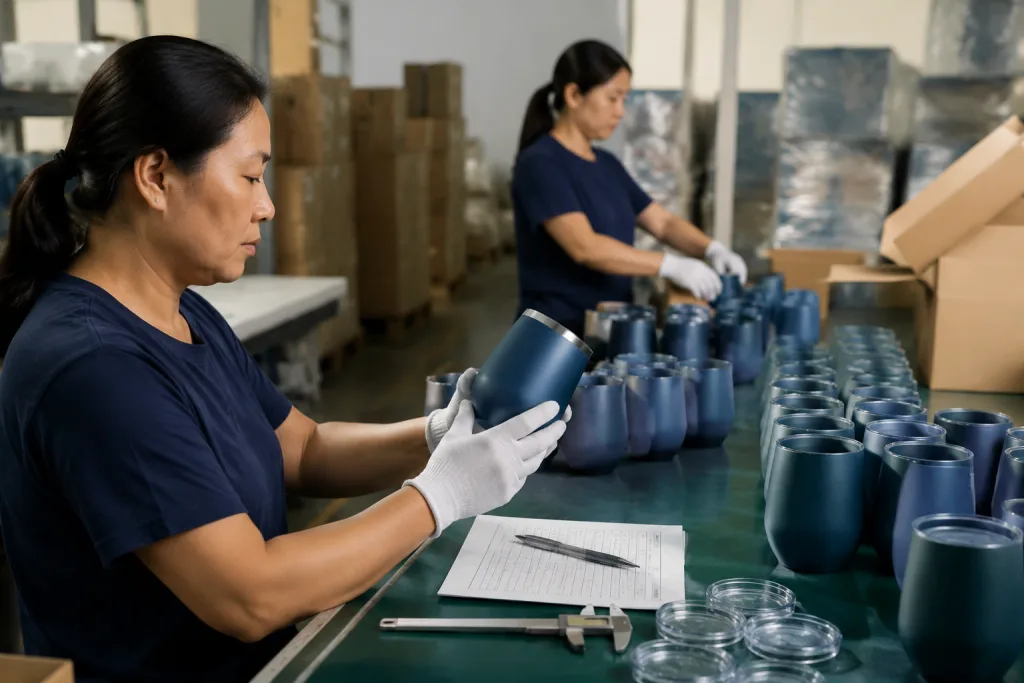
For the 5,000 pc wine tumbler order, we check the sample against a signed specification sheet, not a sales photo. Measure height, top diameter, bottom diameter, capacity to overflow, and net weight with calipers and a bench scale. A 12 oz tumbler should not quietly become 10.8 oz because the supplier used an existing mold. That is the wrong question to ask after mass production starts. Check mouth rim smoothness with a finger and a white cloth; QC pulled one sample last month with a tiny burr that only showed up as a gray line on the cloth. Burrs are not acceptable, especially for drinkware used without a straw.
Then check the finish. Powder coating should be even around the top curve and bottom radius, the two spots where the spray gun often leaves thin coverage. Lightly scratch an unseen area with a fingernail; it should not peel. For printed logos, run a 3M tape pull test after cross-hatching with a blade. For laser logos, check that the engraving is centered, not burnt brown, and not distorted by the curve. We’ve seen this go sideways when a logo looked fine at 30 cm but failed the tape pull in 6 squares.
Packing samples matter too. If you are a canteen distributor or selling through distributor drinkware channels, carton consistency is not cosmetic; it affects warehouse handling. Confirm individual box dimensions, master carton size, gross weight, barcode position, and any FNSKU or SKU label rules. One buyer flagged a PO typo where the carton mark said “wine tumlber,” and catching it before printing saved 120 cartons from rework. For e-commerce, avoid loose lids inside the cup unless there is a protective bag or insert. Rattling parts create bad reviews even when the tumbler itself is fine.

Inspect before the balance payment
Run final inspection when at least 80% of the order is packed and 100% is produced. For 5,000 pcs, we usually set third-party or factory QC against ANSI/ASQ Z1.4, general inspection level II. A common AQL setting is 2.5 for major defects and 4.0 for minor defects. Critical defects should be zero. If a supplier pushes back on AQL wording in the PI, the math doesn't work; we had one buyer flag this after QC pulled 200 samples and found 7 major defects.
For wine tumblers, critical checks are sharp edges, rust, oil contamination, wrong material, severe leaks, or foreign matter inside the cup. Major defects include obvious dents, coating chips, loose lids, wrong logo position, poor vacuum performance, and incorrect carton labels. Minor defects include small dust points, slight color shade variation within tolerance, or tiny box scuffs. On the line, we use a 0.5 mm feeler gauge around the lid fit because “loose” means nothing unless both sides agree on the gap.
Vacuum testing can be done by hot water or thermal retention sampling. For example, fill selected tumblers with 95°C water, close the lid, and check outside wall temperature after 5 minutes. A failed vacuum unit gets hot fast. For cold retention, test 12 hours vs 18 hours if the claim is printed on the box, but this is the wrong test to start during final inspection. The factory should already have run 100% vacuum screening before packing; final inspection checks whether that station actually worked, not whether one inspector can babysit ice water all day.
Carton drop testing is worth doing. For export cartons, we run a 1-corner, 3-edge, 6-face drop sequence from 60-76 cm depending on carton weight. If your order ships to Amazon FBA or a large retailer, follow their carton weight and label rules exactly. One wrong FNSKU, suffocation warning, or carton dimension can cost more than the inspection itself. We have seen a PO typo turn 45.5 cm into 54.5 cm, and the buyer flagged it only after the warehouse measured the master carton with a tape gun on the packing table.
At BottleForge in Zhejiang, we prefer buyers to inspect before paying the 70% balance. It protects you and protects the factory from arguments after the goods have already left China. Clear inspection rules make both sides more serious. We ship smoother when the checklist says “logo center within 2 mm” instead of “logo must look good.”
Plan the reorder before shipment
The best time to fix a wine tumbler program is before the first shipment leaves our dock. After the cartons are on the truck, a 1 mm logo shift or a weak carton corner costs money. If the first 5,000 pcs are for a seasonal promotion, ask your supplier to keep the coating recipe, laser logo jig setting, carton dieline, and signed golden sample record for at least 18 months. Reorders move faster when the line is not guessing from photos.
If sell-through is strong, you might carry the same look into a canteen customized bottle, canteen customizable outdoor bottle, customized canteen gift set, or distributor growler line. This is where a real canteen manufacturers group or integrated canteen factory earns its keep. We run color matching in the same powder booth, check the color chip under D65 light, and keep finish drift within a clear limit instead of arguing by eye. Matching stainless wine tumblers, sports bottles, and a custom growler under one roof is simpler because engineering can pull the old process card in 5 minutes.
For reorders, confirm whether the price still holds. Stainless steel, powder, carton paper, and exchange rates move week by week. A good supplier will not pretend costs stayed flat, but they should show the math on the quote sheet. If your first order was USD 2.68 FOB and the reorder becomes USD 2.82, ask whether the change came from 304 stainless coil, coating loss rate, packaging, or labor. If the answer is just “market price,” push back. The math doesn't work.
Track field complaints after delivery. If 0.5% of consumers report tight lids, that may pass for some channels, especially if QC pulled the sample and the lid torque gauge was still inside spec. If 3% report coating scratches after one week, stop the reorder and cut open returned units before repeating the same PO. B2B buyers sometimes chase the AQL 2.5 pass report and miss after-sale data. Wrong question. Define the spec, inspect the shipment, listen to the market, then tighten the next PO before we ship again.
Send your wine tumbler RFQ for factory review
Share capacity, quantity, logo method, target market, and delivery date. We will reply with practical specs, MOQ, lead time, and FOB pricing.
Frequently asked questions
What MOQ should I expect from wine tumbler suppliers?
For standard 12 oz or 14 oz stainless wine tumblers, expect 1,000 pcs MOQ if you use available body shapes and stock powder colors. For custom PMS powder coating, 3,000 pcs is more realistic because coating line setup, color loss, and cleaning time must be covered. Full-wrap artwork or special lids may push MOQ to 5,000 pcs. If a supplier accepts 300 pcs with full customization, check whether they are using spot inventory, digital decoration, or a trading warehouse. That can work for samples or small events, but color repeatability and reorder stability may be weaker.
Is 304 stainless steel always necessary for wine tumblers?
For export custom drinkware, 304 stainless steel is the safest default, especially for the inner wall that contacts beverages. Some factories quote 201 stainless steel for the outer wall to reduce cost by roughly USD 0.10-0.25 per unit, depending on thickness and market price. We do not recommend 201 inside the cup for wine, cocktails, or acidic drinks. If you accept 201 outside, state it clearly on the PO and inspection checklist. For Europe, also confirm LFGB or relevant food contact testing. For North America, FDA food contact compliance is the normal baseline.
How long does a custom wine tumbler order take from China?
A normal timeline is 7-10 days for pre-production samples after artwork approval, then 35-45 days for mass production after deposit and sample sign-off. Add 2-4 days for final inspection, booking, and loading. Ocean freight and destination handling usually add 30-55 days depending on port, season, and inland delivery address. If you need goods for a fixed promotion date, work backward and add at least 15 days of buffer. Zhejiang factories shipping FOB Ningbo can move quickly, but vessel space, customs exams, and retailer receiving appointments are outside the factory’s direct control.
Which logo method is best for promotional wine tumblers?
For most canteen promotional and corporate gift orders, laser engraving is the lowest-risk choice. It is durable, clean, and usually costs about USD 0.12-0.25 per unit after a USD 40-80 setup charge. Screen printing is better when you need a colored logo, but you should require adhesion testing such as cross-hatch tape, alcohol rub, and dishwasher simulation if relevant. Full-wrap transfer gives stronger retail impact but usually needs 3,000-5,000 pcs per design and more proofing time. Choose the method based on artwork, channel, and complaint risk, not only the first quoted price.
Can one supplier handle wine tumblers, canteens, and growlers together?
Yes, if the supplier is a real canteen manufacturer with stainless forming, coating, decoration, packing, and QC control, not only a catalog office. Combining wine tumblers with customizable canteen, customized growler, or distributor canteen items can simplify color matching and carton planning. The risk is assuming every item uses the same MOQ and lead time. A wine tumbler may be 1,000-3,000 pcs MOQ, while a special growler lid or handle may require 3,000-5,000 pcs. Ask for one project schedule by SKU, including sample dates, production dates, and inspection dates.