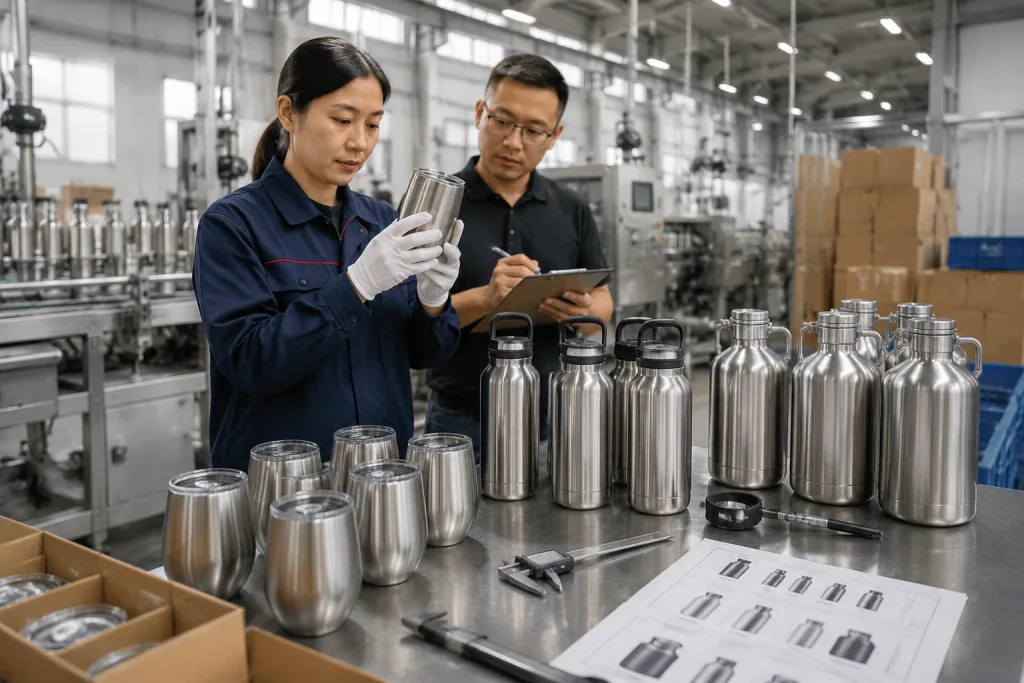
Key Takeaways
- A 12 oz wine tumbler promotional order usually starts from 1,000 pcs per color with 25-35 day production
- 304 stainless steel at 0.5 mm wall thickness is the safer export spec for Europe and North America
- Powder coating adds about USD 0.35-0.70 per unit versus basic polished stainless
- Canteens and growlers win on capacity; wine tumblers win on gifting, logo visibility, and lower freight cube
A wine tumbler promotional order looks simple until the quote sheet arrives. Two factories can both quote a 12 oz stainless tumbler, but one is running 0.4 mm 201 steel and the other 0.5 mm 304. Then the lid fit, powder coating thickness, carton drop test, and logo process move the landed cost by USD 0.18-0.45 per piece. QC catches this fast with a caliper and a water-fill weight check.
If you buy custom drinkware for retail campaigns, wine clubs, outdoor events, or corporate gifts, compare the wine tumbler against canteen custom and growler formats before chasing the lowest FOB. Our Hangzhou, Zhejiang team sees 6-8 buyers a month overpay for the wrong shape. It happens. One buyer flagged a “12 oz” PO last quarter after the sample only held 335 ml to the rim, so the math did not work for their wine-club pack. The wrong question is “which cup is cheapest?” Ask which item fits the use case, decoration area, compliance file, and repeat order plan.
Where the three formats differ
For promotional sourcing, wine tumblers, canteens, and growlers are not interchangeable. They share the same custom drinkware shelf, but buyers order them for different jobs. A wine tumbler promotional item is about perceived value, hand feel, and logo exposure at a dinner, golf event, winery visit, hotel welcome pack, or outdoor concert; on our line, QC checks the 12 oz body with a go/no-go lid gauge because a loose sip lid gets flagged fast. A custom canteen is built for carry, backpacks, and daily hydration. A custom growler is for beer, cider, cold brew, or large-volume takeaway.
Here is the head-to-head baseline we use with B2B buyers from Europe and North America. We run this costing sheet before sampling, because one buyer once approved a 64 oz growler artwork, then pushed back when the packed carton hit 17 kg and his courier quote doubled.
| Item | Typical capacity | Best promotional fit | Common MOQ | FOB China range |
|---|---|---|---|---|
| Stemless wine tumbler | 10-14 oz | Wine clubs, hospitality, corporate gifts | 1,000 pcs/color | USD 2.30-4.20 |
| Canteen customized bottle | 18-32 oz | Outdoor events, schools, travel retail | 1,000-3,000 pcs | USD 3.20-6.80 |
| Customized growler | 32-64 oz | Breweries, sports clubs, camping bundles | 500-1,000 pcs | USD 6.50-13.50 |
The wine tumbler is the safer first order when you need broad demographic appeal. It is not gendered, it is less tied to summer than beach bottles, and it packs well. A 12 oz double-wall tumbler normally ships 24 pcs per master carton, around 0.055-0.065 CBM per carton depending on insert packaging. Small carton, less pain. That matters when air freight is needed for a campaign deadline, and we have seen 3 mm extra EVA foam in gift boxes turn an 18-day sea plan into a 12-day air rescue.
A canteen promotional product has a clearer outdoor identity. If your customer is a canteen distributor or distributor drinkware buyer serving schools, camps, tourism stores, and corporate wellness programs, the canteen format can sell through better because the user expects a carry loop, wider mouth, and 18-32 oz capacity. Growlers are more niche but carry a higher ticket. Choosing a growler just because it looks premium is the wrong question to ask; if end users do not need 64 oz capacity, the math does not work after extra steel, heavier lid tooling, and freight weight. QC pulled one growler sample last month for a 0.6 mm rim dent after drop testing, and that kind of finding is harder to hide on a large polished body.
Material specs that affect claims
Most export buyers should call out inner 304 stainless steel for every beverage-contact surface. For the outer wall, 201 stainless cuts cost, but we run 304/304 for wine tumbler promotional programs headed to retail or food-service shelves. The cost gap is USD 0.15-0.35 per 12 oz piece, and the math works when you compare it with 37 corrosion claims from one salty-coast hotel order we saw after staff put coated cups through a commercial dishwasher. QC pulled the sample. Brown spots showed up around the rolled rim.
For vacuum items, check the construction, not only the steel grade. A decent 12 oz wine tumbler uses about 0.45-0.55 mm wall thickness before forming, measured with a Mitutoyo thickness gauge before the body goes to the stretch-forming line. Some cheap quotes use thinner steel and hide it under a clean powder coat. Wrong place to save money. It can pass a quick office inspection, but it feels light in the hand and dents faster. Canteen manufacturers and canteen suppliers face the same issue on 24 oz and 32 oz bottles, where shoulder denting shows after carton compression or courier handling.
Write insulation performance into the purchase order. For a 12 oz vacuum wine tumbler, a fair test is hot water at 95°C, ambient room at 20-25°C, with temperature readings after 3 hours and 6 hours. Do not accept loose wording like “keeps hot and cold for hours.” We have seen this go sideways when a buyer’s PO said “good insulation” and their warehouse team later expected 8 hours on a lid with a drink slot. For a customizable growler, buyers often ask for 12-24 hour cold retention, but the lid seal and neck design affect results as much as the body.
Compliance is not optional. For EU programs, ask for LFGB or food contact testing, plus REACH for coatings where relevant. For the United States, FDA food contact material expectations and California Proposition 65 risk review apply by distribution plan. If children use the product, ASTM-related safety evaluation can come into play. A serious canteen factory in China should understand these files before production, not after you request shipment release; last quarter one PO even had “LFBG” typed wrong, and the buyer flagged it during pre-shipment document review.
Decoration: logo visibility versus durability
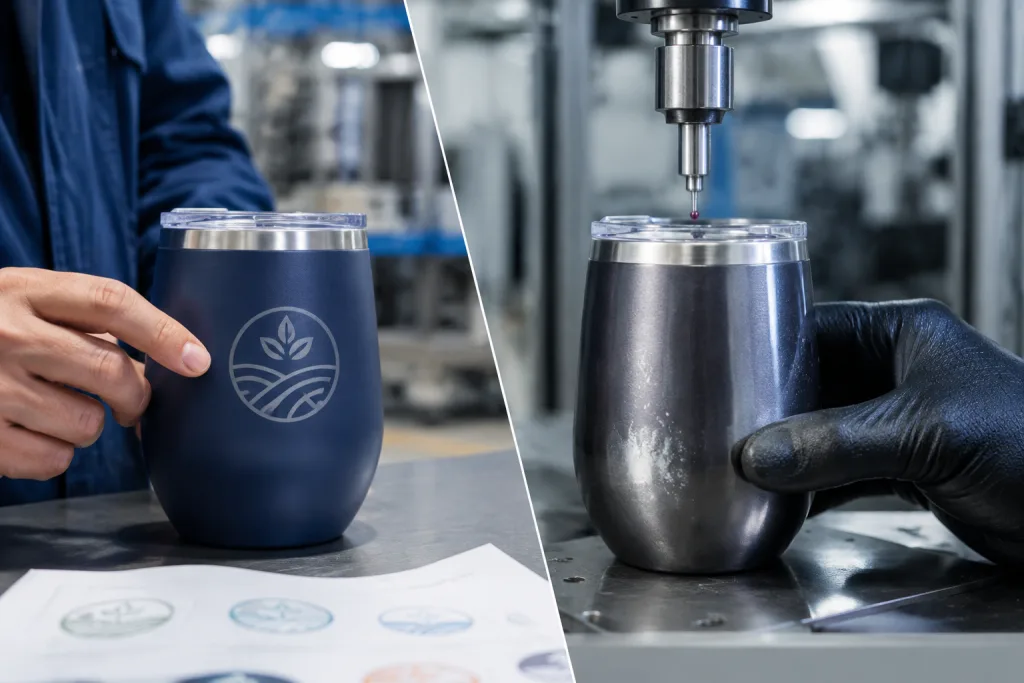
Decoration is where roughly 7 out of 10 promotional tumbler orders either look retail-ready or start to feel cheap. A wine tumbler promotional project gives you a wide, clean logo panel, so use it properly. On a 12 oz stemless body, a common logo size is 45-60 mm wide for front placement, or a 180-220 mm wrap if the design is simple. Laser engraving works well on powder coating and exposes stainless underneath. It holds up in rub tests, looks clean, and suits corporate gifts. It cannot print full-color artwork. Last month QC pulled a matte navy sample from the line where the 55 mm logo looked fine on the PDF but sat 4 mm too low on the cup.
Silkscreen printing is cheaper for one or two colors, usually adding about USD 0.08-0.18 per color per position at normal volumes. Heat transfer and water transfer can handle gradients or large graphics, but they need tighter artwork control and abrasion testing with 3M tape plus a wet cloth rub. If you sell through canteen distributors or distributor canteen channels, they often reorder the same logo in 300-500 pcs batches after the first campaign. Laser is easier to repeat than a multi-color print with tight registration. We have seen this go sideways: the buyer approved Pantone 872C gold, then flagged the reorder because the second print run shifted half a tone under warehouse lighting.
Here is the honest comparison from the factory side:
- Laser engraving: best durability and a premium hand-feel, but the effect depends on coating thickness; we check it after the first 20 pcs, not after 2,000 pcs.
- Silkscreen: cost-effective for simple logos, with curing and adhesion checks needed before packing.
- UV print: broad color range, but the math does not work well on heavy curves or rough powder textures.
- Powder coat plus laser: the most common retail-grade promotional look, especially for black, white, navy, and army green bodies.
- Full wrap transfer: strong shelf impact, with higher setup risk if the seam lands near the front logo panel.
Canteen customizable shapes vary more than buyers expect. Flat-sided canteens are good for large logos, while round bottles stretch artwork at the left and right edges. A canteen vendor should provide a print area template before sampling, with the safe zone marked in mm. For customized growler programs, do not place tiny legal text near the shoulder or base curve. It will not stay crisp after production, even if the digital mockup looks perfect. On one 64 oz growler job, the buyer pushed for 5 pt text near the lower radius; our pad-print master rejected it before the first sample because the silicone pad would blur the letters.
At BottleForge Industrial in Zhejiang, our pre-production sample approval normally includes a coated sample with the confirmed finish, a logo sample checked against the artwork file, and a packaging sample with the carton mark verified for orders above 3,000 pcs. That usually adds 3-5 days, not 12 days vs 18 days. It is still worth doing. It prevents the familiar argument over whether the factory or the buyer misunderstood “matte black with gold logo,” especially when the PO says “golden logo” but the approved mockup shows beige foil.
Use-case fit by buying channel
Start with the channel. A hotel welcome-gift order and a brewery growler program should not be built on the same spec sheet. We match body shape, lid, packing, and target FOB to the handoff scene: front desk, tasting bar, retail shelf, or event table. Small detail, big trouble: last month QC pulled a 12 oz wine tumbler sample because the PP lid sat 0.6 mm high on one side after logo printing.
| Buying channel | Best fit | Why it works | Watch point |
|---|---|---|---|
| Wine clubs and wineries | Wine tumbler | Good fit for tasting rooms, patio service, and 1-day outdoor events | Mouth opening and lid sip comfort need checking with the actual lid |
| Corporate gifting | Wine tumbler or canteen | Clean logo area, gift box option, easy carton planning for 24 pcs per carton | Batch-to-batch color drift, especially matte black and cream powder coating |
| Outdoor retail | Customizable canteen | Better daily-use value for hiking, gym, and travel shelves | We run leak testing and handle pull checks before final packing |
| Breweries and taprooms | Customizable growler | Large capacity supports a higher retail ticket at the taproom counter | Cap seal, inner wall polishing, and beer-odor retention after washing |
| School or camp programs | Canteen customized bottle | Name label area, shoulder strap option, simple carry for kids | Age grading, straw parts, and removable silicone pieces |
If the audience is broad and the campaign runs for 2-4 weeks, pick the wine tumbler. Faster approvals. Fewer questions. It packs cleanly, and end users understand it without a hangtag explaining the product. For hiking, fitness, tourism, or outdoor retail buyers, the canteen promotional route gets used more after the event. Here is the wrong question to ask: “Which one is cheapest?” Ask which lid will survive the channel. For a canteen manufacturer, screw cap, straw lid, chug lid, and carry handle are not small changes; each one affects mold cost, silicone fit, assembly speed, and defect rate on the line.
Distributor drinkware programs live or die on reorder behavior. A promotional wine tumbler often reorders by seasonal color: matte white for spring, navy for autumn, red for holiday campaigns. A custom canteen usually reorders by capacity and lid family, such as 18 oz with straw lid versus 24 oz with chug lid. A custom growler reorders by account, not broad stock demand. We have seen this go sideways when a PO says “black lid” but the buyer meant black slider, not black full lid; that one typo stopped packing for 2 days while the sales team confirmed photos.
Our China production line can output about 450,000 stainless drinkware units per month across tumblers, bottles, and canteens. Normal lead time is 25-35 days after deposit and sample approval for standard colors, and 40-50 days for custom Pantone powder coating or new mold accessories. On the floor, we run coating thickness checks in microns, carton drop tests, and AQL 2.5 final inspection before shipment. The math does not work if a buyer asks for 3 custom lids, 6 colors, and 1,000 pcs total; MOQ pressure shows up in tooling, setup loss, and spare parts inventory.
Cost structure beyond unit price
A low FOB quote can hide expensive choices. For a 12 oz wine tumbler promotional order, the base cup may look like USD 2.60 FOB Ningbo or Shanghai on the first worksheet. Then the line adds matte powder coating, laser logo, individual kraft box, thicker K=K master carton, barcode sticker, and one extra inspection booking, and the working FOB moves to USD 3.25-3.70. We see this often when QC pulls the gold sample and finds the logo is fine, but the buyer's PO forgot the kraft box line. The price is still workable. Just build the full landed model before you give your customer a margin.
For a canteen customized order, the lid set can change the cost more than the stainless body. A basic screw cap may add USD 0.25-0.45. A straw lid with silicone gasket, dust cap, and carry handle can add USD 0.70-1.20, and our packing team may need a taller inner box by 8-12 mm. A shoulder strap, carabiner, or silicone boot also changes carton size and CBM. Some canteen vendors quote the stripped bottle first, then add the accessories after artwork approval. Ask for a component-level quote if you want to compare canteen manufacturers fairly; otherwise the math doesn't work.
Growlers punish freight budgets. A 64 oz stainless growler can look strong on a product page, but freight per unit can run two or three times a wine tumbler because the carton is tall and the gross weight climbs fast. Last season we measured a sample carton with a tape at 46 cm height, and the forwarder billed by dimensional weight, not actual weight. If you ship to Amazon FBA or a 3PL, carton labels and packing rules matter. For FBA, plan for FNSKU labels, carton labels, drop-test packaging, and separate cartons by SKU unless your receiving plan says otherwise.
Inspection cost belongs in the budget from day one. A pre-shipment inspection using AQL II, commonly AQL 2.5 for major defects and 4.0 for minor defects, costs far less than sorting goods in Rotterdam, Hamburg, Los Angeles, or Toronto. On the factory floor, the inspector will use a 2 mm position gauge for logo shift, a leak test table for lids, and a vacuum check after hot-water filling. Typical findings include coating scratches, logo misalignment over 2 mm, lid leakage, odor, sharp rim, vacuum failure, crushed master cartons, and barcodes placed on the wrong panel.
Payment terms vary, but 30% deposit and 70% before shipment remains normal for first orders from China. After repeat business, some buyers negotiate 20/80, OA through insurance, or partial payment against bill of lading. We usually ask accounting to match the deposit slip against the PI number because one buyer once typed 12 oz as 120 oz on the PO, and nobody wants that mistake in production. Be careful if a new canteen vendor offers loose terms and a price below material cost. We've seen this go sideways.

Sampling and approval without surprises
Sampling should answer production questions, not just make a pretty photo. For a wine tumbler promotional order, ask for a plain sample first if you are checking the curve, mouth diameter, and hand feel; then pay for a logo sample only when the order value makes sense. A stock-color sample can usually ship in 3-5 days. A custom powder-coated and laser-engraved sample normally takes 7-12 days. We run these through the sample room with a color chip and a 0.01 mm caliper on the rim. If a factory promises a fully custom sample in 48 hours, push back and ask what is actually custom.
Your sample approval should lock down measurable points: brim capacity versus practical fill line in ml, unit weight tolerance in grams, logo height and width, coating color reference, lid fit after 10 open-close cycles, silicone odor after unpacking, carton dimensions, and gift box material. For matte coating, we recommend a 3M tape test and a basic abrasion rub test before mass production. For printed logos, request curing confirmation and a photo after adhesion testing. QC pulled one sample last month where the logo passed in the photo but failed after 30 rubs with a white cotton cloth. That saves arguments later.
This matters more when comparing canteen suppliers. A canteen customizable project may include several plastic and silicone parts, each with its own color tolerance. A black lid and strap can already look different; add the black powder-coated body and daylight will show the gap fast. We check this under a D65 light box because office lighting hides too much. If the product is for retail, the buyer will flag it on the shelf, not in a spreadsheet.
For customized drinkware orders above 5,000 pcs, we prefer a signed golden sample and a short pilot run before full production. The pilot run may be only 50-100 pcs, but it catches the wrong fixture angle, a 2 mm logo drift, or a gift box that rubs the coating at the rim. We ship from Zhejiang every week, and the factories that control this step usually lose fewer days to rework. This is not about being slow. The math does not work if you discover a coating adhesion problem after 10,000 units are already packed.
Final selection matrix for buyers
If you need one practical decision rule, use this: pick the item the end user understands in three seconds. A wine tumbler promotional item says hotel welcome drink, patio gift, or VIP event giveaway without much explanation. A canteen says hydration on the move, especially when the buyer asks for a carabiner lid or a 58 mm wide-mouth opening. A growler says bulk beverage use: brewery refill, camping set, or member-only gift. Simple wins. We have seen this go sideways when a buyer chose a “cooler-looking” shape, then spent 3 extra days rewriting the insert card because the use case was not obvious.
For a first-time program, we usually steer buyers to a 12 oz or 14 oz double-wall stainless wine tumbler, 304 inner steel, powder coating, laser logo, BPA-free clear lid, and individual kraft box. Keep the color count to 1-3 colors. Use 1,000 pcs per color as a planning MOQ, even if a supplier says 500 pcs is possible. The math often does not work below that: the line still needs coating gun setup, logo jig adjustment, and carton label checking, so the unit price jumps or the color choice gets cut to stock shades. Last month QC pulled a 14 oz sample because the laser mark sat 2 mm off center; that is the kind of issue you catch faster when the spec is simple.
Move to canteen customized products when your channel has a real hydration use case. If you are a canteen distributor supplying outdoor clubs or school programs, a 20 oz or 24 oz custom canteen with a tight screw lid may beat a wine tumbler on reorder rate. We run a leak test by filling the sample, laying it on its side for 30 minutes, then checking the lid thread and silicone ring. No shortcut there. Move to distributor growler programs only when the account can explain the use, such as brewery refill, camping bundle, large cold beverage, or premium membership gift; otherwise the carton size and freight cost make the program harder to sell.
Before issuing the purchase order, ask every canteen factory or tumbler supplier for the same facts: steel grade, wall thickness, insulation test method, coating process, logo method, MOQ, sample time, mass production lead time, packing details, compliance documents, AQL inspection plan, and FOB port. Send the list in one email. We once had a PO typo showing “matte back” instead of “matte black,” and the buyer flagged it only after the pre-production sample photo; that cost 2 days, not 20 minutes. If two quotes still look close, choose the factory that answers these points clearly. In B2B custom drinkware, clear answers beat a USD 0.10 cheaper unit price.
Send your drinkware brief for a factory quote
Share capacity, color, logo, packing, target price, and delivery date. Our Zhejiang team will return practical options, not vague catalog pricing.
Frequently asked questions
What is the best size for a wine tumbler promotional order?
For most B2B campaigns, 12 oz is the safest size. It feels like a proper gift, fits wine, cocktails, coffee, and soft drinks, and usually packs more efficiently than 14 oz or 16 oz. A 12 oz double-wall stainless tumbler commonly uses 24 pcs per master carton and starts around 1,000 pcs per color. If your buyer is a winery or outdoor event organizer, 12 oz with a clear push-on lid works well. For corporate gift sets, 14 oz can look more premium, but the FOB cost may rise by USD 0.25-0.50 per unit and carton volume also increases.
Should I choose a wine tumbler or a custom canteen?
Choose the wine tumbler if the campaign is hospitality, gifting, wine, events, or general brand promotion. Choose a custom canteen if the end user needs daily carry, school use, outdoor travel, or fitness hydration. A canteen customizable order has more lid choices, but also more parts to inspect. A 24 oz customized canteen may cost USD 3.80-6.50 FOB China depending on lid and coating, while a 12 oz wine tumbler promotional item may sit around USD 2.30-4.20. The tumbler is usually lower risk for a first promotional order.
What MOQ should canteen distributors expect from a China factory?
For standard stainless tumblers and bottles, plan around 1,000 pcs per color. For canteen distributors ordering special lids, straps, silicone boots, or Pantone powder coating, 3,000 pcs is more realistic. A canteen manufacturer may accept 500 pcs for stock colors, but the unit price is higher and production priority may be weaker. For new mold work, MOQ can move to 5,000-10,000 pcs depending on tooling cost. Always ask whether the MOQ is per order, per color, per logo, or per SKU, because those four answers can change your budget quickly.
Which logo method is most durable for customized drinkware?
Laser engraving is usually the most durable method for stainless customized drinkware, especially on powder-coated wine tumblers and canteens. It does not peel like a poor print can, and it handles daily use well. Silkscreen is fine for one or two solid colors if the coating is properly cured and adhesion tested. UV print and heat transfer are better for full-color artwork but need more inspection. For a wine tumbler promotional program expected to last 12-24 months in the user’s kitchen or office, powder coat plus laser engraving is the practical premium choice.
How long does production take for promotional drinkware from Zhejiang?
For standard wine tumbler promotional orders from Zhejiang, normal production is 25-35 days after deposit and approved sample. Add 7-12 days if you need a custom powder-coated and logo sample first. Custom canteen or customizable growler orders with special lids, new accessories, or Pantone coating often take 40-50 days. Ocean freight to Europe or North America can add 25-45 days depending on port and season. If you have a fixed event date, build the timeline backward and leave at least 10 days for inspection, document correction, or carton relabeling.