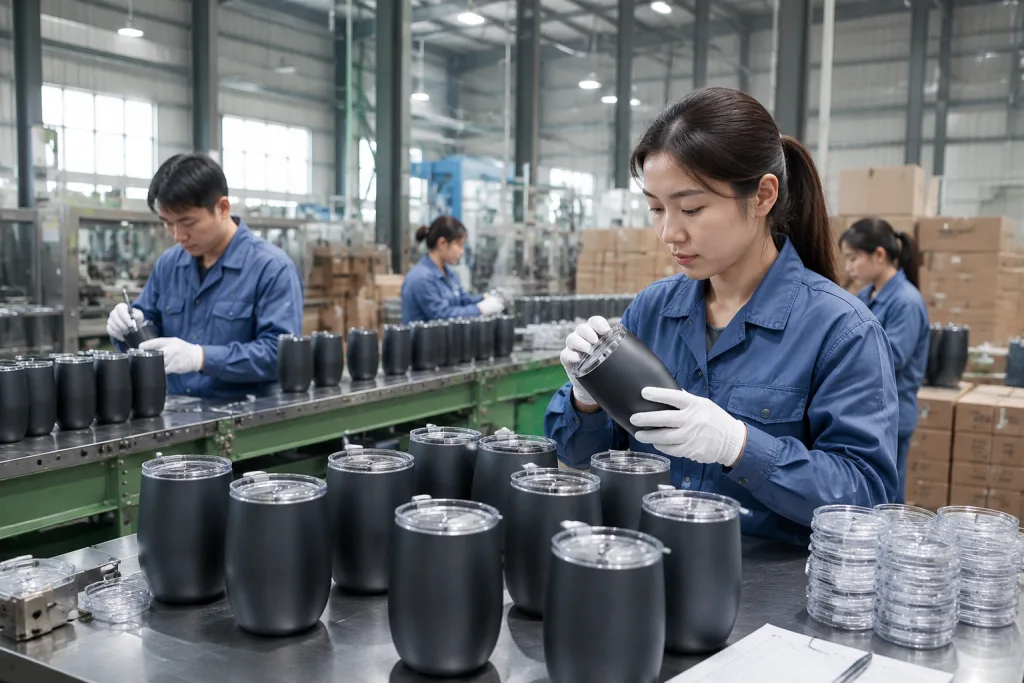
Key Takeaways
- A practical MOQ for custom wine tumblers is usually 1,000-3,000 pcs per color, depending on coating and logo method
- 304 stainless steel, 0.45-0.55 mm outer wall, and vacuum insulation are the safer B2B baseline
- Laser engraving suits long-life retail gifts; screen print suits lower-cost event runs above 3,000 pcs
- FOB China lead time is typically 25-35 days after artwork and deposit approval for standard colors
Wine tumbler promotional products look simple until 5,000 pieces hit a purchase order. Then every small choice has a cost: 304 or 201 stainless steel, powder coat or spray paint, laser logo or screen print, individual box or bulk carton. We’ve seen this go sideways. For a winery, retailer, resort, event agency, or distributor drinkware program, the wrong spec can turn a clean pre-production sample into a margin problem after QC pulled the sample and found a 0.4 mm lid gap.
From our factory side in Hangzhou, Zhejiang, we see this on 6 out of 10 new drinkware inquiries: the buyer compares unit price, not the full build. A USD 2.45 tumbler and a USD 3.20 tumbler look close in a PDF, but the difference can be 0.35 mm vs 0.45 mm wall thickness, coating that passes a 3M tape test, lid fit, carton burst strength, or AQL inspection level. Cheap is not always cheaper. China can make both specs; the question is which one matches your channel and whether the line can hold it for the full PO.
The real comparison starts with channel
A wine tumbler is not one product. It is 4 different products using the same shell shape. A corporate holiday gift, a vineyard tasting-room SKU, a hotel welcome kit, and a mass canteen promotion all need different specs. We had one PO last November with “best price pls” typed in the remarks field; the buyer later flagged the lid as too light for a USD 19.99 retail set. That is the wrong question to ask. If the channel is not named, the factory will quote the cheapest defensible build, not the version that sells cleanly.
For North American and European buyers, the main split is event giveaway, retail resale, or premium brand merchandise. Event programs need delivery dates we can hit, Pantone color within a workable tolerance, and a logo readable from 1 meter away when QC checks it under the light box. Retail resale needs steadier powder coating, barcode/FNSKU handling, packaging that survives a 90 cm drop test, and complaint rates kept below 1%. Premium merchandise is judged by hand feel, lid fit, and whether the logo still looks sharp after use. A canteen distributor selling to clubs and outdoor accounts may need a matched family: wine tumbler with a custom canteen or custom growler in the same powder color. We have seen this go sideways when the tumbler and growler are approved from separate color chips.
Here is the head-to-head logic we use before quoting:
- Event use: 10-12 oz body, screen logo, standard PP lid, white box or bulk pack, target FOB USD 2.20-3.20. The line usually packs these 24 pcs per master carton unless the buyer asks for retail-ready cartons.
- Retail use: 12 oz body, 304 stainless steel, powder coat, laser or fine screen print, retail box, target FOB USD 3.10-4.80. QC pulled the sample from a recent run because 7 pcs had barcode stickers placed 6 mm off the box window.
- Premium gift: heavier body, tighter coating QC, upgraded slider lid, insert card, target FOB USD 4.50-6.80. The math does not work if the buyer wants a soft-touch coating, magnetic gift box, and air shipment at the same budget.
That range assumes normal Zhejiang production, not emergency air freight. At BottleForge Industrial, a typical wine tumbler line can run about 180,000-240,000 units per month depending on color changes and logo complexity. Color change matters. A 6-color order can lose half a shift to gun cleaning, fixture adjustment, and first-piece approval before full packing starts. The cleanest orders are not always the largest orders; they are the ones where the use case is defined before sampling.
Spec table: event versus retail build
Ask for this side-by-side spec before you approve the quote. It stops a canteen supplier, tumbler vendor, or China factory from hiding cost in soft wording such as “stainless steel insulated cup.” Last month QC pulled 3 wine tumbler samples from the line: one quote said 304 stainless, but the outer shell tested as 201 on our XRF gun. If you receive 3 quotes and they do not define steel grade, lid material, coating, carton quantity, and inspection standard, you are not comparing suppliers. You are pricing guesses.
| Spec item | Event promotional build | Retail or gift build |
|---|---|---|
| Capacity | 10 oz or 12 oz | 12 oz, sometimes 14 oz |
| Steel | 201 outer / 304 inner possible | 304 inner and 304 outer preferred |
| Wall thickness | 0.35-0.45 mm outer wall | 0.45-0.55 mm outer wall |
| Insulation | Double-wall vacuum, 4-6 hours practical use | Vacuum with better copper lining option, 6-8 hours practical use |
| Coating | Spray paint or standard powder coat | Powder coat with 3M tape test and cross-hatch check |
| Logo | 1-color screen print | Laser engraving, UV print, or multi-color screen |
| Packing | Bulk pack or plain white box | Printed retail box, barcode label, insert card |
| MOQ | 1,000-2,000 pcs/color | 2,000-3,000 pcs/color |
Cheap is not dirty. For a 2-day festival, a 10 oz tumbler with 201 outer steel and single-color logo can be the right commercial build, especially when the buyer needs 1,000 pcs/color and a plain white box. For a winery selling at USD 18-28 retail, saving USD 0.35 on steel or coating is the wrong question to ask. The math doesn't work after one batch of returns, scratched lids, or a buyer flagging “premium” on the PO while the product feels like a giveaway.
For customized drinkware programs, match the coating system when the wine tumbler sits beside a customizable canteen or customized growler. A matte black wine tumbler from one coating line and a matte black canteen customized at another factory can shift by 1-2 Delta E under retail lighting; we have seen cartons pass warehouse check and fail the showroom shelf test. China factories can hit Pantone targets, but cup shape, coating thickness, and oven temperature change the final color. We run 180-200°C curing on most powder coat jobs, and 10 minutes too long in the oven can turn “same black” into two different SKUs.
Materials are where quotes diverge
Most wine tumbler promotional products are sold as “stainless steel.” Too vague. For food-contact drinkware, 304 stainless steel is the safer choice for the inner wall because it resists corrosion better than 201, especially after coffee, wine, or lemon drinks sit inside for 4-6 hours. Some low-cost programs run 304 inner and 201 outer to hold price. That can work for a short promotional campaign, but put it on the proforma invoice and specification sheet. We once had QC pull a salt-spray sample after 24 hours because the PO just said “SS tumbler,” while the approved sample was 304/201.
For European programs, ask for LFGB or food-contact documentation where applicable, plus REACH or PAHs checks for coatings if your compliance team requires them. For the U.S. market, buyers usually ask for FDA food-contact compliance and California Proposition 65 review. The lid is usually AS or Tritan-style clear plastic with a silicone gasket. If the lid has a slider, confirm whether the slider is removable for cleaning and whether it passes 95°C hot water deformation checks. Cheap lids fail first. On the line, we run a simple lid-fit check with a go/no-go gauge, and the buyer has flagged 1.2 mm slider gaps before because liquid seeped into the gift box.
Thickness matters. A 0.30 mm outer wall can dent during ocean freight if carton packing is weak, especially when the master carton is over 13 kg and the dividers are thin. A 0.45-0.55 mm outer wall gives a better retail hand feel and reduces deformation during assembly. For premium customizable drinkware, a slightly heavier body is often worth paying for even when insulation data looks similar on paper. Buyers notice weight when they pick up the sample, and we have seen this go sideways when a catalog photo looked premium but the 0.30 mm sample felt cheap in hand.
The same material logic applies when your range expands beyond tumblers. A canteen manufacturer may quote a custom canteen, canteen customizable option, and wine tumbler using different steel combinations to hit one target price; ask for 3 separate material lines instead of one blended “family” note. A distributor growler program may need 304 stainless for beer compatibility, while a canteen promotional giveaway may accept a lighter outer wall. Do not approve one “family price” unless each SKU has its own material line. We ship mixed-SKU orders every month, and one typo on a PO—“304 body” instead of “304 inner”—can change the landed cost by 8-12%.
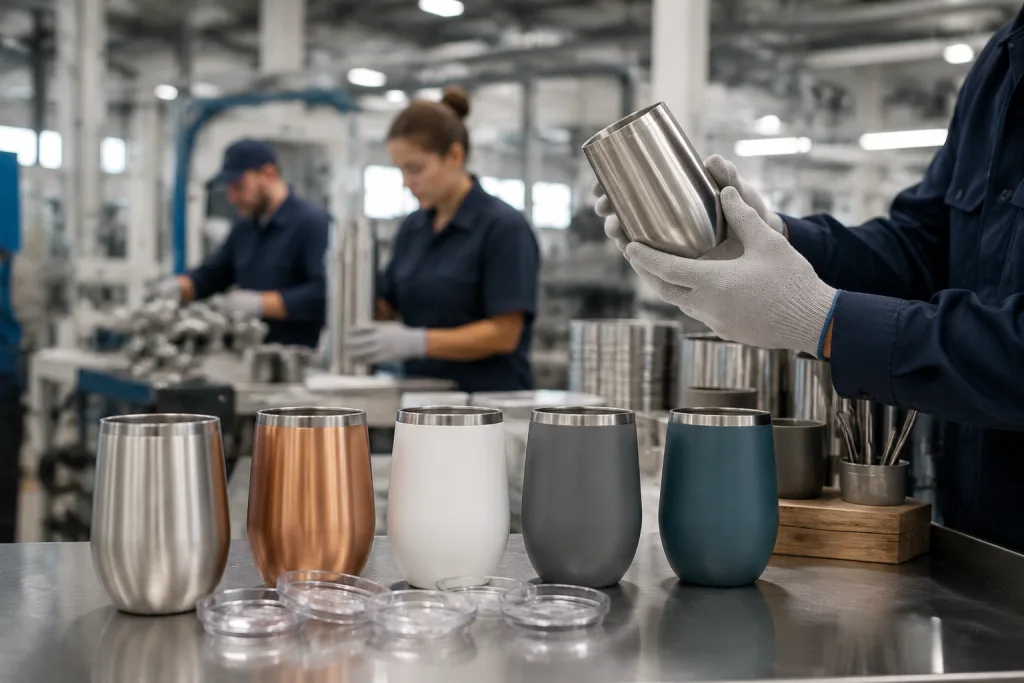
Logo methods change the economics
Logo choice is not decoration. It changes setup cost, defect rate, MOQ, and lead time. On wine tumblers, we usually run silk screen printing for simple 1-color marks, laser engraving when the buyer wants the logo to outlive the coating, and UV printing when full-color artwork matters. QC sees the difference fast: on a curved 12 oz cup, a 38 mm logo can look clean in AI but stretch at the edge on the real jig.
Silk screen printing is the cheap workhorse for 1-color logos and larger runs. For 3,000 pcs or more, it often adds only USD 0.08-0.20 per unit depending on print size. It fits event sponsors, beverage campaigns, and canteen promotional bundles where shelf visibility beats lifetime wear. The risk is curved-surface distortion and ink adhesion, so we ask the line to run a tape test and 50-cycle rub test before bulk printing. We have seen this go sideways when a buyer approved a flat PDF, then flagged the printed oval logo after 12 cartons were already packed.
Laser engraving runs slower, but it is the safer choice for durability. It cuts through the powder coat and shows the 304 stainless underneath. For retail wine tumblers, laser usually gives fewer after-sales arguments because it does not peel, and the buyer cannot scrape off the brand mark with a fingernail. Expect roughly USD 0.15-0.35 per unit depending on logo size and machine time. Fine lines need a pre-production sample, not only a digital mockup; our laser operator will check the file at 0.2 mm line width before loading the rotary fixture.
UV printing gives full color and photo-like detail, but curing control has to be tight. It fits boutique wineries, seasonal artwork, and marketplace sellers that need 4-color variation without changing the cup body. For Amazon or e-commerce packing, combine UV logo approval with barcode label approval, FNSKU placement, and carton drop testing. A nice logo on a crushed box still becomes a return. Last month QC pulled a sample where the UV print passed color but the side label was 6 mm off the approved FNSKU position, and the buyer flagged it before shipment.
For B2B buyers, the best logo method is the one that survives the sales channel, not the one that looks best in a rendering.
If you are building a matching canteen customized line, ask your canteen vendor whether the same logo method can run across the wine tumbler, custom growler, and distributor canteen sizes. This is the wrong question to ask only at carton artwork stage. We ship mixed drinkware programs often, and one PO typo, such as “matte balck” on the growler line, can create two logo approvals for what should be one brand set.
Lids, packing, and hidden failure points
Wine tumblers fail in boring places: lids that rock 1-2 mm on the cup mouth, gaskets with a rubber smell after heat testing, coating chipped at the rolled rim, and cartons crushed after 35 days at sea. We have seen buyers spend 14 days arguing over Pantone shade and 45 minutes checking the packing page. That is backwards for distributor drinkware. QC pulled one sample last month where the lid looked fine on the desk, then popped loose after three presses with a 20 kg push gauge.
A standard wine tumbler lid is a press-fit clear lid with silicone gasket. For basic promotional use, that works. For retail or premium gift, ask for a sliding sip lid, a splash-resistant structure, and a gasket thick enough to hold the rim tolerance, usually checked with a vernier caliper at incoming QC. Do not call it leakproof unless the lid is built for inversion testing. Most wine tumbler lids are splash-resistant, not leakproof. If your sales copy says leakproof and the customer drops it into a tote bag, you own the complaint. The math doesn't work.
Packaging should match the channel. Bulk pack, usually 24 or 48 pcs per export carton, is fine for event fulfillment where staff unpack the tumblers and hand them out. Plain white box suits corporate gifts. Printed retail box fits stores, wineries, and online sales, but leave 3 mm bleed and confirm the barcode position before plates are made. For Amazon-style fulfillment, define FNSKU label size, master carton label, suffocation warning if polybags are used, and carton dimensions before mass production. We had one PO with “FNKSU” typed wrong, and the buyer flagged it only after the first carton label proof.
Carton strength needs a number, not a hope. We commonly use 5-ply export cartons for retail-boxed drinkware, with edge crush strength chosen according to carton size and weight. If a carton holds 24 pcs of 12 oz wine tumblers, gross weight may land around 8-11 kg depending on box style. Your inspection plan should include carton drop testing from 76 cm, barcode scan checks with a handheld scanner, plus AQL visual inspection. A typical inspection setting is AQL 2.5 for major defects and 4.0 for minor defects, though premium programs may tighten this. We ship containers through Ningbo, and weak corners show up fast after two transshipments.
For canteen distributors and canteen vendors managing mixed containers, packing consistency matters more than a fancy box. A customizable growler carton and wine tumbler carton with different label formats slow down warehouse receiving; we have watched a receiver spend 18 minutes sorting two label layouts that should have matched. Put the rules in the purchase order: carton mark, SKU code, barcode size, inner pack count, and pallet note if needed. Keep it boring. The line follows the PO, not the buyer’s memory.
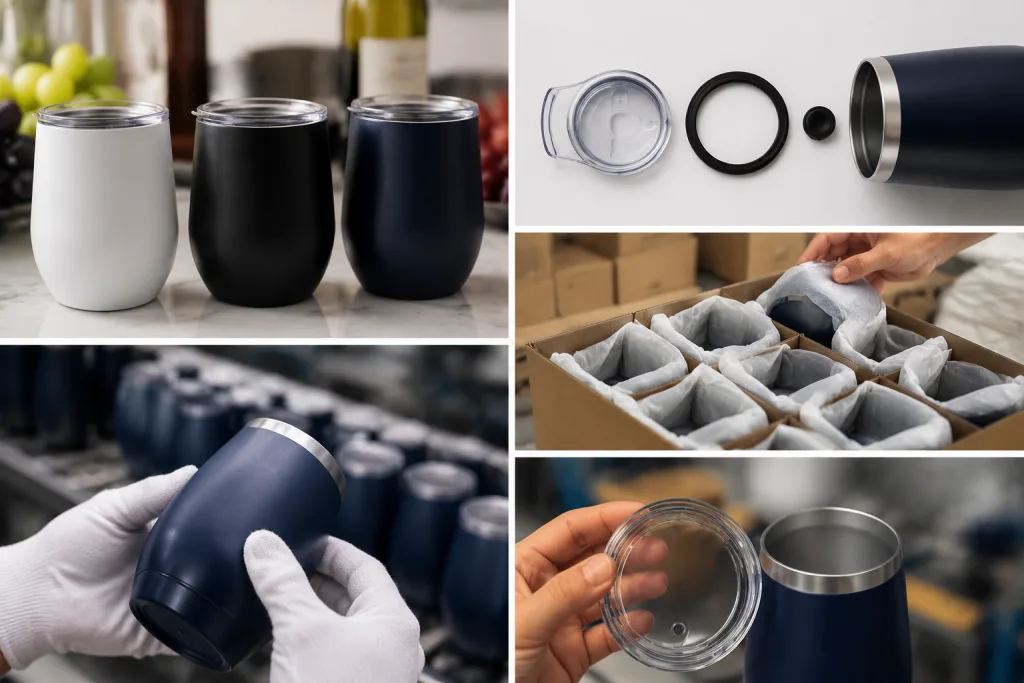
Choosing the right factory partner
A good canteen factory or tumbler factory should push back before it takes your deposit. If every supplier replies “yes, can do” within 6 minutes, you are probably talking to a quotation desk, not the people who run the line. For wine tumbler promotional products, the factory should confirm 2D drawings, capacity tolerance in ml, 304 stainless steel grade, powder-coating adhesion test, logo method, packaging, carton marks, AQL level, and shipping term. We once had QC pull a pre-production sample because the buyer’s PO said matte black, while the artwork file was named “gloss_black_final.ai.” That is normal export discipline, not extra service.
For a first order from China, we recommend treating 1,000-3,000 pcs as a controlled commercial test, not a tiny sample order. The math works at this level: enough units to check vacuum performance, lid fit, logo rub resistance, and sell-through, without turning one wrong lid choice into 86 cartons of slow-moving stock. Standard lead time from our Zhejiang facility is usually 25-35 days after deposit and artwork approval for existing molds and standard colors. Custom molded lids, unusual Pantone colors, or gift-box engineering can add 10-20 days, especially when the color chip needs two spray panels before the buyer signs off.
Certifications matter, but read them correctly. BSCI is about social compliance. ISO 9001 is about quality management systems. LFGB, FDA, REACH, and related reports cover material and chemical compliance. None of them proves your specific custom order was made correctly. We still need golden sample approval and final random inspection; last month QC flagged 3 pcs out of 125 checked because the laser logo sat 2 mm lower than the approved sample.
When comparing canteen manufacturers, canteen suppliers, and tumbler exporters, ask for the same quote format from each:
- FOB port and currency, usually FOB Ningbo or Shanghai in USD.
- MOQ per color and per logo version.
- Exact steel grade for inner and outer wall.
- Coating type and logo process.
- Packaging structure and carton quantity.
- Lead time after deposit and artwork confirmation.
- Available compliance reports and audit status.
This format makes a canteen supplier easier to compare with a canteen manufacturer, and it stops a distributor canteen program from drifting into unclear specs. We have seen this go sideways: one quote used 24 pcs per carton, another used 36 pcs, and the freight comparison looked cheaper only because the carton CBM was missing.
Best fit by buyer type
If you buy for a winery or beverage brand, we’d spec a 12 oz 304 stainless wine tumbler with powder coating, laser logo, and printed retail box. Cost goes up by about USD 0.28–0.45 per cup versus a plain box and screen print, but the return math usually works because the item can sit beside USD 18–25 tasting-room merchandise without looking cheap. Color matters here. Pay for one pre-production color sample before we run the line; our QC team checks the coated cup under a D65 light box because Pantone on paper and powder coat on curved steel never match 1:1.
For an event agency, a 10 oz or 12 oz tumbler with single-color screen print and plain white box is the safer call. Keep the logo bold. Text below 5 pt fills in fast on the curved wall, and QC pulled samples last month where the sponsor URL turned into a gray strip after 300 pcs. Lock artwork at least 5 days before the production slot. We’ve seen this go sideways when a buyer sends “final_FINAL2.ai” at 6 p.m. the night before printing.
If you are a canteen distributor or promotional products wholesaler, think in families, not one lonely SKU. Offer a wine tumbler, custom canteen, customizable canteen, and customized growler with shared colors, matching logo height, and the same carton marking style. This gives your customer a good-better-best ladder without forcing you to source from four different canteen vendors. For outdoor accounts, a distributor growler or custom growler often carries higher average order value than the tumbler; the tumbler works as the entry SKU when the buyer pushes back on MOQ 1,000 pcs.
For an e-commerce seller, packaging and labeling need the same attention as the cup. Ask for retail box dielines, barcode placement, FNSKU label area, and carton drop-test photos before deposit. Small thing, big headache. We ship Amazon-style orders with a 30 mm × 60 mm clean label zone on the box, because one crooked FNSKU sticker can hold a full carton at the warehouse receiving desk. A customized canteen or wine tumbler that looks clean in studio photos still has to survive parcel delivery.
The best purchase order is boringly specific. It names the steel, coating, logo, lid, packing, carton, inspection level, FOB port, and shipment window. One PO typo we flagged changed “clear lid” to “black lid” on 2,400 pcs, and catching it before mass packing saved 12 cartons from rework. That is how custom drinkware moves from a nice sample to a repeatable product line from Zhejiang, China.
Send your wine tumbler brief for a factory quote
Share capacity, quantity, logo, color, packing, and destination port. We will return a practical FOB China specification and pricing range.
Frequently asked questions
What is the normal MOQ for custom wine tumbler promotional products?
For standard molds, a realistic MOQ is 1,000 pcs per color for simple logo work, but 2,000-3,000 pcs is more common for powder-coated custom drinkware with stable pricing. If you need a special Pantone coating, many factories prefer 3,000 pcs because coating line changeover creates waste. Multiple logo versions can sometimes share the same body color, but each logo still needs setup and QC. For mixed programs with a custom canteen or customized growler, ask whether the factory can combine production planning, but do not assume all SKUs share one MOQ.
Should I choose 304 stainless steel or is 201 acceptable?
For the inner wall, choose 304 stainless steel for wine tumblers. It is the safer food-contact choice and has better corrosion resistance. A low-cost promotional build may use 201 stainless on the outer wall and 304 on the inner wall, which can be acceptable if the product is positioned as a short-term giveaway. For retail, winery merchandise, or premium gifts, we recommend 304 inner and 304 outer with 0.45-0.55 mm outer wall thickness. The price difference is usually smaller than the cost of returns, complaints, or brand damage.
How long does production take after I approve the sample?
For existing wine tumbler molds and standard coating colors, FOB China lead time is usually 25-35 days after deposit, artwork approval, and golden sample confirmation. Add about 7-10 days if you need a new powder color sample. Add 10-20 days for custom retail packaging, unusual lids, or a matched family including canteen customizable items and a customizable growler. Sea freight to Europe or North America is separate and can add 25-45 days port to port, depending on routing and season.
Which logo method is best for promotional wine tumblers?
For low-cost events above 3,000 pcs, 1-color silk screen printing is usually the best value, often adding around USD 0.08-0.20 per unit. For retail and long-life gifts, laser engraving is stronger because it will not peel and usually adds about USD 0.15-0.35 per unit depending on logo size. UV printing is best for full-color designs, but it needs careful curing and adhesion checks. If you are also ordering custom growler or canteen promotional products, choose logo methods that look consistent across different shapes.
What inspection standard should I use before shipment?
For most B2B custom drinkware orders, use final random inspection under ANSI/ASQ Z1.4 with AQL 2.5 for major defects and 4.0 for minor defects. Check coating scratches, dents, logo position, lid fit, gasket smell, packing, barcode scans, and carton marks. For retail orders, add carton drop testing and retail box visual checks. For premium winery or corporate gift programs, you may tighten the cosmetic standard or inspect 100% of logo placement. A signed golden sample should be the reference, not only the artwork file.