Key Takeaways
- A 5,000-piece wine tumbler order usually needs 30-35 days production after artwork approval
- 304 stainless steel, 0.4-0.5 mm inner wall thickness, and AQL 2.5/4.0 are practical baseline specs
- Laser engraving costs more upfront than silkscreen, but it avoids most dishwasher-rub complaints
- FOB Ningbo pricing is cleaner than mixed quote formats when comparing canteen suppliers and tumbler factories
You are not just buying a cup. For a wine tumbler distributor, you are buying 43 × 32 × 28 cm master cartons, logo adhesion after 3M tape testing, lid tolerance at ±0.3 mm, customs paperwork, and a product your retail customer will blame you for if it leaks in a display box or scratches after 14 days on shelf.
We would walk a new distributor through one real order from our Zhejiang line: 5,000 double-wall wine tumblers, branded for a regional beverage chain, packed for mixed pallet delivery in North America. QC pulled the sample at pre-production because the buyer flagged a lid that felt loose at the silicone ring. Same thinking applies when we run custom drinkware, a custom canteen, or a distributor growler program from China, but asking only for the lowest FOB price is the wrong question to ask.
Start with the retail promise
The first mistake buyers make is asking a canteen factory or tumbler supplier for “your best price” before the retail promise is clear. Wrong question. In this case, let’s say you are selling to a beverage chain that needs a 12 oz stemless wine tumbler for outdoor events, gift boxes, and loyalty promotions. The buyer will judge the cup by hand feel, brand color match, and whether the lid sounds thin when tapped on the table. They will not ask which vacuum furnace we run in Zhejiang. You should, because QC pulled 18 samples last month with weak vacuum after the line changed furnace settings by 6 minutes.
A workable starting brief looks like this: 12 oz capacity, double-wall vacuum insulation, 304 stainless steel inner and outer body, clear AS lid with silicone gasket, powder coating in two colors, one-position logo, individual white box, 24 pcs per master carton. Add the Pantone code, target logo size in mm, and carton drop-test requirement before asking for a quote. If your customer also buys canteen promotional items, keep the same design language across tumblers, custom canteen bottles, and a custom growler by using one coating family and one logo process where possible. Distributors lose margin when every SKU needs a separate jig, a separate artwork proof, and a new carton dieline; we’ve seen a PO typo on “matte sage” turn into 3,000 pcs of the wrong green.
For wine tumblers, I would not oversell hot retention. The wide mouth and short body lose heat faster than a travel tumbler, and the math doesn’t work once the lid opening is 70 mm. A fair claim is 3-4 hours for warm drinks and 6-8 hours for cold drinks under room-temperature conditions. If a canteen manufacturer claims 12 hours for this shape, ask for the test method, water starting temperature, ambient temperature, and final temperature. Numbers without conditions are decoration; our lab log uses 95°C start water, 20°C ambient, and readings at 1-hour intervals.
Before quoting, we normally ask for the target retail price, distribution channel, annual forecast, compliance market, and whether the product will be sold as customized drinkware or used as a giveaway. A retail product needs tighter scratch control, cleaner lid fit, and packaging that survives shelf handling; for one beverage-chain order, the buyer flagged 9 scuffed lids from a 125 pcs pre-shipment check. A one-week event giveaway can use simpler packaging, but not unsafe materials. We still run material checks, because saving USD 0.08 on a gasket is not worth a failed FDA or LFGB review.
Build the specification sheet
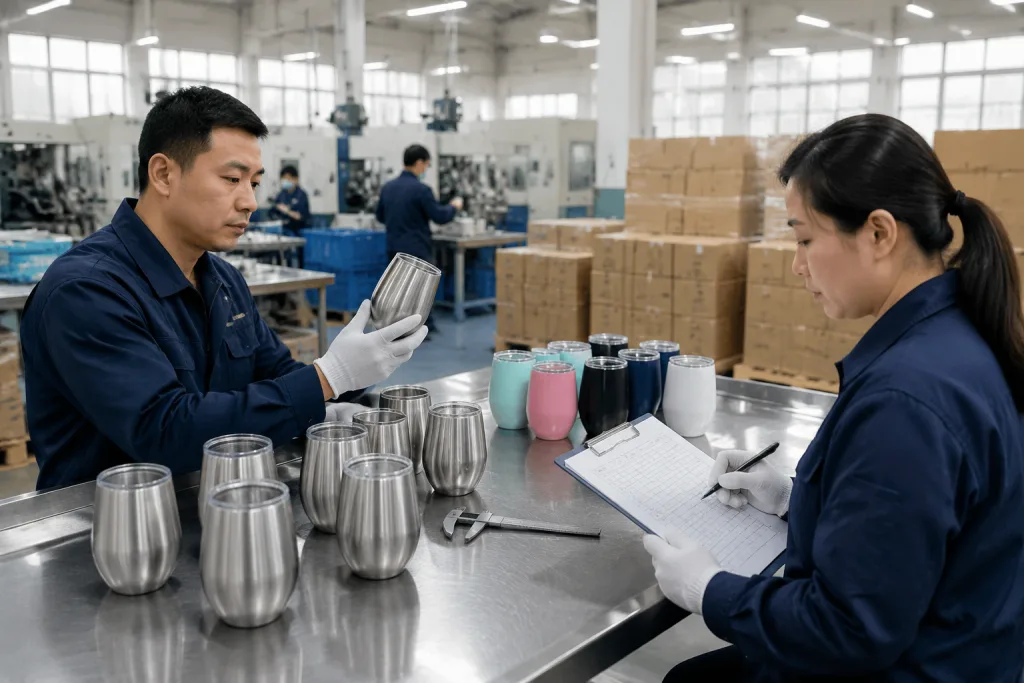
Once the commercial promise is clear, write the spec like our QC inspector will read it at 7:30 a.m. beside Line 3 with a digital caliper in one hand and a marked sample in the other. “Good quality lid” and “premium coating” are not specs. They are arguments waiting for shipment week.
For a 12 oz wine tumbler order, a workable spec sheet should state: body material 304 stainless steel; food-contact parts LFGB or FDA compliant depending on market; inner wall 0.4 mm; outer wall 0.5 mm; vacuum insulation; powder coating thickness around 60-80 microns checked by a coating thickness gauge; lid material AS or Tritan depending on budget; food-grade silicone gasket; capacity tolerance within ±5%. If you are comparing canteen manufacturers, use the same detail for canteen customized products too. Steel grade, cap material, gasket type, coating code, logo size in mm, packaging. We once had a PO showing “black logo” while the artwork file was Pantone 432 C, and the buyer flagged it only after pre-production samples.
Logo method matters. Silkscreen is cheaper in most cases, around USD 0.08-0.18 per position depending on color count and curve. Laser engraving is often USD 0.15-0.35 per position, and it holds up better after 300 dishwasher-style abrasion cycles in our test jig. Heat transfer and full-wrap printing can work, but the math does not work if the buyer keeps changing artwork after film output. For distributor drinkware programs, we run laser for corporate gifts and one-color silkscreen for seasonal promotions unless the order is over 3,000 pcs and the design needs shelf impact.
Packaging also belongs in the spec. A standard individual box might be 350 gsm white card, with 24 pieces per export carton. If you need Amazon or 3PL handling later, specify barcode placement, FNSKU label area, drop-test requirements, carton weight below 15 kg where possible, and pallet height. We ship better when the carton is defined early; QC pulled one sample carton last year with a 17.8 kg gross weight and crushed corners after a 76 cm drop test. About 6 out of 10 canteen distributors still focus on unit price first, but a weak carton can add USD 0.20-0.50 per unit in damage claims.
Quote the order without fog
For the scenario order, price it as 5,000 pieces, two powder-coat colors, one laser logo, individual box, FOB Ningbo. From a Hangzhou line, a sane China factory quote will land around USD 3.10-4.20 per piece, depending on lid type, coating pass rate, 304 stainless price, and box spec. Below that range, check what got shaved: 0.38 mm wall becomes 0.32 mm, coating cure time gets rushed, AQL 2.5 inspection is shortened, K=K carton turns into thin paper, or the factory is buying the order. The math doesn't work. Last month QC pulled the sample on a low quote because the sliding lid warped 1.6 mm after hot-water testing.
Ask the supplier to split tooling, sample fee, unit price, packaging upgrade, logo setup, inland freight, and export carton cost. Then compare line by line. This is cleaner than putting a canteen supplier against a tumbler specialist and pretending both quoted the same product. If you ask three canteen vendors for one lump price, the cheapest one wins by hiding assumptions. We see this go sideways when the PO says “gift box” but the artwork file shows a white tuck box with a 350 gsm paper callout, and nobody priced the insert tray.
MOQ depends on decoration and color. At BottleForge Industrial in Hangzhou, Zhejiang, our practical MOQ for a standard stainless wine tumbler is usually 1,000 pieces per color for existing molds, while a fully customized drinkware shape may need 3,000-5,000 pieces. Monthly drinkware capacity is about 450,000 units across tumblers, bottles, and canteen customizable programs, but color scheduling still matters. A small custom color can delay production if it misses the coating line window; we run powder in color blocks, and a 600-piece matte sage top-up can sit 12 days vs 18 days if the booth is already set for dark colors.
Payment terms for new B2B buyers are commonly 30% deposit and 70% balance before shipment after inspection. For repeat distributors with stable annual volume, we can discuss better terms, but do not build your landed-cost model assuming credit on the first order. Confirm Incoterms early. FOB Ningbo or FOB Shanghai is usually cleaner than EXW for North American and European importers because export handling is already included. One buyer flagged this after the PI showed EXW by mistake; the PO had “FOB NINGBO” typed in row 14, and that typo would have added RMB 2,800 in local trucking and declaration fees.

Sample before you approve artwork
Pre-production samples are not souvenirs. They are the last cheap checkpoint before the order gets expensive. For this wine tumbler order, ask for 2 blank samples first if the body comes from an existing mold, then 1 decorated approval sample with final coating, logo size, lid, gasket, box, and barcode layout checked together. We run blank stock-color samples in 5-7 days; custom powder coating or new artwork plates usually take 10-14 days because the line needs a coating trial, curing check, and logo fixture setup.
Check the sample like a buyer, not like someone who already wants to like it. Fill it to the claimed capacity and record the usable volume in ml. Then shake it upside down for 30 seconds with room-temperature water; QC pulled one sample last month where the silicone gasket sat 0.6 mm high and the buyer flagged “leakproof” on the PO, which was the wrong claim for that lid. Wine tumbler lids are usually splash-resistant, not leakproof, so do not force a leakproof claim unless the lid design supports it. Measure mouth diameter, base diameter, and height against the spec sheet with a digital caliper. If the tumbler must fit a gift insert or shipper, a 2 mm difference can turn into a new insert die.
Color approval needs a physical reference, not a phone photo. Pantone numbers help, but powder coating on 304 stainless steel will not always match paper exactly after baking at around 180°C. For canteen customized programs, we keep approved color chips and production samples in the project file, with the date and supplier batch written on the back, so a repeat order six months later does not drift badly. This matters when the same brand buys a customizable canteen, wine tumbler, and customizable growler as a set; we have seen this go sideways when “matte sage” became three different greens across 3 SKUs.
Artwork approval should show logo size in millimeters, location from rim or base, color value if printed, and acceptable tolerance. For laser engraving, approve the engraving contrast under normal indoor light, not under a bright inspection lamp that makes every mark look sharper than it will on shelf. If your client wants a subtle tone-on-tone mark, make sure sales, design, and QC all understand that subtle does not mean invisible; our QC table has rejected 500 pcs before because the approved sample said 28 mm logo, while the PO typo said 18 mm.
Control production while it runs
After deposit and sample approval, the risk shifts to the line. A 5,000-piece wine tumbler order usually runs 30-35 days after artwork is confirmed, as long as there is no new mold and no special coating. We run it through stainless forming, welding, vacuuming, polishing, powder coating, logo work, assembly, packing, and final inspection. Miss one setting early and the math doesn't work later; a 0.4 mm rim burr found after coating is not a cheap fix.
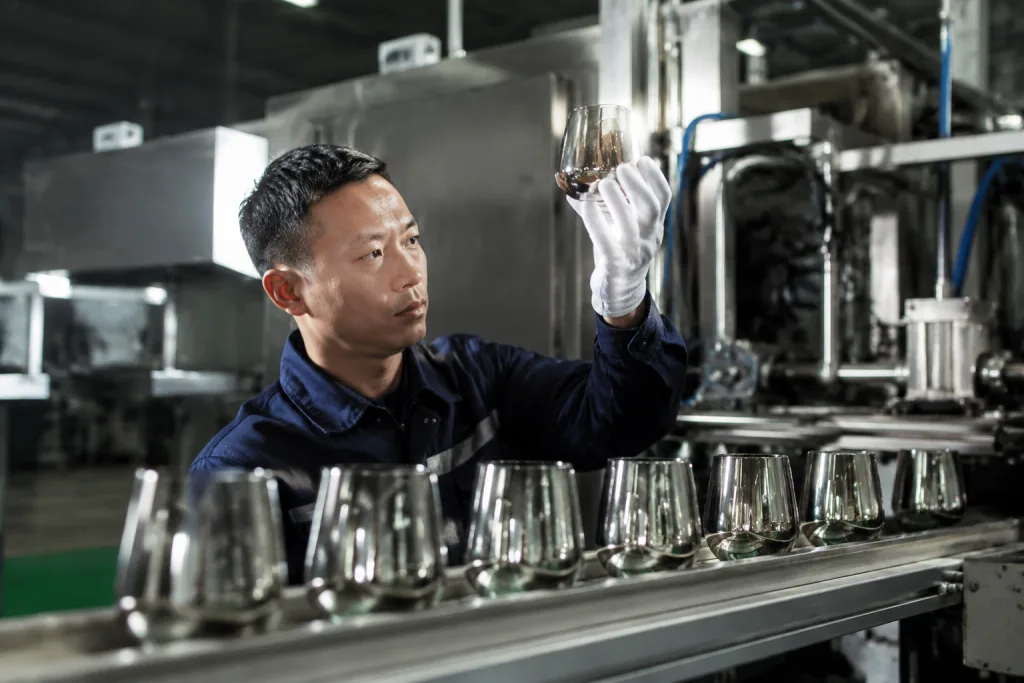
During production, ask for milestone photos or 10-20 second videos, but don't treat them as inspection. Photos prove the goods exist. They do not prove the goods are sellable. Better checkpoints are raw material confirmation, first-off coating approval, logo position against the artwork file, and inline defect rate from the QC sheet. For stainless drinkware, watch vacuum failure, pinholes, black spots inside the cup, uneven coating, sharp rim, loose lid, and color mismatch. Last month QC pulled the sample under a 6500K light box and caught a champagne-gold batch drifting two shades from the approved PMS card.
Use AQL inspection, not emotional inspection. For a 5,000-piece order, buyers often use General Inspection Level II with AQL 2.5 for major defects and 4.0 for minor defects. Critical defects should be zero. Major defects include peeling coating, wrong logo, unsafe sharp edge, failed vacuum, or wrong packaging. Minor defects include small dust spots, slight color specks within the agreed size, or small box scuffs that do not hurt saleability. We've seen this go sideways when a buyer rejected 300 cups for 0.2 mm dust marks that were inside the signed limit sample.
The same inspection logic applies if your order includes distributor canteen SKUs, a customized growler, or mixed custom drinkware. Do not let the factory inspect the easy SKU and skip the difficult one. If one carton contains assorted colors, the sampling plan should cover every color. We have seen distributors approve a black sample, then receive a white production run with visible polishing marks because nobody checked the lighter color separately. One buyer flagged this only after 42 cartons had been sealed with printed FBA labels, which turned a simple re-polish into a repacking job.
Plan cartons, compliance, and freight
Freight planning starts before the line tapes the first carton. For 5,000 wine tumblers packed 24 per carton, we run about 209 master cartons. With a common 20oz tumbler carton at 51 x 35 x 46 cm, total volume lands near 12.5 CBM; a bulkier gift-box version can push it to 15.8 CBM. That is LCL or a shared container load, not a full 20-foot container by itself. If you combine the order with custom canteen bottles or a distributor growler shipment, lock carton dimensions early so the pallet pattern does not collapse at 1.65 m stack height.
For Europe, ask about REACH, LFGB food-contact testing, and packaging waste requirements. For the United States, confirm FDA food-contact compliance and, where relevant, California Proposition 65 review. If the item is for children, ASTM and CPSIA questions enter the discussion, but a wine tumbler should not be sold as a kids product. We have pushed back on this before when a buyer wanted “family picnic cup” wording on a 12oz stemless wine tumbler. A responsible canteen manufacturer or drinkware factory in China should tell you where the product fits and where the math does not work.
Carton markings should include item number, color, quantity, gross weight, net weight, carton size, country of origin, and any customer-required PO or SKU number. Simple list. No guessing. If you supply big-box retailers or 3PL warehouses, send their routing guide before mass production; one buyer flagged a missing 128C SKU barcode after QC pulled the sealed-carton sample, and relabeling 209 cartons took half a day with a Zebra printer and two warehouse staff. Printing the correct marks before packing in Zhejiang is cleaner than adding labels after cartons are sealed.
For freight quotes, compare FOB plus your forwarder cost against DDP only if you know what is included. DDP looks easy, but we have seen this go sideways when duty assumptions were too low or the importer name was wrong on the commercial invoice. Serious canteen suppliers and drinkware exporters should provide a commercial invoice, packing list, HS code suggestion, and export declaration support. We ship from Ningbo or Shanghai most weeks, and our packing list must match the carton count, gross weight, and CBM checked on the floor scale before the truck leaves. Your customs broker still needs to confirm final import classification.
Decide what to reorder
The order is not finished when the container leaves Ningbo. A good wine tumbler distributor writes down what happened after delivery: crushed cartons, sell-through by color, complaint wording, repeat interest, and logo wear after 30 dishwasher cycles. If 3% of cartons arrive crushed, we do not call that “normal freight.” We pull the 620 x 410 x 380 mm master carton, check the corner protector, and run a 1.2 m drop test again. If ivory sells twice as fast as matte black, the reorder should not copy the first PO ratio just because the Excel sheet looked clean.
Ask your customer service team for the exact complaint text. “Lid leaks” may mean the end user expected a sealed travel mug, not a splash-resistant wine tumbler lid with a slider. That is a claim problem, not always a tooling problem. “Logo scratched after dishwasher” may mean the care label was ignored, or the print method was wrong for that sales channel. For customized canteen and customizable drinkware programs, QC pulled the sample tells us more than a sales summary: upgrade to laser engraving, change the powder coating, or add a 90 x 55 mm warning insert if the buyer keeps asking for dishwasher-safe wording.
For the second order, negotiate from evidence. If the mold, artwork, and carton design stay the same, setup costs should come down and approval time should shrink by 3-5 days. A repeat 5,000-piece order may still need 25-30 days because coating and vacuum production are physical processes, not spreadsheet cells. The math does not work if a buyer asks for 20,000 pieces in 12 days after waiting 6 weeks to confirm the forecast. Tell the factory early. In Zhejiang, we can reserve coating line time and 304 stainless coil better with a rolling forecast than with four urgent POs marked “ASAP” in red.
The best distributors treat their canteen vendor, tumbler supplier, and growler factory as production partners, not quote machines. Push for fair pricing. We expect that. Just do it with locked specs, AQL 2.5 inspection data, and a reorder forecast that shows color mix by SKU. We have seen this go sideways when a buyer changes the logo size by 2 mm on the repeat PO and assumes the old pad-print fixture still works. That is how margin gets protected without gambling with quality.
Send your tumbler brief for factory pricing
Share quantity, logo method, target market, and packaging needs. We will return a practical FOB quote and production timeline.
Frequently asked questions
What MOQ should a wine tumbler distributor expect for custom colors?
For existing wine tumbler molds, expect around 1,000 pieces per color for standard powder coating and 3,000-5,000 pieces if you need a special finish, new lid color, or custom packaging. At our Hangzhou, Zhejiang facility, we can sometimes support lower trial quantities for repeat buyers, but the unit price rises because coating setup, logo alignment, and packing line time do not shrink much. If you also order custom canteen or customizable growler SKUs in the same brand color, group the colors together so the coating line can run more efficiently.
Is laser engraving better than printing for distributor drinkware?
Laser engraving is better when the item is sold as retail-quality customized drinkware or used as a long-term corporate gift. It usually adds about USD 0.15-0.35 per unit, depending on logo size and position, but it avoids many abrasion and dishwasher-rub complaints. Silkscreen is still useful for canteen promotional orders where budget matters and the expected use period is shorter. For powder-coated wine tumblers, we normally test printed logos with tape adhesion and rub checks before mass production. If your customer insists on dishwasher-safe claims, be careful and ask for a written test protocol.
How long does a 5,000-piece custom wine tumbler order take?
A normal 5,000-piece order takes about 30-35 days after deposit, final artwork, and sample approval. Add 7-14 days before that for sampling, depending on whether you need custom coating or only a stock color. Sea freight to the U.S. West Coast may add roughly 18-25 days port to port, while Europe often takes longer depending on routing. If the order includes a customized growler, canteen customized bottle, or multiple carton formats, build in another 3-5 days for packing coordination and final inspection.
What inspection standard should I use before shipment?
Use AQL rather than a casual photo check. For a typical export order, General Inspection Level II with AQL 2.5 for major defects and 4.0 for minor defects is a fair baseline. Critical defects should be zero. Major defects include failed vacuum, peeling coating, wrong logo, unsafe rim, wrong color, and missing retail packaging. Minor defects can include small coating specks within an agreed size or light box scuffing. If you are mixing wine tumblers with custom canteen bottles or distributor growler items, the inspection sample must cover each SKU and color.
Can one supplier handle wine tumblers, canteens, and growlers?
Yes, but check whether the supplier is a real canteen manufacturer with stainless drinkware production control or only a trading canteen vendor. A capable China supplier should define steel grade, wall thickness, coating process, lid material, AQL standard, carton spec, and compliance documents for each product. Wine tumblers, custom growler items, and customized canteen bottles share some processes, but molds, lids, and insulation performance differ. Ask for monthly capacity, recent inspection reports, and photos of production lines before placing a mixed distributor canteen or distributor drinkware program.