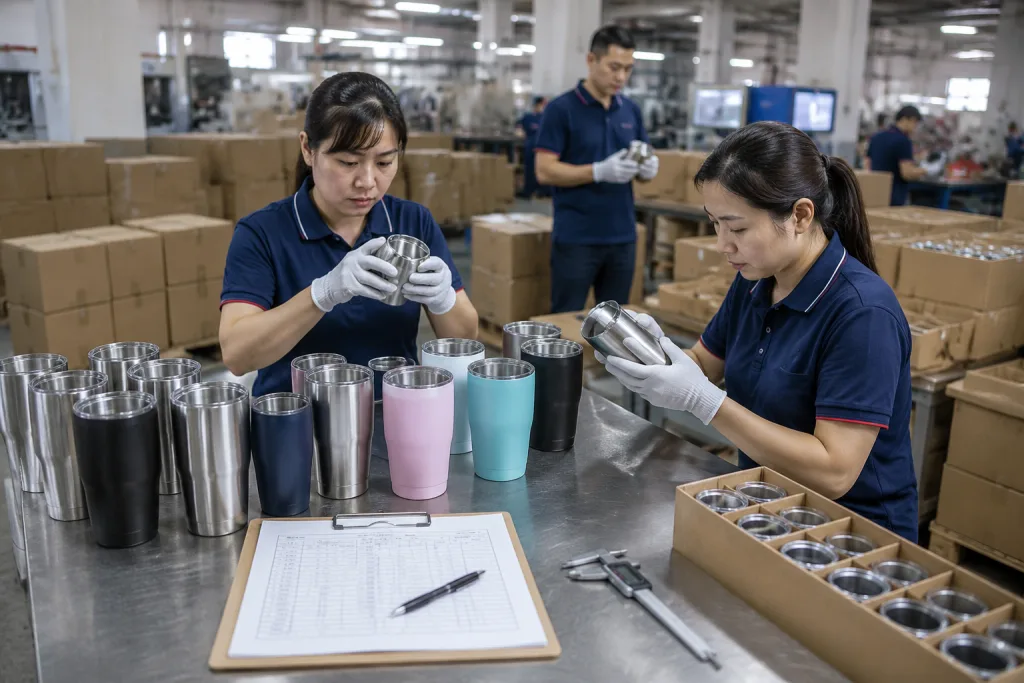
Key Takeaways
- For a 12 oz wine tumbler customizable order, plan 1,000 units/color MOQ and 35-45 days production after artwork approval
- Specify 304 stainless steel, 0.5 mm inner wall, 0.6 mm outer wall, and lid fit tolerance before sampling
- Use AQL 2.5/4.0 inspection for logo, coating, vacuum, carton marks, and barcode placement
- FOB China pricing usually changes 8-18% depending on coating, lid type, packaging, and logo method
A buyer asks for a wine tumbler customizable enough for a summer retail launch, a winery gift set, or a distributor drinkware program. On the RFQ sheet it looks easy: 12 oz stemless stainless body, powder coating, lid, logo, color box. The risk sits in the small parts. We have seen one loose slider lid, 0.4 mm thinner wall, failed 3M tape coating test, or a carton mark typo on the PO turn a profitable order into debit notes.
This is how we run one order through our Zhejiang factory, from RFQ to final inspection. BottleForge Industrial is based in Hangzhou, Zhejiang, China, and our standard stainless drinkware capacity is about 450,000 units/month, with typical MOQ from 1,000 units per color for powder-coated tumblers. QC pulled the sample at the logo line before packing last month because the buyer flagged a 2 mm shift on the winery crest; that is the kind of detail that decides whether the shipment leaves clean or gets stuck for rework.
Start With The Actual Sales Channel
Before asking any canteen supplier or tumbler factory for price, pin down the sales channel. A wine tumbler customizable for a winery tasting room is built differently from a distributor canteen program or an online gift set shipping 1 pc per carton. Same shape, different headaches. On our line, QC pulled a sample last month because the matte coating looked fine under office light but showed 0.8 mm dust spots under the inspection lamp after logo lasering.
For a typical B2B buyer scenario, assume you need 5,000 pieces of 12 oz stainless wine tumblers for North American retail and corporate gifting. You want two matte colors, one laser logo, a clear press-fit lid, and individual color boxes. If your target landed cost is tight, ask us to split the quote into base tumbler, logo, packaging, and freight assumptions. We run these as separate cost lines because a 350 gsm color box can move the FOB by USD 0.18–0.32 per pc, and the buyer will flag it later if the first quote hides it.
A practical RFQ should include capacity, material grade, lid type, logo size in mm, packaging method, Incoterm, destination port, compliance documents, and inspection standard. If you only write “customized drinkware, send best price,” the math doesn't work. You will get a low number that hides decisions. One canteen vendor may quote 201 stainless, another canteen manufacturer may quote 304 stainless, and a third will cut the gift box to win the first email; we have seen POs come in with “304 stainless” in the item line and “201 body acceptable” buried in a note, which is where orders go sideways.
For wine tumblers sold in Europe, ask early about LFGB or food-contact documentation and REACH coating declarations. For the United States, ask about FDA food-contact conformity and ASTM packaging-related expectations if children will handle the product. Serious canteen manufacturers in China will not be offended by this. They will quote cleaner. Our QC file normally keeps the coating MSDS, lid material report, and AQL 2.5 inspection sheet together, because chasing those papers 3 days before vessel closing is a bad way to ship drinkware.
Lock The Product Specification First
The sample spec should be boring and measurable. Good. For a 12 oz wine tumbler customizable order, we run the first sheet with 304 stainless steel inner and outer walls, double-wall vacuum insulation, 0.5 mm inner wall, 0.6 mm outer wall, and a finished weight around 190-230 g depending on shape. Our caliper check is simple: cut one sample, measure the body at the straight wall, and record it before artwork approval. If the buyer wants a lighter promotional item at 170 g to save freight, write it on the PO; do not let QC pull the sample during inspection and find the weight gap there.
The lid is where buyers burn margin. We have had 6 orders where the cup body passed, then the buyer flagged loose lids after the first retail shipment. A cheap PS lid may work for a canteen promotional giveaway, but retail customers notice loose fit, cloudy material, and weak silicone rings. Tritan or AS lids cost more, usually USD 0.10-0.25 extra per piece, but the fit feels cleaner and complaint rates drop. If your client wants dishwasher-safe claims, do not approve that wording until the coating, logo, and lid have gone through 20 wash cycles in the test room.
Color needs a hard reference. “Navy blue” is not a production instruction; we once had a PO typed as “navy balu,” and the line still had to stop for confirmation. Use Pantone for powder coating or send a physical swatch with the sample seal. For matte powder coating, expect normal color tolerance around Delta E 1.5-2.0 if the coating supplier is stable. Gloss finishes show scratches after carton rubbing, while matte finishes show oil marks from handling, so we change the packing: PE bag plus tissue for gloss, cleaner glove handling for matte.
If you source custom canteen, customizable growler, or custom growler programs from the same factory, keep one shared specification sheet format. This is where the math works: 1 sheet lets you compare 0.5 mm versus 0.6 mm wall thickness, 304 stainless versus claimed 201, powder coating code, lid resin, silicone hardness, and carton drop-test results across categories. We ship mixed drinkware programs often, and the buyer’s team usually finds trouble when each category uses a different template. A canteen factory that handles customized canteen and customized growler projects should document these details with gauge photos, material records, and AQL notes, not sales talk.
Price The Order Without Guesswork
For this buyer scenario, we would price a 12 oz stainless wine tumbler with powder coating, laser logo, clear lid, and white box at about USD 3.10-4.20 FOB Ningbo or FOB Shanghai at 5,000 pieces. Treat it as a costing lane, not a signed quote. On our Hangzhou quoting sheet, a 0.10 mm wall-thickness change or a switch from standard matte powder to a textured coating can move the number before the sales team even opens the PI.
Ask the canteen supplier to break the price into pieces. Base tumbler, powder coating, logo, lid, box, master carton, and testing should each show on the cost sheet. One-line pricing looks clean, but it hides where the money is going. We have seen this go sideways: a buyer approved USD 3.48, then added a full-color box, EAN barcode sticker, insert card, and thicker polybag after the PO, and the buyer flagged the extra USD 0.22 as “unexpected.” The math does not work if those items were missing from the RFQ.
MOQ is usually about coating-line efficiency, not sales stubbornness. At our Zhejiang production base, 1,000 pieces per color is a normal minimum for powder-coated stainless drinkware because the line loses material during spray-gun setup and oven warm-up. Laser engraving can run lower. Custom coating, custom lid colors, and molded accessories push MOQ higher. For a canteen customizable project with a custom cap color, MOQ can jump to 3,000-5,000 pieces because resin color matching has its own purge loss, and QC pulled one sample last month for a 1.5 mm color drift against the approved chip.
Payment terms for a new China order are commonly 30% deposit and 70% before shipment after inspection. Some canteen distributors ask for credit terms on the first order; this is the wrong question to ask without credit insurance or order history. If cash flow is tight, negotiate a shipment split, such as 2,500 pieces in week 7 and 2,500 pieces in week 9, instead of loose payment promises. We run capacity by PO number, and even a typo in the PO color code can hold the line for 2 days while the merchandiser gets written confirmation.

Approve Artwork Like An Engineer
Logo approval is not a quick “is it centered?” check. On a curved 12 oz wine tumbler, we run a 50 mm wide logo and it usually sits clean; push it to 90 mm and the left/right edges start to stretch when the cup is turned under the 6500K inspection lamp. Laser engraving cuts through the powder coat and shows 304 stainless underneath. Screen print leaves ink on top. Heat transfer gives better color range, but QC still needs a 3M tape pull and 300-cycle abrasion rub before we trust it. For most wine tumbler customizable orders, laser is the safer B2B call because the finish survives daily handling and looks sharp.
For corporate gifting, send vector artwork in AI, EPS, or PDF, not a 72 dpi PNG copied from a website. We ask for minimum line thickness of 0.15 mm for laser and 0.25 mm for screen print; our artwork desk checks this in Adobe Illustrator before the film or laser file goes to the line. Small ® marks are trouble. They fill in, break, or vanish after coating removal, and we have seen a buyer flag this only after 3,000 pcs were packed. If your client insists on that mark, approve a physical pre-production sample, not only a digital mockup.
Write the placement tolerance on the PO. Example: logo centered opposite the seam area, vertical tolerance ±2 mm, horizontal rotation tolerance ±3 degrees, no visible burn marks outside the logo edge. QC pulled the sample with a digital angle ruler last month and found one batch drifting 5 degrees; the buyer called it crooked, the supplier called it “basically centered.” This is the wrong question to ask after production. Put the numbers in the approval file before mass engraving starts.
For customized drinkware sold online, label and barcode control deserves the same attention as the logo. If the order is for Amazon FBA, FNSKU labels need to scan on the first pass and sit on the correct box face; we test with a Zebra scanner before cartons leave Hangzhou. If the order is for a distributor growler or distributor canteen catalog, carton marks may need customer item numbers, country of origin, PO number, and mixed-color breakdown. One PO typo in the SKU can hold 120 cartons at the forwarder. Confirm the carton mark layout before mass production starts.
Build Packaging Around Damage Risk
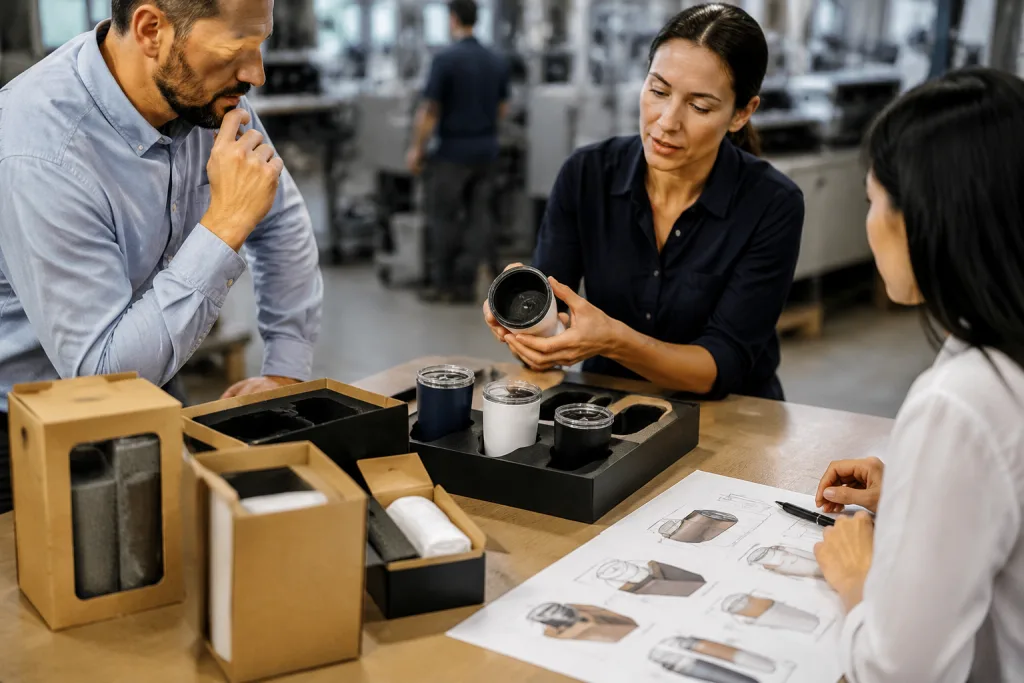
Wine tumblers dent faster than most buyers expect. The rolled rim gets oval after a corner hit, the lower edge takes flat spots when cartons are dropped, and the powder-coated sidewall shows rub marks if the insert is loose by even 2-3 mm. We run a quick fit check with a caliper before sealing the carton. Individual white boxes work for about 5,000-piece canteen promotional orders, but retail sets need cleaner print and stronger corner protection. A 350 gsm color box with an E-flute insert can add USD 0.25-0.45 per unit, and the math works if it cuts even 2% of dent claims.
Test the master carton before final approval. Do not approve it from a PDF dieline. A common packing method is 24 pieces per export carton, with carton size around 48 x 36 x 30 cm depending on the box. Gross weight may land around 8-10 kg. QC pulled one sample carton last month where the PO said “24pcs/ctn” but the buyer’s Amazon prep sheet required “12pcs/ctn”; that typo would have caused repacking in Ningbo. For courier-heavy e-commerce, 12 pieces per carton can reduce crushing, though it increases freight handling cost. Choose by channel, not habit.
Talk about drop testing even when the buyer does not formally require ISTA testing. For normal export cartons, we like to see a practical carton drop test from 76 cm on edges, corners, and faces, then open the carton and check rim roundness with a simple go/no-go gauge. If the product will ship through parcel networks, assume rougher handling and specify thicker outer cartons or better inserts. Shortcuts go sideways here. Powder coating that looks fine after production can still fail if tumblers rub inside weak boxes for 30 days at sea.
Sustainability claims need discipline. “Eco-friendly” is too vague, and buyers will flag it during artwork review. If you want recyclable kraft boxes with clear disposal marks, soy-based ink on the color box, plastic-free packaging with paper wrap, or FSC paper with certificate backup, write it into the packing spec and accept the cost difference. Around 7 out of 10 canteen suppliers we see in Zhejiang can offer these options, but not at the same cost as a plain white box with a polybag. The line needs the spec before mass packing starts.
Control Production Before It Runs
We run the safest sequence this way: sample approval first, then seal the golden sample, collect deposit, prepare material, run coating trial, start mass production, do in-line QC, finish final inspection, collect balance payment, then ship. Do not skip the golden sample. We have seen this go sideways. The sealed sample needs the exact 304 stainless body if specified, the approved coating, lid fit, logo position, box layout, barcode, and carton mark. QC should sign the hang tag, photo the bottom stamp with a ruler beside it, and keep one sample in our sample room while you keep one on your side if the courier timing works.
For a 5,000-piece wine tumbler customizable order, normal lead time is 35-45 days after deposit and artwork approval. A new color match adds 7-10 days; our coating line usually checks it against the Pantone chip under a D65 light box before spraying bulk. A new lid mold can add 18-25 days, special retail packaging often adds 6-12 days, and third-party lab testing can push shipment by 5-8 working days depending on the lab queue. Around Chinese New Year, normal lead times are the wrong numbers to use. A responsible canteen manufacturer in Zhejiang will say capacity is tight when the polishing line is already booked, not pretend the line runs the same as March.
During production, ask for in-line photos and 10-second videos, but do not call that inspection. Photos help you check color, logo direction, packing method, and carton marks; last month one buyer flagged a “matte sage” carton label typed as “mate sage” before 320 cartons were sealed. They still do not measure coating adhesion, lid fit, vacuum performance, or defect rate. QC pulled the sample. We check coating with a 3M tape test, lid gap with a digital caliper in mm, and vacuum performance on the test bench. For orders above 10,000 pieces, book an in-line inspection at 20-30% completion so defects are caught before the full batch is packed.
If you work with multiple canteen vendors, standardize your approval checklist. Include item number with revision date, material spec, finish, logo method, packaging drawing, compliance documents, AQL level, and shipment terms. Small detail, big result. We once saw a PO show “white lid” while the approved artwork showed clear AS lid; the buyer flagged it after pre-production, which saved 5,000 wrong lids from being assembled. This makes sourcing cleaner and gives the factory less room to guess.
Inspect What Customers Will Notice
Final inspection should follow AQL, not someone’s gut feel at 6 p.m. on packing day. For drinkware, most of our US and EU B2B buyers run General Inspection Level II with AQL 2.5 for major defects and 4.0 for minor defects. Critical defects get zero tolerance. Write the defect list before QC opens the first carton: sharp rim, leaking lid, wrong material, failed vacuum, wrong logo, exposed rust, heavy dent, unreadable barcode, incorrect carton mark. We had one PO where “matte sage” was typed as “matte safe”; QC pulled the sample against the approved color chip, not the buyer’s email thread.
For wine tumblers, check coating adhesion with a cross-hatch tape test on retained samples; we use a 1 mm cutter and 3M 600 tape on the line. Check lid fit by filling the tumbler to the normal drinking level, pressing the lid down, then turning it over slowly above a white tray. Most press-fit lids are splash-resistant, not leakproof. Say it that way. Check capacity with water to the practical fill line, not just to the rim. A “12 oz” tumbler may hold 355 ml to brim but closer to 320 ml for comfortable use, and buyers flag this fast when their retail label promises full drinking capacity.
Vacuum testing should be sampled, and this is where the math matters. A simple hot water test catches obvious insulation failure: fill with hot water, wait 3-5 minutes, then check whether the outer wall heats abnormally. Better factories use vacuum testing equipment before packing; on a 5,000 pcs wine tumbler order, ask whether they test 100 pcs, 500 pcs, or every unit after vacuum sealing. Rejects must sit in a marked red bin, not beside good cartons. We’ve seen this go sideways when reworked goods went back to packing without a second scan.
For shipment from China, confirm the FOB port and container loading plan first, then check the documents: commercial invoice with correct unit price, packing list with carton dimensions in cm, bill of lading, certificate of origin if needed, and test reports. Ningbo and Shanghai both work for Hangzhou factories, but the trucking cost is not the same; on 1 x 40HQ, the buyer flagged a 1,200 RMB gap last quarter. A canteen distributor or distributor drinkware buyer should verify HS code assumptions with their broker. The factory can support with product specs and photos, but import classification is your responsibility.
Send Your Wine Tumbler Spec For Review
Share quantity, color, logo, packaging, and destination. We will return a practical FOB quote and production checklist.
Frequently asked questions
What MOQ should I expect for a wine tumbler customizable order?
For stainless steel wine tumblers with standard body shape, standard lid, and laser logo, 1,000 pieces per color is a realistic MOQ at many China factories. If you need a custom powder-coated Pantone color, the same 1,000 pieces per color is usually still workable, but setup loss is built into the price. If you want a custom lid color, molded accessory, or fully customized canteen-style cap, MOQ may rise to 3,000-5,000 pieces. Packaging also matters. A plain white box can be low MOQ, while custom printed retail boxes often start at 1,000-2,000 pieces because the box factory has its own print setup. Always ask whether MOQ is per order, per color, or per artwork.
Is laser engraving better than printing for wine tumblers?
For most B2B wine tumbler customizable orders, laser engraving is the safer default. It removes the powder coating and shows the stainless steel below, so it will not peel like poor ink can. It also works well for winery logos, corporate marks, and distributor drinkware programs. The limitation is color: laser is usually silver or dark gray depending on coating and steel. Screen print is better when you need a specific logo color, but it needs adhesion and abrasion testing. Minimum line thickness should be about 0.15 mm for laser and 0.25 mm for screen print. If the logo has gradients or tiny text under 5 pt, approve a physical sample before mass production.
How long does production take after I approve the sample?
A normal 5,000-piece order takes about 35-45 days after deposit, artwork approval, and packaging confirmation. That assumes an existing mold, standard lid, normal powder coating, and no unusual testing delay. A new Pantone color match can add 7-10 days. Custom retail packaging can add another 5-12 days if the box proof is slow. If you place the order near Chinese New Year, build in at least 2-4 extra weeks because Zhejiang and other China production areas face labor movement and supplier shutdowns. Sampling usually takes 7-12 days for standard laser logo samples, longer if you need a new coating color or special lid.
What quality documents should a canteen manufacturer provide?
For stainless drinkware, ask for material declaration for 304 stainless steel, food-contact compliance documents, and coating information. For Europe, buyers often request LFGB food-contact testing and REACH-related coating declarations. For the U.S., FDA food-contact conformity is commonly requested. If your customer requires social compliance, ask whether the factory has BSCI, Sedex, or an equivalent audit. For the actual shipment, you should also request an inspection report using AQL 2.5/4.0, packing list, commercial invoice, and product photos before loading. A serious canteen manufacturer or canteen factory should be able to explain which reports are current and which need new testing for your exact product.
Can I combine wine tumblers with custom canteen or growler items?
Yes, but treat it as a coordinated program, not one identical product. Wine tumblers, custom canteen items, and customizable growler products often use different lids, wall thickness, packing sizes, and test requirements. A 12 oz tumbler might pack 24 pieces per carton, while a 64 oz customized growler may pack 6 or 12 pieces per carton and need stronger dividers. If the same logo, color, and retail packaging style are used across the set, approve each item separately. For a mixed order, MOQ may still apply per SKU and per color. A canteen distributor should also check whether combined shipment volume changes freight class, pallet height, or warehouse labeling rules.