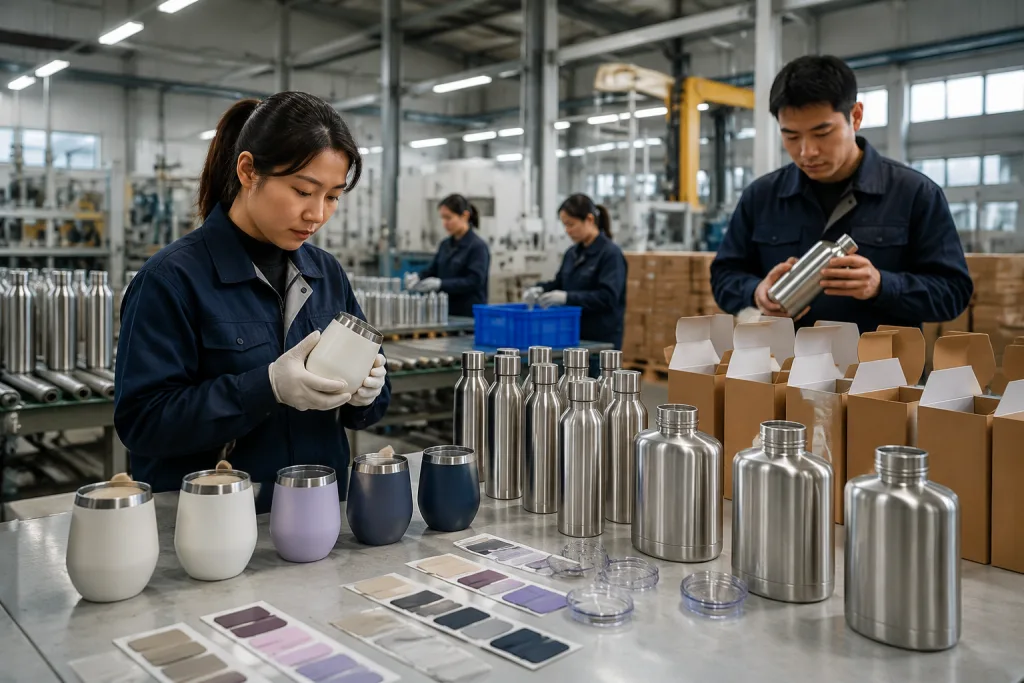
Key Takeaways
- A practical 12 oz stainless wine tumbler custom made order usually starts at 1,000 pcs MOQ per color
- 304 stainless steel at 0.5 mm outer wall and 0.4 mm inner wall is a sensible B2B baseline
- Powder coating adds about USD 0.18-0.35 per unit but improves grip and retail shelf value
- Plan 25-35 days production after artwork approval for standard Zhejiang factory schedules
A wine tumbler custom made order looks simple until the sample room starts measuring the real variables: 355 ml or 500 ml body, 0.5 mm steel wall, push-on lid fit, powder coat adhesion, logo process, carton drop test, FDA or LFGB paperwork, and color tolerance across 10,000 pieces. Cheap quotes usually move the cost somewhere else. We have seen 201 steel quoted as 304 stainless, lids with 0.8 mm play, coating that chips on the cross-hatch tape test, and logos that fail after 20 dishwasher cycles.
At BottleForge Industrial in Hangzhou, Zhejiang, we see this most with first-time custom drinkware buyers moving from retail catalog products into OEM production in China. You are not just buying a cup. You are locking a spec that has to match your sales channel and inspection standard, or the math doesn't work. Last month QC pulled a wine tumbler sample from the line because the buyer asked for matte ivory, the PO typed “ivroy,” and the approved color chip was 2 shades warmer than the production panel.
The Spec Table That Matters
Do not start the comparison with color. Start with the build. We run these cups on the same forming line, and two samples can look identical under the light box but behave differently after a 1.2 m carton drop test. A wine tumbler custom made for a gift box, winery club, outdoor event, or distributor drinkware program can use the same body shape, but the spec should change with the selling channel.
| Spec | Value Option A | Value Option B | Best Fit |
|---|---|---|---|
| Capacity | 10 oz / 300 ml | 12 oz / 350 ml | 10 oz works for tasting sets; 12 oz sells better for retail and promo orders |
| Steel | 201 outer + 304 inner | 304 inner + 304 outer | 304/304 is the better call for premium programs and EU buyers |
| Wall thickness | 0.4 mm outer | 0.5 mm outer | 0.5 mm handles carton pressure better during sea freight |
| Lid | PS clear push lid | Tritan sliding lid | Sliding lid feels more retail-ready and gets fewer buyer pushbacks |
| Finish | Spray paint | Powder coating | Powder coating holds up better for outdoor use and shelf display |
Our blunt view: if you sell into Europe or North America, choose a 12 oz double-wall vacuum tumbler with 304 inner steel, 304 outer steel, powder coating, and a Tritan sliding lid as the default. The math doesn't work on a thin 201/304 build for paid retail; QC pulled 3 dented samples from a 50-piece pre-shipment check last season, and the buyer flagged the wall thickness before they even discussed the logo. For a canteen promotional campaign handed out once at an event, lighter specs can pass. For a winery membership gift or paid retail SKU, we would not risk it.
Wine Tumbler Versus Canteen
Last month 7 buyers asked us whether they should order a wine tumbler, a custom canteen, or both. Wrong first question. Start with where the drink is used. A wine tumbler custom made order sells hand feel and table presence, with controlled sipping from a short rim. A canteen custom order sells carry volume and sealing performance for bags, bikes, and outdoor use. On our line, QC checks the tumbler rim with a 0.02 mm feeler gauge because one tiny burr gets noticed fast.
Here is the practical comparison we use in the sample room. A 12 oz wine tumbler usually weighs 170-230 g depending on steel gauge and coating. A 20 oz canteen customizable bottle often runs 280-360 g and needs a stronger cap seal. Wine tumblers can pass with splash-resistant lids; canteens need leak-resistant or leakproof testing, usually 3-5 minutes inverted after filling with room-temperature water. We run that test over a white tray, and QC pulled one sample last week because 2 drops formed near the silicone gasket after 4 minutes. A canteen customized for hiking or campus use also needs a carry loop and a wide mouth if the buyer wants 25 mm ice cubes to fit.
If you are a canteen distributor or one of 12 canteen distributors building a seasonal catalog, do not treat the wine tumbler as just a short canteen. We have seen this go sideways. The production risks are different. Wine tumblers show coating defects fast because the surface is broad and held close to the face; one buyer flagged a 1.5 mm dust dot on a matte black sample under office lighting. Canteens expose cap and gasket defects faster because users throw them into bags. A good canteen factory controls torque at the cap, gasket fit, and cap thread flash with a go/no-go gauge. A good wine tumbler line controls rim polish and lid insertion force, then tracks vacuum failure rate after the hot water test.
For mixed programs, we often recommend one shared color system across a tumbler and customized canteen, then add the custom growler only if the MOQ math works. We ship cleaner sets that way. Last PO had “sand beige” typed as “send beige,” so our merchandiser locked the Pantone code on the color board before mass production.
Logo Methods Compared Honestly
Your logo method changes the quote fast: cost, wear, lead time, and whether the tumbler looks retail-ready or like a giveaway. On powder-coated 304 stainless, we run laser engraving for most wine tumbler custom made retail orders. The laser burns off about 0.03 mm of coating and shows the steel underneath, so there is no ink layer to peel. Clean result. Unit cost usually stays at USD 0.08-0.18 per position after setup, and QC pulled fewer than 3 logo complaints on our last 20,000 pcs laser run.
Silkscreen printing is cheaper for simple one-color marks, often USD 0.05-0.12 per position, but the ink and oven cure decide the real quality. On matte powder coating, we have seen the wrong ink scratch after a 1.2 m carton drop test and 6 hours of vibration on the test table. Heat transfer gives more colors and gradients, usually USD 0.25-0.60 per position. Ask for abrasion testing before mass production; skipping that test is where we have seen this go sideways.
For customized drinkware sold through retail, we usually push buyers toward laser, embossed badges, or tight two-color printing with a real Pantone callout. For canteen promotional projects, silkscreen can pass because the campaign budget matters more than 18-month shelf appearance. The math doesn't work if a buyer asks for a USD 2.80 target price and a full-wrap glossy transfer. For a distributor growler or customizable growler aimed at outdoor stores, laser plus a 300 gsm hang tag feels more credible than a big shiny transfer, and buyers flagged that exact issue in two REI-style samples last quarter.
Artwork rules are boring. They save scrap. Send vector AI, EPS, or PDF files, not a 96 dpi JPG pulled from a website. Define Pantone codes for printed logos, and do not leave “match sample” on the PO; our merchandiser once caught that typo 2 hours before screen making. For laser marks, check that lines are not thinner than 0.2 mm. If you want wraparound artwork, confirm the printable area after taper compensation on the actual body drawing, not from a flat mockup, because a curved stainless cup can shift a 40 mm logo by 1.5 mm near the edge.
Factory Price Versus Landed Risk
A low FOB Ningbo or FOB Shanghai number gets attention, but it does not decide the order. For a standard 12 oz 304/304 powder-coated wine tumbler custom made in Zhejiang, a realistic FOB China range is often USD 2.35-3.20 per piece at 3,000 pcs, depending on lid fit, inner carton spec, coating thickness, and logo process. Gift box packaging can add USD 0.25-0.55. A color box with 350 gsm paper and E-flute protection costs more than a plain white box, but we have seen it cut dent claims after QC pulled 37 crushed-box samples from one trial pallet.
As a canteen manufacturer and drinkware exporter in China, we quote from the bill of materials, not hope. If another canteen supplier quotes 18% lower, ask what moved on the worksheet: 304 stainless thickness in mm, vacuum testing rate at the line, coating powder brand, lid material, carton bursting strength, or AQL 2.5 inspection allowance. There is a reason. Last quarter a buyer flagged a “same spec” offer, and the lid had changed from Tritan to PS plastic without being marked on the PO.
BottleForge Industrial’s regular capacity for stainless drinkware is about 450,000 units/month across tumblers and bottles, plus growlers and canteens, with a common MOQ of 1,000 pcs per color for custom coating and 500 pcs for stock-color logo orders. Normal lead time is 25-35 days after deposit and artwork approval; add 7-10 days for molded accessories or non-standard lids. We run capacity by coating line hours, not brochure promises, and a 0.15 mm logo placement tolerance on the fixture can still decide whether the buyer accepts the shipment.
The costly mistake is not paying USD 0.20 too much. It is receiving 8,000 units with inconsistent lids or color drift. For distributor drinkware, a 3% defect rate can wipe out margin through replacements and credit notes, before the warehouse even counts relabeling labor. We have seen this go sideways when the buyer pushed for the lowest carton spec and the arrival inspection found lid wobble on 214 pcs from the first 20 cartons.
Compliance And Inspection Choices
For Europe and North America, confirm compliance before the 30% deposit, not after the line has packed 120 cartons. Stainless wine tumblers and canteens need food-contact material paperwork matched to the BOM we run. For EU buyers, ask for LFGB, REACH, and plastic-part tests for lids and gaskets; our QC usually checks the lid resin code with a caliper and sample tag before sending files. For US buyers, FDA food-contact expectations and California Proposition 65 screening depend on the sales channel, especially if the buyer sells through Amazon, Costco, or a California retailer.
Factories in Zhejiang and other parts of China use “food grade” too loosely. This is the wrong question to ask. Ask for test reports tied to the real material family: 304 stainless steel, PP, silicone, Tritan, PS, or powder coating. If the lid changes from PS to Tritan after the PO, the old report does not cover it; we have seen this go sideways when a buyer flagged “Tirtan” typed wrong on a revised PO. If the coating color changes from matte black to PMS 7499C, strict retailers often ask for heavy metal screening again.
Inspection should use AQL, not a 10-minute warehouse glance beside the loading dock. We usually see AQL 2.5 for major defects and AQL 4.0 for minor defects, with critical defects set at 0. For a wine tumbler custom made order, major defects include vacuum failure, sharp rim, wrong logo, severe coating scratch, leaking lid beyond the agreed standard, or carton short count; QC pulled the sample once after a 0.6 mm rim burr failed the glove check. Minor defects include 1–2 tiny dust points in coating or slight logo position deviation within an approved tolerance, often ±1.5 mm from the signed sample.
For canteen vendors and canteen manufacturers shipping to 3–6 distributors, inspection photos should show carton marks, barcode labels, color comparison under neutral light, drop test results, and sample water-fill checks with the lid locked for 30 minutes. We ship this way because distributors argue about labels first, not stainless thickness. If you sell on marketplaces, add FNSKU or carton label verification before final balance payment; one missed digit on a carton label can hold 800 pieces at the 3PL.
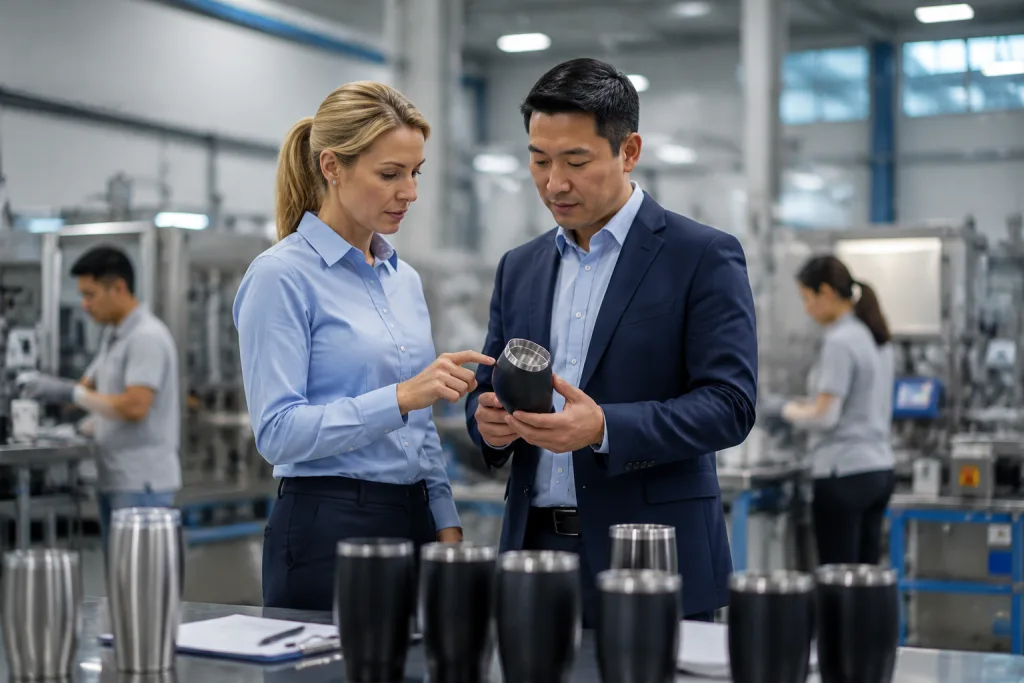
Use-Case Fit Before Purchase
The cleanest buying decision comes from matching the tumbler to the sales channel. For a winery gift set, we look first at base width, usually 68-72 mm on a 12 oz wine tumbler, then the coating feel and whether the lid looks like drinkware or a borrowed coffee-cup part. For a corporate canteen promotional order, the buyer usually pushes back on logo size and unit price at 5,000-20,000 pcs, so we run a 35 mm laser mark on the sample and check it under the line light before quoting bulk. For a distributor catalog, repeatable color matters more than chasing 12 seasonal shades. QC pulled the sample last March because the “matte champagne” lid was 2 tones warmer than the body. That order nearly went sideways.
If you sell through retail, spend money on packaging. A 5-layer export carton, egg-crate divider, and individual box are not decoration; they stop dented rims when the carton sits at the bottom of a mixed pallet. For e-commerce, test one packed unit from 80 cm on 3 faces and 1 corner, then open it and check the rim, lid lip, and powder coating under a 6000K inspection lamp. For Amazon FBA drinkware, confirm carton dimensions, suffocation warnings for polybags if used, and scannable FNSKU placement. We have seen a PO typo list 47 x 39 x 32 cm while the actual carton was 49 x 41 x 34 cm, and the buyer flagged it before booking. For wholesale, simplify the box if needed, but do not remove rim protection. The math does not work if 2% arrive dented.
For customizable drinkware programs, keep SKUs tight. Three body colors, two logo methods, and one lid option are manageable because the line can separate coating batches with clear traveler cards and 1 master carton sample per SKU. Twelve colorways with mixed accessories sound good in a meeting, then approval stretches from 12 days vs 18 days because every extra color needs a coated plate, logo proof, and packing photo. This applies whether you buy a custom canteen, customized growler, or wine tumbler. We ship fewer complaints when the buyer approves a small matrix first.
Our practical recommendation: build a good-better-best ladder. Good is stock color plus laser logo, usually the fastest route when the order is under a tight event date. Better is custom Pantone powder coating plus laser, with a sprayed color chip checked by Delta E meter before mass production. Best is custom color, premium lid, retail box, and pre-shipment inspection under AQL 2.5. That ladder lets you serve promotional buyers and brand owners without rebuilding the product each time. Simple sells better.
Sampling And Purchase Controls
Sampling should answer production questions, not just give marketing a clean photo. For a wine tumbler custom made project above 3,000 pcs, we ask the buyer to approve a pre-production sample using the final powder coating, the final logo process, the final lid, and the retail box. A plain silver sample only proves the body shape came off the forming line. It says nothing about matte cream coating thickness at 60-80 μm, logo contrast under the light box, or whether the insert tray crushes the lid during a 12 kg carton compression check.
Our normal sample time is 5-7 days for stock color with logo and 10-15 days for custom coating. Molded lids, special sliders, or embossed metal badges can push sampling to 20 days because the lid tool must be checked on the caliper before we run assembly. Be careful with a canteen vendor promising a fully custom sample in 3 days. The math usually does not work. We have seen this go sideways when the buyer flagged that the “custom” sample was just UV printed on an existing black cup, not produced to the approved coating spec.
Write the purchase order with measurable terms. Include capacity tolerance in ml or oz; steel grade such as 304 stainless; coating finish with Pantone or RAL reference; logo size in mm; logo placement tolerance, for example ±1.5 mm from the rim; lid material; packaging structure; carton quantity; barcode rules; inspection standard such as AQL 2.5; shipment term. For FOB China, name the port, such as Ningbo or Shanghai. For EXW, inland trucking and export handling sit outside the unit price, and buyers sometimes miss that line on the PO.
Good canteen suppliers and tumbler factories welcome clear specifications because they cut arguments before production starts. Vague orders create bad shipments. We once had QC pull 32 pcs from a pilot run because the PO said “cream logo” while the artwork file showed warm gray, and nobody wanted to own the color gap. If you are comparing canteen manufacturers, customizable canteen options, or a customized drinkware family, send each supplier the same spec sheet with the same lid drawing and carton mark file. Otherwise, you are comparing guesses, not prices.
Send Your Wine Tumbler Spec For Factory Review
Share capacity, logo, color, quantity, destination market, and packaging needs. We will return a practical FOB quote and production timeline.
Frequently asked questions
What is the normal MOQ for a wine tumbler custom made order?
For stainless steel wine tumblers, a realistic MOQ is 1,000 pcs per color for custom powder coating and 500 pcs if you use a stock color with laser engraving or one-color printing. Some factories in China will accept 300 pcs, but the unit price usually rises by 20-40% because coating, setup, and carton printing costs are spread over fewer units. If you need retail packaging, 1,000 pcs is also more practical because box printing suppliers often have their own minimum run.
Should I choose 304 stainless steel or 201 stainless steel?
For export programs in Europe and North America, choose 304 stainless steel for the inner wall at minimum. A lower-cost build may use 201 outer steel and 304 inner steel, but 304/304 is better for premium custom drinkware because it resists corrosion better and feels more credible in buyer audits. The price difference is often USD 0.12-0.30 per unit depending on thickness and market steel cost. For wine, cocktails, and acidic drinks, do not compromise on the inner wall material.
How long does production take after sample approval?
For a standard 12 oz wine tumbler with existing tooling, plan 25-35 days after deposit, artwork approval, and sample confirmation. Add 7-10 days if you require a custom Pantone coating that needs lab matching. Add 15-25 days if you need a new lid mold, special slider, or custom retail box structure. Around Chinese New Year, production and shipping schedules in Zhejiang and the rest of China can stretch by 2-4 weeks, so place spring orders earlier.
Which logo method lasts longest on powder-coated tumblers?
Laser engraving is usually the most durable because it removes the coating rather than sitting on top of it. It is a strong option for wine tumbler custom made orders, distributor growler programs, and premium custom canteen lines. Silkscreen printing can work well for simple logos, but you should ask for tape testing and abrasion checks. Heat transfer is best for multi-color artwork, but it needs careful testing on curved powder-coated surfaces before mass production.
Can one supplier make wine tumblers, canteens, and growlers together?
Yes, if the supplier has stainless drinkware production experience across multiple body types. A capable canteen manufacturer can usually support wine tumblers, customized canteen projects, and custom growler orders under one color and logo system. The main benefit is consistency: same powder coating target, same carton mark rules, same inspection standard, and one export shipment. For mixed orders, ask whether the factory can combine SKUs into one container and keep each item clearly separated by carton code.