Key Takeaways
- Plan MOQ from 500 units for stock-color logo orders and 3,000 units for custom powder coating
- Use 304 stainless steel inside, 201 or 304 outside depending on price target and corrosion risk
- Normal production lead time is 30-45 days after deposit and approved pre-production sample
- AQL inspection, vacuum testing, and carton drop testing catch most wholesale thermos failures before shipment
A wholesale thermos order looks simple until your buyer asks why the approved sample holds heat for 18 hours, but the 5,000-unit shipment tests at 12 hours. Outdoor retailers and promo brands often find the trouble after artwork approval: 304 stainless thickness at 0.45 mm instead of 0.50 mm, weak vacuum, loose lid fit, logo rub-off after 50 tape pulls, crushed B-flute cartons, or a matte black finish that shifts between Monday and Thursday production.
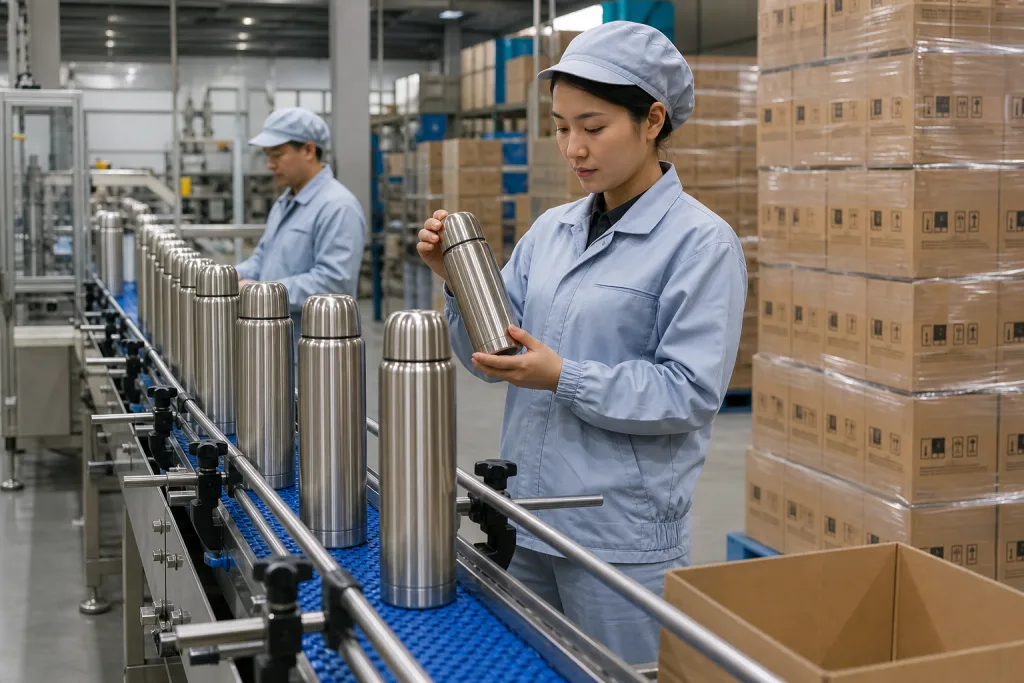
We manufacture stainless drinkware in Zhejiang, China, and we run into the same buying questions every week. Shelf appeal is not enough. Your custom thermos has to survive field use, pass REACH or LFGB documentation checks, and ship on the ETD printed on the PO, not 9 days late because the lid mold needed rework. “Yes, we can” is the wrong answer to trust. The useful answer is heat-retention data, mm tolerances, AQL checkpoints, pre-shipment photos, and clear limits before the line starts.
What should a wholesale buyer specify?
Start with the product use case, not the catalog photo. A wholesale thermos for mountain shops is a different job from a promo bottle for a software conference. On our line, we check the lid thread gauge at 0.1 mm before QC signs off. Outdoor buyers want grip, impact resistance, spare lids, and insulation that holds up in a truck bed. Promo buyers care about logo space, gift-box fit, and a FOB under USD 4.80.
For stainless thermos programs, spell out these items before you ask for a quote. This is the wrong question to ask if your brief still says “nice matte finish” and nothing else. QC pulled a 500 ml sample off the rack at 8:15, and the buyer still changed the lid after the first test.
- Capacity: common sizes are 350 ml, 500 ml, 750 ml, 1,000 ml, and 1,200 ml. A 500 ml bottle moves fastest for retail, while 750 ml and 1,000 ml usually get picked for outdoor sets.
- Steel: 304 stainless steel inner wall is standard for food contact. Outer wall can be 201 or 304 depending on market and budget.
- Wall thickness: 0.4-0.5 mm sheet is common on factory thermos bodies; heavier outdoor models may use 0.55-0.6 mm. If you want a sturdier hand feel, say so in the brief.
- Insulation target: for a 500 ml bottle, 6-hour hot-water performance above 65°C is a realistic mass-production benchmark when tested from 95°C starting water. If your buyer asks for 12 hours at the same fill line, the math changes fast.
- Lid type: screw cap, cup lid, push-button, straw, handle lid, or leakproof coffee lid. The lid decides the leak risk, the packing size, and the user complaint rate.
- Finish: powder coating, spray paint, rubber coating, raw stainless, gradient spray, or full wrap print. Tell us the Pantone code or the print area, or the sample room will guess and you will lose a week.
- Compliance: FDA, LFGB, REACH, CA Prop 65, or ASTM requirements depending on your sales market. Send the target market first, because the test file is different for the US, Germany, and California.
A real thermos supplier will ask these points before pricing. If a vendor sends one number without steel grade, finish, carton count, and logo method, that is not a quote. It is a placeholder. We have seen this go sideways when the PO says “500 ml” in one line and “550 ml” in the next, then the buyer flags the mismatch after samples are already on the press.
How do MOQ and pricing work?
MOQ is where buyers either pay for air or cut specs too far. On our Zhejiang factory thermos lines, a stock-shape, stock-color order with one-position laser engraving can start at 500 units; we run that on the fiber laser with a simple positioning jig, so setup is light. A custom thermos with private powder color usually starts around 3,000 units per color because coating line setup, powder loss, and color matching waste hit the real cost sheet. New mold work is different. A fully customized thermos with new mold tooling may require 5,000-10,000 units to make sense, and if the buyer asks for 1,200 units with a new lid mold, the math doesn't work.
Typical FOB China pricing for stainless vacuum thermos orders varies widely, but these ranges are useful for planning. Last month QC pulled samples from a 750 ml line and found a 0.4 mm lid gap after powder coating, so finish choice is not just a color issue:
- 500 ml basic screw-cap thermos: about USD 3.20-5.20 FOB, depending on steel and finish.
- 750 ml outdoor thermos with handle lid: about USD 5.60-8.80 FOB.
- 1,000 ml cup-lid vacuum flask: about USD 6.80-10.50 FOB.
- Retail gift box: often adds USD 0.35-0.90 per unit, with 350 gsm white card costing less than a rigid gift box.
- Extra lid or spare gasket: usually adds USD 0.18-0.75 per set, depending on silicone grade and packing method.
For a bulk thermos order, unit price is only one part of the cost. Ask for carton dimensions, gross weight, HS code, and estimated CBM before you compare suppliers thermos quotes. We have seen a USD 0.25 cheaper bottle lose the saving because the master carton was 62 cm long and wasted pallet space. Packaging matters. If the carton fails a 1.2 m drop test or the buyer flags crushed gift boxes at arrival, nobody remembers the cheap FOB line.
Checklist: compare FOB price, MOQ per color, sample charge, logo charge, mold fee, carton CBM, spare parts policy, and payment terms on the same sheet.
Which customization method fits your brand?
Thermos decoration comes down to finish, logo complexity, order size, and how much abrasion the bottle will take in cartons and on shelf. On our line, QC pulls a rubbed sample before we release the print method. Outdoor buyers usually go for laser engraving or one-color printing. Campaign orders are different; they want large graphics, PMS matching, and gift boxes because the bottle is part of a promo, not a long-life retail SKU. The wrong question is “which looks best.” Ask what survives 200 cartons and a hard delivery route.
Laser engraving is clean and hard-wearing. On powder coat, the beam cuts through to the steel base, so you get a sharp silver mark. We run it best at 500-5,000 units. A buyer once asked for a PMS match on laser; the math does not work. No ink means no adhesion risk, but you give up color.
Silkscreen printing fits one- to three-color logos and keeps unit cost in check. On straight-wall bottles, a logo height of 40-90 mm is normal; once the shoulder curves, the screen loses contact and the edge goes soft. We had a PO typo last month, “90cm” instead of “90mm,” and QC pulled the sample before the line moved. That saved a wasted screen.
Heat transfer or water transfer is the pick for full-wrap art and lifestyle retail graphics. It covers more of the bottle, but you should approve abrasion testing and tape testing before mass run. A PDF can look perfect; on the line, a 1.5 mm registration shift will show up fast. We’ve seen that go sideways on a 10,000 pcs order.
Embossed or molded parts make sense for a distributor thermos line that stays in the catalog for 2-3 seasons. Tooling for a lid or silicone part change usually lands at USD 800 to USD 4,000, based on cavity count and logo depth. On one lid job, QC measured a 0.6 mm draft issue and we had to re-cut the insert. This is not the place to chase a one-off promo.
A customizable thermos is not the same as a good custom spec. Send vector art, Pantone references, print size, placement in millimeters, and a photo showing the bottle angle you want. Then ask for a pre-production sample first. A digital mockup misses curved shoulder distortion and a 2 mm shift at the seam.
What quality checks actually matter?
For wholesale thermos shipments, the defect that costs money is usually not a hairline scratch. It is vacuum failure. A stainless vacuum bottle keeps heat because the air between the double walls is pulled out and the shell is sealed at the vacuum tail. If that weld or seal leaks, the bottle can look clean in a light box but drop from 95°C to lukewarm before lunch. We run hot-water holding checks on the line, using a probe thermometer and timer, not just a final packing glance.
Our China production checks normally cover incoming material inspection, welding inspection, vacuum test, polishing review, coating adhesion test, leak test, and final AQL inspection. For a 10,000-unit thermos bulk order, we usually set 3 in-line checkpoints before the final third-party inspection: after welding, after surface treatment, and before carton sealing. QC pulled the sample last month for a 0.3 mm pit near the mouth thread; small mark, but the buyer flagged it because the lid gasket could not sit flat.
Ask your thermos factory for these test points:
- Vacuum performance: hot-water temperature test after 6, 12, or 24 hours depending on model; for a 500 ml flask, ask the factory to record start temperature, room temperature, and final temperature, not just write “pass.”
- Leak test: filled bottle inverted or shaken for a defined period, especially for push-button and straw lids; we use room-temperature water first, then repeat after assembly if the lid has 2 silicone rings.
- Coating adhesion: cross-hatch tape test on powder coating or spray paint; a 3M tape pull tells you more than a glossy showroom photo.
- Drop test: carton drop test from 76 cm is common for export packaging reference; check the inner egg-crate or polybag too, because dented cups inside a perfect master carton still become a claim.
- Food contact: material declarations and test reports for 304 stainless steel, PP, silicone, and coatings; match the report name to the actual PO, because one typo in the lid material code can slow customs release.
- AQL: 7 out of 10 buyers we ship use AQL 2.5 for major defects and 4.0 for minor defects, with critical defects set at 0; the math does not work if you only inspect the top layer of cartons.
For outdoor retail, we recommend testing the lid with gloves, checking one-hand opening if claimed, and putting the bottle in a backpack side pocket. Simple test. A product can pass the lab and still irritate the user if the button is stiff at 5°C or the 74 mm body diameter fights the pocket mesh. We have seen this go sideways when the sample worked on a desk but failed on a hiking pack.
How should packaging be planned?
Packaging is not an afterthought for decoration. It controls damage rate, freight cost, barcode accuracy, and how fast your warehouse can receive the goods. A supplier thermos quote should state the packing clearly: white box, kraft box, color box, mailer box, or retail sleeve, with box size in mm if the buyer is planning shelf space. If you sell through outdoor retail, shelf face and barcode position matter; we have had a buyer reject a color box because the UPC sat 8 mm too close to the bottom fold. If you ship promotional orders, case labels and individual name labels usually matter more than fancy printing. The math changes fast.
For North America, most of our retail buyers ask for UPC labels on unit boxes and carton marks with PO number, SKU, quantity, gross weight, net weight, and country of origin. For marketplace or 3PL routing, FNSKU or item barcode placement should be confirmed before mass packing, not after the cartons are sealed. QC pulled a sample last month where the PO typed “matte black” but the carton mark said “matt black,” and the buyer flagged it before booking pickup. Do not assume the thermos suppliers know your warehouse rules unless you send a packing SOP with label size, label position, and carton mark format.
A standard export carton for 500 ml stainless bottles may hold 24 or 25 units. Larger 1,000 ml flasks often pack 12 units per carton. Carton material should be at least 5-ply for heavier stainless thermos products, and dividers or molded pulp trays reduce scuffing on coated bottles. We run a simple carton drop check on the line, usually from around 80 cm, because powder-coated bottles can look fine at packing and still arrive with rub marks if the inner divider is loose by 2-3 mm.
For gift orders, check whether the box paper is 300 gsm, 350 gsm, or corrugated E-flute. A nice-looking 300 gsm box can crush during ocean freight if it is not supported inside the master carton; we have seen this go sideways on LCL shipments where cartons were stacked under 18 kg kitchenware boxes. For a thermos promotional order delivered to 50 event locations, ask for drop-ship carton labeling early. Reworking labels in China after packing can add 3-7 days, and nobody wants to reopen 200 cartons with a box cutter because the event code was missing.
Can one factory support growth?
A passing sample does not prove a thermos manufacturer can carry your program for two years. Look at monthly capacity, paperwork discipline, engineer reply speed, and repeat order consistency. BottleForge Industrial is based in Hangzhou, Zhejiang, and our drinkware network supports about 300,000 stainless units per month across regular bottle, tumbler, and thermos lines. That does not mean every SKU can be made tomorrow. It means we can hold line time when the buyer sends a 90-day forecast instead of asking for 20,000 pcs after the PO typo is already corrected.
If you are building a distributor thermos range, ask the factory how many colors can run per week, how many lid molds are active, and whether spare parts are stocked. A thermos distributors program often fails because the first order sells well, then the reorder color shifts, lid silicone changes, or the retail box gets discontinued. We have seen this go sideways over a 1.5 mm gasket change. Keep a locked specification sheet with material, coating code, logo file, gasket hardness, carton size, and inspection standard.
For manufacturer thermos programs, we suggest a simple growth path: first order on existing mold, second order adds private color and packaging, third order reviews lid modification or exclusive shape after sell-through data is in. This cuts tooling risk. It also gives your sales team real market data before you spend USD 5,000-15,000 on full custom molds. The math does not work if QC pulled the sample twice and your team still has not confirmed the lid drawing.
Certifications should match your channel. BSCI or Sedex may be needed for larger retailers. ISO 9001 helps process control but does not replace product testing. REACH and LFGB reports should be current, model-relevant, and tied to the materials used in your actual customized thermos order. On our side, we check the report model code against the BOM before shipment because one wrong plastic grade on a lid can stop a container at retailer audit.
Buyer checklist before deposit
Before you pay a 30% deposit, give the file one working day and read it like our QC engineer reads a pre-production sheet. Costly disputes usually start before the line opens. We follow the last signed PI, spec sheet, and artwork PDF, not the WhatsApp note from 3 weeks ago; last month a buyer flagged a lid color after deposit, but the PO still said “black flip lid,” so the mold room had no reason to change it.
- Confirm capacity, lid type, inner steel, outer steel, wall thickness, coating, and insulation target. Put the numbers in writing, for example 500 ml, 304 stainless inner, 0.4 mm inner wall, powder coating, 6-hour heat test.
- Confirm MOQ by SKU, color, and logo version. A 3,000-unit MOQ may mean one color, not three colors of 1,000 units. This catches buyers often.
- Approve artwork with size, position, Pantone, and logo method stated in millimeters. “Logo on front” is not enough; we need 42 mm wide, 55 mm from bottom, laser or silk screen.
- Approve packaging dieline, barcode, carton marks, and country-of-origin wording. QC pulled one sample where the barcode scanned, but the carton mark had a PO digit missing.
- Agree on inspection standard: AQL level, sample size, critical defects, and acceptable cosmetic limits. Define scratch length in mm, because “small scratch” means different things to a warehouse inspector and a coating worker.
- Confirm payment terms, FOB port, estimated lead time, and shipping documents. If the shipment leaves Ningbo, say Ningbo, not “China port.”
- Request retained samples: one with you, one with the China factory, and one sealed for inspection reference. We seal ours with a dated QC label and buyer signature photo.
For most wholesale thermos orders, a realistic timeline is 5-7 days for quote and artwork check, 7-12 days for sample, 30-45 days for production, and 7-14 days for inspection, booking, and export handling. Peak season before Q4 can add 10-20 days if powder coating or lid suppliers are full; last September our coating line ran 2 shifts and still pushed matte black orders from 12 days to 18 days.
If you are choosing between several thermos manufacturers, do not pick only by the lowest FOB number. That is the wrong question to ask. Pick the team that gives clear limits, writes specifications, and answers quality questions before they have your deposit; a USD 0.08 cheaper cup does not work if 6 cartons fail leak testing at inbound inspection.
Send us your wholesale thermos specification today
Share capacity, logo, target price, and market. We will return a practical China factory quote with MOQ, lead time, and options.
Frequently asked questions
What is the best MOQ for a first wholesale thermos order?
For a first order, 500-1,000 units is practical if you use an existing bottle shape, stock color, and simple laser logo. It lets you test sell-through without locking too much cash in inventory. If you need custom powder coating, plan around 3,000 units per color because the coating line has setup loss and color-change time. For new mold development, 5,000-10,000 units is more realistic. Outdoor retailers often start with 2 colors and 2 capacities, while promotional brands usually focus on one capacity and one strong logo execution.
Should I choose 304 stainless steel for both inner and outer walls?
Use 304 stainless steel for the inner wall. That is the food-contact surface and the part buyers care about most. For the outer wall, 201 stainless steel can reduce cost and is common for many promotional thermos orders, but 304 outer steel is better for coastal markets, outdoor use, and premium retail positioning. The price difference depends on size and steel market cost, but for a 500 ml bottle it can be roughly USD 0.25-0.60 per unit. If your brand promises rugged outdoor performance, 304 inside and outside is easier to defend.
How long should a stainless thermos keep drinks hot?
Claims should match the test method. A common internal benchmark for a 500 ml vacuum thermos is starting with 95°C water and measuring after 6, 12, or 24 hours at room temperature. A good unit may stay above 65°C after 6 hours, but results depend on capacity, mouth width, lid design, and ambient temperature. Do not print “24 hours hot” unless you have a test report that supports the exact model. Wide-mouth bottles usually lose heat faster than narrow-mouth flasks because the lid area is larger.
Which logo method is most durable for outdoor retail?
Laser engraving is usually the safest for outdoor retail because it does not rely on ink adhesion. On powder-coated bottles, the laser removes the coating and reveals the stainless surface below. It handles abrasion better than many printed logos. Silkscreen can work well for simple one-color marks, but you should request tape testing and abrasion testing on the actual coating. For large graphics, heat transfer is possible, but it needs tighter QC. If your product will be clipped to backpacks or used in campsites, durability matters more than full-color artwork.
What documents should a thermos supplier provide for Europe and North America?
For Europe, ask for LFGB or EU food-contact testing, REACH information for coatings and components, and a declaration of conformity where applicable. For North America, FDA food-contact material compliance and CA Prop 65 review are common requests. Larger retailers may also ask for BSCI, Sedex, ISO 9001, or social audit documents. Make sure reports match the actual materials: 304 stainless steel, PP lid parts, silicone gasket, coating, and printing ink. Old generic reports are not enough for a serious retail or distributor thermos program.