Key Takeaways
- A practical wholesale growler RFQ should include capacity, steel grade, wall thickness, lid type, logo method, carton pack, Incoterm, and target quantity
- For custom logo growler bulk orders, a realistic MOQ is usually 1,000 units per color, with 25-35 days bulk lead time after sample approval
- Sample approval should test leak rate, vacuum retention, coating adhesion, logo durability, and carton drop performance before any bulk PO
- FOB Ningbo or Shanghai pricing is easier to compare than vague door-to-door quotes, especially for mixed wholesale drinkware programs
A wholesale growler looks simple until the first RFQ comes back with three steel options, two lid structures, loose carton wording, and unit prices that do not line up. If you buy for a beverage brand, distributor, brewery group, or outdoor retail line, paying 0.40 USD extra per unit is only the visible loss. The bigger problem is bulk drinkware that leaks at the silicone ring, shows rust dots after a 24-hour salt spray check, misses the approved logo position by 3 mm, or lands 12 days after your launch date.
From our factory base in Zhejiang, China, we see the same mistake about 6 times a month: buyers ask for “growler wholesale price” before fixing capacity, wall thickness, lid sealing, decoration, and inspection terms. This is the wrong question to ask first. We run the process in a tighter order: RFQ, engineering check, sample, pre-production approval, bulk PO, inspection, and shipment. Last month QC pulled a growler sample where the PO said matte black, but the artwork file named it “gloss black”; that one typo would have delayed the line by 5 days if we had caught it after powder coating.
Start with a usable RFQ
Your RFQ is not a shopping message. It is the technical starting point for the whole wholesale growler order. On our line, one missing lid detail can turn into a 2 mm mismatch at sampling. If the RFQ is loose, every supplier fills the gaps differently, and the cheapest quote may be for a different product. For a 64 oz stainless beer growler wholesale project, state the target capacity, insulation requirement, steel grade, surface finish, lid structure, logo process, packaging, order quantity, and destination port.
For example, a usable RFQ line reads: 64 oz vacuum insulated growler, inner 304 stainless steel, outer 201 or 304 optional, powder coated body, screw lid with silicone gasket, laser engraved logo, individual kraft box, 12 pcs master carton, FOB Ningbo, 3,000 pcs first order. That gives a China factory enough to quote on the right BOM. QC pulled the sample, checked the mouth opening at 55 mm, and the price only moved after that detail was locked.
Ask for prices at two or three quantity breaks: 1,000, 3,000, and 5,000 units. For drinkware wholesale, a 5,000-unit quote often drops by 5-12% versus 1,000 units because coating setup, logo setup, and carton printing are spread over more pieces. We have seen buyers try to blend beer tumbler bulk, bulk canteen, and wholesale canteen into one file. Don’t do that. List each SKU separately, or the carton count and lid cost get buried in the average.
Your RFQ should also ask the supplier to confirm monthly capacity. BottleForge Industrial in Zhejiang currently handles about 450,000 stainless drinkware units per month across tumblers, bottles, canteens, and growlers, but a specific growler model still needs line scheduling. We had a buyer flag a PO that said “3,000 pcs” but left out the pack spec, and the line could not book corrugated boxes until that was fixed. Capacity on paper does not mean your production slot is reserved.
Define the product before price
Growler bulk pricing starts with the build. A single-wall beer growler in bulk and a vacuum insulated wholesale growler are two different jobs on the line. For export retail and brewery merch, we usually ship 18/8 stainless inner wall, 0.4-0.5 mm wall thickness, double-wall vacuum insulation, and powder coating. If you need a lower-cost opening item, single-wall stainless can work, but it will sweat with cold beer and it will not hold temperature. QC pulled the sample after a 12-minute vacuum hold test, and that told the story fast. The wrong question is, “What is the cheapest growler?”
Capacity changes tooling and carton math. Common sizes are 32 oz, 40 oz, and 64 oz. The 64 oz size is the standard for beer growler wholesale because it matches common brewery refill expectations in North America. For outdoor and camping lines, some buyers pair a 64 oz growler with a 20 oz beer tumbler wholesale bulk set. That gives better shelf value, but the artwork files and carton plan need tighter control. We changed the neck-forming mandrel on a 64 oz run last month, and one buyer pushed for a single carton size across all SKUs; the math did not work.
Use your PO draft early, before the final order lands. A practical product line item should show: SKU code, product name, capacity, dimensions, net weight, steel grade, lid material, gasket material, coating color, decoration method, packing, barcode requirement, and test standard. If you sell through retail chains, add REACH, LFGB, FDA food contact, Prop 65, or ASTM-related requirements where applicable. We have seen a PO type “304S” instead of 304 stainless, and that typo stopped booking until the buyer fixed it. Blank specs slow the line, and they slow shipments too.
Be careful with alcohol flask bulk and alcohol flask wholesale requests. Hip flasks and beer growlers sit in different product categories, with different shapes, weld points, and compliance expectations. If you need alcohol flask in bulk together with growlers, split them in the RFQ and do not assume the same tooling, MOQ, or leak test method applies. The flask seam uses a different TIG fixture, and the 500 ml flask mold does not share the 64 oz growler neck ring. We once saw “growler flask” on one PO line, the buyer flagged it, and the quote had to be split on the spot.
Compare quotes like an engineer
Once the quotes land, do not sort them by unit price alone. A 64 oz vacuum growler at 5.20 USD and another at 6.10 USD can look straightforward until you check the build sheet: thinner outer steel, a lower-grade lid, a plain white box, and no logo setup are all hiding in the cheap line. We run that check with a wall-thickness gauge and a caliper on the sample bench. This is the wrong question to ask if you only chase the lowest number.
Ask every supplier to quote the same Incoterm, preferably FOB Ningbo or FOB Shanghai if you are sourcing from Zhejiang or nearby China production clusters. EXW hides local trucking, export handling, and the document fee that shows up later; DDP can work for a small trial order, but it blurs the factory cost. On one PO, the buyer flagged a typo in the port name and we had to resend the sheet the same afternoon. For procurement teams, FOB is still the cleanest basis for comparison.
A complete quotation should include unit price, mold or tooling cost if any, logo setup cost, sample cost, packaging cost, estimated carton size and gross weight, MOQ, payment term, sample lead time, bulk lead time, and quote validity. For a custom color wholesale growler, sample timing is usually 7-12 days for an existing mold and 15-25 days if a new lid or body tooling change is needed. Bulk production is usually 25-35 days after deposit and an approved pre-production sample. QC pulled a lid sample last week and the torque meter showed 0.8 N·m, which told us the spring was too loose before mass run.
Your comparison sheet should include hidden cost fields. Add logo plate fee, color matching fee, insert card printing, FNSKU or UPC labeling, spare gasket cost, inspection cost, and domestic China trucking if that is not already in the quote. We also watch carton count and gross weight at the packing table, because a 12.8 kg carton can break a budget fast when the buyer expected 11.5 kg. The best wholesale drinkware supplier is not the one with the lowest unit price. It is the one whose quote still makes sense when the real PO arrives with a typo, a label request, and a missing gasket line.
Sample approval is not decoration approval
Too many buyers sign off a sample because the logo is centered and the color looks close. Wrong checkpoint. A wholesale growler sample is a technical approval, not decoration approval. We run the same basic checks our QC team uses on the line: lid seal with a 30-minute upside-down water test, thread feel with 5 open-close cycles, coating adhesion around the shoulder, internal smell after rinsing, standing stability on a flat glass plate, and carton fit with the insert in place. Fill it with water, turn it upside down for 30 minutes, shake it 20 times, then leave it on its side. For vacuum models, test heat retention with hot water at about 95°C and measure temperature drop after 6 and 12 hours.
For powder coating, ask for a cross-hatch adhesion test, or at least a 3M tape pull test on the approved coating. For laser engraving, check depth and contrast under normal warehouse light, not just under a photo lamp. For silkscreen or transfer print, rub the logo with a damp cloth and mild detergent for 30 seconds. If the product will sit in retail, carton scuffing matters too. We have seen a clean pre-production sample come back as a complaint after 18 days at sea because the carton divider was 2 mm too loose and the growler rubbed against the kraft insert.
Your sample PO or sample confirmation should spell out the acceptance points: approved body color by Pantone or physical color chip, logo size in mm with tolerance, logo position tolerance from the bottom or seam line, lid gasket material, inner polishing level, packaging artwork version, barcode placement, and user manual language. If you need canteen wholesale or beer tumbler in bulk alongside the growler, approve each item separately. Do not approve a family look based on only one bottle. The buyer flagged this once after our merchandiser copied “matte black” across 3 SKUs, but the 64 oz growler used a different powder batch and looked half a shade warmer.
Keep one signed golden sample at your office and one at the factory in China. Photos help, but they do not replace a physical standard. During bulk inspection, the inspector needs the approved sample to judge color, logo alignment, lid fit, and workmanship. We usually seal the factory sample in a PE bag, mark the PO number on the hangtag, and store it with the QC file; without that, AQL 2.5 inspection turns into an argument instead of a measurement.
Build the bulk PO properly
The bulk PO is where sourcing becomes enforceable. A short PO saying “3,000 pcs growler, black, logo, as sample” gives the factory too much room to guess. Bad start. A proper wholesale growler PO needs enough line-item detail that production, QC, finance, and logistics can run from the same document without asking the sales rep to check WeChat screenshots. We have seen POs where “black” meant matte black to the buyer and glossy black to the coating line.
For each SKU, include: product code and model number, capacity and color, decoration and logo size, unit price and quantity, over/under shipment tolerance, packaging and carton mark, inspection standard and delivery date, Incoterm and payment term, plus required certificates. A typical line could read: BG-64V, 64 oz vacuum insulated stainless growler, matte black powder coat, laser logo 45 x 38 mm one side, individual kraft box, 12 pcs/carton, 3,000 pcs, 6.35 USD/pc FOB Ningbo, AQL 2.5 major / 4.0 minor, delivery 30 days after deposit and PPS approval. QC pulled one PPS last month because the logo was 42 mm wide, not 45 mm; that 3 mm difference becomes a claim if the PO is silent.
If you are ordering mixed drinkware bulk items, do not combine different products under one loose quantity. A bulk canteen, alcohol flask wholesale bulk item, beer tumbler wholesale bulk item, and growler wholesale item should each have its own SKU line, carton data, and inspection sampling level. This is where buyers try to save time, and we think it is the wrong question to ask. The line can finish 3,000 growlers on Monday while the flask caps are still waiting for anodizing on Wednesday, so separate SKU lines prevent arguments over partial shipment.
Payment terms for new export buyers are often 30% deposit and 70% before shipment after inspection. Larger repeat buyers may negotiate different terms after two or three clean orders. Be realistic: a factory will not reserve 304 stainless steel, powder coating line time, silicone gaskets, and printed kraft boxes without deposit. In Zhejiang, schedules tighten before Chinese New Year and before major overseas retail seasons; if your launch date is fixed, send the PO 18 days earlier rather than trying to save 12 days at the end. We have seen this go sideways when a buyer flagged a PO typo from “FOB Ningbo” to “FOB Shanghai” after cartons were already marked.
Control inspection before shipment
Inspection costs less than replacement. For wholesale drinkware, we recommend pre-shipment inspection when at least 80% of goods are packed and 100% are produced. Use ANSI/ASQ Z1.4 sampling with AQL 2.5 for major defects and 4.0 for minor defects unless your retail customer sets tighter limits. Critical defects need zero tolerance: sharp edges, severe leaks, wrong food-contact material, or unsafe contamination. On the factory floor, QC pulls sealed cartons with a cutter and scale, not “best-looking” samples from the line.
For a wholesale growler, major defects include leakage, lid thread failure, wrong capacity, visible rust, severe dents, poor vacuum performance, wrong logo, incorrect barcode, and color outside approved tolerance. Minor defects include small coating dots, light carton rub marks, or tiny logo edge breaks within an agreed visual standard. Put this in the PO. We have seen buyers flag a 64 oz growler because the black powder coating looked two shades off under D65 light, then both sides argued for 3 days because the PO only said “black.”
The inspection checklist should measure actual capacity, body height, mouth diameter, unit weight, carton weight, carton dimensions, logo size, barcode scan rate, and packing count. Use a caliper for mouth diameter in mm, a digital scale for unit weight in g, and scan at least 32 barcodes from different cartons. If you ship to marketplace warehouses, FNSKU labeling and carton label placement must be checked before loading. A beer growler bulk order rejected by a warehouse because of bad labels is still your problem, even if the growler itself is good. The math does not work when a USD 0.03 label mistake creates a 12-day warehouse delay.
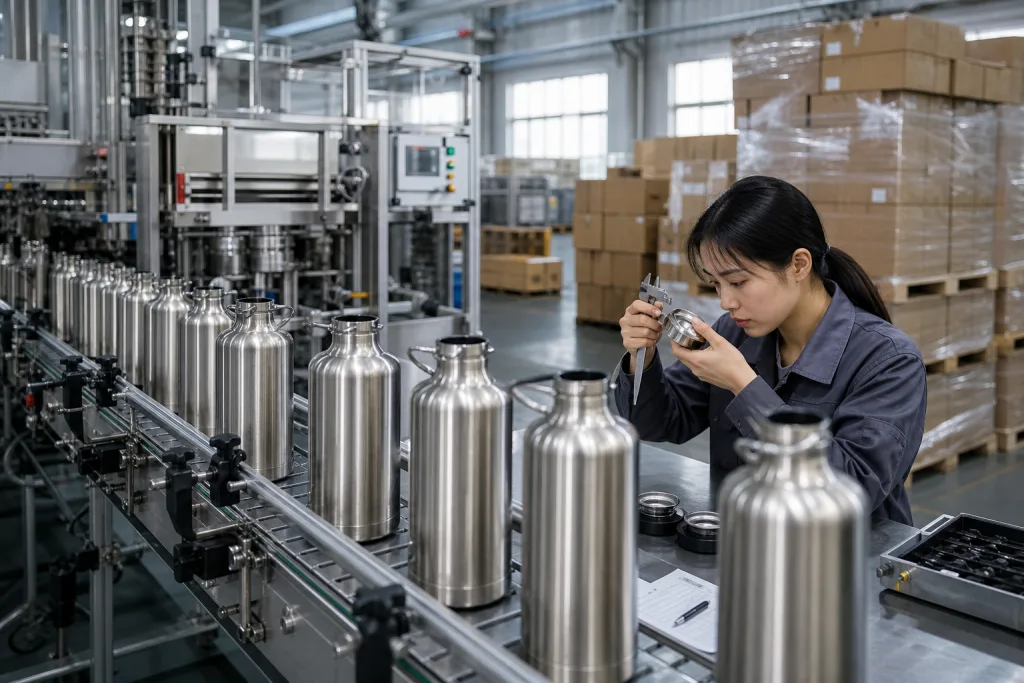
Ask for internal QC photos during production, not only at the end. At BottleForge Industrial, our China QC team checks incoming stainless coils, welding, polishing, vacuum testing, coating, decoration, and final packing. QC pulled one sample last month with a faint weld line after polishing; fixing it during production took 40 minutes, while sorting finished cartons would have taken 18 hours. That does not replace third-party inspection for large orders, but it cuts the chance of finding the problem when the container is already booked.
Plan freight and reorder timing
Growlers are bulky. Freight planning can move your landed cost more than a small factory price gap. We packed one 64 oz insulated growler at 12 pcs per master carton, with cartons around 58 x 43 x 34 cm depending on body shape and lid height. On the line, QC pulled the sample and the tape measure found 3 mm extra at the shoulder, which changed the stack. For a 3,000-unit order, that is about 250 cartons. Exact CBM comes from the final pack-out, not a catalog photo. This is where buyers get burned.
For first orders, we ship LCL or a small FCL depending on volume. If you are combining beer growler wholesale, beer tumbler bulk, wholesale canteen, and glass bottle items, plan the container by carton strength and weight. A buyer once pushed for one mixed pallet, and we stopped it after the drop tester failed at 60 cm with heavy cartons on top of gift boxes. Do not stack heavy cartons over retail gift boxes. If you need Amazon or 3PL delivery, set carton weight, drop test strength, FNSKU labels, and pallet rules before mass packing starts.
Reorder timing is simple math, but many brands ignore it. Add production lead time, inspection time, vessel booking, ocean transit, customs clearance, warehouse receiving, and safety stock. Our QC sheet for AQL 2.5 takes a full day on a 1,000-unit lot, so the calendar is not soft. If bulk production takes 30 days and sea freight to the US West Coast takes around 18-25 days port to port, your reorder point should not be when you have two weeks of stock left. Waiting that late is the wrong question. The line is already booked by then.
The best wholesale drink bottle program is not built on one emergency order. It is built on stable specifications, repeatable QC, and clean communication. If your first PO is 1,000 units and sell-through is strong, lock the next growler bulk order before the first batch is gone. On one PO, the buyer typed 1,0000 instead of 1,000, and we caught it before the 304 stainless coils were cut. That gives the factory time to reserve 304 stainless coils at 0.5 mm, keep the powder coat booth on your color, match lid stock with the silicone ring, and slot carton printing before the next run. We have seen this go sideways when the reorder waits for empty shelves.
Send your growler RFQ for a technical quote
Share capacity, quantity, logo, packaging, and destination port. We will return a clear FOB quote with MOQ, lead time, and sample terms.
Frequently asked questions
What MOQ should I expect for a custom wholesale growler?
For an existing 32 oz or 64 oz stainless mold, a practical MOQ is usually 1,000 units per color for laser logo or single-color print. If you need custom powder coating, retail box printing, or a special lid color, 2,000-3,000 units is more realistic. New body tooling can require 5,000 units or a tooling fee, depending on shape complexity. For mixed wholesale drinkware programs, you can sometimes combine growler wholesale with beer tumbler wholesale or canteen bulk items, but each SKU still needs its own production minimum.
How do I compare beer growler wholesale prices from China suppliers?
Compare on the same specification and Incoterm. Ask each China supplier to quote capacity, steel grade, wall thickness, lid material, logo method, packaging, carton size, MOQ, sample cost, sample lead time, bulk lead time, and FOB port. A 64 oz vacuum growler at 5.60 USD may not match another at 6.20 USD if one uses thinner steel or excludes the printed box. Build a cost sheet with logo fees, barcode labeling, inspection cost, spare parts, and estimated CBM so you compare landed cost, not only unit price.
What tests should be done before approving growler bulk production?
At minimum, test leakage, vacuum retention, coating adhesion, logo durability, capacity, lid thread fit, odor, and carton packing. Fill the sample with water and place it upside down and sideways for 30 minutes. For insulated growlers, use hot water near 95°C and measure temperature after 6 and 12 hours. Check logo size in mm against artwork. If the item touches food or beverage, request applicable food-contact compliance such as FDA, LFGB, or REACH documentation depending on your market.
Can I order alcohol flask bulk and growlers in the same PO?
Yes, but keep them as separate PO line items. Alcohol flask wholesale products use different forming, welding, polishing, and leak test controls than stainless beer growlers. The MOQ, carton size, decoration area, and compliance documents may also differ. If you order alcohol flask in bulk, beer tumbler in bulk, and wholesale growler units together, ask for separate SKU codes, separate pricing, separate packing data, and one combined shipment plan. This keeps QC clear and avoids one delayed item blocking the whole order unnecessarily.
What lead time is realistic for wholesale drinkware bulk orders?
For an existing growler model with standard decoration, sample production usually takes 7-12 days. Bulk production is commonly 25-35 days after deposit and approved pre-production sample. Add 3-5 days for inspection and shipment booking. If your order includes custom color matching, printed retail boxes, new tooling, or multiple drinkware bulk SKUs, add 7-20 extra days. China factory schedules become tighter before Chinese New Year, so place seasonal orders at least 90 days before your required warehouse arrival date.