Key Takeaways
- Set AQL 2.5 for major defects and 4.0 for minor defects before mass production starts
- For stainless vacuum drinkware, specify 304 inner steel, 201 or 304 outer steel, and 0.4-0.5 mm wall thickness
- Most custom wholesale drinkware orders need 1,000-3,000 pcs MOQ per color, depending on finish and lid tooling
- Reserve 3-5 working days for pre-production sample approval and 25-40 days for normal mass production
Wholesale drinkware looks simple until the first container lands with leaking lids, thin powder coating, mixed carton labels, or a logo that fails 3M tape testing. By then, the USD 0.18 you squeezed out of the unit price is gone. You are paying for replacements, retailer chargebacks, air freight, and ugly emails from your sales team.
As a Zhejiang, China manufacturer, we see the same mistakes on stainless tumblers, canteens, growlers, flasks, and sports bottles. Buyers ask for drinkware wholesale pricing, but the PO often leaves out the failure points: lid torque, coating thickness, carton mark format, logo position tolerance in mm. That is the wrong question to ask. A factory can produce 850,000 units/month, but speed only helps when the spec is tight enough for the line and QC to control what actually fails.
Cheap steel creates expensive claims
The first failure mode is material substitution or under-spec steel. It does not explode on day one. The sample looks clean, the bottle has normal hand-feel, and the FOB price looks 8-12% better than the next quote. Then, after 60 days in retail or online reviews, rust spots show up near the laser-weld line, buyers complain about metallic odor, or QC photos show tea staining inside the vessel under a 6000K inspection lamp.
For wholesale drinkware, do not write only “stainless steel bottle” on the PO. That line is too loose. Specify the steel grade by part, because the inner cup, outer shell, lid parts, and straw can come from different coils. For insulated tumblers and canteens, we run 304 stainless steel for the inner wall and 201 or 304 for the outer wall, depending on target price and channel. For food-contact safety in Europe and North America, ask for LFGB, FDA, REACH, and California Prop 65 documentation where relevant. If you are buying alcohol flask bulk or alcohol flask wholesale bulk, the inner surface matters more because spirits sit against the metal for 3 months on a shelf, not just 20 minutes during a factory leak test.
Wall thickness also affects denting and vacuum performance. The cheap quotes usually hide here. In the last 10 RFQs we checked against, 6 offers dropped to around 0.32 mm outer wall thickness without saying it on the quote sheet. For mid-market drinkware bulk programs, 0.4-0.5 mm is safer, and the line should verify it with a digital thickness gauge before polishing. For a bulk growler or beer growler wholesale order, check capacity after forming, not just theoretical volume. A “64 oz” growler that fills to only 60 oz after inner-wall shape changes will create disputes with brewery customers, and we have seen that argument go sideways over one carton of retained samples.
Ask the factory in China to confirm material traceability before deposit. You do not need a 40-page engineering file for every SKU, but you do need a material declaration, food-contact test reports, and a signed golden sample with the PO number and revision written on the label. QC pulled a sample last year where the PO said 304 inner, but the coil tag in the workshop showed 201; that is the kind of mismatch that turns a cheap order into a claim. If the factory cannot explain the difference between 201 and 304 stainless, do not use them for best wholesale drinkware programs.
Vacuum failure hides until retail
Vacuum insulation failure is the defect buyers miss during a 10-minute carton check. A double-wall bottle can look clean on the shelf but drop heat after 2 hours instead of 6. We see it when the weld bead is thin, the vacuum pump cycle is cut from 45 seconds to 28 seconds, or copper plating comes out patchy near the shoulder. QC pulled one 750 ml sample last month that passed visual inspection; the infrared thermometer told the real story.
For stainless wholesale canteen, travel tumbler, and beer tumbler wholesale programs, write the thermal performance test into the PO, not just the email thread. A typical test is filling with 95°C water, measuring after 6 hours at 20-25°C ambient temperature, and setting a minimum retained temperature. For cold retention, factories test with 4°C water or an ice-water mix. The exact number depends on shape and capacity, but the method must match between sample and production. Simple rule: same water level, same digital probe, same room. We once had a buyer flag a 3°C gap because the sample room used 22°C ambient and the line used 26°C.
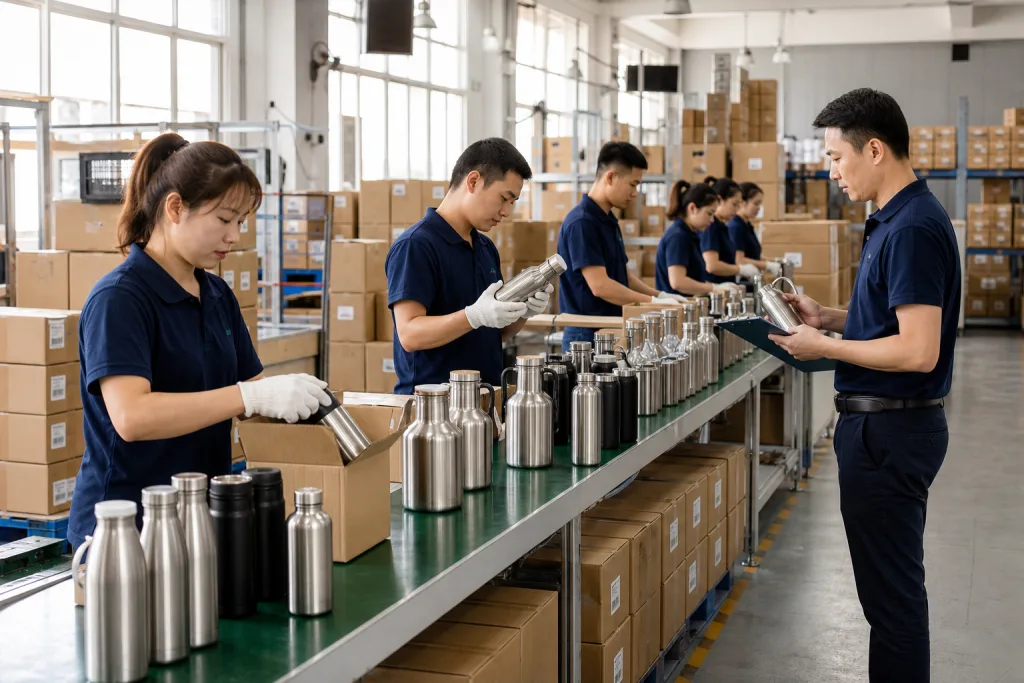
We recommend 100% vacuum testing on the factory line for insulated products, then random thermal performance checks during final inspection. At BottleForge Industrial in Zhejiang, China, our normal process includes vacuum detection before coating and a final functional check after packing for selected AQL samples. The line uses a vacuum detector before powder coating, because repainting a failed bottle is cheaper than arguing after retail returns. For high-risk SKUs such as bulk canteen orders for outdoor brands or beer growler in bulk projects, buyers often add a 24-hour standing test for leakage and temperature retention on pre-shipment samples. The math does not work if you save RMB 0.18 on testing and eat a 1,200-piece claim later.
Do not approve mass production from an attractive CAD rendering alone. Shape changes insulation. Large mouths lose heat faster than narrow necks, thin lids need better inner structure, and welded handle attachments create heat-transfer points if the design is lazy. A wholesale growler with a wide threaded cap needs a different expectation than a narrow-neck sports bottle. If your sell sheet promises “keeps hot 12 hours,” make sure the factory sample supports that claim before you print 20,000 cartons. We have seen this go sideways over one unchecked phrase on a carton artwork file.
Lids leak for boring reasons
Most leak complaints come from plain stuff. We see gasket hardness at 55 Shore A when the drawing asked for 45, thread pitch drift, cap shrinkage after hot pressing, or a straw hole punched 0.3 mm off-center. The buyer usually stares at bottle body cost and treats the lid as a spare part. That is the wrong question to ask. On the line, the lid decides the review.
For canteen wholesale, wholesale canteen, sports bottle, and beer tumbler in bulk orders, write the lid material into the PO: PP, Tritan, silicone, stainless, or a mixed build. On a 3,000-piece MOQ, one buyer flagged a “BPA free” typo on the sample card, and we stopped the run before printing. If your market cares about BPA-free claims, ask for test reports on the plastic parts, not only the bottle body. For children’s bottles, add ASTM or EN checks for small parts and drop resistance.
Leak testing belongs in the inspection plan. Fill to rated capacity, close the lid with normal hand torque, lay the bottle flat for 30 minutes, then shake or invert it for 30 seconds. QC pulled the sample with a caliper at 0.02 mm and found a wet ring on the kraft sheet under one straw lid, so that cavity went on hold. For bulk drinkware with flip lids or straw lids, test open and closed positions as the structure allows. For alcohol flask wholesale, use water in production testing, then check your validation sample for odor pickup and gasket deformation after alcohol contact. We have seen that go sideways.
Thread design needs the same attention. Metal-on-metal threads can feel clean in hand, but they squeak or bind fast if the tolerance drifts by 0.2 mm. Plastic lids on stainless bodies need enough thread engagement to survive drops. When sourcing drinkware wholesale from China, ask for interchangeability data from cavity 1, cavity 4, and cavity 7, not just one golden sample from the tool room. A lid that fits cavity A but leaks on cavity C is a tooling control problem, not a customer education problem.
Coatings fail before the bottle does
Powder coating, spray painting, plating, and gradient finishes are where good wholesale drink bottle projects go soft. The bottle body can pass strength checks, then the surface chips at the base, scratches in carton transit, or fails a dishwasher claim nobody tested. Pretty on a photo sheet. That is easy. Holding up on 10,000 units is the job. On one run, QC pulled a sample from the line and found a 1.2 mm chip ring after the carton shake test.
For powder-coated drinkware bulk programs, call out coating thickness and the test method. We usually see 60-90 microns as the working range, depending on texture and color. The buyer pushed for 40 microns to save cost once. The math does not work. Too thin, and the coating marks fast. Too thick, and threads, grooves, and logos lose definition. Ask for cross-hatch adhesion testing, 3M tape testing, alcohol rub testing for printed areas, and drop testing from 80-100 cm onto a defined surface. If the product is sold as dishwasher safe, run dishwasher cycle testing before sign-off. We checked one batch with a micrometer at the spray booth and got 72 microns on the shoulder.
Color control is another failure point. “Matte black” from one factory can land as blue-black, charcoal, or brown under retail lighting. Use Pantone or RAL references for custom colors, but do not ignore the stainless substrate, coating texture, and gloss level. This is the wrong question to ask if the sample looks good in your office. For canteen bulk or growler bulk orders with multiple capacities, lock one color standard across all shapes before production. At the color room, we use a 5000K lamp and a drawdown card, because a shade that passes on the bench can drift once the line heats up.
For laser engraving, the problem is not peeling. It is weak contrast or a washed-out mark. For silk screen or pad printing, the problem is ink adhesion on curved and textured surfaces. For heat transfer and full-wrap printing, the problem is seam alignment and stretch. Do not approve logos only on flat artwork. Approve the actual decoration on the actual bottle finish, then keep one sealed sample in your office and one at the Zhejiang factory. We have seen a buyer flag a PO typo on logo placement, and the line printed 8,000 cups before anyone caught it. That one hurts.
Decoration mistakes are not small
Logo placement errors hurt in a stupidly practical way: the bottle works, but the brand owner cannot sell it. We see it when AI artwork gets exported as a low-res PDF, the print area is guessed from a catalog photo, or the line uses a production jig 4 mm different from the approved sample fixture. QC pulled one 3,000 pc order where the logo sat 5 mm off center; annoying, but still negotiable. On a 50,000 pc promotional program, that same 5 mm shift turns into debit notes, air-freight threats, and a buyer asking who pays for the unsellable stock.
Give the factory vector files in AI, PDF, or EPS format, and write the decoration size in millimeters on the PO. “Same as sample” is the wrong instruction unless that sample has been measured with a caliper and photographed from front, back, and seam side. For beer tumbler wholesale bulk and beer growler wholesale bulk orders, curved bodies distort circular logos more than buyers expect; our pad-print technician usually checks this on a silicone test head before mass printing. A logo that looks balanced on a 20 oz tumbler can sit low and narrow on a 64 oz growler. The math doesn’t work.
For alcohol flask in bulk, engraving is often the safer decoration because flasks get pocketed, handled, and rubbed against keys or gift boxes. We run a 3M tape test after engraving or screen print when the buyer asks for stronger adhesion proof, and failures show up fast around sharp corners. For large retail programs, silk screen costs less, but it needs tighter adhesion control and a clean curing window on the line. A realistic decoration allowance matters: laser engraving may add USD 0.10-0.35 per unit, while multi-color screen printing can add USD 0.08-0.25 per color depending on complexity and quantity.
Ask for a pre-production sample after artwork is finalized, not before. This adds 3-5 working days, but it prevents the classic problem: the sales sample is plain, then the production order gets decorated at 9 p.m. because the vessel cut-off is close. We’ve seen this go sideways over one missing “mm” on a PO. For FOB Ningbo or Shanghai shipments from Zhejiang, those few days cost less than reworking cartons, changing inner boxes, or discounting inventory because the logo sits too close to the seam.
Cartons cause hidden chargebacks
Packaging gets ignored until it fails a 1.2 m drop test, the barcode won’t scan at receiving, Amazon rejects the FBA label, or a retailer charges back the carton. We’ve had QC pull a clean bottle sample, then reject the shipment because the gift box corners crushed under a 10 kg compression check. The bottle passed. The pack-out failed. Wrong carton marks or an FNSKU label stuck on the blue item instead of black can make good stock unsellable.
For bulk drinkware and wholesale drinkware programs, define the pack-out by layer: polybag or tissue wrap, egg-crate divider or paper sleeve, individual box, master carton, and pallet if the buyer’s DC requires it. Spell it out on the PO. For e-commerce, we usually leave 8-12 mm clearance around the color box and add corner protection on heavier tumblers. For retail shelves, the color box needs to survive ocean humidity and stacked warehouse weight, not just look nice in a pre-production photo. A common master carton for 20-32 oz stainless bottles uses 24 pcs per carton, but this varies by shape and packaging style. Do not accept a carton plan without gross weight and dimensions; we’ve seen this go sideways when a 16.8 kg carton became 22 kg after the buyer added a gift box.
Barcode control needs a checklist. Confirm UPC, EAN, FNSKU, carton SKU, color name, capacity, country of origin, and PO number. Check the actual label with a scanner, not only the PDF artwork. On mixed-color orders, require one SKU per carton unless you approve assortments in writing. Mixed cartons are where receiving errors multiply, and one typo on a PO color code can turn 300 cartons into a warehouse dispute.
For North American buyers, Amazon FBA packaging needs tighter label discipline than normal distributor shipments. For European buyers, packaging waste rules and material declarations may apply. If your best wholesale drinkware program uses recycled paper, soy ink, or plastic-free packaging, name the material and tolerance. “Eco box” is not a specification. A 5-ply export carton with 150-170 g corrugated paper may cost slightly more, but the math doesn’t work if 6% of retail boxes arrive crushed after 35 days at sea from China.
Inspection plans beat apologies
The final failure mode is assuming a good supplier relationship replaces inspection. It does not. Trust helps, but AQL tables and sealed samples with written tolerances are what keep a wholesale drinkware order stable when the vacuum line is full and the night shift is taking over. We have seen this go sideways over a 0.8 mm logo position shift that nobody wrote down.
Set the inspection standard before deposit. A common arrangement is AQL 2.5 for major defects, AQL 4.0 for minor defects, and 0 tolerance for critical safety defects. Major defects include leakage, failed vacuum, wrong material, wrong logo, severe coating damage, or non-scanning barcode. Minor defects include small dust spots, slight print variation within approved range, or small packaging marks. For strict retail programs, you may choose tighter AQL, but expect extra sorting cost and a lead time change such as 32 days instead of 25 days when QC pulls cartons back to the rework table.
At BottleForge Industrial, normal MOQ is 1,000 pcs per color for 18 stock-body stainless bottles and 3,000 pcs per color for custom coating or private mold work. Standard lead time is 25-40 days after deposit and sample approval, with our Zhejiang line capacity around 850,000 units/month across tumblers, canteens, flasks, and growlers. These numbers only protect you if the QC plan is locked before production starts; one buyer once sent a PO with “matte back” instead of “matte black,” and the line stopped until the PMS card was confirmed.
Use three checkpoints for higher-risk orders: pre-production sample approval with the signed sample on the QC shelf, during-production inspection at 20-30% completion, and final random inspection when 80-100% is packed. For growler wholesale, beer tumbler bulk, alcohol flask wholesale, and canteen wholesale orders with multiple lids or colors, the during-production check catches mix-ups early, such as 500 black flip lids loaded beside silver screw caps. The goal is not to punish the factory. Define failure before the market defines it for you.
Send your wholesale drinkware spec for factory review
We will check materials, MOQ, decoration, packaging, and QC risks before you place the order.
Frequently asked questions
What is a realistic MOQ for wholesale drinkware from China?
For stock shapes with a simple one-color logo, 1,000 pcs per color is realistic for many stainless bottles, tumblers, and canteens. Custom powder coating, gradient color, or special lids often push MOQ to 3,000 pcs per color. Private molds usually start higher because tooling, testing, and line setup costs must be spread over the order. For alcohol flask bulk or beer tumbler in bulk, MOQ depends heavily on decoration method and packaging. If a supplier offers 100 pcs with full customization at a very low unit price, check whether it is trading stock, not factory production.
How should I compare quotes for drinkware wholesale orders?
Compare FOB price only after the spec is identical. Confirm steel grade, wall thickness, capacity tolerance, lid material, coating type, logo method, packaging, test reports, and AQL level. A USD 3.20 tumbler and a USD 3.55 tumbler may not be comparable if one uses 304 inner steel, better coating, a stronger carton, and 100% vacuum testing. Ask for itemized adders for laser engraving, silk screen, color box, barcode labels, and spare lids. Also confirm FOB port, usually Ningbo or Shanghai for Zhejiang factories, because inland freight can change the final landed cost.
Can I source bulk growler and beer growler wholesale orders with custom branding?
Yes, but growlers need tighter functional checks than standard bottles. For a bulk growler or beer growler bulk order, confirm actual filled capacity, cap seal, thread strength, coating adhesion, and carton protection. A 64 oz stainless growler is heavier and more likely to dent in transit than a 20 oz tumbler. For beer growler wholesale bulk programs, we normally recommend pre-production samples with the final cap and decoration, then random leakage testing during final inspection. If the growler is used by breweries, confirm whether they need specific labeling space, batch stickers, or retail barcode placement.
What certificates should I request for wholesale canteen and flask orders?
For wholesale canteen, canteen bulk, and alcohol flask wholesale orders, request food-contact test reports that match your sales market. Common documents include FDA-related food contact testing for the United States, LFGB for Germany and broader EU confidence, REACH for restricted substances, and California Prop 65 where applicable. For kids’ drinkware, ask about ASTM or EN testing related to small parts and safety. Factory audits such as BSCI or ISO 9001 are useful, but they do not replace product-level testing. Make sure the report covers the actual materials: stainless body, plastic lid, silicone gasket, coating, and ink.
How long does a custom bulk drinkware order usually take?
A normal custom bulk drinkware order takes 25-40 days for mass production after deposit and approved pre-production sample. Add 3-5 working days for logo proofing and sample approval, and longer if you need new molds, special colors, or third-party lab testing. Sea freight to North America or Europe often adds 25-40 days depending on port and season. If you need drinkware bulk for a fixed promotion date, work backward with at least 10-14 days of buffer for inspection, document corrections, and possible rework.