Key Takeaways
- A practical stainless thermos order should define capacity, steel grade, wall thickness, lid type, coating, logo method, carton drop standard, and AQL before pricing.
- For custom thermos projects, our usual MOQ starts at 1,000 units per color for standard molds and 3,000-5,000 units for private mold changes.
- A realistic China factory timeline is 7-10 days for sample approval and 30-45 days for mass production after deposit and artwork confirmation.
- Heat retention, leak testing, coating adhesion, logo rub resistance, and carton compression matter more than saving USD 0.20 on a promotional thermos.
Your buyer asks for a 750 ml stainless thermos for a spring outdoor campaign. They want a matte finish, logo, retail box, and delivery before a trade show. Sounds simple. Then you compare three quotes that all say “304 stainless steel, vacuum insulated” but list different body weights, lid molds, powder-coating specs, and carton packing; last month we checked one RFQ where the PO said 750 ml, but the drawing showed 780 ml at 78 mm diameter.
That is where 6 out of 10 vendors thermos orders start to drift. A cheap bulk thermos can pass a desk review and still fail heat retention, leak testing, or logo adhesion after a 3M tape pull. As a Zhejiang, China manufacturer, BottleForge sees the same pattern on the line: loose spec first, price fight second, rushed QC problem last. The math doesn't work if the buyer wants a gift-grade finish at promo-grade pricing.
Start with the buyer’s real use case
Say you are sourcing a vendors thermos order for an outdoor retailer that sells branded merchandise to hiking clubs. The first mistake is asking for “a 750 ml stainless bottle with logo.” Too loose. For a factory thermos quotation, that line leaves the supplier thermos team guessing on lid structure, body diameter, coating, carton spec, and test standard. Last month we had a PO that said “black bottle,” but the artwork file showed matte charcoal; QC pulled the sample under a D65 light box before the buyer noticed the color gap.
Start with the use case. Will the bottle sit in a backpack side pocket? Check body diameter first; 72-78 mm is usually safer than a wide 90 mm shape. Will customers pour coffee at a campsite? A cup lid and push-button stopper often beats a screw cap. Will the item be given away at an event? A lighter promotional thermos at 280-330 g may be acceptable. Will it be sold at retail for USD 19.99-29.99? Then the math needs stronger powder coating, cleaner weld polish, and a box that does not look like a giveaway. We run a 3M tape cross-cut test on coated samples because one buyer flagged peeling after only 6 pieces were handled at their booth.
A useful RFQ for thermos vendors includes these basics: capacity in ml and oz, target FOB price range, order quantity by color, logo size, packaging type, required compliance market, and delivery deadline. Better yet, send the logo position in mm from the bottom edge and state whether the carton needs a drop test. For Europe, ask about LFGB or REACH contact-material considerations where relevant. For North America, ask about FDA food contact declaration and, for children’s items, ASTM or CPSIA-related expectations. Not every stainless thermos needs every test, but the thermos manufacturer should know the destination market before the line quotes steel grade, lid material, and packing.
At our Hangzhou, Zhejiang factory network, a standard 500-750 ml manufacturer thermos program can be quoted within 24-48 hours if the RFQ is complete. If the request only says “best price,” you will get a price that moves after artwork and packaging are discussed. We have seen this go sideways: one inquiry started at plain white box, then became color box, insert card, barcode sticker, and 5-ply export carton, adding 12 days vs 18 days on the schedule. That is not bad faith; it is an incomplete engineering brief.
Lock the bottle specification before price
For a customized thermos order, price comes after the bottle spec. Quote first, spec later is the wrong order. If a buyer pushes price down before we lock the drawing, the factory has three places to cut: body weight, lid structure, finish thickness. That is how a 500 ml outdoor bottle becomes a dent-prone sample that looks fine in a photo but fails after two shelf drops in QC.
For stainless steel, most distributor thermos projects use 304 stainless steel for the inner wall and 201 or 304 for the outer wall. A full 304/304 construction costs more, often USD 0.25-0.60 extra depending on size and market price of steel. Inner wall thickness is commonly around 0.4 mm, with outer wall around 0.5 mm for mid-range bottles we ship to retail programs. We check this with a micrometer after cutting the first trial body, not by reading the sales sheet. Light bottles sell well on paper, but the math does not work if the buyer then asks for a “solid outdoor feel” and fewer dent complaints.
Vacuum performance should be written as a test condition, not a slogan. Use a line like this: fill with 95°C water, close lid, test room temperature at 20°C ± 5°C, temperature after 6 hours should be above 65°C for a 500 ml model. Larger bottles often perform better because of volume-to-surface-area ratio. Cold retention claims need the same discipline, especially if your marketing prints “24 hours cold” on the color box; QC pulled one sample last season that passed hot water but missed the cold claim by 3 hours because the lid plug design was changed after sampling.
Coating matters for thermos custom orders. Spray paint is cheaper. It also gets scratched faster on the packing table when workers slide bottles into egg-crate dividers. Powder coating adds cost, usually USD 0.20-0.45 per unit, but it gives better scratch resistance and a better hand feel. For outdoor retail, we usually recommend powder coating unless the order is a short-term giveaway with no repeat-sale target.
Logo method is another cost and durability decision. Silk screen works well for simple one- or two-color logos, especially when the logo area stays under 60 mm wide. Laser engraving is the safer choice for permanent marks on powder coating or bare steel. Heat transfer can handle gradients, but we run a rub test before mass production. A solid thermos supplier will ask for AI or PDF vector artwork, Pantone codes, logo position, and tolerance; “put the logo on the front” is not enough when you are approving 3,000 units, and we have seen this go sideways over a 5 mm placement argument on a PO.
Price the order like a vendor
Once the specification is locked, you can compare thermos suppliers on the same sheet. A 500 ml standard stainless vacuum bottle from China might range from roughly USD 3.20 to USD 6.50 FOB Ningbo or Shanghai depending on steel grade, body weight, lid structure, coating, logo process, and packing method. A 750 ml or 1,000 ml outdoor model can price higher, especially with cup lids or side handles; a retail gift box can add another USD 0.25-0.60 before carton cost. Not all quotes fit these numbers, but they are close enough to catch fantasy pricing. We see it often: the buyer sends a 280 g sample, then gets a quote based on a 235 g body. The math doesn’t work.
For a vendors thermos program, split the price before you argue about it. Show the base bottle, surface finish, logo, packaging, testing, and inland freight as separate lines. If one thermos vendor quotes USD 4.10 and another quotes USD 4.85, the higher price may include powder coating, a 5-layer export carton instead of 3-layer, and a tighter stopper that passed our 30-minute inverted leak test. Ask what changed. “Too expensive” is the wrong question if the two samples are not built the same.
MOQ is another factory-floor issue, not a sales slogan. At BottleForge, standard mold customizable thermos orders usually start at 1,000 units per color. Mixed colors may be possible at 500 units per color if total order quantity reaches 2,000 units, but setup waste and color-change time affect cost; the powder line loses about 18-25 minutes each time we clean the gun and change color. For private mold work, expect 3,000-5,000 units minimum and tooling charges from USD 1,500 to USD 8,000 depending on body shape and lid complexity. We’ve seen this go sideways when a PO says “matte black” but the approved sample was “sand black.” QC pulled the sample, and production stopped.
Packaging can quietly eat your margin. A plain white box may cost USD 0.08-0.15. A printed retail box with insert can run USD 0.25-0.60. E-commerce-safe packaging may need a stronger box plus bubble bag, or a molded pulp insert if the cap edge marks easily during drop tests. If you sell through retail and online channels, define both carton packing and unit packing early. A thermos bulk shipment packed cheaply can arrive with scuffed caps and crushed boxes, which becomes your problem, not the factory’s brochure line. One buyer flagged 7 crushed color boxes in a 50-piece pre-shipment check; after that, the carton spec changed to 5-layer K=K.
Define trade terms before the deposit. FOB is common for importers with their own forwarders. DDP can look convenient for smaller promotional brands, but you need to know who carries duty, customs risk, and final-mile delivery responsibility. Serious distributors thermos buyers usually compare FOB first, then calculate landed cost on their side. We ship FOB Ningbo most weeks, and the forwarder will ask for carton size, gross weight, HS code, and ready date; if those numbers change after booking, someone pays for it.
Build the sample approval trail
The sample stage is where you stop mass-production arguments before they start. For a custom thermos order, approve a physical pre-production sample, not just a rendering. The 3D file is fine for checking logo position, but it will not show powder-coat grain, lid torque, pad-print edge quality, or how the bottle feels after you hold it for 10 seconds.
A workable sample pack should include 1-2 blank bottles for construction review, 1 finished logo sample, 1 packaging sample, and a basic factory test report. For standard models, we run samples in 7-10 days after artwork approval. If you need a special Pantone powder coating, allow 10-15 days because the coating room has to match powder, spray trial panels, and check them under a D65 light box. Courier to Europe or North America adds 3-6 days.
Check the sample like a buyer, not like a catalog reader. Weigh it on a 0.1 g scale. Measure capacity to the fill line. Open and close the lid 20 times. Fill it with hot water and lay it sideways for 30 minutes on tissue paper. Rub the logo with a wet cloth, then with 75% alcohol if your market requires that durability. Inspect the inner weld line and smell the silicone gasket. Short test. Big difference. A clean stainless thermos should not have a strong oil or rubber odor after washing; QC pulled a sample last month for exactly that gasket smell.
Document the approval. The golden sample should have a signed label or photo record showing model number, color code, logo version, packaging version, and approval date. For thermos customized orders, I prefer a simple approval sheet with five photos: front, back, lid, bottom mark, and packaging. This sheet becomes the reference for the QC inspector and the line, especially when 12 cartons of mixed samples are sitting near the packing table.
If you change artwork after the sample is approved, treat it as a new revision. We have seen this go sideways. About 7 out of 10 sourcing disputes we handle start from casual chat messages like: “please make logo a little bigger.” That sentence can create a 5 mm difference across 5,000 bottles, and then the math does not work for reprinting or discount claims. Use drawings with dimensions.
Control production without hovering
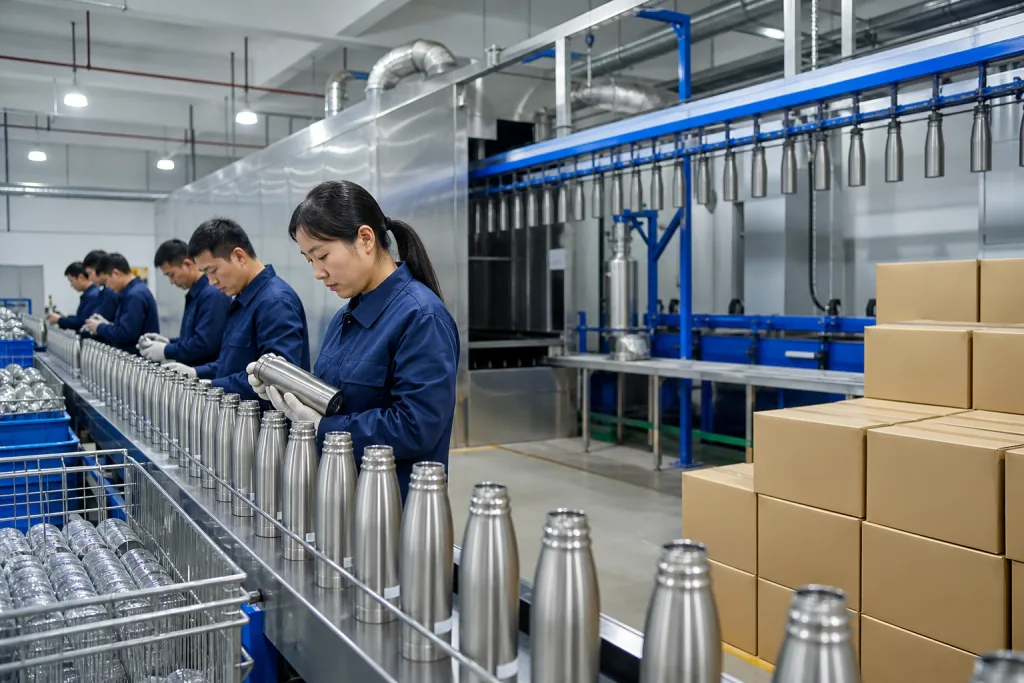
You do not need to stand inside the thermos factory every day, but you do need fixed checkpoints. For a normal 3,000-unit to 10,000-unit factory thermos order, the line moves through raw material cutting, tube forming, welding, vacuuming, polishing, coating, logo printing or engraving, assembly, leak testing, packing, and final inspection. We run 304 stainless coils through cutting dies first; if the supplier thermos team cannot show where welding ends and vacuum testing starts, be careful. We have seen this go sideways.
At BottleForge Industrial in Zhejiang, China, our stainless drinkware capacity across active lines is about 300,000 units per month, depending on model mix and coating load. Capacity is not a promise that an urgent order ships next week. Vacuum bottles need process time, especially coating curing and QC; a powder-coated body often sits 12 hours before the next handling step, or the finish picks up marks. A realistic mass production lead time is 30-45 days after deposit, artwork, and sample approval. Peak season before summer campaigns or Q4 gifting can stretch this by 7-14 days.
Ask for production photos at three points: raw or polished bodies, coated bodies before logo, and packed goods before final inspection. Photos do not replace QC, but they catch simple mistakes such as wrong color, wrong cap, or incorrect carton mark. Last month QC pulled the sample because the PO said “navy,” while the carton mark printed “royal blue.” For larger distributor thermos orders, book a mid-production inspection at 20-30% completion, especially when the order uses new molds or new packaging.
Color control should stay practical. Pantone on paper and powder coating on curved steel will not match 1:1. Set an acceptable tolerance using a physical color chip or approved sample, then make that sample the line reference. For matte black, white, navy, and army green, small differences are common between batches; the buyer flagged this on a repeat order when two coating powder lots sat 3 shades apart under D65 light. If you require exact retail shelf consistency across repeat orders, tell the thermos manufacturer to reserve coating powder from the same batch when possible.
For logo placement, specify tolerance. A typical acceptable position tolerance might be ±2 mm vertically and horizontally for silk screen on a cylindrical body. Without that number, “slightly crooked” becomes a subjective argument after goods are packed, and the math does not work once 60 cartons are sealed. Put the tolerance on the artwork approval sheet.
Inspect the goods before shipment
Final inspection is not paperwork for thermos promotional orders or outdoor retail programs. It is the last cheap place to catch trouble. Once the container leaves Ningbo or Shanghai, sorting 5,000 bottles in a North American 3PL warehouse can cost USD 0.35-0.80 per unit, often more than a proper pre-shipment inspection. We have seen this go sideways: QC pulled the sample at 9 a.m., found 11 leaking lids in one carton, and the buyer still wanted to ship because the booking was tight. Bad call.
Use AQL sampling. Around 8 out of 10 import buyers we work with use AQL 2.5 for major defects and 4.0 for minor defects, with critical defects not accepted. Critical defects include leaking, unsafe sharp edges, broken glass liners if any, contaminated interior, or wrong material declaration. Major defects include poor vacuum performance, badly misprinted logo, wrong color, loose lid, or damaged retail box. Minor defects include small dust points, slight coating specks, or carton scuffs within agreed limits. On the inspection table, we run a 0.02 mm feeler check on sharp rim complaints when the buyer flags mouth-edge safety.
For a stainless thermos, the inspection checklist should include capacity check, weight check, lid torque feel, leak test, vacuum heat retention spot test, coating adhesion, logo rub test, barcode scan if applicable, carton drop test, and packing count. Do not make the checklist too pretty. Make it usable. For e-commerce or promotional fulfillment, check carton marks, SKU labels, and any FNSKU or marketplace label placement against the PO and artwork file. One buyer once sent “matte black” on the PO but “mat black” on the carton mark file, and Amazon receiving treated it as a mismatch. A beautifully made bottle with the wrong barcode can still miss your delivery window.
A basic leak test should fill the bottle to normal use level, close it, invert it, and shake or lay it sideways for 10-15 minutes. For production-line testing, factories often use air pressure or vacuum-related checks, but final QC should still include water testing on sampled units. For coating adhesion, a cross-hatch tape test with 3M 600 tape can reveal weak paint before the buyer sees flakes on day one. For logo durability, rub 50 cycles with a dry cloth and, if relevant, 20 cycles with alcohol on the approved sample standard. The math does not work if you skip this and then replace 300 scratched logo units by air.
Cartons deserve attention. Export cartons for thermos bulk orders often use 5-ply corrugated board. If the bottle is heavy or the carton is large, ask for stronger board and reasonable gross weight, ideally under 15-18 kg per carton for manual handling. We ship a lot of 500 ml and 750 ml bottles, and cartons over 19 kg get dropped more often on the line. Your warehouse team will thank you.
Prepare reorders and retail feedback
The first order should make the second order easier. Keep one technical file for every thermos distributor program: approved sample photos, AI or PDF artwork, Pantone references, inspection report, carton dimensions, net and gross weight, HS code used by your broker, and test documents. We usually save the lid gasket spec, laser jig position, and carton drop-test photos too. Six months later, when your buyer asks for a reorder, nobody should be digging through 47 old emails or guessing whether the logo was 38 mm or 42 mm wide.
Track complaints by defect type. If 1% of customers report leaking, check whether it is a gasket seating issue, lid design issue, or user misunderstanding. QC pulled the sample for one 750 ml sports bottle last year and found the silicone ring was twisted after assembly, not damaged in shipping. If coating scratches appear after retail handling, move to powder coating upgrade or add a single polybag and sleeve protection. If outdoor customers say the bottle is too heavy, the next version needs a different capacity or handle design; chasing cheaper wall thickness is the wrong question to ask.
For promotional brands, reorder discipline matters just as much. Campaign buyers often reorder at the last minute because the first run worked. We see this every March before trade-show season. If you need 2,000 units in 25 days, standard colors and existing artwork may work, assuming the line has open capacity and the PO code is not typed wrong. If you need a new customized thermos color, new retail box, and third-party testing, 25 days is not realistic. Build a reorder calendar around factory lead time, sea freight, customs, and your own decoration or kitting schedule; 12 days saved on paper can disappear at the port.
A good thermos suppliers relationship is not about always saying yes. It is about telling you when a requested price, finish, or delivery date carries risk. If you are building a long-term outdoor or promotional line, choose a thermos manufacturers partner that keeps records, repeats colors, explains failures, and supports QC. The buyer may like the lowest first quote, but we have seen that go sideways: late cartons, mismatched lids, and 3 cartons held back after AQL 2.5 inspection. Clean records beat cheap surprises.
Send your thermos brief for a factory quote
Share capacity, quantity, logo artwork, packaging needs, and delivery market. We will return a practical Zhejiang factory quotation and timeline.
Frequently asked questions
What MOQ should I expect for a vendors thermos order?
For standard stainless thermos molds, a realistic MOQ is 1,000 units per color, with some flexibility at 500 units per color if the total order reaches about 2,000 units. For a customized thermos with a new lid, new shape, or private mold, expect 3,000-5,000 units and tooling charges. Promotional thermos projects using stock colors and one-color logos are easier to schedule. Special powder coating, retail packaging, or multiple logo positions increases setup time and cost. If a thermos supplier promises 100 units at factory price with full customization, check whether they are using inventory goods or trading-stock decoration.
How long does a custom stainless thermos order take from China?
For a standard model from China, plan 7-10 days for logo sample approval and 30-45 days for mass production after deposit and artwork confirmation. Add 3-6 days for sample courier delivery and your own approval time. Sea freight to Europe or North America may add 25-45 days depending on port and season. Air freight is possible for urgent promotional thermos orders, but it can add USD 1.50-4.00 per unit depending on weight and destination. If you need third-party testing, add another 5-10 working days.
Which logo method is best for outdoor retailer thermos programs?
For outdoor retail, laser engraving and silk screen are the two most common choices. Laser engraving is durable and clean, especially on powder-coated bottles, but it usually gives a single metal-colored mark. Silk screen is better for solid-color logos and costs less for simple artwork, often around USD 0.05-0.15 per print depending on size and color count. Heat transfer works for gradients or detailed promotional artwork but should be rub-tested. For any thermos custom order, approve a physical logo sample and define size, placement, and tolerance before mass production.
What inspections should I require before shipping thermos bulk orders?
Use AQL inspection, commonly 2.5 for major defects and 4.0 for minor defects, with zero tolerance for critical safety issues. For thermos bulk shipments, the checklist should cover leaking, vacuum heat retention, capacity, weight, lid assembly, coating adhesion, logo position, barcode scan, packaging, carton marks, and drop resistance. A sampled heat test can use 95°C water and check temperature after 6 hours under defined room conditions. Cartons should be checked for correct count and strength. Do not rely only on factory photos for 3,000 units or more.
How do I compare thermos manufacturers without choosing the cheapest quote?
Ask each thermos manufacturer to quote against the same specification: capacity, steel grade, wall thickness or unit weight, lid type, coating, logo method, packaging, MOQ, lead time, and compliance documents. Then compare FOB price line by line. A quote that is USD 0.30 cheaper may use spray paint instead of powder coating, a lighter body, thinner carton, or a simpler stopper. Also check communication speed, sample quality, and whether the factory can provide AQL inspection support. For distributors thermos programs, repeatability is often worth more than the lowest first order price.