Key Takeaways
- For stainless vendors growler orders, realistic MOQ usually starts at 1,000-3,000 pcs per color and size
- 304 stainless steel at 0.5-0.7 mm wall thickness is the usual baseline for durable custom drinkware
- Laser engraving works well for low-risk branding, while full-wrap printing needs tighter artwork control
- AQL 2.5/4.0 inspection plus leak, coating, and carton drop tests should be agreed before deposit
Buying a vendors growler is not just picking a bottle with a handle. You are fixing the fill volume, vacuum structure, 304 stainless thickness, lid seal design, logo process, export carton spec, FDA or LFGB test plan, and the amount of supply risk your team is willing to carry. The cheap quote is often the wrong question to ask. We have seen a USD 0.18 thinner carton fail a 10 kg drop test, and the buyer paid for repacking before the goods could move by LTL.
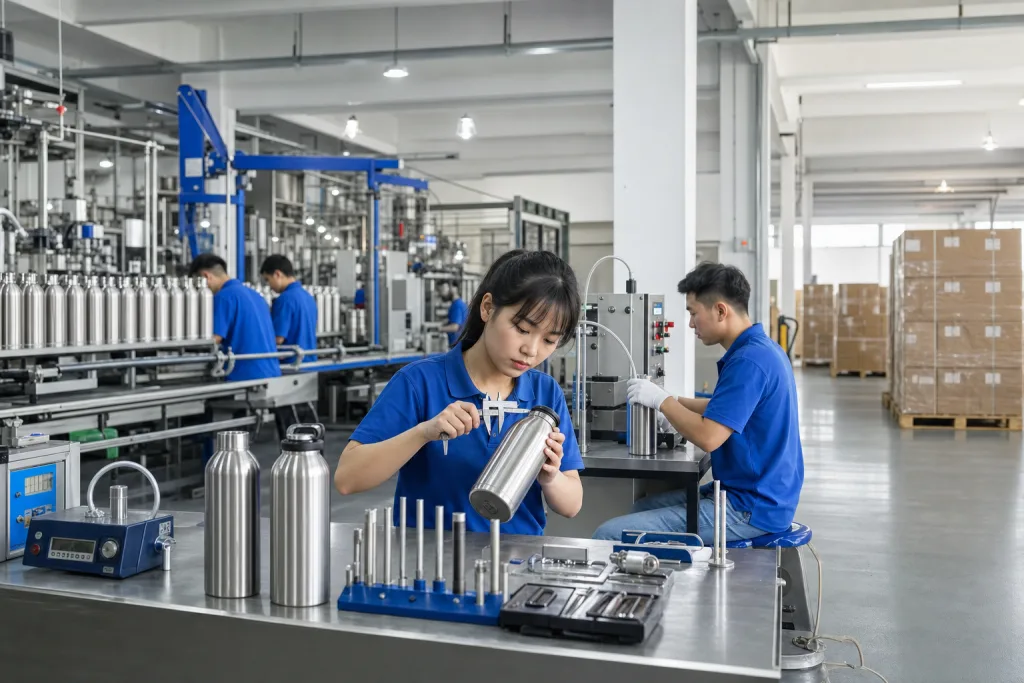
At our Zhejiang, China factory, the best projects usually start with four calls: product structure, branding method, order quantity, and inspection standard. Simple works. If you are comparing a canteen manufacturer, canteen supplier, or distributor growler program, put every quote against the same spec sheet: capacity in ml or oz, steel grade, logo size in mm, MOQ, carton drop requirement, and AQL 2.5 if that is your standard. Last month QC pulled the sample because the PO said matte black, but the artwork file read satin black. That small typo would have changed the whole line.
Start With The Use Case
The first decision is where the growler will actually be used. A brewery gift shop, an outdoor retail chain, a corporate promotion, or a distributor canteen catalog each needs a different build. Ask this first. If you skip it, you will pay for features the end user ignores, or under-spec the growler and watch returns come back after QC checks show dents, lid leaks, or poor heat retention.
For brewery and food-service programs, buyers often ask us to quote 32 oz, 40 oz, or 64 oz stainless custom growler models. The 64 oz size looks strong on a shelf, but the math does not always work: carton weight goes up, sea freight cost rises, and the body is easier to dent during drop testing. On our line, QC pulled one 64 oz sample with a 1.8 mm side dent after a packed-carton drop. For outdoor and promotional channels, 32 oz or 40 oz usually sells faster because it fits backpacks and cup holders better. A canteen promotional project may not need full vacuum performance. A premium retail growler usually does.
Decide early whether you need single-wall, double-wall vacuum, or double-wall copper-coated insulation. Single-wall costs less and weighs less, but it sweats with cold liquid and will not keep beer or coffee stable for long. Double-wall vacuum is the normal choice for customized drinkware sold at retail. Copper coating inside the vacuum layer can add 5-10% cost, but it improves heat retention and gives your sales team a cleaner premium pitch. We run this test with a thermometer probe after preheating the sample, not by guessing from a catalog photo.
If you are a canteen distributor or distributor drinkware buyer, think about repeat orders before you approve the body shape. A one-off event order can accept a unique mold. A stock catalog program needs a stable mold, replaceable lids, and color continuity for 12-24 months. Ask the canteen factory whether the lid thread, gasket, and handle design are standard or private tooling. Standard parts cut after-sales trouble; we have seen this go sideways when a buyer reordered 3,000 pcs and the old private lid was already discontinued.
Material And Construction Trade-Offs
Most serious vendors growler programs use food-grade 304 stainless steel for the inner wall. Buyers sometimes push for 316 stainless because it sounds safer on a spec sheet, but for beer, water, tea, or coffee, 304 stainless is the practical call. 316 costs more and belongs in salt-heavy or chemical use cases. The math doesn't work for a normal retail growler. On our incoming material rack, QC checks the coil certificate against the PO line item before stamping, and for North America and Europe we still ask for LFGB, FDA food-contact, REACH, and RoHS declarations where the market requires them.
Wall thickness gets underestimated. A 0.4 mm outer wall can pass a basic appearance check, then pick up dents during carton drop tests or retail shelf handling. For a sturdy customized growler, 0.5-0.7 mm stainless steel is a safer range, depending on shape and capacity. Go too thick and you pay twice: more steel per unit and slower forming on the hydraulic press. We have seen samples look fine at the booth, then QC pulled the sample after a 76 cm drop test because the shoulder dented near the logo area.
Look closely at the lid. No shortcut here. A good body with a weak lid is still a failed product. Check whether the lid uses PP or Tritan plastic, stainless steel, or a composite build, then ask for the gasket material; food-grade silicone is the common choice. A 64 oz growler filled with liquid puts real pressure on the seal when tipped inside a delivery carton. We normally run an inverted leak test for 30 minutes and a shake test before approving mass production samples, and the buyer flagged one order last year because a PO typo changed the gasket color from clear to black.
For a canteen custom project, the handle deserves attention too. Plastic handles cut weight and cost, while stainless or reinforced handles feel stronger in hand. If the growler is aimed at outdoor retail, test the handle with at least 1.5 times the filled product weight. For a 64 oz model, that means testing above 3 kg. We hang the loaded sample on a simple pull-test jig beside the line, because one cracked handle can turn into 20 ugly customer photos after shipment.
Branding Methods And Real Costs
The branding choice hits price, lead time, defect rate, and reorder consistency. Laser engraving is the safest route for a custom canteen or custom growler because it does not peel, does not need ink approval, and holds up on powder coating. On our laser table, QC pulled a 5 pcs sample and checked the depth at 0.15-0.25 mm. It is not the cheapest option for a huge logo, but the risk stays low. For 1,000-5,000 pcs orders, laser usually gives the best balance.
Silkscreen printing is the low-cost answer for a simple one-color logo. We run 160 mesh screens on straight body panels, and that is where it behaves. Curved growler shoulders and rough coatings are where the buyer flags registration drift. Heat transfer and water transfer carry richer artwork, but the sample sign-off has to be strict. Full-wrap art looks clean in a PDF and falls apart if the seam, color density, or top-bottom alignment is off. We have seen that go sideways fast.
Powder coating is the standard finish for premium customizable drinkware. Standard colors are cheaper because the line runs them every week. Custom Pantone colors usually need a higher MOQ, typically 2,000-3,000 pcs per color, plus 7-10 extra days for powder matching and approval. Our spray booth uses an X-Rite spectro, and the buyer who sent only a phone photo was unhappy when the chip came back half a shade off. If the brand color has to be exact, approve a physical color chip, not a screen image.
For a canteen customizable line, ask your canteen vendor to break out costs line by line: blank bottle FOB price, logo setup charge, logo running charge, special packaging, and carton marking. A quote that says only “customized canteen USD 5.20” is weak. You need to know whether that includes a retail box, barcode label, insert card, and drop-tested export carton. One PO we checked had the carton mark typo and the quantity written as 500 pcs instead of 5,000 pcs. In China export production, that kind of loose paperwork burns margin.
MOQ, Pricing, And Lead Time
MOQ is not a punishment; it is production math. Stainless growlers need coil purchasing, deep drawing, welding, vacuum pumping, polishing, powder coating, printing, assembly, and carton packing. Each station has setup loss: one color change on the coating line can eat 18-25 pcs before the film thickness sits at 60-80 microns. For most vendors growler orders, a realistic MOQ is 1,000-3,000 pcs per size and color. Six colors at 500 pcs each sounds buyer-friendly on a spreadsheet, but the math doesn't work; the factory may accept it, then your unit price and defect risk climb.
As a working reference, a 32 oz double-wall stainless customized growler can range around USD 4.80-7.50 FOB Ningbo or Shanghai depending on steel thickness, lid, finish, and packaging. A 64 oz model may sit around USD 7.80-12.50 FOB. These are not fixed quotes. They are guardrails when you compare canteen suppliers or canteen manufacturers. If one quote lands 25% below the market, ask what changed: 0.5 mm steel became 0.4 mm, the vacuum hold spec was loosened, the carton dropped from five-layer to three-layer, or final inspection was cut from the cost. We have seen this go sideways after QC pulled the sample and found weak coating at the shoulder radius.
Lead time usually runs 30-45 days after deposit and sample approval for standard models. Custom mold work can add 25-40 days. At BottleForge Industrial in Zhejiang, our drinkware line capacity is about 420,000 units per month across tumblers, bottles, canteens, and growlers, but the line still needs a slot. A PO approved on the 3rd can ship in 38 days; the same PO approved on the 18th during retail peak may need 52 days, especially with gift boxes, barcode labels, and four-color assortments. Book earlier for Q3 and Q4. The buyer flagged a one-digit EAN typo last October, and that alone held packing for 2 days.
Payment terms for new buyers are commonly 30% deposit and 70% balance before shipment. Some larger distributor growler buyers negotiate against inspection pass and bill of lading copy after 2-3 clean orders. If you are new to a canteen manufacturer in China, keep the first order simple: one capacity, one or two colors, one branding method, and a defined AQL inspection plan. We run AQL 2.5 for major defects on most export drinkware orders, and it is cheaper to catch a loose lid gasket on the inspection table than after 1,200 cartons reach a warehouse in Hamburg.
Quality Checks Before Shipment
A nice sample does not protect you from a bad production run. Samples are usually built slowly by senior hands at one bench; bulk goods move under line pressure, with 800 to 1,200 pcs per shift on a busy growler line. Put the inspection points into the purchase order before the deposit is wired. We normally recommend AQL 2.5 for major defects and AQL 4.0 for minor defects for custom drinkware, unless your retail account writes a tighter standard into the vendor manual.
Run the checks that actually catch claims: leak testing, vacuum performance, coating adhesion, odor check, logo rub test, lid fit, capacity check, plus carton drop test with the final export carton. For vacuum growlers, we fill with hot water at 95°C and measure again after 6 or 12 hours in a room held near 23°C. Same method, same result sheet. Comparing two factories without matching the test method is the wrong question to ask, and we have seen buyers argue over 3°C when one lab preheated the bottle and the other did not.
Coating adhesion should be checked with a cross-hatch tape test, usually with a 1 mm cutter and 3M tape. It is simple, fast, and it catches weak powder curing before the cartons leave Hangzhou. Logo durability depends on the process: alcohol rub for many silk prints, 3M tape pull for some transfer logos. For canteen customized projects going to retail shelves, surface appearance matters, but cosmetic sorting cannot replace leak and lid testing. A beautiful bottle that leaks is still a claim.
Ask for pre-production samples made from mass production materials, not just hand-made salesman samples from the sample room. For larger orders above 5,000 pcs, a mid-production inspection is worth the schedule pressure because QC can still pull the sample, stop the line, and correct a lid gasket or powder color issue before all goods are packed. Third-party inspection from SGS, Intertek, BV, or a buyer-appointed QC team is normal for Europe and North America. A reliable canteen supplier should not push back on reasonable inspection; when a factory refuses, the math does not work for the buyer.
Packaging, Logistics, And Compliance
Packaging is part of the product, especially for distributor drinkware and retail growler programs. A plain egg-crate carton can pass for 500-piece warehouse giveaways, but it is too weak for e-commerce parcels or club-store handling. We ask buyers to lock the pack spec early: white box, kraft box, color box, belly band, hangtag, instruction leaflet, warning label, barcode, FNSKU, or master carton label. Small detail, big mess. Last month the buyer flagged a PO where “kraft box” was typed as “craft box,” and the line had to stop until sales, artwork, and packing all agreed on the same file.
For export cartons, specify 5-ply corrugated board for heavier 64 oz growlers and ask for a drop test that matches your sales channel. We run 6-face, 3-edge, 1-corner checks on trial cartons when the order is going into parcel delivery, not just pallet storage. Most damage claims we see are carton failures, not bottle failures; the math does not work if you save USD 0.18 on a carton and lose 36 pieces in the first claim. If the product ships to Amazon-style fulfillment, your carton size, weight, FNSKU labeling, suffocation warnings for polybags, and scannability matter as much as the bottle itself. QC pulled one sample carton at 21.6 kg gross weight and the buyer’s forwarder rejected it because their warehouse cap was 20 kg.
Compliance depends on destination and use. For the EU, ask about LFGB food contact, REACH for coating and plastics, and packaging waste requirements. For the US, FDA food-contact expectations and California Proposition 65 review may be relevant. Kids’ products bring ASTM and CPSIA issues, but most adult growlers do not fall into that category unless marketed to children. Do not ask “is it compliant?” by itself; this is the wrong question to ask. Send the destination, coating type, lid material, logo method, and intended user, because a 304 stainless body with a powder-coated finish and PP lid is checked differently from a bare stainless growler with laser logo.
FOB Ningbo is common for our Zhejiang shipments, while FOB Shanghai is also workable. Ningbo port works well for drinkware exports from eastern China, and it keeps inland trucking controlled; from our Hangzhou packing area, a full container to Ningbo usually books at 1 day trucking, while Shanghai can take 2 days when the G60 is jammed. If you are comparing canteen vendors, ask whether the price is EXW, FOB, CIF, or DDP. DDP looks convenient, but you still need to know who owns customs risk, tariff classification, and insurance. We have seen this go sideways when a buyer compared our FOB Ningbo quote against another factory’s DDP quote and missed a 7% duty line buried in the forwarder sheet.
How To Compare Suppliers Fairly
Compare a canteen factory, trading company, or canteen vendor on spec first, price second. Build a sheet with capacity, steel grade, wall thickness in mm, empty weight in g, lid material, coating type, logo method, MOQ, lead time, packaging, test reports, audit status, and after-sales terms. We run this check on every RFQ because a USD 0.40 gap means nothing if one quote includes a 350gsm color box and the other is only 24 pcs in bulk packing.
Ask whether the supplier has BSCI, ISO 9001, or customer audit experience, then ask for one redacted audit page or corrective-action record. An audit does not make every product good. It does show whether the factory understands documentation, worker safety, traceability, and corrective action. For brand owners, traceability matters when you need to isolate a defective batch by production date, color, or carton number; QC once pulled 312 cartons because the bottom stamp showed the wrong heat-transfer date code.
For a canteen distributors network, continuity beats the lowest first order price in most cases. You need stable models, spare lids, repeat colors, and early warning when material cost changes. Nickel prices, coating powder, cartons, and freight can move fast; we have seen a supplier win the first PO, then shave 0.08 mm off the inner wall on the repeat order. The math does not work if distributors start mixing lid versions in the same market.
The best RFQ is specific without turning into a 19-page puzzle. Send target capacity, expected order quantity, market, compliance requirements, logo artwork, packaging style, and delivery date. If you are still testing demand, say so. A good canteen supplier can recommend a stock mold customized canteen first, maybe 1,000-3,000 pcs with laser logo and kraft box, then move you into private tooling once annual volume reaches 20,000-50,000 pcs. That route protects your cash while the line proves demand.
Build Your Growler Program With Factory Specs
Send your capacity, logo, MOQ, and market requirements. We will return a practical FOB quote with options, risks, and lead time.
Frequently asked questions
What MOQ should I expect for a vendors growler order?
For stainless steel vendors growler production, expect 1,000-3,000 pcs per size and color as a normal MOQ. Some factories accept 500 pcs for stock colors and stock lids, but the unit price is usually higher and logo options may be limited. If you need a custom Pantone powder coating, 2,000-3,000 pcs is more realistic because coating setup and line cleaning create waste. Private mold development usually only makes sense when annual demand is above 20,000 pcs.
Is a custom growler different from a custom canteen?
The terms overlap, but buyers usually use custom growler for larger stainless bottles, often 32 oz to 64 oz, designed for beer, cold brew, water, or outdoor use. Custom canteen can mean military-style flasks, sports water bottles, or general reusable drinkware. For sourcing, the important details are capacity, insulation, lid sealing, and compliance. A canteen customizable product for promotions may use simpler packaging, while a retail growler needs stronger coating, better carton protection, and more consistent logo placement.
Which logo method is best for customized drinkware?
For most customized drinkware, laser engraving is the lowest-risk method because it does not peel and handles washing better than many printed logos. It is ideal for stainless powder-coated growlers and canteens. Silkscreen is cheaper for simple one-color artwork, especially above 3,000 pcs, but it needs proper curing and rub testing. Heat transfer or full-wrap printing is best for complex graphics, but you should approve a physical pre-production sample and define alignment tolerance before mass production starts.
How do I know if a canteen manufacturer is reliable?
Ask for specific evidence, not just a sales promise. A reliable canteen manufacturer should share product specs, steel grade, test reports, AQL inspection standards, audit status such as BSCI or ISO 9001, and clear FOB terms. Check whether they can explain wall thickness, lid gasket material, coating adhesion, and carton strength. You should also ask for a pre-production sample using mass production materials. If the supplier avoids inspection, cannot define lead time, or gives a price 25% below other canteen suppliers, slow down.
What lead time should distributor growler buyers plan for?
For a standard distributor growler using an existing mold, plan 30-45 days after deposit and sample approval. Add 7-10 days for custom powder color matching and 25-40 days for new tooling. If you need retail boxes, barcode labels, FNSKU labels, or third-party inspection, build those into the schedule. For Q3 and Q4 delivery, place orders earlier because China drinkware factories become busy with holiday, corporate gift, and retail replenishment programs.