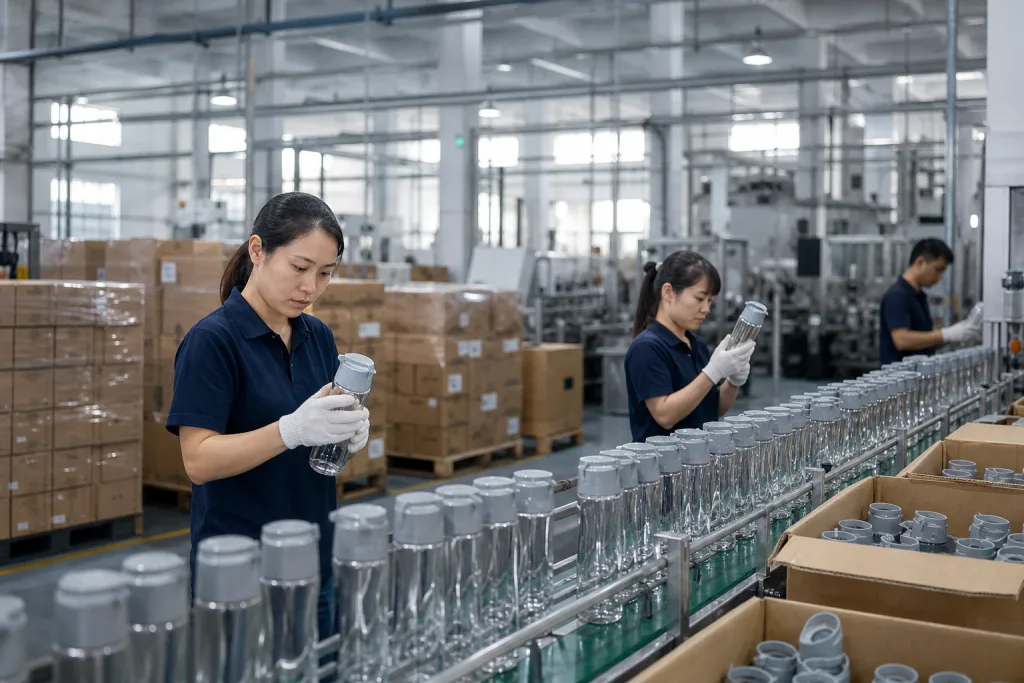
Key Takeaways
- Typical FOB China pricing for a 500-750 ml tritan renew glass bottle lands around USD 1.35-3.20 per unit at 3,000-10,000 pcs
- Most tritan renew glass bottle wholesale MOQs start at 1,000-3,000 pcs, with custom shape tooling often requiring 5,000 pcs
- Standard lead time is 25-35 days after sample approval; new molds add 15-25 days in Zhejiang factories
- Export buyers should budget AQL 2.5 for critical defects, REACH-compliant materials, and 5-8% extra for carton and freight losses
If you are pricing a tritan renew glass water bottle wholesale program, do not treat it like a normal glass bottle. It is a hybrid build, and the cost follows that. We run these jobs with tighter cosmetic checks, plus pack-out that has to survive export drops. In Zhejiang, the buyer usually starts with “premium look” and ends at “what does 3,000 units do to my margin?” The answer often moves 12% to 25%.
The better question is whether your brand can carry the mold fee, decoration cost, and carton loading without blowing the FOB or DDP target. On the line, a 500 ml body with a bamboo lid prices nothing like a 750 ml version with a silicone sleeve, and one PO typo on the lid color can stall a whole batch. We saw a buyer flag a spec sheet because the cap note said “matte black” but the sample sign-off was gloss. That is the wrong question to ask if you only ask whether the bottle looks good. Break it into bottle body, cap, decoration, freight.
What you really pay for
When you ask for tritan renew glass bottle wholesale pricing, the quote usually breaks into five cost buckets: glass body, Tritan or polymer sleeve/cover, lid assembly, decoration, and export packing. The body is rarely the big number. On a standard 550 ml round bottle, the glass component may only run USD 0.28-0.55 ex-factory. The lid, gasket, and outer sleeve often add another USD 0.35-0.90, depending on whether you want PP, Tritan, bamboo-look overmold, or stainless steel accents. On the line, we check sleeve fit with a 0.2 mm gauge, and that tolerance matters more than buyers think.
If you need a tritan renew glass bottle custom program, logo method changes the math fast. Silkscreen in 1-2 colors usually adds USD 0.05-0.12. Laser engraving on a metal cap can add USD 0.10-0.25, while full-color UV printing can push decoration above USD 0.20. A tritan renew glass bottle private label order with retail carton, barcode, and hangtag can easily add USD 0.18-0.45 per set. We had one buyer flag a PO typo on the carton size, and the reprint cost wiped out the “cheap” quote. Two quotes that look the same can still land 18% apart.
You also need to check whether the supplier is quoting FOB Ningbo, FOB Shanghai, or EXW from Zhejiang. For a brand shipping to North America or Europe, those terms change landed cost more than a small unit-price gap. A serious tritan renew glass bottle factory will split unit cost from carton master pack cost, because one cracked bottle in transit can turn into a claim, not a small headache. QC pulled the sample from drop test at 80 cm, and the buyer still pushed for thinner cartons. That was the wrong question to ask.
MOQ tiers that make sense
MOQ is where a lot of wellness brands get stuck. We see it every week. A tritan renew glass water bottle manufacturer in China usually gives three workable tiers. At 1,000-2,000 pcs, you are buying stock mold or light semi-custom, and the unit price sits higher, often USD 1.95-3.20 FOB, because the setup cost gets spread across fewer bottles. At 3,000-5,000 pcs, the wholesale math starts to work. That is where a tritan renew glass bottle bulk order can land at USD 1.45-2.40, depending on lid style and carton spec. QC pulled one sample with a 2 mm cap gap last month; the buyer flagged it, and that sort of detail changes the quote fast.
At 10,000 pcs and up, a tritan renew glass bottle wholesale program gets much cleaner on cost. In Zhejiang, a factory running 250,000 units/month can usually hold pricing steady if you repeat the same spec for 2 or 3 orders. If you need a new mold, budget USD 1,200-4,500 for simple shapes, more for deeper contours. I would not pay for tooling unless you expect to reorder 8,000-15,000 pcs in the first 12 months. The math doesn't work otherwise. We had one buyer push for a new lid cavity on a 6,000-pc trial; the line cost more than the order margin, and that was the wrong question to ask.
There is a second MOQ to watch: color MOQ. If you want custom lid colors, many tritan renew glass bottle suppliers ask for 3,000 pcs per Pantone unless they already have the resin in stock. Ask before you send artwork. A PO typo on a "Pantone 186 C" lid once turned into a 12-day delay because the buyer meant 186 U, and the shop had already mixed the masterbatch. For one logo and one lid color, the setup is simple; for a full private label set with three SKUs, the MOQ jumps fast.
Lead times from sample to shipment
Lead time is usually easier to pin down than price, if you ask the right questions on day one. A stock tritan renew glass bottle wholesale order can move from PO to shipment in 20-30 days after artwork is approved. If the order only needs custom decoration, 25-35 days is the planning number we give buyers. A true tritan renew glass bottle odm project with a new mold, new cap, and new retail box usually takes 45-60 days, before ocean freight.
Here is the timeline we give at the desk:
- Sample confirmation: 5-10 days
- Artwork and carton proof: 2-5 days
- Production: 15-25 days for stock tooling, 25-35 days for custom sets
- QC and packing: 2-4 days
- Sea freight from Zhejiang to Europe or North America: 18-35 days port-to-port
If you are working with a tritan renew glass bottle factory in Zhejiang, ask whether they run inline inspection or only final inspection. We run inline checks with a caliper and torque meter, and that saves headaches later. A steady plant should show monthly output, reject rate, and packing standards without stalling. We normally hold critical defect control at AQL 2.5, with leakage and cap fit checked at 100% on pilot lots. The buyer flagged one batch because the gasket compression was off by 0.3 mm, and the photos never showed it.
Buyers who plan only for production time and skip carton testing usually lose 1-3 weeks later when the first export cartons crush in stacking tests. We saw that go sideways on a 4-layer carton spec last quarter.
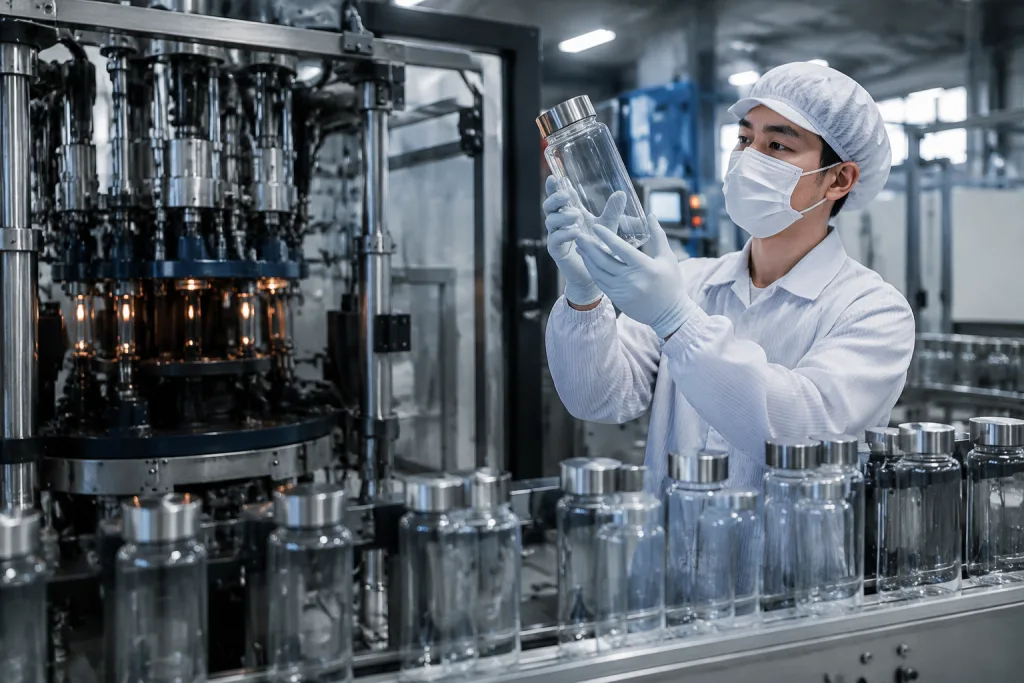
Glass quality and safety checks
“Glass is glass” is the wrong question to ask. On a tritan renew glass bottle, we check wall thickness, annealing, and rim finish, because those three decide whether the line runs clean or starts breaking cartons at packing. For most 500-750 ml bottles, 1.8-2.4 mm is the normal range. Go thinner and breakage climbs fast. Go thicker and the bottle picks up weight; freight goes up, and the hand feel starts to lose that premium touch buyers pay for.
A good tritan renew glass bottle manufacturer should talk straight about ASTM and REACH-aligned compliance for lids, gaskets, and sleeves. We ship to Europe, so REACH files get pulled early. For the US, FDA food contact declarations need to cover every part touching the liquid. QC pulled a sample last month and found a 0.6 mm gasket mismatch on one lot; that kind of miss turns into a buyer flag on arrival. For retail programs, ask for drop test records at 80 cm to 100 cm, matched to the carton spec, not a vague “passed test” note.
The glass body should be clean in the drink zone, with no inclusions, sharp seams, or visible bubbles. We write cosmetic acceptance in AQL terms: major defects at AQL 2.5, minor defects at AQL 4.0, and zero cracks, chips, or leakage. The math does not work any other way. One PO typo can ruin a whole order; we once saw “500 pcs” printed as “5000 pcs,” and the buyer caught it before packing. That is why a tritan renew glass bottle wholesale program needs hard checks, not hope.
Decoration and private label options
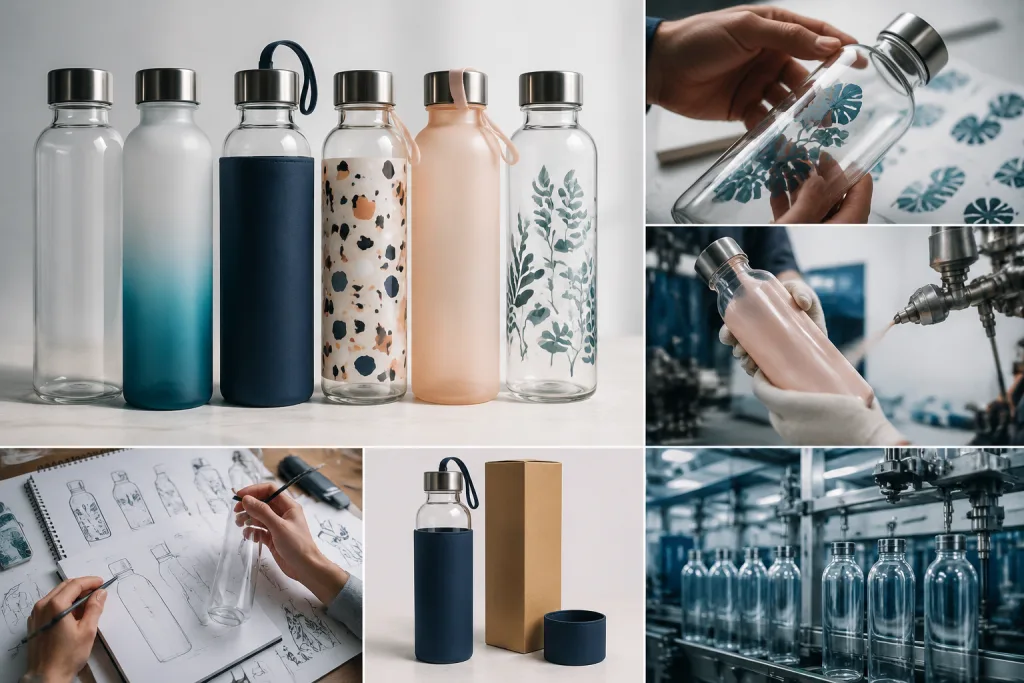
If your brand sits in wellness or sustainability, packaging is part of the product. A tritan renew glass bottle private label order usually starts with four decoration routes: one-color silkscreen, multi-color UV print, laser engraving on metal parts, or a label-and-box combo for a fast launch. Each one has its own cost and its own way to fail. Silkscreen is the cheapest to repeat on the line. UV print looks cleaner, but we have seen it scratch when the coating is thin. Laser engraving holds up, though it only works on the parts that take the mark. Paper labels are flexible, but if the box design is lazy, the bottle looks like a budget item. QC pulled a sample last month and the edge lift showed up after one carton rub test.
On a tritan renew glass bottle custom order, logo placement changes factory speed. A centered logo on the body runs faster than wraparound art. One Pantone color beats four, no question. If you want a tritan renew glass water bottle branded for retail shelves, a matte outer sleeve or a color-matched lid gives you SKU separation without new tooling. That is how we keep unit cost under control. The buyer flagged a PO typo once—“Pantone 18-4252” got written as “18-4522”—and the sample set had to be rerun.
In China, buyers often spend on fancy decoration and cut corners on the carton. That is the wrong question to ask. A good insert, proper dividers, and a 5-ply export carton do more for breakage than a metallic print effect ever will. We ship a lot to Amazon, distributor warehouses, and chain retailers with inbound QC, and the carton spec decides whether the goods pass or get held at receiving. On one 20-foot container, a 3 mm gap in the divider was enough to raise the breakage rate. The math does not work if you ignore packing first.
FOB pricing by order size
If you want a usable FOB frame, start with order size and work from there. A stock tritan renew glass bottle can land low on paper, but lid spec, sleeve, and pack-out decide the margin. We run these numbers every week. For a 550-650 ml set with a standard lid and simple logo, the China FOB range is usually:
- 1,000 pcs: USD 1.95-3.20
- 3,000 pcs: USD 1.45-2.35
- 5,000 pcs: USD 1.32-2.05
- 10,000 pcs: USD 1.08-1.75
If you open a custom mold, the first PO carries the tooling hit, so unit cost often runs 15%-30% above repeat production. That is the real math. On one job, the buyer flagged a 2 mm logo shift on the sample and tried to squeeze the price; we held the line because the cost gap was tied to setup, not margin padding. A tritan renew glass bottle odm project works when you spread tooling over later runs, not when you chase the cheapest first quote. For a tritan renew glass bottle factory in Zhejiang, repeat specs and fixed carton size save more money than a small unit discount.
Ask for three quotes: bottle only, complete set, and packed master carton. Then you can see where the cost sits if freight jumps. We had one PO with a typo on carton size, 38x28x24 cm instead of 38x29x24 cm, and the pallet count changed by 12 cartons. That kind of mistake is what bites you. From China to Europe or North America, a 12-gram difference per unit adds up over 10,000 pcs, and the shipping line notices it fast. A good tritan renew glass bottle supplier will show the weight split clearly, because every kilo hits your landed cost.
How to choose the right factory
Choosing a tritan renew glass bottle manufacturer is about line discipline, not sales talk. Ask for monthly output, sample lead time, in-house QC, and whether the plant runs glass forming and final assembly under one roof. A good tritan renew glass bottle factory in Zhejiang can tell you what stays in-house and what gets outsourced. If they cannot name the gasket supplier or the carton printer, the risk sits with you. We have seen that go sideways on a 20,000 pc order because the buyer never asked who made the lid liner.
Use a simple qualification checklist:
- Monthly capacity: at least 200,000 units for stable wholesale supply
- MOQ: clear by SKU, color, and packaging level
- Compliance: REACH, food-contact declarations, and test reports on request
- QC: AQL standard, leakage test, drop test, and carton compression test
- Commercials: FOB terms, tooling ownership, and re-order pricing
For a tritan renew glass bottle supplier in China, I push buyers to place one pilot order before they talk annual forecasts. A 1,000-3,000 pc trial tells you more than a catalog ever will. QC pulled the sample on a 0.5 mm cap gap, and the buyer flagged a typo on the PO the same day. You will see whether the torque stays consistent, whether the print holds after 12 days of transit vibration, and whether the pack-out survives freight. That is the difference between a real export partner and a factory that only looks good on paper.
Request a factory quote with real numbers
Send your target size, logo method, and order volume. We will reply with FOB pricing, MOQ, and lead time from Zhejiang, China.
Frequently asked questions
What is the usual MOQ for tritan renew glass water bottle wholesale orders?
For stock shapes, 1,000-2,000 pcs is common. For semi-custom private label, 3,000 pcs is a better planning number. If you need a new mold or new lid, many factories in Zhejiang will ask for 5,000 pcs or a tooling commitment. Small pilot orders cost more per unit, often USD 1.95-3.20 FOB, because setup and packing are spread across fewer bottles.
How much does a tritan renew glass bottle cost from China?
A standard 550-650 ml set usually lands around USD 1.08-3.20 FOB China depending on MOQ, lid material, print method, and carton spec. At 10,000 pcs, you can often get close to USD 1.08-1.75. At 1,000 pcs, the same set may be USD 1.95-3.20. Freight, duties, and last-mile distribution are extra.
How long does production take at a tritan renew glass bottle factory?
If you approve a stock design, expect 20-30 days from PO to shipment. Custom printing usually takes 25-35 days. If you need a new mold, add 15-25 days. Ocean freight from Zhejiang to Europe or North America is usually 18-35 days port-to-port, so total calendar time is often 45-70 days.
Can I order tritan renew glass bottle private label with low risk?
Yes, if you keep the specification simple. Start with one bottle size, one lid color, and one logo method. A 3,000 pc pilot is usually safer than jumping straight to 10,000 pcs. Ask for AQL 2.5 inspection, drop test confirmation, and REACH documentation for all food-contact parts. That keeps returns and compliance issues under control.
What should I ask a tritan renew glass bottle supplier before placing a PO?
Ask for FOB price by tier, MOQ by color, lead time by SKU, carton dimensions, and QC standards. Also confirm whether tooling is owned by you, what the re-order price will be, and whether the factory can provide test reports for glass, lid materials, and packaging. A serious China supplier will answer these in writing, not only by message.