Key Takeaways
- MOQ for a custom Tritan Renew double wall bottle is often 3,000-5,000 pcs, with FOB Zhejiang pricing usually starting around USD 1.85-3.20 depending on lid and print.
- Wall thickness, usually 1.5-2.2 mm per layer, affects weight, clarity, and impact resistance more than most buyers expect.
- For Europe and North America, ask for REACH, food-contact declaration, and migration test reports before you approve samples.
- Private label orders move faster than fully custom molds: 25-35 days for sample development, then 35-45 days for mass production is common.
Three decisions that drive your cost
When you source a tritan renew double wall bottle wholesale, the price usually comes down to three calls: resin grade, bottle structure, and decoration. Get one wrong and you pay for a feature the buyer never asked for, or you ship a bottle that clouds up and sweats on the shelf. We have seen buyers push for the cheapest quote, then the line shows stress marks after drop tests. A solid tritan renew double wall bottle supplier asks which channel you sell into before they quote. That is the right question.
First, choose between a tritan renew double wall bottle custom spec and a standard private-label platform. Custom shapes need tooling; mold cost usually lands at USD 3,000-12,000, and the spread is tied to cavity count, undercuts, and cap fit. We once had a PO typo on a neck finish callout, and the buyer flagged it before we cut steel. If you use an existing mold, you skip that spend and MOQ can stay near 3,000 pcs.
Second, set the wall structure. A true double wall bottle usually runs 1.5-2.2 mm per layer. Go thinner and the bottle feels light in the hand, but the outer shell scratches easier in transit. Third, pick the decoration route. Silk screen runs about USD 0.08-0.18 per color per unit. Laser engraving looks cleaner for a premium SKU, but the cap or body surface has to match the process. QC pulled a sample with 0.3 mm print shift last month, and we reworked the jig. If you sell into the EU, the ink and coating still need to pass REACH and food-contact checks.
In Zhejiang, the factories that know this business will send a spec sheet with resin grade, lid material, temperature range, and test scope. We ship that sheet before the sample run, not after. If the supplier cannot give you those numbers, walk away. The math does not work.
Tritan Renew and what it means
Buyers often use “Tritan Renew” as shorthand for a clear, shatter-resistant copolyester, but we treat it as a material choice, not a slogan. Clarity and impact resistance are the real value. On the line, if injection pressure, barrel temperature, or mold cooling drift even a little, you get haze, sink marks, or stress whitening at the shoulder and base.
For sourcing, ask for the exact resin declaration, melt flow data, and whether the bottle body uses 50% or higher certified recycled content if that claim sits in your brand brief. Some buyers want that story for retail and Amazon FBA. Fair enough. But the supplier has to back it with traceable paperwork. We have seen buyers get burned by “eco material” on a PO, then the certificate trail stops at a screenshot. Ask for the batch code and the linked certificate. No batch, no trust.
The bottle also has to hold its shape under normal filling conditions. Typical use ranges are -20°C to 96°C for the body, but lids, gaskets, and decorative coatings can have tighter limits. A 2 mm wall on the sample may pass in the lab, then a hot-fill test shows a slight oval at the neck finish. If you sell to gyms or outdoor stores, ice water, hot rinse cycles, and drop damage matter more than the resin brochure. China factories that run 100% of the premium-clear range in-house usually control these variables better than trading companies, and a Zhejiang plant with an in-house QC lab can show drop-test and dishwasher-cycle results before you place bulk.
Wholesale pricing without guesswork
For a tritan renew double wall bottle bulk order, the price moves with order size, lid style, and print complexity. On a 500 ml bottle with a basic PP lid and one-color logo, FOB Ningbo or Shanghai usually sits around USD 1.85-2.35 at 3,000 pcs. Change to a premium screw lid, silicone wrap, or laser engraving, and the same bottle lands at USD 2.45-3.20. That spread is normal. QC pulled the sample on the line for a 1.2 mm print misalignment, and the buyer flagged it fast.
Do not compare unit price only. Compare total program cost. A tritan renew double wall bottle branded for a retail chain may need individual polybags, barcode labels, carton marks, and master carton dropship labeling. Those packaging steps can add USD 0.12-0.35 per unit. If you ship by sea to the U.S. East Coast, carton setup also changes cube efficiency. A 48-piece master carton that packs to 0.085-0.095 CBM is easier to move than a bulky display-ready carton that burns space. We’ve seen this go sideways on a 40HQ when the buyer approved the wrong outer carton size.
Here is the honest way to check a tritan renew double walled bottle wholesale quote:
- Tooling: confirm whether mold cost is one-time, amortized, or refundable above volume. We run 2-cavity molds on this line, so the math has to be clean.
- Sample charge: some factories charge USD 50-150 per concept sample, then credit it back on order. Ask who pays the courier bill; that detail gets missed on the PO.
- Packing: check whether the quoted price includes carton inserts, desiccant, and export marks. A missing insert looks cheap until the buyer opens the first carton.
- Testing: ask if migration and dishwasher testing are included or billed separately. The wrong question is “can you test it?”; the real one is who pays when the report fails.
If a China supplier is far below market, one of these four items has been cut out. That is not savings. That is deferred pain.

OEM, ODM, and private label paths
Your route depends on control. If you already have a retail spec, target weight, and decoration standard, an OEM tritan renew double wall bottle program is the clean fit. We ran one last month with a 420 mm height callout and a 58 g target; engineering still needed 30-45 days for review and sample sign-off because the drawing missed the cap neck tolerance. OEM moves slower at the front end, but it keeps the same look across distributors and regions.
If speed matters, private label is the smarter play. Pick an existing body, choose lid colors, add your logo, and ship under your name. On a 24 oz line, we can move from artwork approval to production in 35-45 days because the mold is already in the rack. The buyer flagged a shoulder curve change on one order, and the math did not work for a seasonal drop. Use stock tooling. It saves time.
ODM sits between those two. A tritan renew double wall bottle ODM program lets the factory start from a base design, then you change capacity, color, finish, or lid detail. We see this a lot in China because it keeps development cost down and still gives you a bottle that does not look generic. QC pulled the sample and checked wall thickness at 1.8 mm; that kind of quick check tells us whether the line can hold the spec before we commit. If you are testing a new market, ODM usually gives the better margin-to-risk balance.
One thing we push back on: “branded” is not a clear order note. It can mean printed logo, embossed logo, laser mark, or a full sleeve label. Each one changes lead time, MOQ, and scrap risk. A tritan renew double walled bottle manufacturer in Zhejiang should lay those out in one quote, not send five emails and a typo on the PO back to you. If the buyer does not define the mark method, the order goes sideways fast.
What compliance must cover
For Europe and North America, compliance is part of the product, not paperwork on the side. A tritan renew double wall bottle supplier should hand over food-contact declarations, REACH support for the EU, and migration test reports from a third-party lab. For U.S. retail or Amazon FBA, buyers ask for FDA food-contact support, while private label importers usually want carton labels matched to FNSKU flow. We ship this every week, and the first question is always the same: which market is this going into?
Do not accept a certificate pack that only covers the body. The lid, gasket, and print inks count too. If the cap includes stainless steel, confirm the grade on the spec sheet. If there is a silicone seal, ask for the material declaration and odor test. On one PO, the buyer flagged a “silicone” typo that hid an EVA ring, and that part failed the first smell check. That is the weak link.
A practical QC plan for a tritan renew double walled bottle manufacturer should include:
- AQL 2.5 for major defects and 4.0 for minor defects at final inspection
- Drop test from 1.2 m on six faces
- Leak test for 30 seconds after lid assembly
- Dishwasher cycle check if the product is sold as dishwasher-safe
If a China supplier says “safe for Europe” and cannot show the file, stop there. The better Zhejiang factories keep batch traceability and retain samples for 12 months, usually tagged by lot number and packed in a sealed bag on the QC shelf. We had a retailer ask for backtrace after 6 months once, and the line records saved the deal. This is the wrong question to ask: not whether the bottle looks fine, but whether the paper trail survives a complaint.
How to evaluate a factory
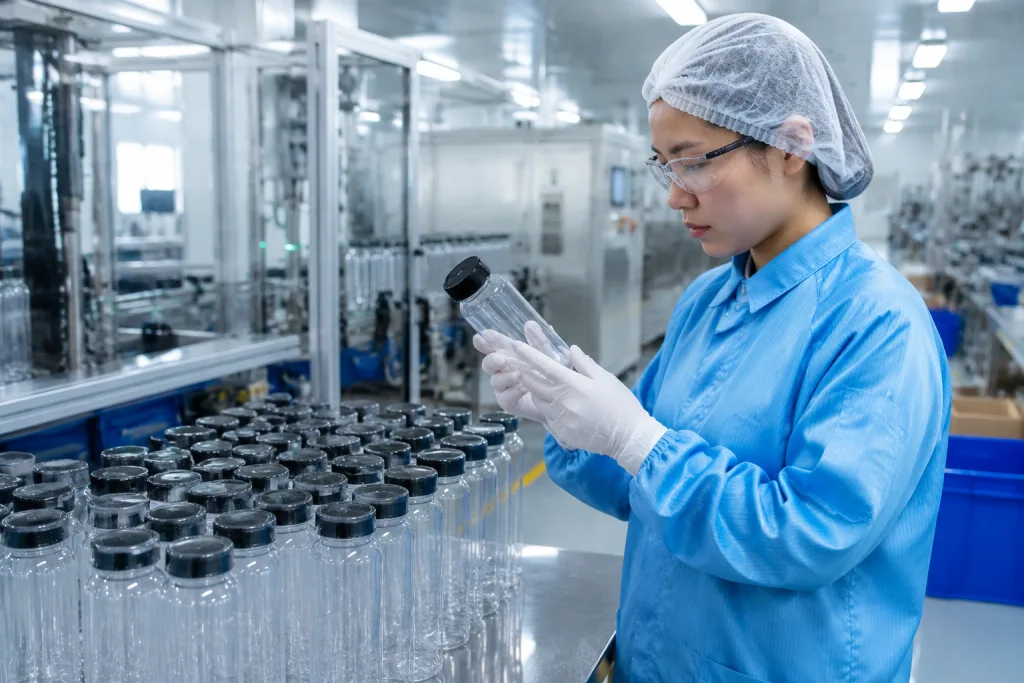
Finding a tritan renew double wall bottle factory is easy. Finding one that holds clarity, deadlines, and communication quality is the hard part. Start with capability, not sales talk. Ask how many injection machines they run, the machine tonnage, whether molding and printing stay in-house, and whether they have a QC lab. A serious plant in Zhejiang should answer monthly output, mold maintenance intervals, and spare lid lead time without a pause. We once saw a PO typo turn “clear lid” into “white lid”; the line caught it only because the packing list was checked against the sample card.
One useful benchmark: if a factory says it can only do 20,000 units per month, that is fine for a small line, but it will choke on a 60,000-unit rollout. A better target for a mature tritan renew double wall bottle factory is 300,000+ units per month across multiple SKUs, with a standard lead time of 35-45 days after sample approval. That capacity leaves room for reorders and color changes. We run the math first; if a supplier cannot cover two peak months back to back, the price looks good only on paper.
Check how they handle the ugly details:
- Do they polish mold cavities to keep the wall visually clear, or do you still see scuff lines under the light box?
- Can they keep logo placement within ±1.5 mm on the 300 ml and 500 ml sizes?
- Do they inspect for base ring stress marks and body haze after the drop test?
- Will they share photos of inline checks, not just one perfect sample from the showroom?
Trading companies can help with sourcing, but if you want a tritan renew double wall bottle factory relationship for long-term pricing, go direct when you can. Direct factory communication usually cuts problem-solving by 2 to 3 days per revision cycle. That matters when artwork has to lock before a retail deadline. QC pulled the sample once because the collar print sat 2 mm high; the buyer flagged it, and we fixed it before the cartons were sealed.
Packaging and market fit
The bottle sells the first glance, but the pack closes the order. For a tritan renew double wall bottle bulk order going into club stores, e-commerce, or premium corporate gifting, the carton has to fit the channel. A plain white carton with one-color print keeps cost down. A full-color gift box usually adds USD 0.25-0.80 per unit, depending on board thickness, insert style, and print coverage. We ran a 5,000-piece job last quarter and the buyer pushed back on a 28mm insert because the bottle rattled in transit.
For North America, if you sell through Amazon or a distributor that wants barcode control, lock down label placement and carton size before we start the line. FNSKU labels need to scan clean, and they need to sit in the same spot on every carton. For Europe, multilingual carton warnings and country-of-origin statements may be required, depending on your importer and destination. QC pulled the sample and found one PO typo on the inner carton, so we held the run before packing.
If you want the product sold as sustainable, be exact. Don’t overstate the claim. Use the resin wording backed by your lab report, and if the program is a tritan renew double walled bottle branded line, the box copy has to match the material story. Buyers notice fast when a premium “eco” bottle shows up in oversized plastic wrap with no recycling guidance. That is a branding mistake. The math does not work.
Ask your supplier for three pack levels: bulk shipper, retail-ready box, and gift set. Then run the gross margin on each one. A cheap carton can kill the channel fit. We’ve seen a USD 0.12 save on packaging turn into a lost listing because the club-store pallet spec missed by 8 mm.
Request a factory quote and sample plan
Send your target capacity, lid style, logo method, and destination market. We will return a clean FOB quote, MOQ, and lead time from Zhejiang.
Frequently asked questions
What MOQ should I expect for a Tritan Renew double wall bottle wholesale order?
For a standard private-label order, MOQ is often 3,000 pcs per color or SKU. If you need a new mold, expect 5,000 pcs or higher to justify tooling. Some Zhejiang factories can accept 1,000-2,000 pcs for stock shapes, but the unit price usually rises by 12-25%. If you want mixed colors, ask whether the MOQ applies per color or total per design. That detail changes your cash flow more than the catalog price does.
How much does a custom Tritan Renew double wall bottle cost FOB China?
For a 500 ml bottle with one-color logo and a basic lid, FOB China is commonly USD 1.85-2.35 at 3,000 pcs. Add a premium lid, laser mark, or special packaging, and the price can move to USD 2.45-3.20. Custom tooling is separate and can range from USD 3,000 to 12,000 depending on geometry. If someone quotes far below that, check whether testing, packaging, or mold cost has been removed from the quote.
What tests should I request before approving samples?
At minimum, ask for migration testing, food-contact declaration, and a leak test. For retail programs in Europe and North America, also request REACH support, drop testing from 1.2 m, and dishwasher-cycle results if you plan to claim dishwasher-safe. A good factory in China should provide final inspection records using AQL 2.5 for major defects and 4.0 for minor defects. If the bottle has a silicone gasket or metal cap parts, get material declarations for those too.
Is private label faster than OEM for this bottle?
Yes. Private label is usually faster because the mold already exists. After artwork approval, production can often finish in 35-45 days. OEM starts slower because engineering, mold review, and sample revisions take time; 30-45 days just for preproduction development is common. If you need a launch date tied to retail or Amazon FBA, private label is usually the safer route unless you need a unique silhouette or capacity.
How do I choose a real factory instead of a trading company?
Ask for machine list, monthly output, in-house QC details, and photos of the molding and decoration lines. A real tritan renew double wall bottle factory in Zhejiang should tell you capacity in units per month, not just say “we can do it.” Look for 300,000+ units per month if you need scale, and ask for sample traceability, mold maintenance records, and export packaging examples. If the answer is vague, you are probably dealing with an intermediary.