Key Takeaways
- A workable stainless thermos MOQ is often 1,000–3,000 units, with sampling in 7–12 days and mass lead time around 25–35 days.
- For a 500 ml custom thermos, expect FOB China pricing roughly USD 2.10–4.80 depending on 304/316 steel, lid type, and decoration.
- A serious thermos factory should quote AQL 2.5 for critical defects, 4.0 for major defects, and provide drop, leak, and vacuum-retention test data.
- Print methods matter: laser engraving holds up better than screen print on thermos promotional orders that will see heavy outdoor use.
You are not buying a bottle; you are buying a repeatable order. That is the part many first-time buyers miss when they start calling thermos vendors. A polished sample can hide weak lid torque, 0.4 mm wall loss, bad coating adhesion, or a decoration process that flakes after 3,000 dishwasher cycles. If you sell outdoor gear or run promotional programs, those details decide whether your thermos order turns into margin or a claims pile.
At our Zhejiang factory, we see the same pattern every week: a buyer wants a 500 ml stainless thermos for retail, corporate gifts, or event kits, then asks the wrong first question, usually price. That is the wrong question to ask. The math does not work if the vendor cannot hold spec across 5,000 or 50,000 units, ship FOB China on time, and pass REACH, FDA, and AQL control without excuses; QC pulled the sample, checked the lid at 12.8 mm, and the line caught the issue before packing. That is the order we will walk through here, from brief to final carton count.
Start With the Buyer Brief
Here is the actual order: a North American outdoor retailer needs 12,000 units of a 500 ml stainless thermos for a winter launch, split into two colors, with the logo on the body and a one-color retail carton. Marketing wants a premium shelf hit. Sales wants the landed cost down. We run that spec every week, and the first job is keeping both sides honest without wrecking the build.
Do not start with “send price.” Start with the buyer brief, because the use case sets the cost drivers. A commuter thermos and a trail thermos are not the same thing, and the lid often decides whether a sample passes or gets flagged. For outdoor retail, the seal needs to hold and the powder coat has to survive abrasion; for promo thermos programs, decoration often matters more than a cap upgrade. On a real quote, we usually define:
- Capacity: 350 ml, 500 ml, or 750 ml
- Inner material: 304 stainless or 316 stainless
- Body thickness: 0.4 mm, 0.5 mm, or 0.6 mm
- Lid type: screw lid, push-button, or cup lid
- Finish: matte powder coat, glossy paint, or bare steel
If you are comparing thermos vendors across Zhejiang and the rest of China, make every supplier quote the same spec sheet. We’ve seen this go sideways when one factory quotes a 0.5 mm body and another slips in 0.4 mm; the math does not work. A proper thermos manufacturer comes back with wall thickness, vacuum retention, and coating process, not just a clean mockup. One PO typo on color code can cost a full reprint, and QC pulled that sample fast.
Lock the Stainless Thermos Spec
For this buyer setup, the spec should be easy to run on the line and tough enough to keep return rates down. We would start with double-wall vacuum insulation, 304 interior and exterior, a 0.5 mm body wall on the shell, and a copper-plated thermal layer if the customer wants better heat retention. With that build, hot holding lands around 8–12 hours and cold holding 18–24 hours, depending on fill temperature and ambient conditions.
The lid is where too many thermos suppliers get lazy. For outdoor use, ask for a lid torque test and a leak test at both 45-degree tilt and full inversion. We had one buyer flag a lid that passed a quick bench check but failed after a 1.0 m drop; that is the wrong question to ask if the order is going to retail. A promo thermos for event giveaways can use a simpler lid, but a retail distributor needs the tighter spec.
Useful spec targets for a 500 ml order:
- Vacuum gap: stable after 48-hour aging test
- Drop test: 1.0 m on concrete, 3 faces
- Finish adhesion: cross-hatch or tape test after cure
- Odor test: no metallic smell after 24-hour soak
- Carton packout: 24 or 50 pcs per master carton, depending on size
If your custom thermos includes a straw lid or tea filter, check the extra grams against landed cost before you approve the drawing. We’ve seen this go sideways: 8 g per unit sounds harmless, then you ship 20,000 units by sea and the math stops working. In Zhejiang, the better factories run this calculation early, because a small lid change can turn into a real freight problem.
Price the Order Honestly
I’ll keep the tags and list structure intact, rewrite the prose to sound like a factory-side sales engineer, and make the pricing details more concrete.Buyers always ask what a custom thermos should cost. The honest answer depends on the build, not the product name. For a 500 ml stainless model, a plain export unit in 304 steel usually lands around USD 2.10–2.70 FOB China at 3,000 pcs. Add powder coating, a laser logo, and a tighter leakproof lid, and we ship closer to USD 3.20–4.80. If the buyer wants 316 steel or a special cap, the number moves up again. QC pulled one sample last month with a lid torque issue at 1.8 N·m, so this is the wrong question to ask without the spec sheet.
That is why thermos vendors should quote line by line. We run quotes with tooling, artwork setup, carton print, test fees, and master carton reinforcement shown separately. A manufacturer thermos quote that hides those items is not cheaper; it is just incomplete. The buyer flagged a PO typo once — “1,000 pcs” turned into “10,000 pcs” — and the margin math blew up fast. For a distributor thermos business, that kind of hole eats the deal.
Ask for a clear commercial breakdown:
- Unit price at 1,000 / 3,000 / 5,000 pcs
- Sampling fee and sample freight
- Tooling or mold cost, if any
- Logo setup fee for silk screen, pad print, or laser
- FOB port and valid quote window, ideally 15–30 days
Ask about reorders too. The second order should not start from zero. On our line, once the tooling, color chip, and logo file are locked, repeat lead time is often 12 days instead of 18 days. A supplier thermos partner worth keeping will keep those records clean, because the math does not work any other way.
Branding That Survives Use
I’ll rewrite the section in a more factory-side voice, keep the HTML exactly as-is, and preserve the technical specifics already in the copy.Your branding choice should match the product’s service life, not the mockup. For a promotional thermos handed out at a trade show, screen print works if the order is small and the campaign ends in 30 days. For an outdoor retailer, laser engraving is the cleaner call. It costs more on day one, but it does not chip when the bottle hits pack straps, cup holders, or grit.
If you are comparing thermos customizable options, check how the decoration sits on the finish. Dark powder coat plus a laser logo reads cleaner and takes abuse better. Gloss paint with wrap print looks louder, but we’ve seen it scratch in the first week. On a customized thermos run, we usually set a 40 mm logo zone on the body and only place a second mark on the lid insert if the panel is flat enough for the line.
Practical branding rules:
- Laser engraving for permanent marks
- Silk screen for simple 1–2 color artwork
- Heat transfer or UV print only when surface prep is controlled
- Stay within a 2 mm safety margin from seams and curves
For thermos promotional programs, packaging pulls more weight than buyers expect. A plain one-color carton with FNSKU sticker space, if you sell through Amazon, usually beats a busy insert. We had a buyer flag a PO because the logo looked fine on screen but sat too close to the seam on the carton. That is the wrong question to ask. The real test is simple: does the mark still look intentional after 6 months in the field?
QC Before You Approve Production
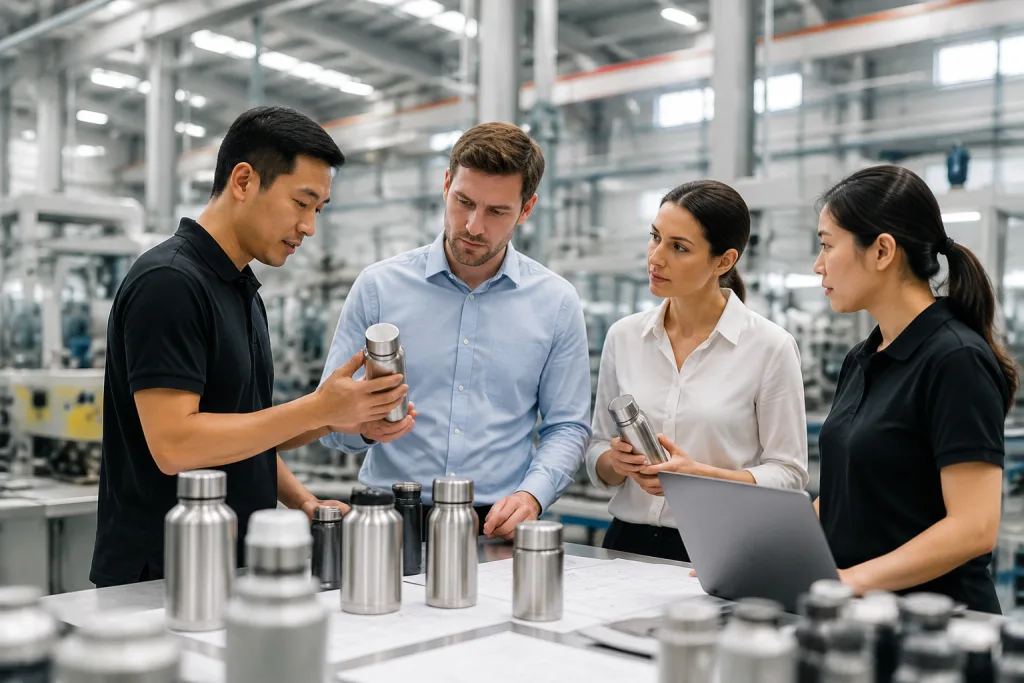
Sample approval saves some orders and kills others. We run a buyer’s first order in Hangzhou, Zhejiang with a pre-production sample, a sealed material sample, and an artwork proof on the table. Then QC checks the real items: mouth diameter, lid alignment, coating color, and the base finish. If the sample misses on a 1 mm lip gap or a crooked lid, the line will copy that mistake 10,000 times.
Set the gate before production starts. First article approval checks the sample against the PO and artwork. Midline inspection checks 30–50 pieces after the line settles. Final inspection uses AQL 2.5 for major defects and 4.0 for minor defects. Zero tolerance applies to leakage, smell, and vacuum failure. This is the wrong stage to be vague.
Ask for these test records:
- Leak test at full fill and tilt position
- Vacuum retention after thermal aging
- Coating abrasion or tape test
- Drop test on packed and unpacked samples
- Carton compression check for export freight
“If a thermos vendor cannot show the QC flow, they are asking you to trust a sample more than a shipment.”
That is a fair warning. We have seen a buyer flag a PO typo on the print layout, and the whole batch had to wait while the artwork proof was reissued. A serious thermos manufacturer welcomes written tolerances because the factory knows exactly what “good” means. In export plants across Zhejiang, written QC is how we keep 10,000 units from drifting off the approved sample.
Move the Order Through Production
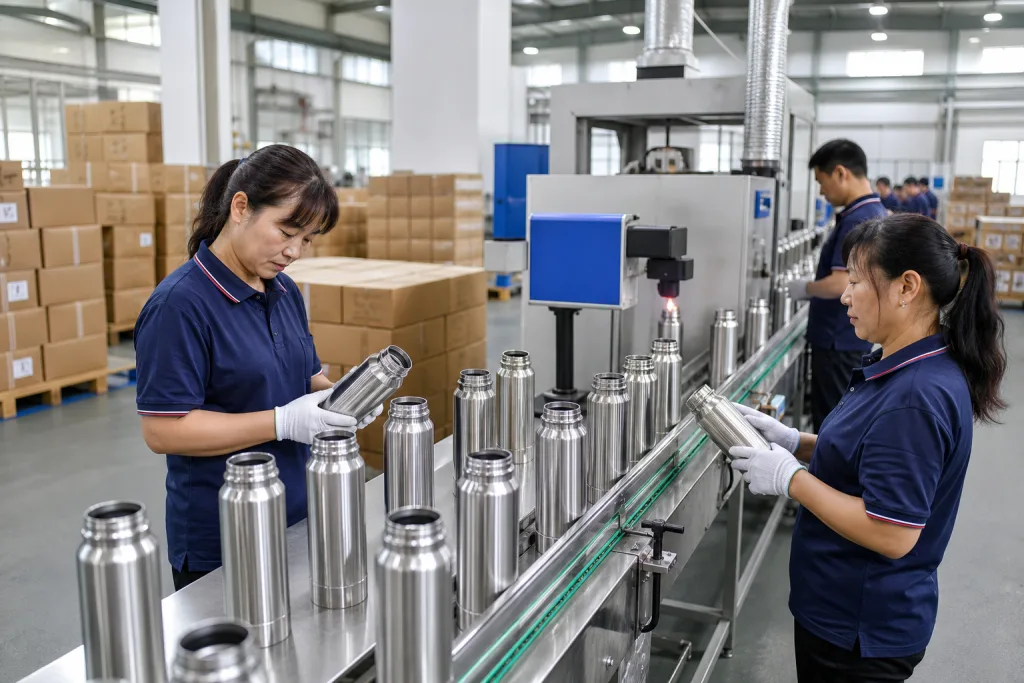
I’ll rewrite the section in-place, keeping the HTML tags and list structure untouched, and tighten the prose so it sounds like a factory-side sales engineer wrote it.Once the sample is approved, the order moves in a clear shop-floor sequence: incoming material check, shell forming, spot welding, vacuum sealing, polishing or coating, logo printing, assembly, then packing. If you buy from thermos manufacturers that run real volume, ask for daily output and the exact choke point. On a standard line, 30,000 to 60,000 units per month is normal, but custom work often waits behind coating ovens and screen-print slots.
For this case, we would split a 12,000-unit order into two lots if the buyer wants staggered delivery. One buyer flagged the delivery plan as “too slow,” but the math did not work any other way once the powder-coating booth was booked. Typical timing is 7–12 days for samples, 3–5 days for artwork and sign-off, 20–30 days for production, and 5–7 days for packing plus export booking. Total lead time lands around 30–45 days, depending on whether the factory already has the bottle body and lid on hand.
What to confirm before launch:
- Confirmed Pantone references for body color
- Carton dimensions for container loading
- Barcode and FNSKU placement, if needed
- Spare parts policy for lids and seals
- Replacement rate for transit damage
This is where a real thermos supplier shows whether they can run like a partner. If the plant in Zhejiang can send weekly production photos, packing count sheets, and container loading data, your team can sell with confidence. If not, you are buying blind, and we’ve seen that go sideways fast.
Ship, Inspect, and Reorder
FOB China is the start, not the finish. Once the thermos bulk order clears the port, you still need receiving inspection, retail readiness, and a reorder rule that does not depend on memory. On arrival, we check carton count, logo position, color swing, leak rate from random samples, and coating rub marks from transit. For retail orders, a 2% incoming inspection is the floor; if this is the first shipment into a new market, we go higher. QC pulled one carton open last month and found a 3 mm dent that the buyer flagged before store delivery.
If you sell through distributors, put spare lids and gaskets into the purchase plan. Too many returns come from a missing cap or a torn seal, not the bottle body. We ship spare-parts packs for that reason. A 200-piece lid kit can save a week of back-and-forth and a messy credit note, and the math does not work if you ignore after-sales costs.
Ask your thermos supplier for reorder records and a locked color standard. Reorders need to match the approved master, not “close enough.” We keep the first approval sample, the Pantone note, and the lid torque spec on the line for exactly this reason. Good custom thermos programs run like a controlled build: one body, two lid options, repeatable print, and a tight bill of materials. That is how a thermos vendor becomes a long-term factory thermos partner instead of a quote that dies after the first PO typo.
When the first order lands cleanly, the second order moves faster. That is the real value of working with experienced thermos vendors in China: fewer surprises from sample to shipment to shelf, and fewer fire drills for your sales team.
Send your thermos spec and get a quote
We can review your artwork, lid choice, MOQ, and FOB target, then map a production plan that fits your retail or promotion calendar.
Frequently asked questions
What MOQ do thermos vendors usually require?
For stainless thermos orders, many thermos vendors set MOQ at 1,000 units for a standard shape and 3,000 units for full custom colors or special lids. Some Zhejiang factories will sample at 1 pc, but production pricing usually starts at 1,000 or 3,000. If you need two colors, expect the MOQ to apply per color only when the coating line needs separate runs. For a distributor thermos order, it is smarter to keep one body and vary the logo or carton.
How much does a custom stainless thermos cost FOB China?
A 500 ml custom stainless thermos typically lands around USD 2.10–2.70 FOB China for a basic 304 build at 3,000 pcs. Add powder coating, laser logo, better lid sealing, or retail-ready cartons, and the range often moves to USD 3.20–4.80. If you upgrade to 316 steel or add a special temperature-display lid, the price rises again. A reliable thermos manufacturer should quote the cost by component so you can see where the money goes.
What QC checks matter most for thermos bulk orders?
Leak testing, vacuum retention, lid torque, coating adhesion, and carton compression are the main ones. For export orders, we usually target AQL 2.5 for major defects and 4.0 for minor defects, with zero tolerance for leakage or smell. Ask for a drop test at 1.0 m and a thermal retention report. If your thermos distributor business is retail-facing, you also want color consistency and logo placement checked on every carton lot.
Which logo method is best for a promotional thermos?
If the thermos promotional order is short-cycle and cost-sensitive, silk screen or pad print can work. If the product will see daily use, laser engraving is the safer choice because it does not chip or fade easily. For a dark powder-coated bottle, laser usually gives the cleanest result. On a 10,000-unit run, the decoration choice can change both the unit price and the return rate, so do not treat it as cosmetic only.
How long does production usually take in China?
A normal thermos custom order takes about 7–12 days for samples and 20–35 days for mass production after artwork and deposit are confirmed. If the factory in Zhejiang already has your base model, lead time can be shorter. If you need a new lid, special color, or complex packaging, add time. For a large thermos bulk order, plan around port booking and sea freight cutoffs as well, not just factory time.