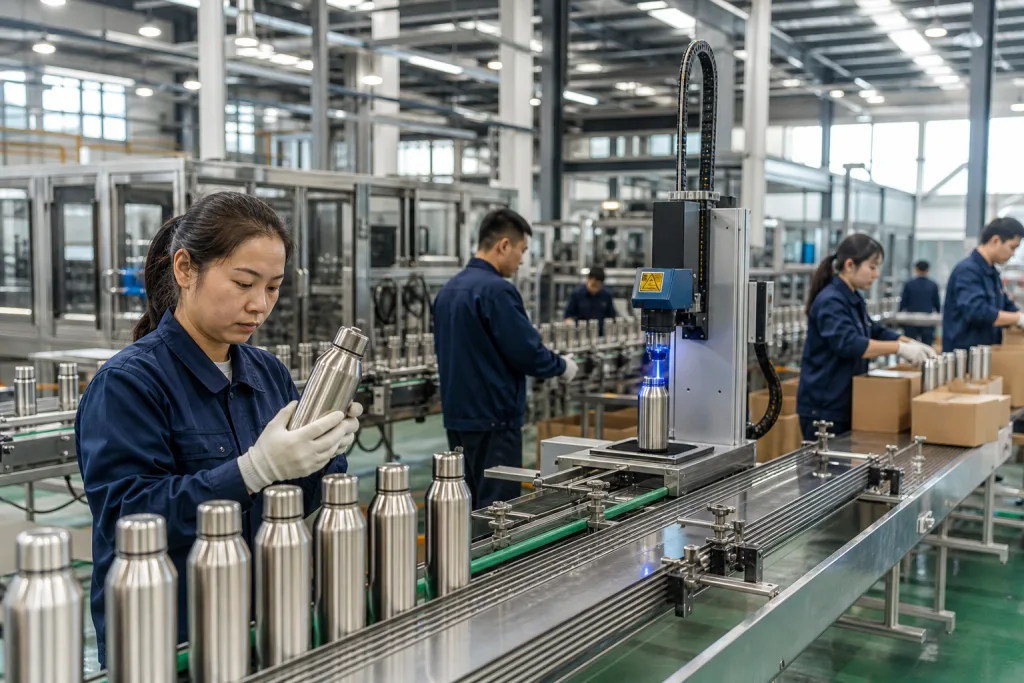
Key Takeaways
- Typical FOB stainless thermos pricing runs USD 2.10-6.50 per unit, depending on wall construction, lid, and decoration
- Standard MOQ for a custom thermos is usually 1,000-3,000 units; simple stock-color orders can start at 500 units
- Production lead time is often 25-45 days after sample approval, with 7-15 extra days for complex packaging or private labels
- AQL 2.5 is common for general inspection, and buyers should specify REACH, LFGB, and ASTM tests where needed
If you buy stainless thermos products for outdoor retail or a promotion program, the first bad move is usually chasing the lowest unit price without checking what that number covers. A thermos supplier can quote USD 2.10, USD 3.40, or USD 5.80 for what looks like the same bottle, and all three can be correct depending on steel grade, coating, lid structure, and print method. On our line in Zhejiang, the same body can run on different molds and cap sets, so the quote changes fast once the spec shifts.
Price is only half the story. The real question is what that price does to MOQ, lead time, and carton consistency. If you are comparing thermos suppliers for a custom thermos order, you need a clear way to judge bulk thermos cost, production timing, and how custom artwork affects the schedule. We’ve seen buyers focus on the unit price and miss a 12-day slip on print prep; that math does not work when the ship date is fixed.
What drives thermos pricing
I’ll rewrite the prose inside the existing tags, keep the structure intact, and sharpen the pricing logic with more factory-floor detail and fewer AI tells.When thermos suppliers send a quote, they are pricing more than steel and labor. Construction drives the number. A single-wall stainless shell with a plain screw lid is one thing; a 304 inner and 201 outer body with copper plating, vacuum insulation, powder coating, and a push-button lid is a different line item. On a 500ml stainless thermos, the gap between basic and upgraded spec usually lands at USD 1.20-2.40 per piece at FOB China.
Material grade comes first. 304 inside and outside works better for premium retail, while 304 inside plus 201 outside is standard for promo thermos programs when the buyer wants a lower thermos price. Wall thickness and steel gauge also move the cost. We run a lot of 0.35mm to 0.5mm inner walls; moving from 0.35mm to 0.45mm adds material cost, and QC pulled the sample showed better dent resistance and more stable heat retention. If you are comparing thermos manufacturers, ask for the exact steel grade, vacuum process, coating type, and lid BOM, not just the volume. A good thermos vendor gives that breakdown without playing games.
Decoration changes the number fast. One-color silk screen on a blank shell is cheap. Laser engraving, full-wrap UV print, matte powder coat with spot gloss, or a wrapped sleeve label adds setup time and per-unit cost. We have seen buyers flag a PO typo on the print position and lose two days on approval. For bulk thermos orders, packaging can take 8%-18% of landed cost if you need a color box, barcode, and retail insert. If you are sourcing from China or Zhejiang, ask for each bucket separately: body, lid, print, box, and carton loading. That is the only clean way to compare suppliers thermos quotes. The math does not work any other way.
MOQ tiers that actually matter
MOQ is where a lot of buyers burn cash by forcing a 200-unit trial through a thermos supplier built for volume. For stock finishes and basic print, 500-1,000 units is the number we usually quote. Add custom colors, a custom lid, or a shaped body, and the floor moves to 1,500-3,000 units. Once you ask for private mold work on a fully customized thermos, 3,000-5,000 units is where the line starts to make sense.
We run that math every week. A buyer once pushed for 300 pieces on a new paint scheme, then flagged the $0.38 gap between sample price and production price as if it were a mistake. It was not. Setup, coating changeover, and carton printing do not shrink cleanly, so the wrong question is, “Can you do less?” Ask, “What order size makes the tooling and QC cost sane?”
Here is the practical way to think about it:
- 500-1,000 units: stock molds, promotional thermos runs, and simple logo work
- 1,000-3,000 units: the normal zone for custom thermos orders with a unique finish or color box
- 3,000+ units: where molded lids, special handles, or double-print decoration start to pay back
If you are a distributor thermos buyer, small MOQs sound safe, but the unit cost often climbs 12%-25% versus a 3,000-unit run. We saw this on a 24oz order last month: QC pulled the sample at AQL 2.5, the packing line was fine, and the only real issue was that the numbers did not work for a tiny run. For thermos distributors and distributors thermos programs, the best setup is usually one stock model with one or two decoration changes per season. That keeps stock under control and still gives the buyer something that looks custom.
In Zhejiang, factories that ship 300,000-600,000 units per month usually want repeat orders because coating cups and lid components can stay locked. If you need a thermos customizable program with multiple SKUs, keep the body common and change only print, sleeve, or carton. The buyer gets flexibility. The factory keeps the line moving.
Lead time from sample to shipment
I’ll rewrite the section in-place, keep the HTML structure untouched, and tighten the prose so it sounds like a factory-side sales engineer wrote it.Lead time breaks into three chunks: sample, production, and pre-shipment handling. A stock stainless thermos sample usually takes 3-5 days. A logo sample runs 5-7 days. If you need a new color, a new lid, or a true custom thermos body, plan on 10-15 days for sampling, and we’ve seen that stretch when the line is packed in peak season.
Production normally takes 25-35 days after sample approval and deposit. Add 5-10 days if you want custom packaging, multi-step decoration, or you land in a crowded December schedule. For a trade show order, 50-60 days of buffer is safer if you want room for artwork fixes, sample sign-off, and freight booking. Buyers often miss freight. FOB is only one part; sea space, inland drayage, and customs can add another 7-21 days depending on destination, and that math does not work if your launch date is fixed.
Lead time also depends on factory thermos capacity. A real manufacturer setup with automated vacuum sealing and polishing lines can run 20,000-40,000 units per day across multiple SKUs, but only when the design stays frozen. Change the cap mold, color match, or carton size, and the line slows down fast. We’ve had a buyer flag a PO typo on carton size and lose 4 days while QC pulled the sample again. That is why thermos suppliers with export experience push for final artwork and packaging early. They are not being difficult; they are protecting the ship date.
Practical rule: if your launch date is fixed, work backward from shipment, not from the purchase order date.

How decoration changes unit cost
Decoration is where buyers usually miss the math. A one-color silk screen print can add USD 0.08-0.18 per unit. Laser engraving lands around USD 0.12-0.30, depending on size and setup. A wrapped full-color label or heat-transfer graphic is often USD 0.20-0.55. Add a textured powder coat with logo and you can be at USD 0.35-0.90 more than a plain brushed body. We run this comparison on the line all the time.
The logo method should fit the channel. Outdoor retailers want a finish that survives scuffing, and the buyer will flag a weak coating after the first carton test. Promo orders care more about speed and shelf pop, so a promotional thermos with pad print or spot color usually makes more sense. If you need a thermos custom program for both retail and giveaways, split it into two SKUs on the same base body. The wrong question to ask is, “Can one decoration do everything?” It can’t.
Packaging counts as decoration cost too. A plain master carton is cheaper, but Amazon and big-box programs often need an individual box, barcode, warning copy, and FNSKU labeling. That can add USD 0.12-0.45 per unit. On one recent PO, the buyer missed a carton label line, and QC pulled the sample before packing started. For custom thermos and thermos customized programs, lock the packaging spec before production; changing carton art mid-run is how we lose 12 days and then spend another 3 fixing it. Good thermos vendors ask for dielines early. That is a solid sign.
Inspection and compliance costs
I’ll rewrite the section in place, keep the tags exactly as-is, and tune the prose to sound like a factory-side sales engineer.Low price means nothing if the carton gets held at port or the buyer rejects the lot. For stainless drinkware, we talk AQL, material papers, and migration tests before extra packaging. A common inspection target is AQL 2.5 for major defects and 4.0 for minor defects, though some brand owners tighten that when the channel is risky. For Europe, ask for REACH, LFGB, and food-contact declarations where they apply. For North America, the factory needs FDA food-contact support and any retailer test list on file.
Inspection cost is not small, but it is predictable. A third-party pre-shipment inspection in China often runs USD 250-450 per man-day, plus travel if you send your own agent. We run in-house QC in Zhejiang, but that does not replace a written sample standard. Put the drop test height, lid cycle count, leak test time, and insulation retention limit in writing; QC pulled the sample with a 1.2 meter drop on one job because the PO typo said 12 meters, and that kind of mistake burns time. A good spec sheet also states hours at temperature, like 12 hours hot and 24 hours cold, since that is a sales claim and a line check.
Do not leave compliance to the end. If you are a thermos distributor or a supplier thermos buyer, lock the test plan with the PO. That is the right move. Then the factory chooses the coating, gasket compound, and ink from day one, and the buyer flagged it early instead of after sample approval. Change those later and you lose 5-10 days, sometimes a full production slot.
Getting a better quote from China
I’ll rewrite the prose only, keep the HTML exactly as-is, and make it sound like a real sales engineer wrote it.If you want a clean FOB quote from a thermos factory in China, give us the parts that drive the price. Send capacity, lid type, body finish, logo method, box style, and the target market. A request that only says “customized thermos, 500ml, logo needed” leaves too much open. We see that all the time. The quote comes back padded because the factory has to price the risk.
The RFQ that works best for thermos suppliers is simple: capacity, material spec, MOQ, target unit price, artwork file, packaging need, testing standard, and ship window. If you are comparing thermos suppliers in Zhejiang and elsewhere in China, keep the assumptions identical. Use the same incoterm too. `FOB Ningbo`, `FOB Shanghai`, and `EXW` are three different numbers. On a 1,000-unit custom thermos order, we’ve seen `USD 2.65 EXW`, `USD 2.82 FOB`, and `USD 3.40` landed before duty, with carton size and freight density doing the damage. The math doesn’t lie.
When a thermos vendor can answer MOQ, sample timing, and production slots without guessing, that matters more than a ten-cent gap. QC pulled the sample on one order because the buyer’s PO said `500ML` in one line and `500 ml` in another, and the line had to stop for confirmation. For outdoor retailers, a steady replenishment plan beats a one-time bargain. For promo brands, a firm ship date is the real value. Good Zhejiang suppliers price for repeat export work, not a single lucky order.
Send your spec for a fast thermos quote
We can price your stainless thermos by MOQ, artwork, and lead time, then show the cost drivers line by line before production starts.
Frequently asked questions
What is a normal MOQ for stainless thermos orders?
For stock-style bulk thermos orders, 500-1,000 units is common. For a custom thermos with logo, color, or box changes, 1,000-3,000 units is the usual range. If you want a truly customized thermos with a new mold or special lid, expect 3,000-5,000 units. A lower MOQ usually means a higher unit price because setup cost gets spread across fewer pieces. For a thermos distributor program, ask whether the factory can combine several SKUs into one production slot to reduce total MOQ pressure.
How much does a stainless thermos usually cost FOB China?
A basic promotional thermos can start around USD 2.10-2.80 FOB China for simple spec and one-color print. A mid-range custom thermos with better steel, powder coating, and upgraded lid often lands around USD 3.20-4.80. Premium retail-grade designs with complex caps or full decoration can reach USD 5.50-6.50 or more. The exact number depends on steel grade, wall thickness, finish, packaging, and test requirements. Ask for a line-item quote so you can see the cost drivers instead of only the final number.
How long does production usually take?
For most thermos supplier orders, sample approval plus mass production takes 25-45 days total. A stock sample can be ready in 3-5 days, a logo sample in 5-7 days, and a new custom thermos sample in 10-15 days. Once approved, production often takes 25-35 days. Add 5-10 days for custom packaging, color matching, or busy-season queues. If your launch date is fixed, build in at least 60 days before shipping so you have room for artwork correction, inspection, and freight booking.
What quality tests should I ask for?
Ask for leak testing, insulation testing, lid cycle testing, and coating adhesion checks. For export to Europe, request REACH and, where relevant, LFGB support. For a factory thermos program, a common inspection target is AQL 2.5 for major defects and 4.0 for minor defects. Many buyers also specify hot retention and cold retention targets, such as 12 hours hot and 24 hours cold, depending on the model. If you are ordering from China, define the test list in the PO so the supplier chooses the correct materials and process from the start.
Can I get a custom logo on a small order?
Yes, but the economics matter. Many thermos suppliers will accept 500 units for a simple custom logo on a stock body, especially for a promotional thermos program. If you need laser engraving, multi-color print, or a custom box, the MOQ often moves up to 1,000 units or more. Small orders work best when you keep the base bottle standard and change only the decoration. That is the cheapest route for a thermos vendor to produce a custom thermos without forcing a high unit price.