Key Takeaways
- A practical promotional thermos MOQ starts at 1,000-3,000 units for standard colors and 5,000 units for custom coating
- 304 stainless steel at 0.4-0.5 mm inner wall is the normal baseline for retail-grade vacuum insulation
- Laser engraving is durable but slower; silk screen is cheaper for 1-2 color bulk logos above 2,000 units
- Plan 35-55 days production after artwork approval, plus 28-38 days ocean freight to Europe or North America
A thermos promotional program looks simple until the PO asks for steel grade, capacity, powder coating, logo method, lid design, carton pack, and AQL level before the launch date. We see outdoor retailers and promo brands miss the target for 3 plain reasons: the buyer signed off the wrong finish, the bulk thermos lead time was planned at 12 days when the line needed 18 days, or the target price only worked with thinner steel and a carton that failed the drop test. QC pulled one sample last month with a 0.18 mm dent under the shrink bag. That is how small mistakes become chargebacks.
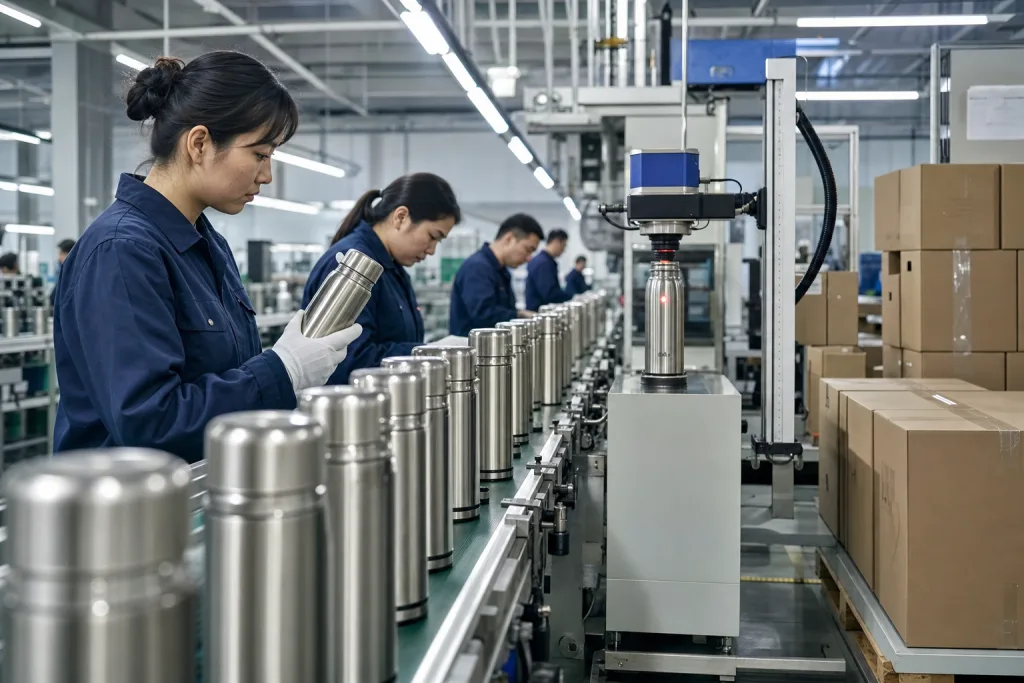
From our factory floor in Hangzhou, Zhejiang, good projects start with four decisions: usage scenario, construction spec, branding method, and delivery risk. The order sheet matters. We run 304 stainless bottles from 500 ml to 1,000 ml every week, but asking 8 thermos suppliers for “best price” without a wall thickness, coating code, logo size, and packing method is the wrong question to ask. The math does not work.
Start With The Use Case
Before you compare thermos manufacturers, decide where the bottle will actually be used. A ski resort retail thermos, a construction trade gift, and a national park merchandise item do not need the same body, lid, or coating. Use drives spec. If the user carries it in a backpack, we check leak resistance, finished weight, and coating abrasion after a 3M tape test on the logo area. If it sits in a truck cup holder, diameter and one-hand opening matter more; 72-75 mm is safer than a fat 82 mm body. If it is sold as outdoor retail stock, shelf feel and packaging can justify USD 0.30 more, especially when the buyer wants a color box instead of a white tuck box.
For most thermos promotional orders, we run 3 practical capacity ranges, but the 500-600 ml size wins the most repeat POs. A 350-420 ml item works for corporate gifts and kids outdoor sets. A 500-600 ml custom thermos is the safest retail and event size because it balances insulation, weight, and shipping cube. A 750-1000 ml stainless bottle is better for hiking, fishing, and camping, but carton volume rises fast. The math gets ugly. One 1,000 ml bottle can use almost twice the carton space of a 500 ml item, even when the FOB unit price difference looks small; last month QC pulled a 1,000 ml sample that passed vacuum testing, but the carton count pushed one buyer’s freight estimate up by 18%.
You should also define the buyer channel early. A distributor thermos order for resale needs neutral master cartons, barcode placement, and sometimes multiple logo versions. A promotional thermos for one campaign may accept simpler packing and a single delivery address. For outdoor retailers, we usually recommend testing 2-3 capacities first instead of launching six colors and four sizes. We have seen this go sideways when the PO says “assorted colors” but the buyer later expects equal split per SKU. A clean 500 ml and 750 ml range with the same lid thread is easier to replenish and easier for your warehouse to manage.
Do not start with the cheapest quotation. Start with the usage case, then remove features that do not serve that case.
Set The Stainless Steel Baseline
The baseline for any customized thermos is the steel body. We usually run 304 stainless steel on the inner wall, with 201 or 304 stainless on the outer wall depending on the target shelf price. For Europe and North America, 304 inner steel is the safer call for food-contact orders. If a thermos factory quotes USD 0.40 below everyone else, do not start with the logo artwork. Ask for steel grade, wall thickness in mm, and a written line on the PI that sample and mass production use the same material. We have seen this go sideways when a buyer approved a 304 sample and the bulk order arrived with a 201 inner wall flagged by PMI testing.
For a 500 ml stainless thermos, a workable structure is 0.4-0.5 mm inner wall and 0.5 mm outer wall before forming, although the final gauge changes after deep drawing. Thin bodies cut cost. They also dent fast. On the line, QC pulled a 0.32 mm inner-wall sample last year that passed the first visual check but failed after a 1 m carton-drop test. Outdoor retailers are usually better off with a slightly heavier body because dent returns and coating-chip complaints cost more than the USD 0.10-0.25 saved in production.
Insulation needs test data, not nice wording on a catalog page. A normal vacuum flask should keep water above 60°C for 6-8 hours when tested from a 95°C starting temperature at room temperature. Premium builds can hold heat for 10-12 hours under the same setup, but lid design, mouth diameter, and capacity change the result. Wide-mouth products lose heat faster than narrow-mouth products. A thermos custom design with a flip straw lid sells well for gym and commuter channels, but the math does not work if the buyer expects screw-cap performance from a lid with a silicone straw vent.
Ask your thermos manufacturer for the test method, not just the claim. At BottleForge Industrial in Zhejiang, we check vacuum performance during production and again before packing; one station uses a temperature probe, timer, and a water bath record sheet, not a quick touch test by hand. Our monthly drinkware output is about 450,000 units across stainless bottles, tumblers, and thermos products, but capacity means little if inspection is loose. For formal orders, use AQL 2.5 for major defects and AQL 4.0 for minor defects as a normal starting point, and make sure the PO does not carry a typo like “AQL 25” because the buyer flagged that once after cartons were already booked.
Choose Branding That Will Survive
Branding is where 3 out of 10 thermos promotional projects either keep margin or eat it. A logo that looks sharp on a PDF can break up on a curved powder-coated body, especially near the lower radius where the screen frame starts to lose contact. Method choice depends on artwork complexity, order size, surface finish, and whether the bottle sits in a truck cup holder or gets thrown into a hiking bag.
Laser engraving is the safest choice for outdoor brands. It removes the coating and exposes the stainless steel underneath, so there is no ink layer for keys or sand to scrape off. Clean look. Premium feel. Good for single-position logos. The trade-off is speed and no color. For 3,000 pieces, laser can add 2-4 production days depending on logo size and machine queue; last month we ran a 55 mm logo on two fiber laser machines and QC pulled the sample twice because the edge looked smoky on matte black powder coat.
Silk screen printing works well for 1-2 color logos on smooth cylindrical surfaces. It is usually cheaper than laser for thermos bulk orders above 2,000 units, especially when the logo area stays under about 60 x 80 mm. The weak point is abrasion. On rough outdoor use, screen print wears fast if ink viscosity, oven curing time, or surface pretreatment is off. Always request a 3M tape test and alcohol rub test on pre-production samples; we run both before mass printing because one buyer flagged ink lift after only 20 rubs with 75% alcohol.
UV printing gives more color and gradient options. It suits promotional brands that need full-color artwork, but the math doesn't work for heavy outdoor abrasion unless the buyer accepts the wear risk in writing. Embossing or debossing can be excellent for high-end customized thermos projects, but tooling cost often starts around USD 300-800 per mold, so it makes more sense at 5,000 units or more. We also check the mold drawing against the cup wall thickness in mm, because a deep deboss on a thin body can leave a shadow line inside the bottle.
If you work through thermos distributors or a thermos vendor, make sure the artwork file, Pantone color, logo position, and print size are written into the purchase order. Verbal approval is not enough. A 2 mm shift may not matter for a giveaway, but it can hurt retail shelf presentation. We have seen this go sideways from one typo on a PO: “front logo 45 mm” became “54 mm,” and the buyer rejected the first carton during AQL inspection.
Understand Price And MOQ Trade-Offs
Two suppliers can quote the same 500 ml bottle at different prices because they are not quoting the same build. A plain stainless 500 ml factory thermos starts around USD 3.20-4.20 FOB China at 3,000 units when we run stock lids, bulk-packed steel bodies, and a normal export carton. Add powder coating, laser logo, color box, and a better lid, and the same project moves to USD 4.60-6.20. A premium 750 ml bottle with 304 inner and outer steel, handle lid, powder coating, and retail box lands around USD 6.50-9.00 depending on design and order volume. Check the spec sheet line by line. Last month QC pulled a 500 ml sample with a 0.42 mm outer wall, while the buyer’s old approved sample measured 0.50 mm; that gap alone changed the quote.
MOQ is not just a factory rule. It comes from coating line efficiency, component purchasing, carton printing, and labor setup. For standard models with existing lids and colors, a manufacturer thermos MOQ of 1,000 units works if the lid gasket, silicone ring, and carton size are already in our warehouse. For custom Pantone powder coating, 3,000-5,000 units is more realistic because the coating line loses time during color change and gun cleaning. For a new mold lid or proprietary body shape, think in 10,000 units and a tooling timeline of 25-45 days before mass production. Small custom runs sound attractive, but the math often does not work; we have seen 800-piece promotional orders go sideways when the buyer wanted four body colors and two lid styles.
Be careful with quotations that hide costs outside the unit price. Ask whether the price includes inner box, master carton, logo setup, sample charge, export carton marks, and palletization. For Amazon-style distribution or retail DC delivery, FNSKU labels, suffocation warnings, and carton drop-test requirements add USD 0.05-0.20 per unit. That is not a factory trick; it is real labor and material. On the packing table, one worker using a Zebra label printer can handle about 1,200-1,500 FNSKU labels per shift before carton sealing slows down, and the buyer usually flags crooked labels during pre-shipment inspection.
A direct thermos factory in China gives better control over steel grade, vacuum testing, coating color, and packing details, while thermos vendors can make communication easier and accept smaller mixed orders. Neither model wins every time. For outdoor retailers with repeat seasonal demand, direct manufacturer thermos sourcing usually becomes more efficient after the first 2-3 purchase orders because color, packing, and inspection standards are already fixed. We ship faster once the approved sample, carton mark, and AQL 2.5 checklist are locked; 18 days for the first repeat order can become 12 days when the line does not need new instructions.
Control Compliance Before Production
Compliance is not a certificate to chase after the cartons are sealed. It decides the 304 stainless steel, powder coating, pad-printing ink, lid plastic, silicone ring, glue, and even the export carton mark before we run the first sample. For Europe, check LFGB or EU food-contact testing, REACH on coatings and components, plus packaging rules by country. For the United States, FDA food-contact expectations are common, and some children’s products need ASTM or CPSIA-related review based on design and age grading. On our line, QC asks for the material list before the first 30 pcs pilot run, not after mass production.
For a stainless thermos, the steel body is not the whole risk. The trouble usually comes from silicone seals, PP lids, paints, inks, adhesives, and printed packaging. If the order is a customized thermos for a large outdoor retail chain, ask for current test reports on similar materials, then confirm whether your exact coating and lid material are covered. A three-year-old report for matte black does not cover your new cream white finish. We have seen this go sideways when the buyer flagged a soft-touch coating at inspection because the PO only said “same as sample” and never named the coating code.
Factory audits matter too. BSCI, ISO 9001, and internal quality systems do not guarantee perfect goods, but they tell you whether the supplier thermos team is used to records, CAPA forms, and closing corrective actions. If your brand has social compliance requirements, state them before deposit. Do it early. Trying to arrange an audit two weeks before shipment is how a 12-day booking window becomes an 18-day delay, and the math does not work when the vessel cut-off is already fixed.
For inspection, we recommend a written checklist covering capacity, weight, steel grade declaration, logo position, coating adhesion, leakage, vacuum performance, carton strength, barcode scanning, and quantity count. At our Hangzhou, Zhejiang facility, pre-shipment inspection is scheduled when goods are 100% produced and at least 80% packed. That timing lets an inspector check finished goods while we still have time to replace crushed 5-layer cartons, retest leakage with the pressure fixture, or rework visible scratches pulled by QC under the light box.
Plan Lead Time Like A Buyer
A realistic thermos promotional calendar keeps you out of expensive air freight. For an existing model with standard color and approved artwork, sampling usually takes 5-10 days; on our line, that means one printed sample, one spare body, and a QC check with a 3M tape test before we pack it. Pre-production sample approval may take another 3-7 days if your brand team must sign off. Mass production for 1,000-5,000 units usually needs 30-45 days after deposit and final approval. Custom coating, multiple logo versions, or retail packaging can push production to 45-55 days. The math doesn't work if the buyer approves artwork on Friday and expects 2,000 gift sets ready the next week.
Ocean freight is the next piece. From Ningbo or Shanghai, a shipment to major North American ports often needs 25-35 days on the water, plus origin handling, customs, and inland delivery. Europe is commonly 30-40 days port to port depending on routing. If your launch is tied to a trade show, hunting season, ski season, or holiday retail window, build the schedule backwards and add at least 10 days of buffer. We have seen a 12-day production delay turn into an 18-day arrival problem because the vessel cut-off was missed by one afternoon.
One common mistake is approving the golden sample but leaving carton marks, barcode files, or retail box dielines open. The factory may finish bottles while the packaging waits. It happens. QC pulled the sample, the bottle passed, then the buyer flagged a 1 mm barcode quiet-zone issue on the color box PDF. For distributors thermos programs with multiple end customers, confirm whether each carton needs a separate PO number, SKU, or destination label. Warehouse mistakes are boring, but they are expensive.
You should also decide your shipping term clearly. FOB Ningbo or FOB Shanghai is normal for China export orders. EXW can look cheaper but transfers local truck booking, export documents, and terminal handling to you. DDP is convenient for smaller promotional brands, but you need to know who carries customs risk and whether duties are transparent. A good thermos supplier will not just quote a price; they will point out the two or three decisions that can hold the order, like a missing consignee name or a typo on the PO.
Build A Repeatable Sourcing Spec
Strong buyers do not ask for “your best thermos customized price” every season. They send a sourcing spec our costing desk can quote, sample, inspect, and reorder without guessing. A workable spec sheet should lock capacity such as 500 ml or 750 ml, body diameter in mm, height, mouth diameter, steel grade, wall thickness target, lid material with gasket material, finish with Pantone color, logo method with logo size, packing, carton quantity, AQL level, compliance requirement, and shipping term. Small detail matters. Last month QC pulled a 750 ml sample where the PO said matte black, but the artwork file said Pantone 426C gloss; that one typo cost 2 days before the line could start coating.
For outdoor retail and promotional thermos programs, we ask buyers to keep a defect photo standard, not just a written sentence saying “good quality.” Show the limit sample for coating dust over 0.5 mm, dents on the shoulder, color variation under a D65 light box, logo scratches after a 3M tape test, lid flash, silicone stains, and carton crushing. Photos stop arguments. We have seen this go sideways when an inspector rejects 8% of cartons for corner dents and the buyer’s team has no signed standard to back the decision. If you work with 3 thermos suppliers, run the same checklist so the comparison is fair.
A repeatable spec gives you better leverage in negotiation without playing games on every PO. Once a thermos manufacturer knows your annual forecast is 20,000-50,000 units across two capacities, they can reserve coating capacity, buy components better, and hold color consistency. The math does not work if every order is treated as a one-off 1,000 pcs job. During September peak season, our powder coating line is booked by diameter and color; a confirmed 65 mm body in white gets protected line space faster than a vague “similar to last order” request.
China is still one of the strongest places to source stainless vacuum drinkware because the component base, coating plants, carton suppliers, and export logistics sit close together. Zhejiang gives buyers access to metal forming, polishing, powder coating, injection lids, silicone gaskets, and Ningbo or Shanghai export routes without moving every component across the country. That saves time. On a normal reorder, we ship 12 days faster when the lid supplier and carton plant are within 80 km of Hangzhou. The buyer’s job is to turn that supply base into a controlled program, not a random quotation exercise.
Send Your Thermos Spec For A Factory Review
Share capacity, logo, MOQ, market, and deadline. We will reply with practical FOB options, risks, and production timing.
Frequently asked questions
What is a realistic MOQ for a thermos promotional order?
For an existing stainless thermos model, 1,000 units is sometimes possible if you accept standard colors and simple logo placement. A more realistic MOQ is 3,000 units for better pricing and smoother production. If you need custom Pantone powder coating, expect 3,000-5,000 units because coating lines need setup time and minimum powder usage. For a new lid mold or unique body shape, 10,000 units is a better planning number, plus tooling cost and 25-45 days for mold development.
Which logo method is best for outdoor promotional thermos products?
For heavy outdoor use, laser engraving is usually the safest because it does not rely on an ink layer. It works well on powder-coated stainless bottles and gives a premium retail look. Silk screen printing is better when you need a lower unit cost on 1-2 color logos and the product will not face extreme abrasion. UV printing is useful for full-color artwork but should be tested carefully. For any method, approve a pre-production sample and require tape, rub, and visual alignment checks before mass production.
How long does a custom thermos order take from China?
For a standard model, plan 5-10 days for sampling and 30-45 days for mass production after artwork and deposit. If you add custom coating, retail color boxes, multiple SKUs, or special lids, production may be 45-55 days. Ocean freight from China to North America is commonly 25-35 days port to port, and Europe is often 30-40 days. Add customs, trucking, and inspection time. For seasonal outdoor launches, start 90-120 days before your required warehouse date.
What should I check before approving a bulk thermos sample?
Check capacity, weight, diameter, lid fit, leakage, logo size, logo position, coating texture, color match, carton pack, barcode scan, and insulation test. For insulation, a practical test is filling with 95°C water and checking whether temperature stays above 60°C after 6-8 hours at room temperature. Also compare the sample against your quoted steel grade and packing spec. A sample that looks good but uses a different lid, box, or coating than mass production is not a reliable approval sample.
Should I buy from a thermos factory or a trading vendor?
If you need small mixed SKUs, flexible communication, or one-off promotional sourcing, a thermos vendor can be practical. If you expect repeat orders, tighter cost control, and detailed engineering changes, working with a thermos factory or manufacturer is usually better after the first project. The key is transparency. Ask who controls production, who owns the inspection process, and who is responsible if AQL fails. For annual demand above 20,000 units, direct factory development usually gives you more control.