Key Takeaways
- A realistic MOQ for a custom stainless thermos is often 3,000 units, with sample lead time of 7-10 days
- A 500 ml thermos bulk order often lands around USD 2.10-4.80 FOB depending on 304/316 steel, lid type, and decoration
- For export QC, ask for AQL 2.5 on critical defects and 4.0 on major defects before you approve shipment
- A well-run thermos factory in Zhejiang can produce 80,000-150,000 units per month, but finishing and packaging still set the real lead time
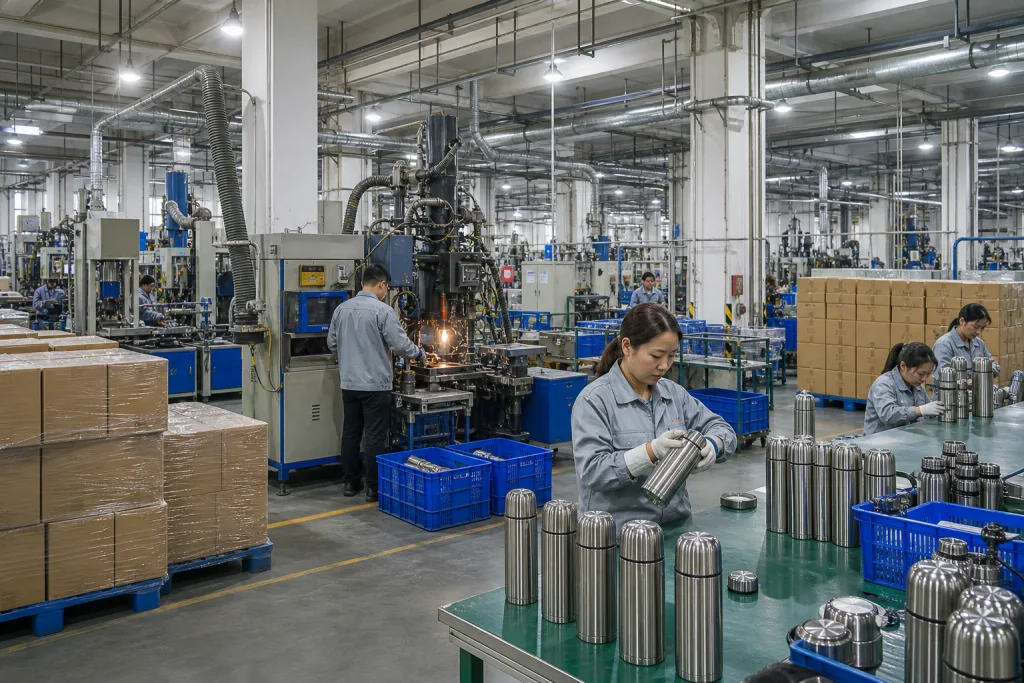
You are not buying a bottle. You are buying a production plan, a shipping slot, and a complaint rate you can live with. If you work with a thermos factory on a stainless order, the first mistake is treating it like a catalog pick. The second mistake is assuming every custom thermos builds the same way. Wall thickness, vacuum retention, lid tooling, logo method, carton strength, and food-contact paperwork all change the result. On the line, we check the shell gauge with a micrometer, because 0.2 mm off can shift the feel and the cost.
For outdoor retailers and promo brands, the clean orders are the ones written like a manufacturing job. In Zhejiang and across China, a solid thermos supplier should quote in 24 hours, send a sample in 7 to 10 days, and run 5,000 to 30,000 units with a 30 to 45 day lead time depending on decoration. That is the math. We have seen buyers push for a glossy sample and then flag the first carton drop test, so the question is whether the approved factory thermos is the one that lands in the carton. QC pulled one sample last month because the lid torque missed spec by 0.3 N·m.
Start with the buyer scenario
I’ll rewrite the two paragraphs in a more field-tested sales-engineer voice, keep the HTML exactly as-is, and strip out the AI-ish phrasing while adding a couple of concrete factory details.Picture the first PO: 8,000 pieces of a 500 ml stainless thermos for a fall outdoor launch. Black matte body, laser logo, screw lid with a tea filter, printed retail cartons. Looks straightforward until the spec sheet lands on the desk. Does the buyer want 304 stainless steel or 316 for the inner wall? Is the lid PP or Tritan? Does the silicone seal need REACH and LFGB? And is this a giveaway thermos for a campaign, or a distributor item that has to hold up through shelf time, returns, and repeat orders?
This is where a thermos factory earns the margin. We start with use case, not paint color. Outdoor retail buyers usually push for heat retention, drop resistance, and logo placement that stays clean after carton packing. Promo buyers care about unit cost, print clarity, and carton counts that match the PO line by line. On the line in Zhejiang, QC pulled a sample with a 0.3 mm cap gap, and the buyer flagged it before mass production. We ask the awkward questions early: target market, sales channel, peak season, and whether the quote needs FOB Ningbo, FOB Shanghai, or landed cost. That is not sales fluff. It keeps you from paying for a second sample round after the first one is already approved.
Choose the right stainless build
I’ll rewrite the section in-place, keep the HTML tags unchanged, and tighten the prose so it sounds like a factory sales engineer wrote it.The stainless build decides whether a thermos customized order feels like a real premium piece or a cheap giveaway. For bulk programs, 304 stainless steel is the baseline we run. It is food-safe, common on the line, and keeps the cost in line. If the buyer wants a higher-end custom thermos for hiking, winter sports, or a tougher insulation claim, 316 inner steel makes sense, but the math jumps fast. A typical inner wall sits at 0.35 mm to 0.5 mm, while the outer wall usually runs 0.4 mm to 0.6 mm, depending on capacity and target price. One buyer pushed for 0.3 mm all around to save weight; we told them that was the wrong question to ask, because the dent rate went up on drop checks.
Do not stop at the shiny finish. The bottom seam, neck geometry, and vacuum quality decide whether the flask survives real use. A thermos customizable on the outside can still fail if the vacuum leak rate is off. Ask for retention data from a defined test method, not ad copy. A solid thermos manufacturer should show the starting water temperature, ambient temperature, and the readings at 6, 12, and 24 hours. On a 500 ml double-wall flask, QC pulled the sample at 12 hours and still saw above 60°C when the vacuum process and lid seal were controlled. We have seen this go sideways when a PO typo changed the lid spec from 48 mm to 49 mm, so the factory records matter more than a hero photo.
Lock the quote before sampling
I’ll rewrite the two paragraphs in-place, keep the HTML exactly as-is, and tighten the sales-engineer tone with concrete sourcing detail.Once the build is set, you need a quote that means something. A proper thermos factory quote breaks out the body, lid, logo method, surface finish, packing, and freight term. If one supplier says USD 2.20 and another says USD 3.40, they are often not quoting the same job. One may include a plain silver body with no carton insert; the other may bundle a custom color box and individual polybag. We’ve seen buyers miss that and waste a week comparing the wrong numbers.
For an 8,000-unit customized thermos order, a realistic FOB China range for a 500 ml model can sit between USD 2.10 and USD 4.80, depending on tooling, print complexity, and packing. Laser engraving stays cleaner on long runs, while silkscreen or pad print can shave cost on promotional thermos programs. If your brand wants a more premium feel, powder coating, UV print, or a wrapped label works, but QC pulled the sample for scratch resistance before we signed off. A thermos supplier in Zhejiang should also tell you whether the cap, handle, or tea infuser needs special tooling. If tooling is needed, ask who owns it and whether the mold cost comes back at volume — this is the wrong question to leave vague.
Treat the sample as a test order
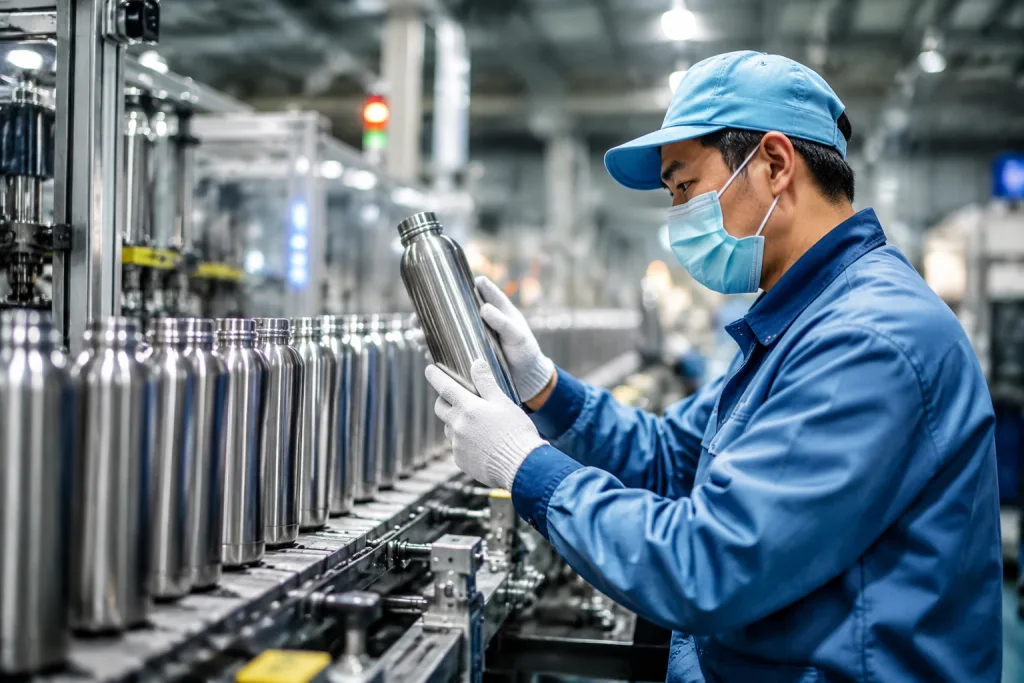
I’ll rewrite the section in-place, keeping the HTML tags and the heading structure intact, and I’ll tighten the prose so it sounds like a factory-side sales engineer wrote it.A sample is not a souvenir. We treat it like a test order, just with a smaller count. Ask for pre-production samples, not stock samples, because stock pieces can hide the real decoration method. For a custom thermos, the sample should match the final body color, logo position, lid build, and carton insert. If the order uses a custom thermos lid or a special tea strainer, ask for a function sample with the exact closure torque and gasket material. QC pulled one last month with a 1.2 mm gasket mismatch, and the buyer flagged it before the line ran.
When the sample lands, test the same points your customer will chase. Fill it with 95°C water, close it, and check for leaks after inversion and a short vibration run. Measure thread smoothness, cap odor, and coating consistency. Check the logo under daylight and fluorescent light. If you source for distributor thermos channels, verify whether the retail carton can survive export stacking. This is the wrong question to ask after mass production starts. A distributor buyer will notice barcode placement, carton size, and whether the inner tray crushes under 10 kg stacking pressure. If the sample fails, fix the spec now. One extra week at sample stage beats 8,000 angry customers later.
Set QC like an import team
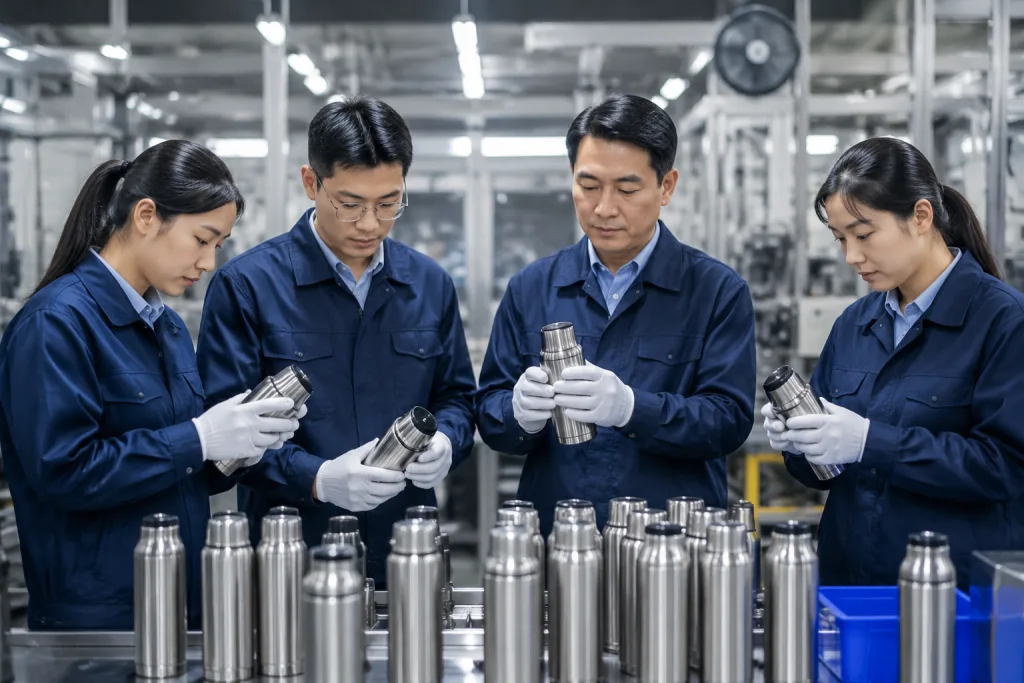
I’ll rewrite the two paragraphs in place, keep the HTML exactly as-is, and tighten the QC language so it reads like a factory-side sales engineer wrote it.Write QC into the PO before production starts. For a thermos factory relationship, ask for pre-production approval, in-line inspection, and final inspection with AQL terms on the purchase order. A common export setup is AQL 2.5 for critical defects and 4.0 for major defects. Critical defects include vacuum failure, leaking lids, sharp edges, and contamination. Major defects include visible color mismatch, print misalignment, and carton damage. Minor defects cover small scuffs or slight logo variation, but only if they stay inside the tolerance you agreed. We’ve seen buyers leave this out and then fight about claims later. That never ends well.
In a serious thermos factory, QC is not a checkbox. It starts with incoming steel checks, then welding seam monitoring, vacuum leak testing, and finished retention sampling. Ask how many units get pulled per batch, and ask what happens when the defect rate crosses the internal limit. On our line, QC pulled 12 samples per 1,000 pcs when the buyer flagged a lid torque issue, and that saved the shipment. Many Zhejiang factories can run 80,000 to 150,000 units per month, but output means nothing if the first carton on the pallet is mixed across shifts. Ask for lot traceability by date, line, and packing team. If your brand sells through outdoor retailers, a 1% leakage rate is already a problem. For promotional orders, one off-center logo can sink the campaign faster than a late truck.
Plan packaging for retail or promotion
Packaging changes burn cash faster than most buyers expect. A plain bulk thermos in an egg crate with a master carton is one price; a shelf-ready retail box with insert, barcode, hangtag, and instruction sheet is a different deal. We have seen buyers send a PO for 10,000 pcs and forget the pack-out, then the margin disappears on the line. If you ship through distributor thermos channels, the carton has to survive mixed-load freight and warehouse knocks. If the order is for a promo thermos going to event organizers, the job is clean presentation and quick unboxing, not shelf appeal.
Be exact on carton specs. Say 25 pcs per master carton or 30, call out 5-layer B-flute or heavier board, and state whether you need FNSKU labels or country-of-origin stickers. For North America, some buyers also send case-pack data so it drops straight into Amazon or warehouse receiving; we run that check before print, because a 2 mm carton mismatch turns into a receiver complaint. QC pulled one sample last month with a sloppy barcode placement, and the buyer flagged it on the first scan. A good supplier thermos team in China will ask about drop-test targets and humidity exposure, especially for printed cartons. Cheap packaging can wipe out a good bottle. Packaging is part of the product.
Manage production and delivery
I’ll rewrite the section in place, keep the HTML untouched, and tighten the sales-engineer tone with concrete factory details and cleaner delivery timing.Once the PO is signed, the job turns into schedule control. A plain stainless thermos bulk order with no mold change usually runs 30 to 45 days from deposit to shipment. If we open new tooling, add a special coating, or build a complex lid, plan on another 10 to 20 days. In peak season, our Zhejiang line gets booked 2 to 4 weeks ahead. That is the wrong time to assume a reorder can ship on the same date as the first lot. We have seen that go sideways more than once.
Track the milestones: raw material purchase, first article approval, mass production, QC, packing, and booking. Ask for photos and counts at each step, not just the loading shot at the end. QC pulled the sample once and found a 1.2 mm gasket mismatch; that saved a bigger headache later. For FOB, confirm carton count, gross weight, and CBM before the truck leaves the factory. If you are ordering customized thermos products for multiple markets, split carton marks by SKU and destination. It cuts warehouse mix-ups. The buyer flagged a PO typo on the destination code once, and we caught it before the pallets moved. A factory that reports cleanly before shipment usually handles claims faster after shipment too, which matters when your Europe and North America buyers expect same-day replies.
Send your thermos spec for a fast quote
Share capacity, lid style, logo method, and target price. We’ll review the drawing, confirm MOQ, and quote FOB China clearly.
Frequently asked questions
What MOQ should I expect from a thermos factory?
For a standard custom stainless thermos, MOQ is often 3,000 units per design and per color. Some thermos suppliers will accept 1,000 to 2,000 pieces if they use existing tooling and simple decoration, but your unit price usually rises 10% to 25%. If you need a special lid or customized carton, expect a higher MOQ or a mold fee. For large distributor thermos programs, 5,000 to 10,000 units is more common because the factory can better control coating and packing consistency.
How do I compare thermos bulk quotations correctly?
Compare the same spec, not just the final number. Confirm steel grade, capacity, wall thickness, lid type, logo method, carton type, and FOB port. A USD 2.35 quote with a plain box is not equal to a USD 3.10 quote with custom printing and insert. Ask whether samples, mold fees, and test reports are included. If one manufacturer thermos quote omits packing or export labels, the real landed cost may be 8% to 15% higher after you add those items.
What quality checks matter most for a stainless thermos?
Leak testing, vacuum retention, coating adhesion, and logo durability matter most. For export orders, ask for AQL 2.5 on critical defects and 4.0 on major defects. Check for sharp edges at the mouth, seal compression consistency, and odor in the lid gasket. A proper thermos factory should also do temperature retention testing with a documented method, such as starting water at 95°C and measuring at 6, 12, and 24 hours under controlled ambient conditions.
Can I order a promotional thermos with fast turnaround?
Yes, if you keep the design simple. A promotional thermos using existing tooling, one-color logo, and standard carton can often be sampled in 7 to 10 days and produced in 25 to 35 days after sample approval. If you need a special finish, unique lid, or full-color print, add time. The fastest orders are usually one SKU, one color, and one artwork file. That is why many promotional brands choose a proven thermos supplier in China instead of starting from a blank sheet.
What documents should a thermos supplier provide for export?
At minimum, ask for commercial invoice, packing list, and test support for food-contact materials. Depending on your market, you may also need REACH, LFGB, FDA-related declarations, or material traceability records. For some accounts, ISO 9001 and BSCI audit status helps with vendor approval, especially if you are working with a chain retailer or a large distributor. A professional thermos distributor program should also include carton marks, HS code guidance, and final quantity confirmation before booking freight.