Key Takeaways
- A 500 ml stainless thermos typically needs 0.4-0.5 mm 304 inner wall, not the thinnest sheet you can buy.
- Leak failures usually come from lid tolerance, not the bottle body; specify 100% torque and upside-down leak checks.
- For bulk thermos orders, a realistic MOQ at a Zhejiang thermos factory is often 1,000-3,000 units per SKU.
- Promotional thermos programs should lock decoration at 2-3 print positions and verify adhesion after 50 dishwasher cycles.
If you buy for outdoor retail or promo programs, the hard part is not finding a thermos. The hard part is avoiding the batch that looks fine on paper and then leaks, dents, peels, or misses temperature claims after the first 200 units leave Zhejiang. We’ve seen a 0.3 mm lid gap turn into a 4% return rate. A thermos distributor usually gets blamed for what the factory should have caught, so your spec has to catch it upfront.
At BottleForge in Hangzhou, Zhejiang, we see the same pattern across bulk thermos and custom thermos orders: buyers ask for price first, then find out lid torque, vacuum stability, coating thickness, and print adhesion are the real risk points. QC pulled one sample with a 12 N·m lid slip, and the buyer flagged it before shipment. If you want a customizable thermos or customized thermos program that survives retail returns, write the order like a QA engineer, not a catalog shopper. That is the right way to run private label, seasonal promo, and mixed-color cartons into the United States and Europe.
Where thermos orders break first
I’ll keep the HTML exactly as-is and rewrite only the prose, with tighter factory-floor language and concrete spec detail. Then I’ll do a quick pass to make sure the tag structure and the heading stay untouched.The vacuum is usually not the first thing to fail. We see trouble where the bottle meets the lid, where the coating meets the steel, or where the carton gets crushed in the export stack. A thermos distributor who only checks the sample cup misses the messy part: production drift. One lot gets a tighter gasket, the next comes with a mouth that is 0.4 mm taller, and the same custom thermos leaks on retail shelves even though the pre-production sample passed.
For stainless thermos programs, work layer by layer. Start with steel grade, then wall thickness, then weld quality, then vacuum hold, then lid fit, then decoration. If one layer is vague, the supplier thermos deal turns into guesswork. We put the critical dimensions in the PO: mouth diameter tolerance within ±0.3 mm, lid thread depth within ±0.2 mm, and vacuum loss below 5% after 24 hours at room temperature. QC pulled the sample with calipers on the line, and that one check saves a lot of returns. The math does not work if the buyer leaves those numbers out.
Common breakpoints:
- gasket compression too low, so the bottle seeps during 12-day transit
- neck finish out of spec, so the cap wobbles and the buyer flags it
- powder coat cure too hot, so color shifts on customized thermos orders
- carton compression too weak for export stacking
If you buy from manufacturers thermos lines in China or Zhejiang, ask for the process sheet, not just the render. We run the line with a torque meter and a go/no-go ring gauge, and that tells you more than a pretty drawing ever will.
Vacuum loss is not random
I’ll keep the HTML structure intact and rewrite only the prose, with a more field-tested sales-engineer tone and a few concrete factory details.Vacuum loss looks random only until you check the weld and the evacuation line. We’ve seen a factory thermos fail because the seam wandered 0.15 mm, the vacuum furnace cycle got cut short, or the stopper went in before the shell cooled and trapped residue. The spec should call out process control, not just final inspection.
For a 500 ml to 750 ml insulated bottle, ask for a vacuum retention test on every lot: 95°C hot water, 20-25°C room temperature, then internal temperature at 6 hours and 12 hours. If the supplier gives you one pretty result, that’s not enough. For a 3,000-unit bulk thermos run, we expect at least 32 pieces under AQL 2.5 for major defects, and 13 pieces for critical leak checks if the line is stable. Promotional thermos orders can live with weaker insulation, but carton-to-carton drift is the wrong thing to accept.
Ask one direct question: can you show me the same thermal curve from three different cartons, not one hero sample?
That question exposes a weak thermos supplier fast.
Lid tolerance decides leak risk
I’ll rewrite the prose in place, keep the HTML exactly as-is, and tune the copy to sound like a factory sales engineer with sharper, more concrete language.Most leaks start at the lid, not the bottle. We’ve seen a thermos custom order pass visual check and still fail when one mold cavity bottoms the thread while another seals too shallow. If the gasket is too soft, the cap feels fine in hand, then loosens after a 60°C to 5°C cycle. If it is too hard, the closing torque climbs and scars the mouth finish.
Write the lid spec in plain numbers. For a flip-top or screw lid, define gasket material, hardness, and compression set. Silicone at Shore A 50-60 is common for reusable thermos distributor programs. Set the leak test at 80°C water, inverted for 30 minutes, then vibration for 20 minutes on standard export pallet settings. QC pulled a sample with a 0.2 mm thread mismatch once, and it held only until carton shake. That is why the vibration step matters more than most buyers admit. Truck and parcel movement turn small cap errors into claims.
We also recommend a torque range. Example: opening torque 0.35-0.55 N·m, closing torque 0.45-0.70 N·m. Too loose and your distributors thermos shipment leaks. Too tight and store staff complain on the line. This is the wrong question to ask if someone says “can we just make it tighter?” The math does not work. Good lid control is part engineering, part what we’ve seen go sideways in real shipping.

Steel grade and wall thickness matter
I’ll rewrite the section in-place, keeping the HTML tags and the exact structure intact while making the prose sound like a factory-side sales engineer wrote it.If you are sourcing stainless thermos products, steel grade is not decoration. 304 is the safe default for most consumer programs; 316 fits harsher use, but it pushes cost up. On a 500 ml custom thermos, inner wall thickness usually lands at 0.4-0.5 mm, with the outer wall at 0.35-0.45 mm depending on the target FOB. Go thinner and you get denting, weld distortion, and more rejects during vacuum processing.
For a thermos distributor selling outdoor retail, dent resistance matters as much as thermal performance. Hikers drop gear. Promo buyers crush cartons on the line. If you spec ultra-thin steel just to shave price, the math does not work later. We have seen 0.3 mm inner walls drive a 2-4% dent complaint rate after distribution trials, while 0.45 mm cut that risk fast, especially on matte powder-coated surfaces. QC pulled the sample, and the dent marks were obvious under side light.
Ask for material certificates, not verbal confirmation. REACH and food-contact papers should be on file for Europe, and ASTM and food-grade declarations should be ready for North America. A real thermos manufacturer in Zhejiang can send those documents without chasing. If they cannot, they are not ready for retail or promo volume. We once had a PO typo on the steel grade, and the buyer flagged it before production started.
Decoration fails when curing is rushed
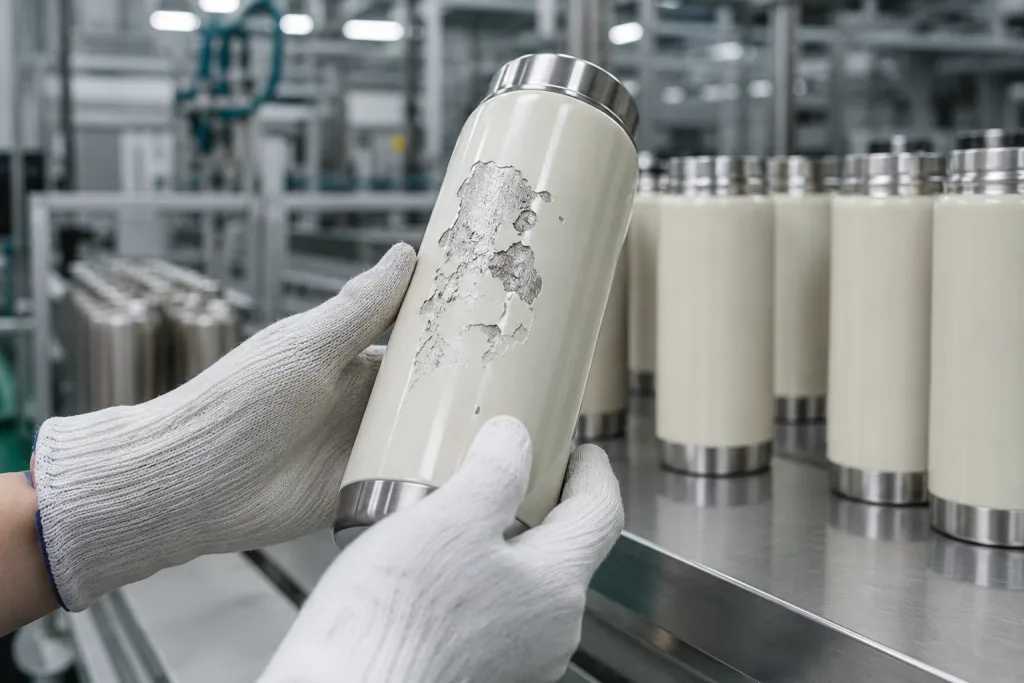
I’ll rewrite the section in-place, keep the HTML structure unchanged, and tighten the copy so it sounds like a factory-side sales engineer.Decoration is where a lot of custom thermos orders quietly fall apart. The sample looks clean, then the mass run shows ghosting, edge lift, or a logo that scratches off after normal handling. The root cause is usually cure time, surface prep, or a mismatch between coating and print process. A customized thermos with a laser mark behaves differently from a silk screen or UV print, so the spec has to name the method and the placement.
For promotional thermos orders, cut the decoration variables down. One logo, one side, one Pantone target, one finish. If the buyer wants mixed colors for a thermos promotional campaign, keep the art fixed and lock the substrate first. For powder coat, we ask for crosshatch adhesion testing and a 48-hour salt spray check if the item will go outdoors. For premium retail, ask for abrasion testing after 50 rub cycles or 1,000 scratch cycles, depending on the decoration method.
At BottleForge in Hangzhou, Zhejiang, our monthly output for stainless drinkware runs into the hundreds of thousands of units, but we still treat decoration as a separate process gate. QC pulled the sample at 48 hours, and that is where you catch a rushed cure before it turns into a claim. That is the difference between a factory thermos seller and a dependable thermos supplier. You want volume, and you want control.
Packaging kills margins in transit
I’ll rewrite the section in place, keeping the HTML tags and list structure intact, and I’ll tighten the language so it sounds like a factory-side sales engineer wrote it.Packaging is where bulk thermos margins get eaten in transit. The bottle passes QC, then shows up with lid scuffs, crushed corners, or a missing spoon because the packout was built for a showroom shelf, not a freight lane. We’ve seen buyers push back on this after a 1.2 m drop from the line cart shook loose a straw set. A thermos vendor shipping one unit in a thin white box may survive local delivery, but export cartons need stack strength, corner protection, and clean inner pack counts.
For ocean freight and mixed distributor thermos shipments, write the carton spec first, then the product spec. We run a 60 cm drop test on the master carton, and for heavier stainless lines we use a 5-layer export carton with a compression target the freight forwarder can actually stack. FBA needs its own check: barcode facing out, FNSKU match, case pack count right. The buyer flagged a PO typo once, and that one missing digit sent 240 cartons to the wrong label set.
A practical shipping spec for thermos bulk orders should include:
- inner box size and paper weight
- master carton quantity and gross weight
- pallet pattern for 40HQ loading
- humidity protection for long sea transit
Get the carton right, and the product lands in the warehouse without turning into a claims file. That’s the whole game.
Spec your thermos order before production starts
Send us your target price, capacity, and decoration plan. We’ll turn it into a production spec that protects your margin and your launch.
Frequently asked questions
What MOQ should I expect from a thermos distributor factory?
For a standard stainless thermos SKU, a realistic MOQ is usually 1,000 to 3,000 units per color or decoration setup. At a Zhejiang thermos factory, simple logo print can sometimes start at 1,000 units, while mixed-color or multi-decoration programs often need 3,000+ units to stay efficient. If you want a custom thermos with new tooling, expect a higher entry point, especially if the cap mold or cup body shape changes. The right question is not just MOQ, but MOQ per variant, because one extra lid color can split the lot and raise your unit cost by 8-15%.
How do I check if a thermos supplier can handle leak prevention?
Ask for the leak test method, not a vague promise. A solid thermos supplier should show inverted leak testing at 80°C water, torque control for the lid, and sample records by batch. For outdoor retail, we recommend testing at least 32 pieces per lot under AQL 2.5 for major defects, with 100% cap-fit inspection on the line if the design is new. If the factory only has a one-sample demo, that is a warning sign. Also ask whether the gasket is silicone and what Shore A hardness they use, usually 50-60 for reliable sealing.
What price range is normal for bulk thermos orders?
For a basic 500 ml stainless thermos, FOB China pricing can sit around USD 2.20 to 4.80 depending on steel grade, wall thickness, lid structure, and decoration. A more premium custom thermos with better finish, stronger vacuum control, or more complex packaging can rise to USD 5.50 to 8.50. Promotional thermos programs with simple print and standard box can stay closer to the lower end if the order is large enough. If someone quotes far below that range, check the steel thickness, coating quality, and whether the price excludes cartons or testing.
Can a customized thermos pass EU compliance for retail?
Yes, if the thermos manufacturer documents the right materials and testing. For Europe, you want REACH-related declarations, food-contact compliance, and traceability for stainless steel, silicone, and coatings. A good supplier should also provide batch records and retain samples. If you are selling through distributors thermos channels, keep the paperwork simple: material certificate, test report, and invoice/spec sheet that matches the shipment. Problems usually happen when the sample and mass production differ in coating or gasket material. Keep those locked in writing before production starts.
What lead time should I plan for a thermos bulk order?
For a standard bulk thermos order, expect 25-35 days after sample approval and deposit if the factory already has materials. If you need new tooling, new color matching, or large custom packaging, plan 40-55 days. A Zhejiang thermos factory with stable capacity can often produce around 300,000 to 500,000 units per month across multiple lines, but your specific SKU still depends on decoration and packing complexity. Sea freight to North America or Europe adds another 20-40 days, so build the schedule backward from your retail or promo launch date.