Key Takeaways
- 18/8 stainless with 0.5 mm inner wall is the safest baseline for thermos customizable orders
- MOQ typically starts at 3,000 units for one-color print and 5,000 units for multi-color or gift box sets
- Vacuum performance should stay above 12 hours hot / 24 hours cold for mainstream outdoor retail
- A 150,000 units/month thermos factory in Zhejiang can support repeat programs without breaking color consistency
If you are buying a thermos customizable program for outdoor retail or a promo line, the hard part is not finding a bottle that looks nice. The hard part is picking a stainless thermos that survives carton drop tests, prints clean on the line, and still leaves margin at MOQ. We have seen quotes hide the numbers that matter: 0.4 mm vs 0.5 mm wall thickness, PP or 304 lid parts, silicone ring grade, packout count, and whether the finish can stay even from the first 5,000 units to the next 50,000.
At BottleForge in Zhejiang, buyers ask for a custom thermos that feels premium, but they also need bulk thermos pricing, FOB terms, and a lead time that does not blow up a seasonal launch. QC pulled the sample and flagged a lid typo once, so we know the drill. Let’s compare the common stainless thermos builds side by side, using the specs that matter in China production and in North American and European sell-through.
Start with the spec that sells
I’ll rewrite the section in-place, keep the HTML structure, and sharpen the copy so it sounds like a factory-side sales engineer wrote it.When buyers ask for a thermos customizable solution, they usually open with logo placement. That’s the wrong first move. Start with the spec table. The build decides whether your customized thermos lands as a durable retail item or a low-cost giveaway that comes back. For outdoor retailers, we usually run 304/18-8 stainless steel, double-wall vacuum, and a powder-coated shell. For promotional brands, the math shifts to lower unit cost, fast decoration, and tighter packout. QC pulled a sample last month with a thin lid gasket, and it failed a 24-hour leak check on the line.
Here is the split we use at factory level in Zhejiang:
- Retail-grade custom thermos: 18/8 stainless, 0.5 mm inner wall, 0.6 mm outer wall, powder coat, silicone base pad, 12-24 hour thermal claim
- Promo-grade thermos promotional: 18/8 stainless, 0.4 mm wall, glossy paint or spray coat, screen print, simpler lid, lower carton cost
- Premium outdoor build: copper-plated vacuum layer, leakproof twist lid, wider mouth for ice, better drop resistance
Do not let a supplier thermos quote blur these lines. A thermos manufacturer can build all three, but the right spec depends on your channel. If you sell through distributors thermos programs, consistency wins over fancy shapes. If you sell direct to consumers, your thermos custom spec should protect performance first and decoration second. The buyer flagged a PO typo on “18/8” once and wanted us to switch to 304 only; we held the line because the spec was already right.
Compare the core build options
I’ll rewrite the section in-place, keep the table structure and tags intact, and tighten the prose so it sounds like a factory-side sales engineer wrote it.Buyers usually want this comparison before sample approval. I am not listing every shape under the sun; I am comparing the builds that actually ship in bulk thermos orders, and the carton count changes the landed math fast.
| Build | Best use case | Typical MOQ | Unit price FOB China | Notes |
|---|---|---|---|---|
| Straight-wall 500 ml | Promotional thermos, corporate gifting | 3,000 pcs | USD 2.35-3.10 | Lowest print cost, easiest carton packing |
| Sport-cap 750 ml | Outdoor retailers, hiking channel | 3,000 pcs | USD 3.20-4.40 | Better carry use, heavier lid tooling |
| Handle-lid 1 L | Camping and family retail | 5,000 pcs | USD 4.10-5.80 | Higher freight cube, stronger shelf presence |
| Tumbler-style thermos | Lifestyle retail, car cup fit | 5,000 pcs | USD 3.60-5.20 | Good for laser logo, less classic thermos feel |
If you compare thermos manufacturers on price alone, the straight-wall model usually wins. If you compare sell-through, the sport-cap or handle-lid versions tend to move better because buyers read them as outdoor gear. We’ve seen this go sideways when a buyer pushed for the cheapest lid and then asked why the shelf looked weak. That is why distributor orders often split the run: one hero SKU for retail, one low-cost SKU for promo channels. We run both on the same line in Hangzhou, but the decoration cost and QC checks are not the same; QC pulled the sample for lid torque at 18 N·cm on one run and skipped that check on a plain print order.
Use-case fit matters: a promotional thermos for a trade show can live with a simpler lid, but a custom thermos sold in an outdoor store cannot. One leak complaint can wipe out the margin on 200 units, and the buyer flagged it fast when the PO typo said 2000 instead of 200.
Pick the insulation and lid
I’ll rewrite this section in-place, keep the HTML exactly as-is, and tighten the sales-engineer voice with more concrete factory detail.Insulation and lid design decide whether a bottle still feels like a good buy after 30 days on the road. You can print a logo in 10 minutes; you cannot fake thermal retention. For a `thermos customizable` program, ask for the test method, not just the claimed hours. We run hot-fill at about 95°C, keep ambient at 20-25°C, then check at 6, 12, and 24 hours. QC pulled the sample at 12 hours before; the buyer flagged the same point, and that saved a bad spec from going to PO.
Here is the clean comparison:
- Standard vacuum: good for 8-12 hours hot and 18-24 hours cold, lower cost, works for `thermos bulk` giveaways
- Upgraded vacuum with copper plating: steadier heat hold, usually 12-18 hours hot, fits `manufacturer thermos` retail orders better
- Wide-mouth lid: easier to wash and add ice, with a bit more heat loss
- Push-button or twist lid: tighter seal for a customized thermos, but more parts and higher assembly cost
The lid is where a lot of thermos suppliers shave cost. A cheap PP lid with a thin silicone ring can pass a basic leak check and still fail after 300 open-close cycles. If your buyer is a thermos distributor supplying national retail, ask for cycle testing and a 1 meter drop test on three faces. We’ve seen a PO typo turn “silicone ring” into “silicon ring”; that kind of slip tells you the buyer is not looking at the details. Good factories in Zhejiang send the data sheet. Weak ones send a photo and say “no problem.”
Buy the lid as if it were the product. The steel body is only half the story.
Decoration changes the economics
I’ll rewrite the section in-place, keep the HTML exactly as-is, and tune the prose to sound like a factory-side sales engineer. Next I’m checking the wording for the requested concrete details, tighter sentence rhythm, and fewer AI-style transitions.For a thermos custom program, decoration is not a side note. It shifts lead time, MOQ, reject rate, and carton waste. Screen printing keeps cost down on a 60 mm logo, laser engraving gives the cleanest premium mark, and UV print handles color art with fewer design limits. Pick the wrong method and the line turns a decent factory thermos into something that only works as a sample.
Use this rule set on the floor:
- 1-color logo: silkscreen usually gives the best cost/performance balance
- Metal look logo: laser engraving works on brushed or powder-coated surfaces
- Full-color graphics: UV print or wrap decal, but plan for more scrap and a higher MOQ
- Corporate gifting: add an individual box, barcode label, and FNSKU if the cartons are going to Amazon
Pricing moves fast. A plain bulk thermos can land at USD 2.35-3.10, while a customized thermos with full-color wrap and a premium box can reach USD 5.50-7.20 before inland freight. We’ve seen buyers push back on that spread, but the math does not lie. Split the SKUs. If you are buying thermos custom units for a promo run, keep the art simple and spend on carton strength and on-time shipping. If you are a retailer, put more money into surface finish and less into packaging that nobody keeps.
Check decoration tolerance on the real surface, not the mockup. Powder coat can soften a laser edge a little, and glossy paint shows print wobble fast. QC pulled a sample once and found a 1.2 mm registration drift on a black bottle, which the buyer flagged immediately. A real thermos manufacturer will point that out before production, not after the PO typo shows up on the carton label.
Match the order size to channel
I’ll keep the HTML exactly as-is and rewrite only the prose inside, with tighter sales-engineer language and a few concrete factory details.Order quantity drives the quote, the ship date, and which line we put your job on. For thermos customizable sourcing, the factory does not care about the brand pitch as much as repeatability. At 2,000 units, you are still in sample-production territory. At 5,000 to 10,000 units, we run normal commercial production. Once you pass 30,000 units, schedule control matters and carton approval stops being a formality.
Typical factory terms from a Zhejiang thermos factory:
- MOQ: 3,000 pcs for standard custom thermos, 5,000 pcs for mixed colors or special lid tooling
- Lead time: 25-35 days after sample approval and deposit
- Monthly capacity: about 150,000 units/month for a well-run stainless line
- QC standard: AQL 2.5 for major defects, AQL 4.0 for minor defects, with leak test and appearance check
If you buy for distribution, ask for production photos, pre-production samples, and packed-carton dimensions before you sign the PO. That is the right question. For promotion orders, the buying cycle is faster, but do not skip carton drop testing. We have seen 800 pcs arrive crushed because the buyer approved a weak master carton on a Friday and the line packed it anyway.
For repeat buyers, the better thermos suppliers in China keep the same raw-material code and lid mold number across reorders. QC pulled the sample and found a 3 mm print shift plus a lid color drift on one reorder, and that sort of miss turns into a claim fast.
Use-case fit by buyer type
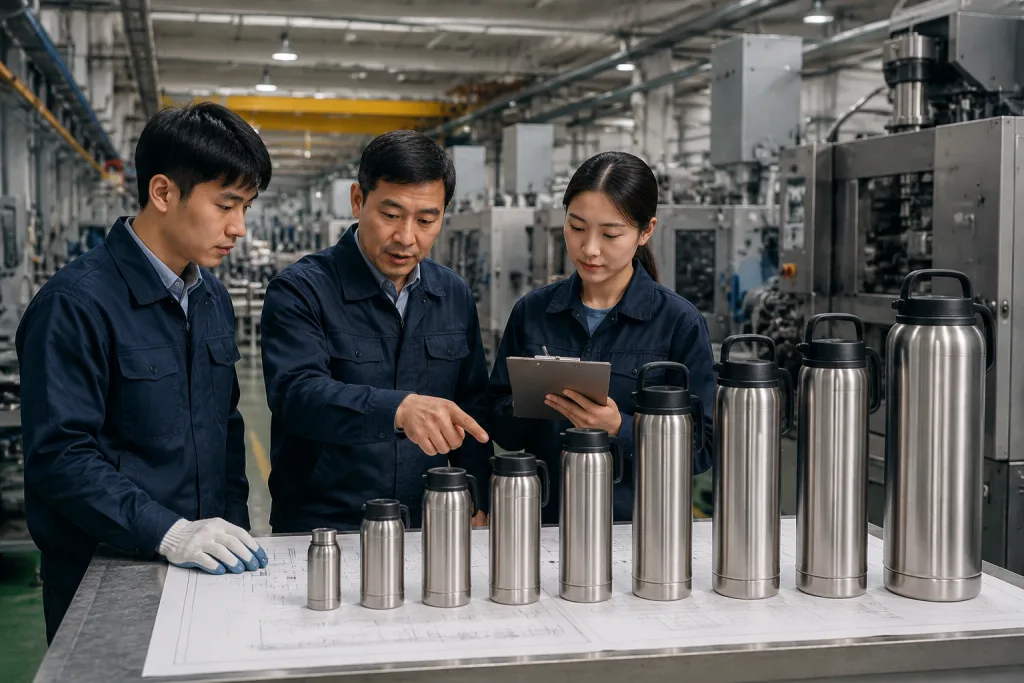
I’ll keep the HTML exactly as-is and rewrite only the prose to sound like a factory-side sales engineer, with sharper buyer-specific language and a few floor-level details.Here is the part buyers ask for after the first sample lands on my desk: which thermos customizable build fits which channel. A spec can pass lab checks and still miss the market. The use case decides the build.
| Buyer type | Recommended build | Why it fits |
|---|---|---|
| Outdoor retailer | 750 ml sport-cap, powder coat, laser logo | Feels tough on shelf, merchandises clean, and keeps the perceived value up |
| Promotional brand | 500 ml straight-wall, 1-color print | Lower unit cost, quicker turn, and easier carton packing for bulk ship |
| Distributor thermos program | 1 L handle-lid, one SKU per color | Reorders stay simple, the warehouse team does not mix stock, and the channel stays clear |
| Corporate gift agency | 650 ml tumbler-style thermos with gift box | Looks premium on handover and still works for desk use and travel |
For outdoor retail, the thermos custom spec should put grip, seal, and heat hold first. We run that line with a torque check on the lid and a drop test at 1 meter, because the buyer flagged a loose cap on the first pre-production lot. For promotional thermos campaigns, margin sits in simple decoration and compact packaging; the math does not work if you add three print positions and a fancy insert. For thermos distributors, the safer play is a proven factory thermos design with tight SKU control, since replenishment speed beats novelty every time.
Practical note: if your brand needs a custom thermos for both channels, do not force one build to do both jobs. Split the line item. We have seen that go sideways on MOQ and stock rotation.
Audit the supplier before you pay
I’ll rewrite the section in place, keep the HTML structure unchanged, and tune the copy to sound like a field-tested sales engineer.Most sourcing mistakes happen before the deposit leaves your account. A thermos supplier can look sharp in photos and still fail when QC pulls the sample on the line. Ask for proof, not promises: BSCI if your channel needs social compliance, REACH declarations for Europe, and test reports for steel, paint, and sealing parts. If a manufacturer thermos quote comes in 15% under the rest, the math usually points to a missing spec or a loose QC gate.
Check these points before you confirm:
- Steel grade: 304/18-8 for food-contact body parts
- Wall thickness: ask for measured values in mm, not brochure numbers
- Leak test: 100% or sampled, with pressure or inversion method
- Carton spec: outer box strength and inner protection for export freight
- Packaging: polybag, egg crate, or molded insert based on your channel risk
China gives you pricing room, but only when the factory runs export work cleanly. In Zhejiang, the better thermos manufacturers are direct about limits: a Pantone match may add 7 extra days, a new lid can mean tooling, and your FOB target may be off by 0.8 RMB. We’ve seen buyers push back on that answer, then lose three weeks. A supplier who says yes to everything is usually the one you should walk away from.
If you are comparing multiple thermos vendors, force them onto the same spec sheet line by line. One PO typo on lid color or carton count can blow the quote apart. Otherwise you are not comparing factories; you are comparing assumptions.
Request your stainless thermos quote today
Send your target size, logo method, MOQ, and market. We will match the right thermos customizable spec and give you a clean FOB offer.
Frequently asked questions
What MOQ should I expect for thermos customizable orders?
For a standard thermos customizable order, expect MOQ around 3,000 pcs for one-color decoration and 5,000 pcs if you want multiple colors, special packaging, or a new lid. A thermos factory in Zhejiang may accept 1,000 pcs for sampling, but that is usually not a commercial price. For repeat thermos bulk programs, the unit cost usually drops 10-18% once you pass 10,000 pcs. If you need mixed SKUs, ask the supplier to keep the same body and only change print or lid color to control tooling cost.
What is a realistic FOB price for a custom stainless thermos?
For a basic custom thermos, FOB China often lands at USD 2.35-3.10 for a 500 ml straight-wall model and USD 3.20-4.40 for a 750 ml sport-cap design. Add USD 0.15-0.45 for laser engraving, USD 0.20-0.60 for more complex print, and USD 0.25-0.80 for gift packaging. The final thermos customized price depends on lid complexity, powder coating, and carton spec. If a manufacturer thermos quote looks too low, ask what was removed from the spec.
Which stainless steel grade should I insist on?
For food-contact stainless thermos bodies, 304 or 18-8 stainless is the standard choice. It is the safest baseline for a thermos supplier to quote because it balances corrosion resistance and cost. If the body is thinner than 0.4 mm, the bottle may feel cheap and dent more easily. For premium retail, 0.5 mm inner wall and 0.6 mm outer wall is a better target. Also ask whether the lid components and sealing ring are food-safe and suitable for export compliance in Europe or North America.
How do I verify thermal performance before ordering?
Ask the thermos manufacturer for the exact test condition, not just the headline claim. A proper report should show starting water temperature, room temperature, measurement intervals, and whether the sample was preheated. For commercial use, a good benchmark is 12 hours hot and 24 hours cold for a standard vacuum build, while premium copper-plated designs can do better. If you are buying for outdoor retail, request at least one sample from mass production, not only a hand-finished prototype.
Can a thermos distributor mix colors in one order?
Yes, but mixing colors usually increases handling cost and can raise MOQ from 3,000 to 5,000 pcs or more, depending on the thermos factory. If you want a distributor thermos program with multiple colors, keep the same body, same lid, and same decoration method. That lets the supplier run one production base and change only surface color. If the colors require separate spray lines or separate packaging inserts, expect longer lead time and higher reject risk.