Key Takeaways
- 18/8 stainless with 0.4-0.6 mm inner walls is the practical baseline for retail-grade thermos custom orders
- Typical MOQ starts at 3,000 units per design, with lead time around 25-35 days after sample approval
- A vacuum thermos with PP lid usually costs USD 2.10-3.80 FOB, while a premium powder-coated build can reach USD 4.20-6.50
- For promotional thermos programs, simple 1-color print beats laser on speed; for distributor thermos orders, laser engraving reduces brand wear
If you are buying thermos custom for outdoor retail or a promo run, the wrong spec gets expensive fast. A 500 ml bottle can look clean on a sample sheet and still miss a 4-hour hot hold, chip the print after 30 dishwasher cycles, or crack a cap insert after 10,000 open-close tests. We see that on the line in Zhejiang all the time. The buyer flagged the artwork first; QC pulled the sample later and found the real issue was steel grade, wall structure, lid fit, and how the bottle takes a drop test after packing.
This guide compares stainless thermos formats side by side so you can match the bottle to the job. If you are sourcing bulk thermos, you need more than a nice render. You need a manufacturer thermos partner that can quote FOB, keep MOQ at a workable level, and tell you why one customizable thermos fits hiking retail while another is the better promotional thermos for a trade show. We run about 300,000 units a month in Hangzhou, Zhejiang, and the math changes fast once you compare North America and Europe shipping specs.
Which thermos spec wins each job
I’ll rewrite the section in-place, keep the HTML structure intact, and tune the prose to sound like a factory-side sales engineer.Buyers skip this part too often: each thermos format wins a different job. We see it on the line all the time. If the bottle goes to outdoor retail, it has to take pack rub, 15°C swings, and repeat use without denting. If it goes through promo channels, the unit price has to stay tight, decoration has to move fast, and the lid needs to be simple enough for a PO clerk to type without a back-and-forth. That is why a side-by-side spec table beats a generic catalog page.
| Spec | Retail fit | Promo fit | Distributor fit |
|---|---|---|---|
| 500 ml straight-wall vacuum thermos | Strong | Good | Strong |
| 750 ml slim thermos | Strong for hiking | Weak | Good |
| 1,000 ml wide-mouth thermos | Best for camping | Weak | Moderate |
| Single-wall stainless bottle | Weak | Strong for low cost | Moderate |
For most outdoor retailers, a 500 ml or 750 ml custom thermos with 304 stainless steel and powder coating is the safer commercial pick. The 500 ml version usually comes in at about 9-10 inches tall, so it sits better on shelf and keeps carton loading tight. A 1,000 ml body gives more shelf appeal, but the math changes fast: more steel, more carton volume, and sometimes a new mold. The buyer flagged a 1,000 ml quote from us once because the lid spec and carton size made freight jump by 12% on the same lane. The smallest bottle that still covers the daily-use target usually wins. That is where a lot of thermos quotes go sideways.
Use a simple rule. For commuting and trail daypacks, stay with 500-750 ml. For campsite use or jobsite hydration, move to 1,000 ml. For a fast-turn promotion, keep the structure plain and the decoration clean. A custom thermos does not need a complicated lid when the campaign only runs 6 months. QC pulled the sample on one promo job because the cap had three extra parts; the buyer wanted one-piece assembly and faster packing, and they were right.
Stainless steel grades and wall build
I’ll rewrite the prose only, keep the HTML exactly as-is, and tighten the wording so it reads like a factory-side sales engineer wrote it.For stainless thermos sourcing, the steel spec matters more than the brochure copy. We run 304 stainless on the inner and outer wall as the standard build. It gives corrosion resistance, food-contact confidence, and stable forming on the line. If a buyer wants a higher-end position or stronger chemical resistance, 316 works, but it adds cost and most thermos custom programs do not need it.
Wall thickness is where a lot of factory thermos claims get slippery. On most vacuum bottles, the inner wall runs about 0.4-0.6 mm and the outer wall about 0.4-0.5 mm. Go thinner and you get dents plus higher scrap. Go thicker and the bottle gets heavy and the price climbs without a real performance gain. A proper manufacturer thermos quote should show the gauge, not just say “premium steel.” QC pulled the sample twice on one job because the PO typo listed 0.5 mm on both walls, and the real build did not match.
For outdoor retail, I would take a clean 304 body at 0.45 mm over a vague “heavy-duty” build with no thickness data.
Finish consistency matters in distribution. Powder coating, spray paint, and brushed metal behave differently in transit. Powder coat hides small tooling marks better and gives stronger scratch resistance for thermos bulk programs. Brushed stainless looks sharp, but it shows handling marks faster. If you sell to premium retail, that can work. If the buyer flagged a store display that gets tossed around, powder is the safer call.
Lids decide the complaint rate
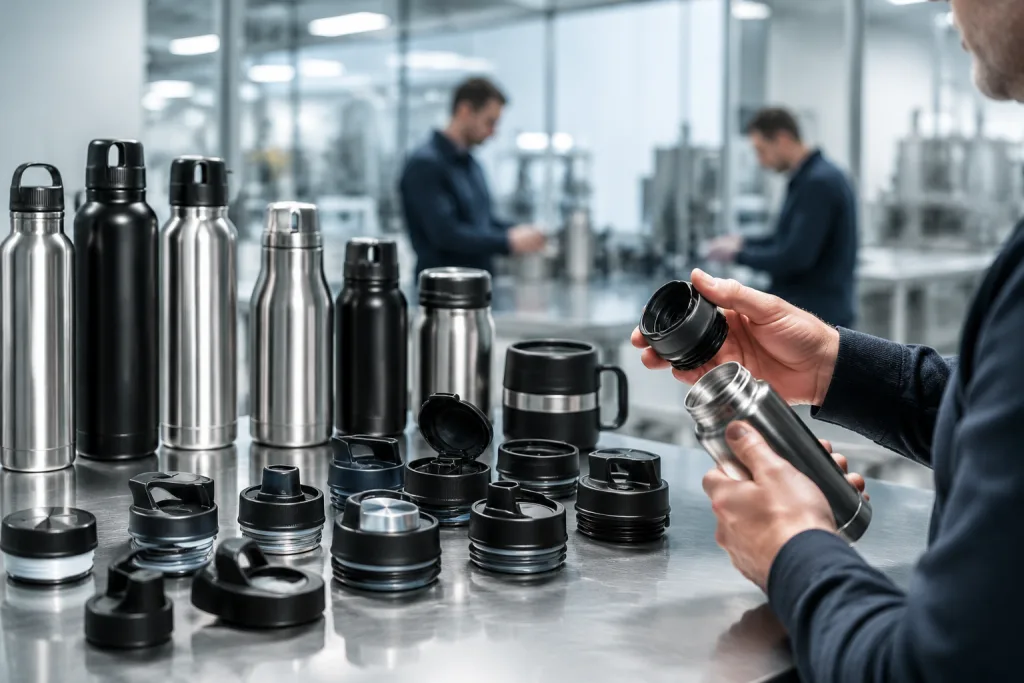
I’ll rewrite the section in place, keep the HTML exactly as-is, and tighten the copy so it sounds like a factory sales engineer wrote it.If a thermos distributor comes back with a leak complaint, the lid is usually where we start. The bottle body can pass, but the closure still decides the customer’s mood. For thermos custom jobs, we run three lid families most often: screw-top, push-button, and wide-mouth cap. Each one changes the complaint rate, carton damage risk, and after-sales load.
- Screw-top lid: Lowest leak risk, simplest sealing path, and the easiest choice for distributors who want stable shipping results.
- Push-button lid: Better day-to-day convenience, but it has more parts, more assembly steps, and a higher complaint risk if the gasket is off by even 0.2 mm.
- Wide-mouth cap: Good for camping and soup use, but it looks less polished for office gifts or brand campaigns.
For outdoor retailers, screw-top and push-button lids usually move faster because buyers connect them with leak resistance and easy cleaning. For promo brands, the lid has to work in one short instruction line. If the buyer flagged a demo on the PO, the math does not work for bulk handouts. A thermal bottle that still opens with gloves on also sells better in winter sports and jobsite channels.
We test lids for torque, seal integrity, and cycle life. Our normal target is 5,000-10,000 open-close cycles, depending on the price point. QC pulled the sample and checked the gasket under a caliper; food-grade silicone passed, generic rubber did not. If a thermos supplier cannot name the gasket material, the quote is incomplete. That is usually the first clue you are talking to a trading company, not a real thermos factory.
Decoration methods change your margin
I’ll rewrite the section in place, keep the HTML unchanged, and tune the prose to sound like a factory-side sales engineer.Decoration is not just branding. It changes unit margin, line speed, and how the buyer reads the bottle in hand. For thermos custom orders, the main methods are screen print, laser engraving, heat transfer, and full-color wrap. Each fits a different channel; we run them for different price points.
Screen print is the cleanest path for bulk thermos orders when you need one logo, one color, and a tight budget. It goes fast and usually adds about USD 0.20-0.45 per unit, depending on logo size and color count. Laser engraving costs more up front, but it holds up on a 304 stainless body. QC pulled the sample after a 1,000-rub test, and the mark was still clean, which is why distributor thermos and outdoor retail buyers keep asking for it.
Heat transfer and wrap graphics fit seasonal campaigns or a customized thermos where the shelf look does the selling. They are not the cheapest route. Still, they make sense when the artwork carries the order. A factory thermos partner in Zhejiang should show you the print-height layout before you confirm, because a 3 mm shift can change yield across 5,000 units. The buyer flagged this on a PO last month, and the math did not work.
One practical point: if you need speed, keep the artwork simple. A single-color logo on a matte bottle usually makes more money than a full-wrap design that needs extra handling. For thermos manufacturers selling into Europe and North America, simpler decoration also cuts the risk of color mismatch and AQL inspection rework. This is the wrong question to ask if you start with “how fancy can we make it?”
MOQ, pricing, and lead time reality
I’ll keep the tags intact and rewrite the prose with sharper factory-floor detail, tighter numbers, and a more natural sales-engineer tone.Let’s put the numbers on the table, because this is where a lot of thermos suppliers get slippery. For a standard stainless custom thermos, a workable MOQ is usually 3,000 units per color or per design. We have seen 1,000-unit quotes, but the unit price jumps so much that the “small trial” stops making sense. For distributors running thermos programs, 500 units is the wrong question to ask; the line is built around repeat volume, not one-off experiments.
At the Zhejiang factory level, a normal FOB China range looks like this: a plain 500 ml vacuum thermos at USD 2.10-3.20, a powder-coated mid-range bottle at USD 2.80-4.10, and a premium or more complex model at USD 4.20-6.50. Branding may add USD 0.20-0.80, depending on screen print, laser, or UV transfer. Last month QC pulled a sample with a lid typo on the carton mark, and that tiny mistake would have cost a buyer a rework round. If your supplier says the bottle is “cheap” but skips packaging, carton count, and testing charges, the final invoice will not match the first quote.
Lead time is usually 25-35 days after sample approval and deposit for regular production. If the project needs new molds, a special cap, or color matching, plan on 35-45 days. The bottle body is rarely the bottleneck. It is usually the lid assembly, coating cure, and the QC queue at the line. A practical thermos distributor should ask for production lead time and packing lead time separately, because retail-ready boxing can add 3-5 days.
For North America, budget for carton labels, barcodes, and sometimes FNSKU prep if the order goes into Amazon channels. For Europe, confirm REACH material declarations and ink compliance before shipment. We’ve seen this go sideways when a buyer flagged the pallet label format two days before ETD. A thermos quote that ignores compliance is not a complete quote.

Quality checks that protect your brand
I’ll rewrite the prose only, keep the HTML exactly as-is, and sharpen it with factory-floor detail plus cleaner sales-engineer tone.You do not need a lab to avoid bad thermos custom orders, but you do need a tight QC plan. Set the inspection standard before production starts. For bulk orders, AQL 2.5 for major defects and 4.0 for minor defects is common in consumer drinkware. That gives both sides a clear pass or fail line.
Ask the thermos team to check vacuum retention, leak test, coating adhesion, logo durability, carton drop test, and odor control. We run those checks on the line with a simple 500 ml fill test and a 24-hour leak rack, because hand-waving here is a bad bet. For hot and cold performance, buyers usually want 6-12 hours of usable temperature retention depending on size and lid style. Do not promise 24-hour performance unless the test method and lab conditions are clear. A real manufacturer should state the test temperature, fill ratio, and lid closure method.
Shipping damage matters too. A solid outer carton saves you headaches on long sea freight routes from China to the US or Europe. Double-wall master cartons, dividers, and polybags sound basic, but they cut paint rub and dent claims. We had one buyer flag a 2 mm carton gap at the corner tape seam, and that tiny typo on the PO turned into a dock dispute. If you are running a thermos promotional campaign with high sticker volume, even a 1% damage reduction can protect margin across tens of thousands of units.
One thing I would never skip is pre-production sample approval. It should lock the final logo placement, pantone reference if needed, lid color, and packaging mockup. QC pulled the sample on a 304 stainless order last month and found the logo 3 mm off-center; that is the kind of miss that becomes expensive later. Without approval, “approved sample” arguments go nowhere.
Send your spec and get a real quote
We’ll price your thermos custom project by lid, coating, print method, MOQ, and packing so you can compare China options properly.
Frequently asked questions
What MOQ should I expect for thermos custom orders?
For most stainless thermos custom programs, 3,000 units per design is the practical starting point. Some thermos suppliers can do 1,000 units, but the price usually rises by 15-30%, which makes the order less useful for distribution. If you want mixed colors, ask whether the MOQ is per color or total. For promotional thermos runs, a 3,000-unit MOQ normally gives you a better FOB price and more stable decoration setup than a tiny trial order.
What is a realistic FOB price for a custom thermos?
For a standard 500 ml vacuum thermos from a China factory, FOB pricing often lands around USD 2.10-3.20. A powder-coated or more premium custom thermos can run USD 2.80-4.10, and a more complex build may reach USD 4.20-6.50. Decoration usually adds USD 0.20-0.80. If a supplier thermos quote looks unusually low, check whether it excludes printing, inner packaging, or compliance documents.
How long does thermos bulk production take?
After sample approval and deposit, normal lead time is 25-35 days. If you need a new lid mold, special coating, or custom packaging, plan for 35-45 days. In Zhejiang, China, the actual bottleneck is often coating and assembly rather than the bottle shell itself. For seasonal retail, lock the spec early so your distributor thermos shipment is not delayed by artwork revisions or carton approval.
Which decoration method is best for promotional thermos orders?
Screen print is usually best when you want low cost and fast production. It works well for a single logo on a promotional thermos and can add only USD 0.20-0.45 per unit. Laser engraving is better for premium brand programs because it lasts longer and resists wear, but it costs more. If your campaign runs through distributors or retail, choose the method that matches how the bottle will be used, not just how it looks in a mockup.
What certifications should I ask for from thermos manufacturers?
Ask for material declarations and test reports aligned with your market: REACH for Europe, food-contact declarations where applicable, and any local compliance documents your importer requires. For the US, many buyers also want carton and barcode prep for FNSKU if the product enters Amazon. A serious thermos manufacturer should also support AQL inspection, leak testing, and vacuum retention reports. If the answer is vague, the supplier thermos setup is probably incomplete.