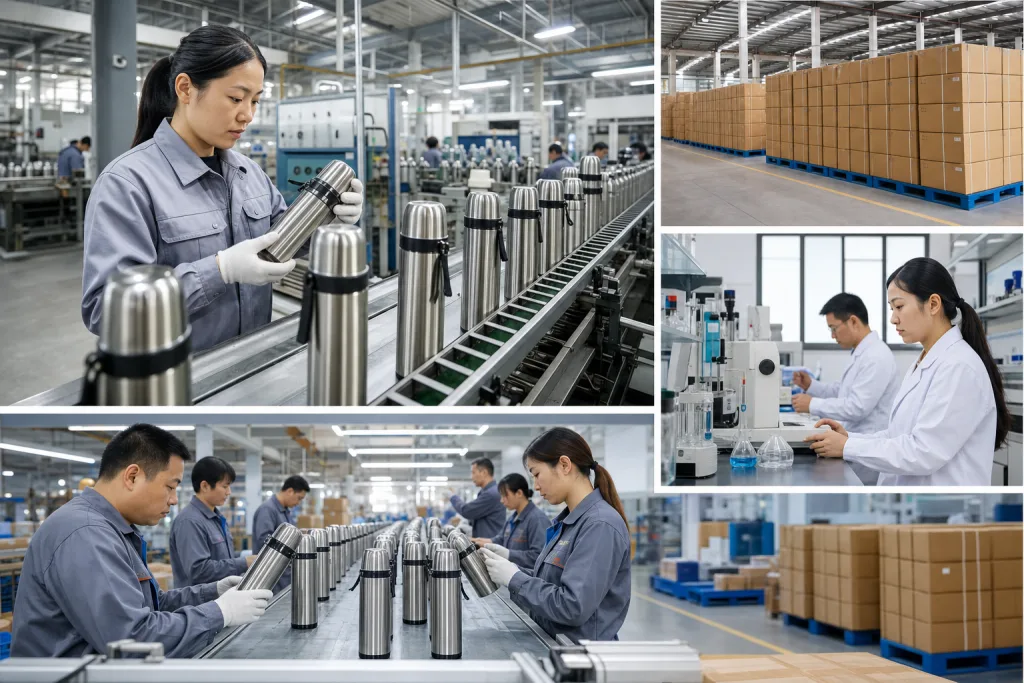
Key Takeaways
- Most thermos bulk orders land at 1,000 to 3,000 units MOQ, with simpler stock models available from 500 units.
- A custom thermos with laser logo and kraft box usually adds USD 0.35 to 1.20 per unit over plain bulk thermos pricing.
- Typical lead time from approved sample to ship-ready order is 25 to 40 days; full custom decoration can push it to 45 days.
- A Zhejiang thermos factory running 300,000 units per month can usually quote faster and hold tooling better than a small trading desk.
If you are buying thermos bulk for outdoor retail or a promo run, do not ask for price first. Define the bottle first. A 500 ml double-wall stainless model with powder coat, laser logo, and gift box is a different order from a plain vacuum flask with one-color print. We see the gap every week: one small change in Zhejiang can move landed cost by 8% to 30%.
Smart buyers treat thermos sourcing like a cost-and-timeline job, not a catalog job. You need the unit price drivers, the MOQ breakpoints, and the days each step adds. We run quotes off steel grade, wall construction, test standard, packing, and lead time. If a supplier leaves those out, QC pulled the sample and the math does not hold.
What actually changes the unit price
I’ll rewrite the section in-place, keep the HTML and list structure intact, and make the pricing logic sound like factory-side sales copy.For thermos bulk buying, unit price is never driven by one line item. We run it as a stack. Start with the bottle body: 304 stainless steel, a 0.4 mm inner wall, and a 0.5 mm outer wall is a common commercial spec. Switch the inner liner to 316, and the quote usually jumps 8% to 15%. Add copper plating in the vacuum layer, and the cost climbs again because the cycle slows and scrap goes up on the line.
Then check the parts. A PP lid costs less than a stainless lid. A silicone ring with tighter compression tolerance costs more than a loose fit, and the buyer flagged it for a reason: leaks kill repeat orders. Powder coating, UV print, and laser engraving all land at different price points. For a custom thermos, decoration alone can move the unit price from USD 0.20 to USD 1.00. Packaging does the same. A plain white box is one number; a printed retail box with barcode label and insert card is another. We’ve seen POs with the wrong box type turn a clean quote into a mess.
- Steel grade: 304 vs 316 changes base cost and corrosion resistance.
- Capacity: 350 ml, 500 ml, and 750 ml use different amounts of steel and insulation space.
- Decoration: one-color silk print usually costs less than full-wrap UV.
- Packing: bulk pack, color box, or mailer-ready set changes labor and carton cost.
If you compare a thermos supplier quote from China with one from another region, check whether the build matches line by line. This is the wrong question to ask if the spec sheets are different. A quote without the same steel, lid, finish, and packout is not a fair comparison. In Zhejiang, we quote by structure, not by photo, because a thermos customized for retail can turn into a different SKU in production and shipping.
MOQ tiers that make sense
I’ll rewrite the section in-place, keep the HTML structure unchanged, and make the copy sound like a factory-side sales engineer wrote it.MOQ is where buyers burn days. A thermos distributor may talk flexibility, but on the line we still have to run lids, body forming, vacuuming, coating, and packing in batches. For stainless thermos sourcing, the workable MOQ usually lands in three tiers. At 500 units, you are mostly choosing stock shapes with a limited logo process. At 1,000 to 3,000 units, we can usually open custom color, custom box, and one or two decoration methods. At 5,000 units and above, a thermos manufacturer usually gives better unit pricing, tighter carton loading, and more room for lid or packaging changes.
The math is simple. A screen print setup, packaging plate, or color match batch gets paid once. Split that over 500 units and the unit cost jumps fast. Spread it over 3,000 units and it settles down. We had a buyer flag a PO typo once—“5000” turned into “500”—and QC pulled the sample back before production started. That is why a thermos bulk order often looks overpriced at 500 units and makes sense at 2,000 units.
Practical rule: if your logo, color, and box are all custom, target at least 1,000 units. If you only need a branded lid and stock box, 500 units can work.
For outdoor retailers, a split color order can work. Two colors in one size is fine if the factory agrees to split the run, but each color still has to clear the coating batch minimum. We run this with a 300 pcs-per-color limit on some lines, and the buyer has to lock it early. Ask before sample approval; changing it later adds 2 to 4 days and sometimes a surcharge. This is the wrong question to ask after the sample is signed off.
Lead time from sample to ship
I’ll rewrite the section in place, keep the HTML exactly intact, and tighten the sales-engineer tone with concrete factory details and timing.Lead time is where sourcing plans blow up. A workable schedule for a customized thermos starts with sample sign-off. Stock samples take 3 to 5 days if the 500 ml body already sits on the shelf. If you need a new mold, add 10 to 15 days before approval, and QC pulled the sample again if the cap torque was off by 1 mm. Once the sample and artwork are confirmed, production usually runs 20 to 30 days for a normal 1,000 to 3,000 unit order. Add 5 to 10 days if the order has custom packaging, multi-step decoration, or a tighter AQL 2.5 check. That is the real calendar.
That puts a normal project at 25 to 40 days from PO to ship. A more complex promotional thermos order, especially gift sets or multi-Pantone printing, can hit 45 days. If a thermos factory says 12 days for a fully customized run, the math does not work. We’ve seen that story go sideways: they were quoting only the body line, or they were skipping vacuum testing, carton drop checks, or both. The buyer flagged it on the PO too, because the packing list still showed plain cartons.
- Stock sample: 3-5 days.
- Custom sample: 5-7 days.
- New tooling/sample: 10-15 days.
- Mass production: 20-30 days.
- Inspection and packing buffer: 3-7 days.
For a thermos distributor serving seasonal outdoor channels, timing beats a small price cut. Miss the spring push or the Q4 window, and the lost sell-through hurts more than a $0.20 difference. We run this in Zhejiang every week: no approved artwork, no deposit, no final carton data, no packing. Simple. The line waits until those three items are locked, because a typo on the carton spec can stall shipment for a full day.
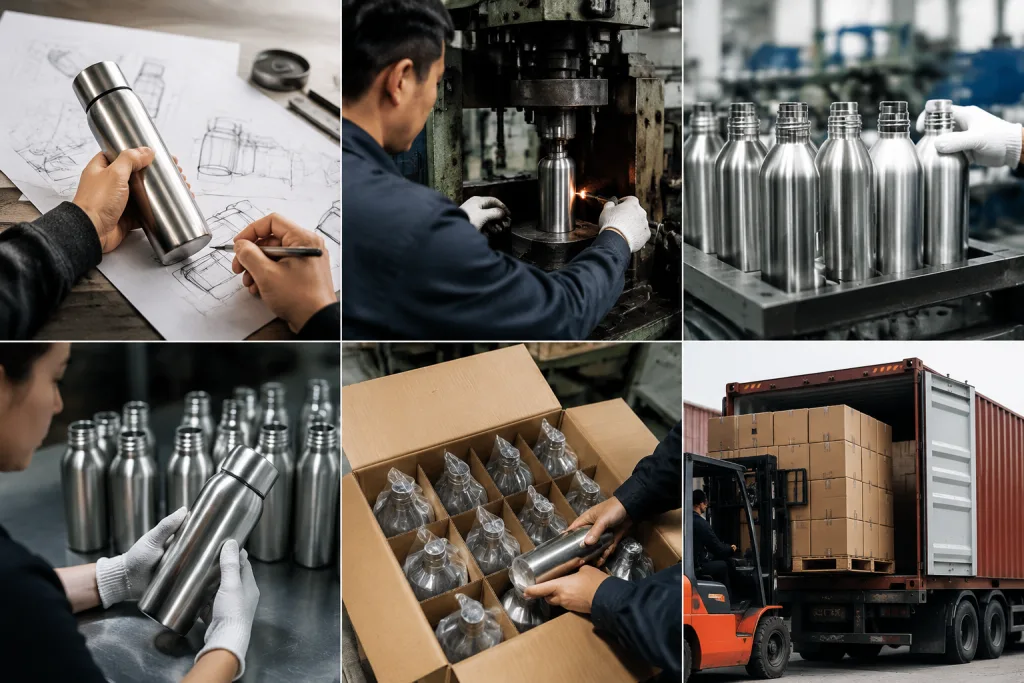
Cost drivers you should ask about
I’ll keep the HTML exactly as-is and rewrite only the prose, with tighter sales-engineer language and a few concrete factory-floor details.When you talk to a thermos supplier, do not start with the lowest price. Ask what is inside the number. What bottle spec, what surface finish, what logo method, what box, what carton count, what test standard. On our line, we split product cost from freight, tooling, and packaging in the first quote; if a supplier hides those pieces, the price will move later.
These are the main cost drivers in thermos bulk sourcing:
- Material thickness: thinner walls cut cost, but the hand feel drops and the shell dents easier. A 0.4 mm body and a 0.5 mm body do not price the same.
- Vacuum performance: better heat retention means tighter welding and leak checks at QC. We have seen a 12-hour hold spec pass one day and fail the next when process control slips.
- Lid complexity: flip lids, carry handles, and tea filters add parts, molds, and assembly time.
- Surface finish: matte powder coat, glossy spray, and brushed steel each run on different equipment, so the quote changes with the finish.
- Compliance: REACH, food contact declarations, and test reports add paperwork and cost, but skipping them is the wrong move for export.
For North America and Europe, compliance is not optional. If you need a custom thermos for retail, ask for food-contact documentation, REACH-related material declarations, and a physical test report. If you need a stainless vacuum flask for Amazon or retail chain onboarding, carton labels, barcode placement, and master carton strength also matter. The buyer flagged a “strong carton” claim once, then the drop test showed crushed corners at 60 cm; cheap on paper, expensive in the warehouse.
In Zhejiang, experienced suppliers can usually quote these details clearly because export paperwork is part of the job, not an extra. That is the gap between a thermos vendor selling cartons and a thermos manufacturer running a complete order from sample to ship.
How to compare factory quotes
I’ll rewrite the section in place, keep the HTML exactly as-is, and strip the AI-ish wording while adding factory-floor specifics and sharper buying language.Do not compare quotes on unit price alone. Compare landed value. One thermos manufacturer’s quote may bundle a better lid, tighter coating spec, and print setup, while another leaves those out and adds them back later. You need a true like-for-like check across five points: bottle structure, decoration, packing, carton quantity, and test/doc support. On our line, a 0.35 mm wall and a 0.4 mm wall can look the same in a PDF, but the cost and dent rate are not the same story.
Use this checklist when reviewing bulk thermos offers:
- Is the inner steel 304 or 316?
- What is the wall thickness? Ask for body gauge, not just “premium steel.”
- What decoration method is included? Laser, silk screen, UV, or heat transfer.
- What is the carton pack-out? Single box, 24 pcs per carton, or mixed SKUs.
- What is the inspection plan? AQL 2.5 is common for general export orders; confirm the standard.
If you are sourcing from a thermos distributor, ask straight out whether they are the factory or a middle layer. A distributor model is fine when they hold stock and can ship in 7 days, but the pricing logic is different. If you need a custom thermos, a direct thermos factory or thermos supplier in China usually gives tighter control and fewer revision mistakes. We’ve seen buyers get burned by a PO typo on logo size, then chase three rounds of changes because the seller did not own the line.
The best buyers send one brief with exact numbers: size, steel grade, logo area, pack style, target quantity, and deadline. That is how you get a cleaner quote from a supplier thermos team and stop the email ping-pong that eats a week. QC pulled the sample, the buyer flagged the cap color, and the quote changed by 0.18 USD; that is the kind of detail that matters.

A practical buying path for retailers
I’ll rewrite the section in-place, keeping the HTML structure intact and tightening the copy so it reads like a real factory-side sales note.Outdoor retailers and promotional brands should buy thermos bulk in a sequence, not in one shot. Start with a stock shape that already passes vacuum tests. Then set the decoration level around margin. After that, lock packaging once the channel is clear. If you sell in-store, a retail box helps. If you ship DTC, a stronger mailer and barcode label matter more than a window box.
For a typical order, this is the route we run:
- Ask the thermos manufacturer for 2 to 3 stock body options.
- Confirm logo size, Pantone color, and artwork position.
- Get a sample with real decoration, not just a blank one.
- Approve the carton spec and master pack count before the PO.
- Build in 7 days of buffer for inspection, especially before seasonal launches.
A factory in Hangzhou or wider Zhejiang with a monthly output of 300,000 units can usually handle this pace if approvals move fast. We run into trouble when buyers sit on a sample for 12 days and then want a rush shipment in 5. If your program is under 1,000 units, ask whether stock line is the better move. If your volume is 5,000 units or more, push for a thermos customized package so repeat-order math works. QC pulled the sample on one run and the buyer flagged a 2 mm logo shift; that sort of miss is cheaper to catch before PO than after packing.
Do not chase the lowest FOB price if the spec sheet is fuzzy. This is the wrong question to ask. In China, good sourcing comes from clear drawings, not luck. The quote that looks 3% higher may save you 10 days and stop a rejected delivery later; we’ve seen that go sideways when a PO typo changed master pack count from 24 to 20.
Request a thermos bulk quote today
Send your size, logo, color, and target quantity. We’ll give you a clear FOB range, MOQ, and lead time from Zhejiang.
Frequently asked questions
What is a realistic MOQ for thermos bulk orders?
For most stainless thermos programs, a realistic MOQ is 1,000 units for custom logo and color, 500 units for stock shape with simple branding, and 3,000 units if you want stronger pricing. A thermos factory in China may go lower on a repeat SKU, but custom packaging usually pulls the minimum back up. If your order includes multiple Pantone colors or a custom lid, expect the MOQ to move upward. In Zhejiang, factories often quote by setup cost, not just by unit count, so a smaller order can still work if decoration is simple.
How much does a custom thermos usually cost in bulk?
A plain bulk thermos from China can start around USD 2.20 to 3.20 FOB depending on size and steel spec. Add a one-color logo, and the price may rise by USD 0.20 to 0.50. Add powder coating, a custom box, and a better lid, and a custom thermos can land around USD 3.50 to 5.80 FOB. 316 stainless, vacuum copper coating, or premium packaging will push it higher. The biggest cost jump usually comes from decoration and packing, not the stainless body alone.
How long does production take for a customized thermos?
If the bottle shape already exists, sample approval usually takes 5 to 7 days and production takes 20 to 30 days. That puts a normal customized thermos order at about 25 to 40 days before shipment. If you need new tooling, special packaging, or complex printing, total lead time can reach 45 days. Freight time is separate. A Zhejiang factory with a stable line can move faster, but only if your artwork and carton details are final before production starts.
What compliance documents should I ask for?
For Europe and North America, ask for food-contact material declarations, REACH-related compliance support, and a production or inspection report. For retail or Amazon shipments, you should also ask about carton strength, barcode placement, and final label format. If the thermos supplier says the product is compliant but cannot provide written documentation, treat that as a red flag. For bulk thermos buying, compliance paperwork should be part of the quote, not an afterthought.
Can I mix colors or logos in one order?
Yes, but only if the factory agrees to the production split. Most thermos manufacturers can handle 2 colors in one SKU if the order volume is high enough, often from 1,000 to 3,000 units. Multiple logos or different artwork for each retailer usually require separate setups, which raises cost and can add 5 to 10 days. If you are working with thermos distributors or a thermos vendor acting as a trading layer, make sure they confirm the true factory rule before you commit. Mixed runs are possible, but they are not always cheap.