Key Takeaways
- A real supplier growler program starts at MOQ 3,000 units and 25-35 day lead time after sample sign-off.
- Ask for AQL 2.5 inspection, REACH or FDA-relevant material docs, and lid leak test data before PO.
- For custom drinkware, decoration changes unit cost by USD 0.12-0.80 depending on print method and coverage.
- A Zhejiang canteen factory should quote wall thickness, steel gauge, and packing spec, not just a logo price.
When you buy a supplier growler, you are not buying a bottle with a logo. You are buying a line-ready part, a shipping plan, a compliance file, and a factory that can repeat the same result 20,000 times without the lid torque drifting or the coating going thin. That is where first-time buyers lose money. The sample looks fine, then the bulk run comes back with weak welds, off-center print, or a cap that starts leaking after two weeks in a hot warehouse. We have seen that go sideways on a 64 mm cap more than once.
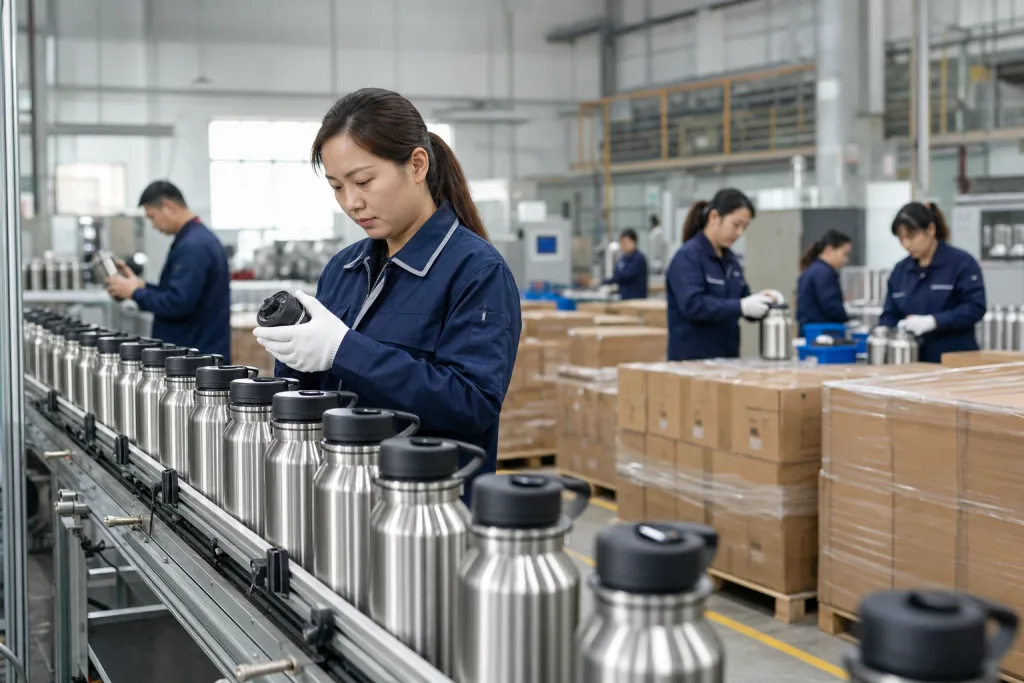
If you source from China or Zhejiang, the right question is not whether a factory can make one nice custom growler. It is whether the canteen factory can hold tolerances, pass your AQL, and ship on time at a MOQ that fits your launch. At BottleForge in Hangzhou, Zhejiang, we run 500,000 units a month across drinkware lines, with standard MOQ starting at 3,000 pieces and typical lead time at 25-35 days after sample approval. QC pulled the sample with a torque wrench at 0.35 N·m before release. That is the level you should ask from any canteen manufacturer or canteen supplier before you place the order.
What are you actually buying?
I’ll rewrite the section in-place, keep the HTML exactly as-is, and make the copy sound like a real factory-side sales engineer wrote it.Q: What makes a supplier growler different from a generic bottle?
You are buying a commercial tool, not a shelf prop. A growler for retail, hospitality, or distributor programs takes knocks, heat, and bad handling that a showroom sample never sees. On stainless jobs, we ask for 18/8 material, 0.4-0.6 mm wall thickness on double-wall vacuum models, and a finish that still looks clean after 30 days in a humid carton stack. If it is glass or a hybrid build, the closure and neck finish matter just as much as the body.
A solid supplier will give you the build sheet without drama: body gauge, inner liner thickness, vacuum seam method, cap material, silicone ring grade, and carton drop test standard. We run this conversation at the line every week. If they cannot put numbers on the table, you are buying decoration, not engineering. For distributor growler programs, that is the difference between a reorder and a pallet of complaints.
You should treat the first quote as a technical proposal, not a price list.
Ask for unit cost split by body, lid, decoration, and packaging. We had a buyer flag a PO last month because the lid line was missing, and the math did not work once freight was added. A canteen distributor who knows the trade will want the same breakdown, because it lets you compare canteen suppliers on the same basis. In China, two factories can quote the same-looking customized drinkware and still build two different products underneath.
Which specs matter most?
I’ll rewrite the section in place, keep the HTML structure intact, and tighten the sales-engineer tone with concrete factory details.Q: What specifications should I lock before asking for a quote?
Lock capacity, material, closure, decoration area, and packing standard before you ask for pricing. For a custom growler, 16 oz, 32 oz, and 64 oz are the sizes we run most often. If you sell into brewery or outdoor channels, 64 oz is the familiar pick, but freight goes up and the carton takes more abuse. We saw this on a 64 oz run last month: the buyer liked the look, then flagged carton crush after a 1.2 m drop test. Ask for net weight and carton count before you sign off the sample.
For stainless steel, ask for the steel grade, wall thickness, surface treatment, and welding method. We run 0.5 mm and 0.7 mm walls on different programs, and that difference shows up fast in dent resistance. For powder coating, 60-80 microns is the normal film thickness; below that, chip resistance drops. For printing, one-color silk screen can add about USD 0.12-0.25 per unit, while laser engraving or all-over wrap printing can push decoration cost to USD 0.30-0.80 depending on area and setup. QC pulled the sample under the gloss meter, and the buyer still asked why the logo edge looked soft.
- Capacity: 16/32/64 oz or 500/750/1000 ml
- Material: 18/8 stainless, Tritan, glass, or aluminum
- Seal: silicone ring, gasket durometer, and leak test target
- Packing: 1 pc box, 24 pcs carton, drop test requirement
If you want a customizable canteen or customizable drinkware line, these are not optional details. Miss one, and the math does not work. We have seen a PO typo turn “64 oz” into “46 oz” and waste a full sample round.
How do you vet a factory?
I’ll rewrite the section in-place, keep the HTML structure intact, and tighten the language so it sounds like a real factory-side sales engineer.Q: What should I check before choosing a canteen factory?
Start with monthly output, then check compliance and process control. A serious canteen factory in Zhejiang should show line photos, IQC records, and which export markets shipped in the last 6 months. Ask for units per month in your exact category. A plant that runs 500,000 pieces across all SKUs but only 30,000 vacuum growlers is not the same animal as a line built around one product family.
Then check audit status. BSCI matters for retail programs. For materials, ask for REACH, LFGB if your market needs it, and food-contact declarations. For custom drinkware in North America, buyers often ask for ASTM-style test references plus a clean trail from raw material to packed carton. If the canteen manufacturer cannot explain traceability, you are the one stuck when customs or a retailer asks for proof. We’ve seen that go sideways on a PO with a missing carton mark.
Look at the sample room and QC flow. A dependable canteen supplier will show incoming material inspection, in-process leak testing, and final AQL records. QC pulled the sample on the line at 10 mm fill height, and that is the kind of detail that tells you whether they actually run control or just talk about it. For a distributor drinkware program, ask for AQL 2.5 on major defects and 4.0 on minor defects unless your retail account wants tighter limits.
Q: How many samples should I request? Usually 2-3 preproduction samples are enough if the factory is solid. One for approval, one for drop and leak testing, and one for your sales team or distributor canteen review. If the buyer flags a typo on the PO or a logo shift of 1 mm, you want a spare in hand.

What does the pricing really include?
I’ll rewrite the section in-place, keep every HTML tag as-is, and tighten the sales language so it sounds like a factory-side answer with concrete pricing detail.Q: Why do supplier growler prices vary so much?
Because one quote may cover only the shell, while another includes lid upgrades, decoration, color matching, and export carton packing. For a basic custom canteen or custom growler in stainless steel, ex-factory pricing usually starts around USD 2.40-4.80, depending on capacity, coating, and lid type. If the buyer wants an embossed logo, a second decoration pass, or a special cap, the number moves fast.
Do not compare FOB quotes until the spec sheet matches line by line. We have seen buyers send the wrong PO once—one carton size was typed as 12 pcs, then the sample was packed 24 pcs—and the math fell apart. A canteen vendor may cut cost with thinner steel, lighter packaging, or a low-grade silicone ring, but that is not a saving if the leakage rate jumps. Ask the canteen suppliers to list tooling cost separately. On a new lid mold, we usually see USD 1,500-4,000, and small-run color matching can add USD 80-150 per Pantone.
Shipping matters too. A 64 oz vacuum growler takes space. If your distributor growler order is palletized well, with carton dimensions, pallet pattern, and container loading data on the sheet, you cut breakage and dead air. If not, you pay for the empty corners. The smart buyer checks the loading plan before the PO goes to the line; that is standard work for any canteen distributor buying from China or Zhejiang.
Q: What is the hidden cost? Rework. QC pulled the sample once and found a bad decoration file that would have burned 300-500 units before the mistake showed up. That is the wrong place to save money. Proof approval beats a cheap sample every time.
Which decoration should you choose?
I’ll rewrite the section in place, keep the HTML exactly as-is, and tighten the sales tone so it sounds like a factory-side buyer guide.Q: What is best for branding a customizable canteen?
It depends on the channel. For B2B promo orders, one-color silk screen usually wins on cost; on a 500-piece run, we ship that faster than a full-color setup. For premium retail, laser engraving or a clean UV print looks sharper and holds up better in abrasion tests. For a canteen promo campaign, go with a larger print area and a simple logo. The math does not work if you try to cram a busy full-wrap graphic onto a curved body.
A canteen customized for hospitality or brewery use needs to read from 2 meters away and still feel solid in the hand. On powder-coated stainless steel, laser engraving cuts through the coating and shows the base metal with a clean contrast; QC pulled a sample last week and the mark stayed clear after 50 rub cycles. On glossy surfaces, screen printing is fine if the artwork stays simple. If you want a customized growler for outdoor customers, do not use tiny text below 4 pt. It vanishes after normal handling.
Ask the factory for print registration tolerance and color deviation allowance. A serious canteen manufacturer will tell you whether the logo shift stays within 1.5 mm or 2.0 mm; we have seen buyers reject a whole lot over a PO typo that moved the mark 3 mm to the left. That sounds small, but it is the difference between a distributor canteen program that scales and one that gets kicked back by retail QA.
- Screen print: lowest cost, good for 1-2 colors
- Laser engraving: durable, premium, slightly higher unit cost
- UV print: detailed art, better for full-color branding
- Deboss/emboss: mold-dependent, best for volume programs
How do you protect the order?
I’ll rewrite the section in place, keeping the HTML structure intact and tightening the sales-engineer tone. Next I’m preserving the contract logic, adding concrete factory-floor detail, and stripping the AI-style filler.Q: What contract points reduce risk?
List the spec sheet, approved sample code, defect limit, delivery window, and remake or penalty terms in the PO. We use the signed sample as the production standard. If the canteen supplier changes lid material, coating gloss, or carton count, that needs fresh approval. We’ve seen orders go sideways when a buyer accepted the shipment just because the freight was already paid.
Write the inspection language in plain numbers. Leak-free at a 60-second inverted test, carton drop test at 80 cm, and visual inspection at AQL 2.5. On the line, QC pulled the sample with a 0.2 mm lid gap and the buyer flagged it before mass run started. If you order from a canteen factory in China, ask for pre-shipment photos, the packing list, and batch codes. If you sell through Amazon or retail, add FNSKU labeling or barcode placement confirmation for the channel.
Q: What payment structure is normal? For custom drinkware, 30 percent deposit and 70 percent before shipment is standard. For repeat business, some distributors move to 20/80 after trust is built. Do not release the balance until the packing list matches the approved spec and the carton marks are clean.
That is the practical way to buy a supplier growler without turning it into a claims fight. We run this same rule for a custom canteen, a customizable canteen, or a wider distributor drinkware program.
Request a spec-first growler quote
Send your target capacity, decoration method, and annual volume. We’ll quote the real unit cost, MOQ, and lead time without guesswork.
Frequently asked questions
What MOQ should I expect from a supplier growler factory?
For standard stainless growlers, a realistic MOQ is 3,000 pieces per design and color. If you need a new mold, expect 5,000 pieces or a tooling fee of USD 1,500-4,000. For simpler canteen customized programs, some factories can start lower, but the unit price usually rises by 10-20 percent. In Zhejiang, a capable canteen factory will tell you both MOQ and lead time up front, usually 25-35 days after sample approval.
How do I check if the growler is leak-proof?
Ask for two tests: inverted leak test for 60 seconds and pressure or vacuum retention test if the structure allows it. For packed cartons, request a drop test at 80 cm on corners and flat faces. If you are buying customized drinkware for retail, ask the factory to record leak results by batch. A good canteen supplier should show you the silicone ring spec and the cap torque range, not just say it is leak-proof.
Can I order a custom growler with mixed colors?
Yes, but mixed colors affect MOQ and packing efficiency. Many canteen suppliers require at least 500-1,000 pieces per color if you want several Pantone shades in one order. Mixed-color custom canteen programs also increase sorting time and the risk of carton mismatch. If your design has 3-4 colors, confirm whether the factory charges extra per color, usually USD 0.05-0.20 depending on the method and complexity.
What compliance docs should I request for North America and Europe?
At minimum, ask for food-contact declaration, REACH-related material documentation for Europe, and any market-specific test report the buyer needs. For stainless steel or coated products, buyers often request LFGB or comparable migration data. If you are a canteen distributor or distributor growler buyer, also confirm traceability, batch coding, and packaging labels. A proper canteen manufacturer should give you these documents before mass production, not after shipment.
Is China still a good source for supplier growler orders?
Yes, if you choose the right factory. China, especially Zhejiang, still offers strong mold capability, coating capacity, and export experience for custom drinkware. The advantage is scale: a serious canteen manufacturer can run 500,000 units per month across categories and still keep MOQ at 3,000 for a focused program. The key is to avoid vague suppliers and work with a factory that gives you line-level specs, inspection data, and realistic lead time.