Key Takeaways
- Typical MOQ for supplier drinkware starts at 500-1,000 pcs, with custom logo setups adding 5-7 days
- A workable factory lead time is 25-35 days after sample approval, not from the first email
- For stainless items, 304 inner / 201 outer construction can cut cost by 12-18% versus full 304
- Use AQL 2.5 for critical defects and confirm REACH, LFGB, or FDA paperwork before PO release
You are not buying a mug. You are buying a carton count, a production slot, a compliance file, and a shipping problem you will have to explain to your boss if it blows up. That is the real job when you source supplier drinkware from China or Zhejiang.
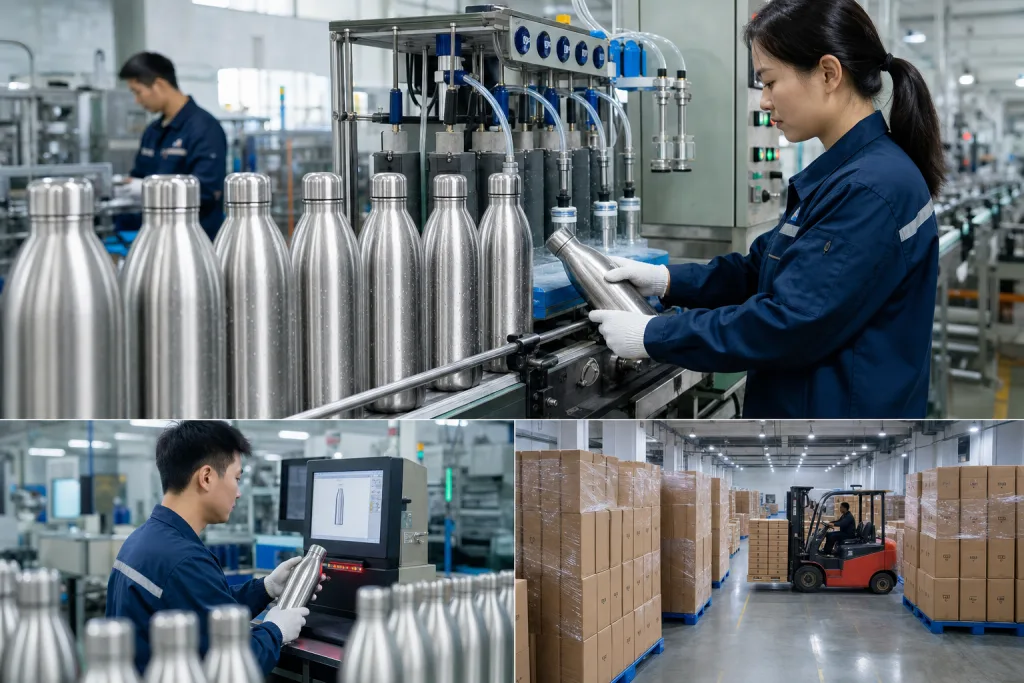
The fastest way to burn money is to treat a custom canteen or custom growler like a catalog SKU. Wrong move. We start with the use case, then check the factory, the artwork, the tolerances, and the packout. At BottleForge in Hangzhou, Zhejiang, we run 120,000 units a month, and the same issues keep landing on the line: vague specs, 15-day timelines on a 30-day job, and QC pulled too late to save the order.
Here is the buyer path that works when you want customizable drinkware, not a headache.
Start with the real use case
I’ll rewrite just this section, keep the HTML exactly intact, and make the copy sound like a factory-side sales engineer.Start from the end user, not the decoration. A trade show giveaway, a retail distributor line, and an outdoor-brand growler all call for different wall thickness, lid specs, carton strength, and price points. Skip that, and you end up comparing the wrong samples.
Take a real buyer brief: 3,000 pieces for a North American distributor canteen program. The landed target is USD 4.80, the artwork is one-color laser engraving, and the buyer wants a 32 oz bottle with a leakproof lid. Sounds simple. Then the line breaks into choices like a canteen custom item with a handle, a customizable canteen with powder coating, or a plain brushed finish that cuts unit cost by 8-10%.
Write the brief the way we read it at the factory:
- Target market: Europe or North America
- Usage: office, gym, camping, promotional, retail
- Capacity: 500 ml, 750 ml, 1 L, or 32 oz
- Material: 304, 316, Tritan, glass, or aluminum
- Decoration: silkscreen, laser engraving, UV print, wrap label
One page is enough. QC pulled a sample on the 12th day once because the buyer left out carton test spec, and that kind of miss costs time. A good brief lets a canteen manufacturer tell you fast whether your target price works or the math doesn’t.
Choose the construction, not the catalog photo
I’ll rewrite the prose in place, keep the HTML structure untouched, and tighten the language so it sounds like a factory-side sales engineer wrote it.Most supplier drinkware quotes go wrong for one reason: the buyer likes the photo and skips the structure. A stainless canteen with a 0.4 mm inner wall and 0.5 mm outer wall behaves differently from a 0.35 mm lightweight promo bottle. You feel it in hand, you see it in dent resistance, and we ship different damage rates on the same carton size.
If you are sourcing a custom drinkware line, ask for wall thickness, lid type, and coating process before you compare price. For a custom canteen or customized canteen, double-wall vacuum with a 304 inner liner is the safer middle ground. If the buyer pushes for the lowest number, a 201 outer shell or single-wall build cuts cost, but the math gives up thermal hold and shelf appeal. We’ve seen that trade go sideways on retail orders.
What usually moves the price
- 304 versus 316 stainless: 316 usually adds 10-15%.
- Powder coating versus raw steel: coating can add USD 0.18-0.35 per piece.
- Laser engraving versus one-color print: engraving runs slower, but it holds up better after 200 wash cycles.
- Silicone base, flip lid, carry loop, or straw lid each adds tooling or assembly time; QC pulled the sample and checked each extra part on the line.
If you need a custom growler or customizable growler for retail, check neck finish compatibility first. Growlers are not forgiving: a lid that fits one mold set can leak on another. Good canteen factory teams will show torque specs, gasket material, and closure cycle tests before you send mass production. One PO typo on the neck size cost us 4 days once, and the buyer flagged it only after pre-shipment QC.
Ask for samples that can be measured
I’ll rewrite the prose in-place, keep the HTML exactly as-is, and tighten the language so it reads like a factory-side sales engineer wrote it.Do not approve a sample because it “looks fine.” Put it on the bench and measure it. A real canteen supplier will send a pre-production sample, and a decorated sample if the finish matters. We want the buyer sample, not the sales sample that was wiped down for photos.
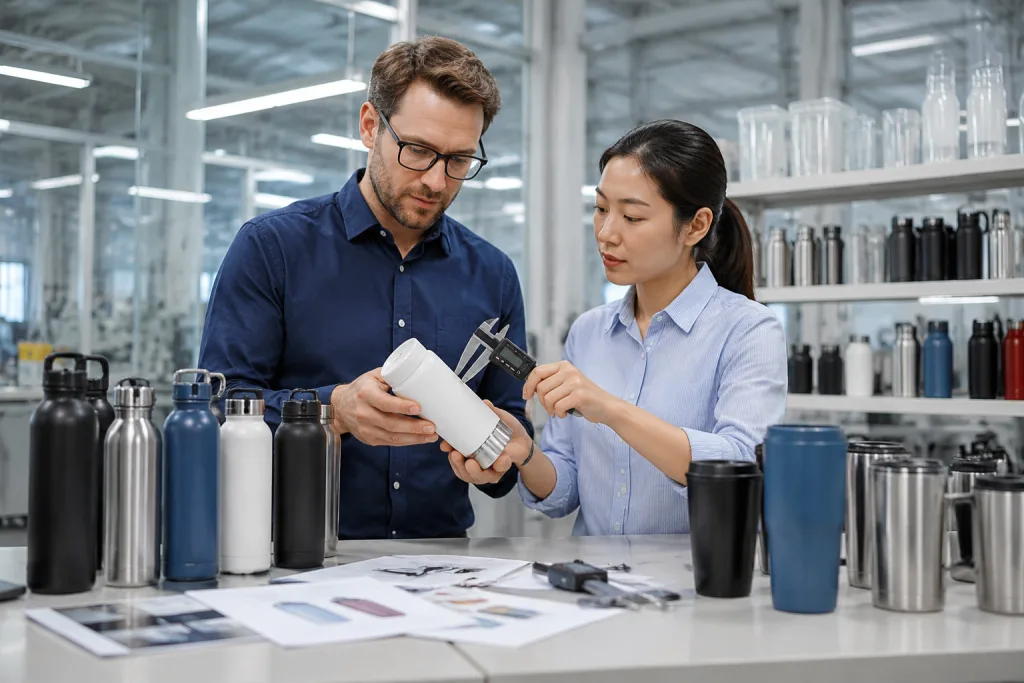
For sample check, we run calipers, a scale, and a plain water leak test. Confirm the weight stays within ±5%, the mouth opening matches the spec drawing, and the lid closes with the same torque every time. On the line, we also check the seam and the print edge. If the item is a customized drinkware piece for retail, compare print placement against the artwork file. A logo shifted 2 mm is nothing on a giveaway cup. On a distributor drinkware SKU, the buyer will flag it the minute it sits next to the next carton.
Ask the supplier for the following before approval:
- Sample photos with dimensions
- Material declaration
- Closure test result
- Color reference: Pantone or sample chip
- Packaging mockup with carton count
When you buy from Zhejiang or anywhere else in China, this is where experienced buyers split the vendor from the factory. A vendor can quote in 12 minutes. A factory can prove the sample at 1200 pcs stays the same, and that is the real question.
Price the order like an importer
I’ll rewrite this section in a more lived-in buyer voice, keep the HTML exactly as-is, and preserve the structure and numbers already in the text.The unit price is one line on the sheet. For a buyer in Europe or North America, we run the math as product plus decoration plus carton plus inland freight plus export handling plus compliance. FOB Ningbo or FOB Shanghai stays the cleanest comparison point for China quotes, and that matters even more when the line is shipping out of Zhejiang.
For a 3,000-piece custom canteen order, the breakdown can look like this: base product USD 2.05, laser logo USD 0.12, kraft box USD 0.18, export carton allocation USD 0.06, total FOB USD 2.41. If the same design turns into a canteen customized with four-color print and a premium gift box, the total can move to USD 2.95-3.20. We’ve seen buyers push back on that, then QC pulled the sample and the math still held.
Watch these buyer traps:
- Sample fee not credited against mass production
- Tooling fee hidden inside “unit price”
- Packing upgrade quoted after PO approval
- Freight assumptions based on a full container when you only need LCL
Distributor drinkware buyers should ask about mixed SKU loading from the start. If you are combining a canteen promotional item with a custom growler in the same shipment, a 12 mm carton change or a different pallet pattern can shift landed cost by 6-9%—this is the wrong question to leave for the last email.
Run QC before the goods leave China
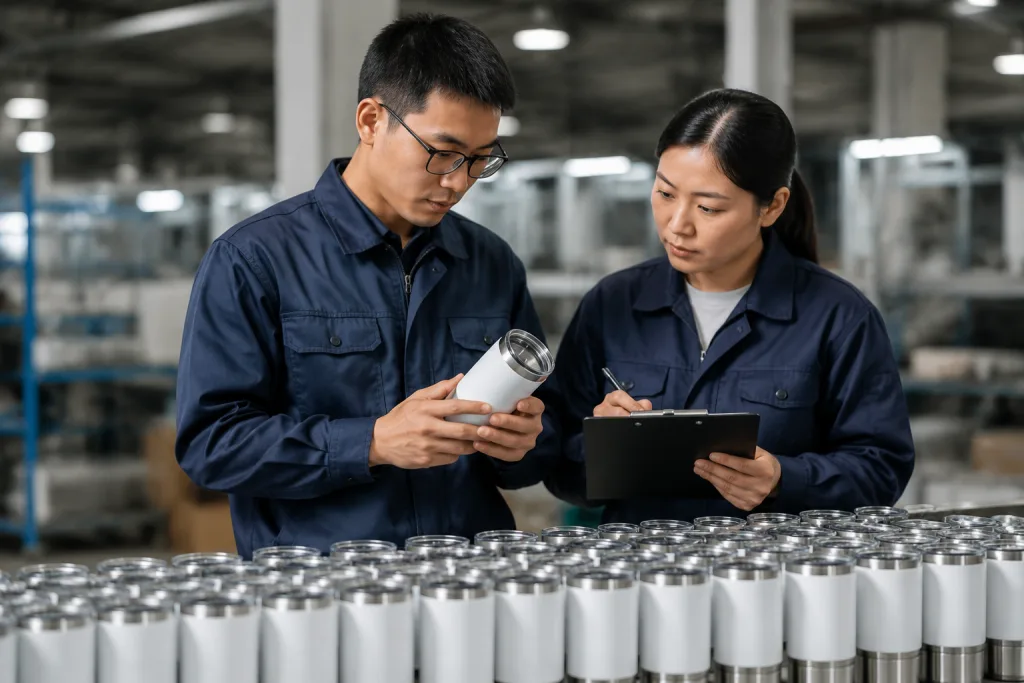
I’ll rewrite the section in place, keep the HTML structure intact, and tighten the sales-engineer tone with concrete shop-floor detail.Quality control is a gate, not a checkbox. If the factory in Zhejiang runs 10,000 pieces and you inspect only after packing, you are already late. We run incoming material checks, in-process checks, and final inspection under AQL 2.5 for major defects and AQL 4.0 for minor defects, unless your retailer asks for a tighter spec.
For stainless supplier drinkware, QC pulled the sample and checked weld seams, vacuum retention, lid fit, odor, coating adhesion, and logo durability. For a canteen custom order, add a shake test and a leak test at room temperature, then repeat after hot-fill exposure. For a customizable growler, check the thread finish and gasket compression after 20 opening cycles; the buyer flagged this on a 58 mm cap once, and the math did not work.
Good QC is boring. That is exactly what you want when the goods are already on the truck.
A practical factory should document:
- Material lot numbers
- Inline defect photos
- Drop test results if required
- Carton compression checks
- Final piece count versus PO
If your canteen manufacturers or canteen suppliers cannot show a sampling plan, you are not buying a controlled process. You are buying hope. We have seen that go sideways on a 2,400-carton shipment when one PO typo changed the lid color.
Move from approved sample to shipment
I’ll rewrite this section in-place, keep the HTML exactly as-is, and tighten the sales-engineer tone with concrete factory details and cleaner export language.Once the pre-production sample is signed off, the schedule gets tight and predictable. In our Zhejiang line, with 304 stainless on hand and no bottle-neck on lids, 25-35 days is a realistic lead time for a standard customized canteen order of 3,000-10,000 pieces. Need special packing, gift boxes, or a second logo check? Add 7-10 days. That math is simple.
Before shipment, the buyer should lock the commercial invoice, packing list, HS code, carton marks, and any market-specific compliance file. For North America, buyers usually ask for FDA-related material declarations on food-contact items. For Europe, REACH and LFGB are the usual checks. If the SKU is going to Amazon or a distributor channel, we also need barcode placement, polybag warnings, or FNSKU labels; QC pulled one sample last month because the barcode sat 8 mm too low on the carton.
New buyers often treat shipping like a paperwork step. That’s the wrong question. The export job is part of the product. If the canteen distributor wants mixed cartons by SKU, say it before production. If the order needs unit polybags with printed lot numbers, put it on the drawing. We’ve seen this go sideways when the PO typo changed “12 pcs/carton” to “21 pcs/carton” and the buyer flagged it only after carton sealing. Clean shipment usually comes from six small calls made early, not one big fix at the end.
Send your spec and get a real quote
We will review your drawing, MOQ, compliance needs, and target price before production starts, so your order from China lands on time.
Frequently asked questions
What MOQ should I expect for supplier drinkware?
For standard supplier drinkware, a common MOQ is 500-1,000 pcs per color or per design. For custom canteen, the floor is often 1,000 pcs if you need powder coating or multi-color printing. A simple engraved model can sometimes start at 500 pcs, but the price per unit will be higher by 8-15%. If you need mixed SKUs, some canteen suppliers will allow 300 pcs each style as long as the total order reaches 3,000 pcs. Always confirm whether the MOQ is per mold, per color, or per artwork version before you issue the PO.
How long does a custom order usually take?
After sample approval, a normal lead time is 25-35 days for stainless custom drinkware in China. If the order uses special packaging, you should budget 35-45 days. For a simple canteen promotional item with one-color logo and standard carton, 20-25 days is possible from deposit to ready goods when the canteen factory has stock material. Shipping adds another 5-40 days depending on air, LCL, or FCL. In Zhejiang, the real schedule risk is usually artwork approval or carton revisions, not forming the bottle body.
Which materials make the most sense for retail?
For retail supplier drinkware, 304 stainless is the default for the inner liner, especially for a custom canteen or customized growler. If you need premium positioning, 316 is better for corrosion resistance but raises cost. For lightweight distributor drinkware or a promotional campaign, Tritan or aluminum may be more cost-effective. Glass works well for a small high-end line, but breakage risk and packaging cost are higher. A good canteen manufacturer should explain the tradeoff in price, weight, durability, and compliance instead of pushing one material for every channel.
How do I check if a factory is reliable?
Ask for business license, export history, audit reports, and recent production photos. A serious canteen factory in China or Zhejiang should be able to share BSCI, ISO 9001, or third-party audit results if they have them. Then ask for one practical thing: a production control sheet with inspection points and AQL levels. If they can only send pretty product images, treat them as a canteen vendor, not a controlled canteen manufacturer. Reliability shows up in how they handle defects, rework, and documentation, not in the homepage design.
Can I combine logo styles in one order?
Yes, but it changes the cost structure. A distributor canteen program can combine laser engraving and silkscreen across different SKUs, but every artwork change adds setup time and inspection complexity. If you mix one customized canteen, one custom growler, and one promotional SKU in the same container, expect an extra 3-7 days for QA and packing control. Most canteen suppliers will charge a setup fee per logo method, usually USD 20-80 depending on process. Combining styles is fine if you manage the carton labeling and PO line items cleanly.