Key Takeaways
- A realistic custom MOQ starts around 1,000 units per color for powder coating and 3,000 units for new shape development
- 304 stainless steel is standard for inner walls; 316 is useful but not always worth the extra USD 0.35-0.80 per unit
- Plan 35-50 days production after approved PP sample for normal OEM orders from China
- Use AQL 2.5/4.0 inspection plus 100% leak testing for export-grade insulated bottles
You are not just buying a bottle. You are buying a line: 304 stainless, vacuum hold, powder coat, lid fit, logo tolerance, carton strength, and the plant’s ability to repeat all of it at 5,000 or 50,000 units. If the first quote is vague, the math goes off fast.
For B2B brands and outdoor retailers, finding a stainless steel insulated water bottle supplier in China is the easy part. The real job is asking the questions that separate a trading quote from a factory offer. We run these jobs in Hangzhou, Zhejiang, and the same problems show up every season: a PO with the wrong cap code, artwork sent as a low-res PNG, MOQ assumed at 1,000 when the line is set at 3,000, and leak tests skipped until QC pulled the sample and found a slow drip at the lid ring.
What are you really buying?
Buyers who ask for a stainless steel insulated water bottle wholesale quote usually start with capacity, unit price, and logo method. Fair enough. That is not the whole story. A stainless steel insulated water bottle is a vacuum product first, a decorated item second. If the wall is too thin, the lid thread is loose, or the carton fails a courier drop, the cheap quote turns expensive fast.
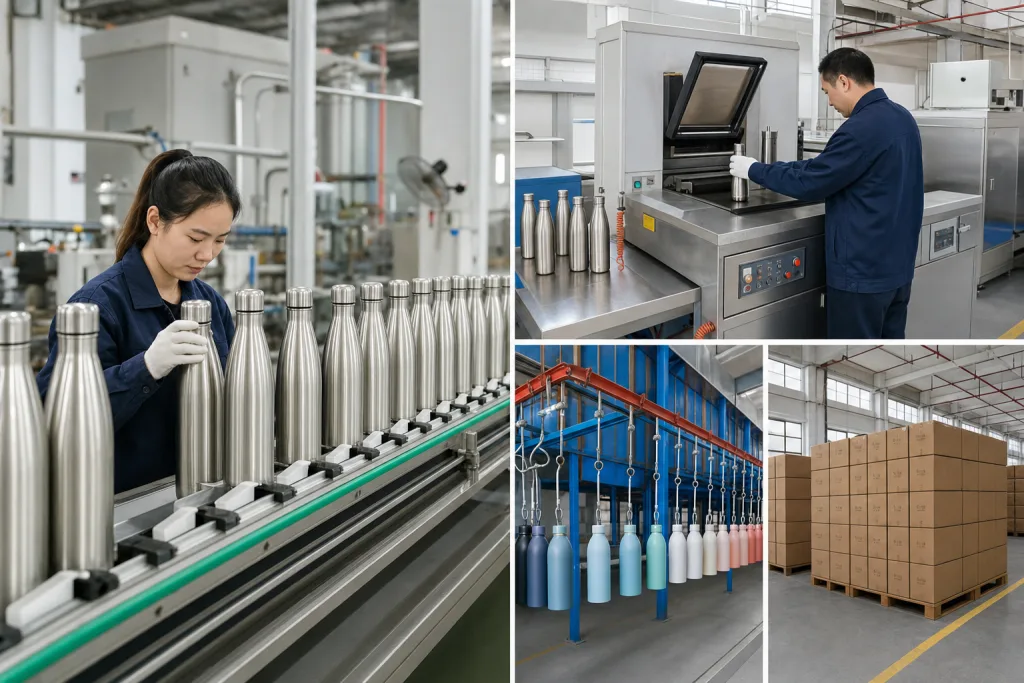
A proper wholesale spec should cover material, structure, decoration, compliance, and logistics. On our line, the first check is wall thickness. Most export bottles use SUS304 for the inner wall and either SUS304 or SUS201 for the outer wall. For a premium bottle, we push 304/304 for humid coastal markets because buyers do see rust claims come back. Typical thickness is 0.40-0.50 mm inside and 0.45-0.55 mm outside, depending on body shape and the forming press.
For structure, ask whether the bottle is double-wall vacuum insulated, copper plated inside, and tested before coating. Copper plating can help heat retention, but the process has to be clean. QC pulled one sample last month with a 0.3 mm seam gap at the base, and that bottle lost heat faster than the spec sheet promised. A 500 ml bottle should usually hold water above 42-50°C after 12 hours at room temperature, depending on lid design and starting temperature. We’ve seen the buyer flag that test when the lid gasket was 1 mm off.
A useful quote does not say “high quality bottle.” It says 304 inner, 304 outer, 0.5 mm wall, powder coating, laser logo, 24-hour leak test, carton drop test, FOB Ningbo, 40-day lead time.
BottleForge Industrial runs partner lines in Zhejiang and nearby China production clusters, with monthly output capacity around 350,000 stainless bottles across standard thermos, sports bottle, and travel tumbler models. That number only matters if the factory can hold the small stuff. We have seen a PO typo on the cap color turn into 8,000 units of rework, so the math does not work unless the QC team keeps the process tight.
Which factory model fits you?
There are three sourcing paths: standard wholesale, OEM customization, and ODM development. The sales quote may look close on paper, but they change cost, MOQ, lead time, and your risk on the line.
Standard wholesale means you pick an existing model from a stainless steel insulated water bottle factory, add a logo, and stay with stock colors or a low-risk custom color. Good fit for a first outdoor order. MOQ is usually 500-1,000 units per model if you accept stock color, or 1,000 units per color for custom powder coating. Tooling cost is zero. We had one buyer flag a PO typo on the color code and QC caught it before the first 3,000 pcs ran.
Stainless steel insulated water bottle OEM means the factory builds to your spec and uses existing molds where it can. You may ask for a cap strap, silicone boot, custom lid color, laser logo, retail box, barcode, FNSKU, and master carton marks. MOQ is usually 1,000-3,000 units per color, and sample time is 7-12 days after artwork approval. The buyer often pushes back on this line item, but the math does not work if you want a full set of branded parts at 300 units.
Stainless steel insulated water bottle ODM means you start from a factory-developed concept and tune it for your channel. Good choice when you want a bottle that is not off-the-shelf, but you do not want full mold spend. New mold work can take 60-90 days and cost USD 2,000-8,000 depending on body, cap, and accessories. We run this with a 1.5 mm wall spec on some bodies, and the buyer usually asks for a sample first before they sign off on tooling.
Quick buyer check
- If you need launch speed, choose an existing stainless steel insulated tumbler or bottle shape.
- If you need exclusivity, ask for mold protection in writing.
- If you sell through retail chains, lock carton size before mass production.
- If you sell online, confirm FNSKU placement and scannability before shipment.
What should the quote include?
A serious stainless steel insulated water bottle manufacturer should give you more than a unit price. The quote should read like a pre-production control sheet. If it does not, you will spend the next 3 weeks asking basic questions while your launch date slips.
Ask for capacity, dimensions, net weight, steel grade, lid material, insulation test method, coating type, logo process, packing method, MOQ, sample cost, tooling cost, production lead time, payment terms, and Incoterm. For North America and Europe, FOB Ningbo or FOB Shanghai is standard from Zhejiang factories. EXW can look cheaper, but it shifts export handling onto you. We see buyers get burned here when the PO says “FOB” but the supplier’s quote leaves out trucking and customs docs.
For a typical 750 ml stainless steel insulated water bottle bulk order, a realistic FOB price range is USD 3.20-5.80 depending on steel grade, cap complexity, coating, logo, and packaging. A simple laser logo may add USD 0.10-0.25. Full-color UV printing can add USD 0.25-0.60. A custom retail box may add USD 0.25-0.70 if it uses 350 gsm white card and color printing. These are guardrails, not final numbers. One buyer once pushed back on a USD 4.60 quote until QC pulled the sample and found a 0.35 mm wall spec and a lid that failed the leak test after 8 hours. The cheap quote did not include that.
Watch the very low quotations that avoid details. If one supplier quotes USD 2.10 and another quotes USD 4.20, do not assume the higher price is padding. It may include 304/304 steel, better coating, tighter lid sealing, thicker carton, and AQL inspection support. The wrong question to ask is, “Why are you expensive?” Ask what is missing. We’ve seen a PO typo turn “304 inner” into “201 inner,” and that one line changed the whole job.
Quote checklist
- Steel grade: 304 inner minimum, outer wall confirmed with wall thickness.
- Test: vacuum, leak, coating adhesion, and heat retention, with test hours stated.
- Decoration: logo size, position, Pantone, and tolerance in mm.
- Packing: individual box, polybag, carton gauge, carton marks, and carton count per master case.
- Terms: FOB port, lead time, payment split, validity period, and sample cost.
How custom can it be?
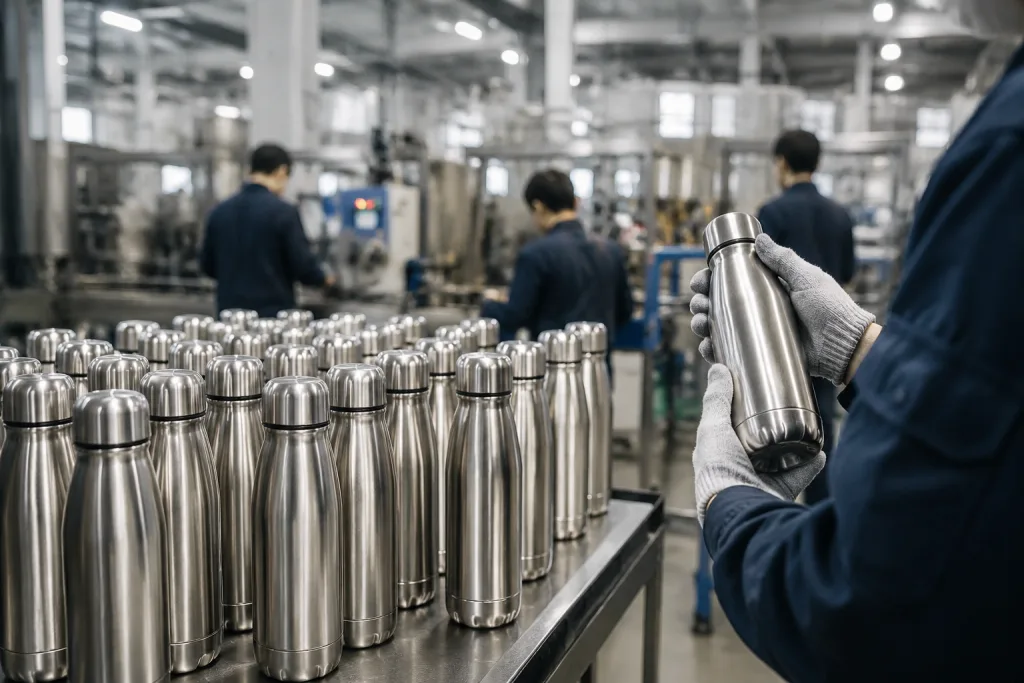
Stainless steel insulated water bottle custom work can be simple, or it can turn into a line headache. The mistake is treating every change the same. Logo engraving is a 2-minute setup on the laser bench. A new leakproof lid with a folding straw is not. A custom Pantone powder coat is manageable. A gradient finish with tight color repeatability across 20,000 units needs tighter oven control and a better first-article check.
For a stainless steel insulated water bottle private label program, most buyers change five parts: logo, bottle color, lid color, packaging, and insert materials. Laser engraving is durable and clean, especially on powder-coated bottles where the logo cuts through to the stainless layer. Silk screen is fine for a one-color mark. UV printing works for complex graphics, but we still run an abrasion test before sign-off. Heat transfer can cover the full body, but the seam has to line up. QC pulled the sample twice on one 500ml order because the artwork drifted 3 mm.
For outdoor retail, I tell buyers not to over-customize the first order. Start with one or two proven body shapes, 2-4 colors, laser or silk screen branding, and retail packaging that passes a 76 cm drop test. That is the right question to ask: what sells, not what looks clever on a CAD sheet. Once sell-through data is real, then move to lid changes, silicone boots, gift sets, or exclusive shapes. We saw one buyer push for all four on the opening PO, and the math did not work.
Custom color needs its own approval path. Powder coating is not just “make it blue.” We need a Pantone reference, finish requirement, and a physical color chip signed off by the buyer. Matte finishes hide fingerprints but can show scratches. Gloss finishes look bright but show handling marks fast. For dark colors, laser logos usually look sharp. For light colors, printed logos often give better contrast. On one 10,000-piece run, the buyer flagged a 1.5 mm shade shift between lid and body, so we held the line and remade the lid batch.
If you want stainless steel insulated water bottle branded packaging for chain stores, build in time for dieline approval, barcode testing, warning labels, and multilingual copy. Rushing packaging is how good bottles arrive in bad cartons. We have seen a simple PO typo turn “inner box” into “inner bags,” and that one line sent the whole carton spec back for correction.
Which compliance questions matter?
数据库和模板状态正常。三个项目都在300万以上区间,我会统一采用20家公司版本:一区8、二区独占4、二/三区重合5、三区独占3,兼顾命中率和资金占用。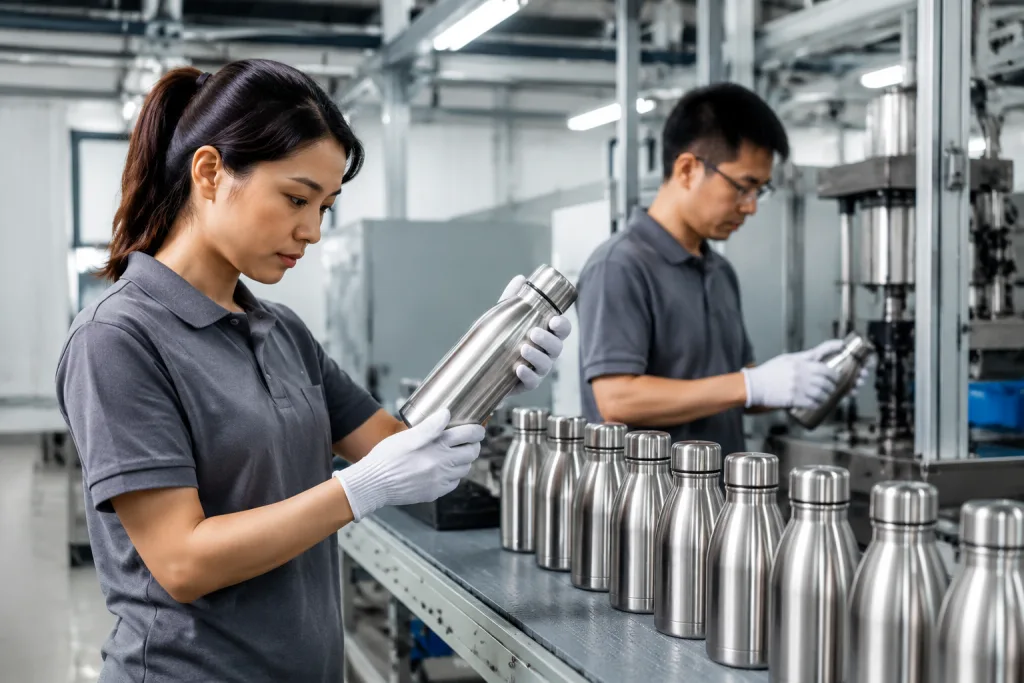
How do you control quality?
Quality control for stainless steel insulated water bottle wholesale orders starts before the line runs. The PP sample is not a souvenir; it is the contract sample. We lock capacity, weight, color, logo, lid fit, packaging, and barcode before the buyer’s PO goes to material buying. One typo on the PO can turn into the wrong cap color.
For production, set inspection rules in black and white. AQL 2.5 for major defects and 4.0 for minor defects is common for drinkware exports. Critical defects get zero tolerance: leaking, sharp edges, loose internal contamination, wrong material, broken cap function, unsafe packaging. We run 100% leak testing, usually with inverted or pressure-assisted methods depending on lid type. Vacuum performance is usually sample-tested after finishing, not every piece, so the upstream vacuum step is where the fight is won or lost.
Coating is another spot where orders go sideways. Ask for cross-hatch adhesion testing, alcohol rub testing for printing, and visual checks under the same lighting every shift. For powder coating, set limits for orange peel texture, pinholes, dust points, and color variation before production starts. Without a defect board or photo standard, “acceptable” turns into an argument after 3,000 pcs are packed.
For Amazon or online channels, carton strength is not optional. Use 5-ply export cartons for heavier bulk orders, protect bottles with individual boxes or sleeves, and confirm carton drop test requirements. If you ship stainless steel insulated water bottle bulk units into FBA, carton weight, FNSKU labels, suffocation warnings, and pallet requirements should be confirmed before packing. QC pulled the sample carton and crushed it at 18 kg; the buyer flagged it on the first test, and they were right.
At BottleForge in Zhejiang, a normal OEM order runs 35-50 days after PP sample approval, with in-line checks during coating and final inspection before shipment. If a China supplier promises 12 days for a custom powder-coated private label order during peak season, ask what step they are skipping. The math does not work, and we’ve seen that promise blow up on a 304 stainless run when the vacuum line backed up.
What should you do before deposit?
Before you pay a deposit, slow down for one hour and check the order like an engineer, not a buyer running against a ship date. The ugly mistakes are already there before the proforma invoice is signed.
First, confirm the business identity. Are you buying from a stainless steel insulated water bottle factory, an export company with factory control, or a pure trader? The answer changes who answers your call, who fixes a lid issue, and who can touch the line if QC pulled the sample and found a 1.2 mm gap. If you need custom lids, mold changes, or tight QC, direct factory control matters.
Second, freeze the specification. The PI should list model number, capacity, color, logo method, packaging, carton quantity, MOQ, unit price, lead time, Incoterm, payment terms, and inspection arrangement. If the PI only says “500 ml bottle with logo,” the math does not work. We have seen buyers sign that kind of PI, then argue later because the box size was never stated and the carton came in 58 x 39 x 32 cm instead of what their warehouse needed.
Third, request a sample path. For existing models, a blank sample can ship in 3-5 days. A custom logo sample usually takes 7-10 days after artwork approval. A new color sample can take 10-15 days because powder coating needs line scheduling. For ODM or mold work, plan on 12 days versus 18 days, not “next week”; that promise usually breaks once the buyer flags a Pantone mismatch or a 2 mm lid gap.
Finally, decide who owns final inspection. For orders above USD 8,000-10,000, third-party inspection is cheap insurance. If you skip it, at least require factory photos, packing video, test records, carton marks, and a signed QC report before balance payment. We had one PO with a typo on the carton mark, and the freight forwarder caught it only because the shipping clerk read the wrong SKU twice.
- Approve the physical sample, not the rendering.
- Lock Pantone, logo size, and logo position.
- Confirm FOB port and export carton dimensions.
- Check compliance documents against the actual 304 stainless and lid gasket.
- Agree AQL level and defect definitions before production.
Good sourcing is not about squeezing the last USD 0.08 from a stainless steel insulated water bottle manufacturer. It is about getting the product you can sell, reorder, and defend when your customer asks why the lid passed pull test at 18 kg but failed after the second drop. That is the real job.
Send your bottle brief for a factory quote
Share capacity, logo, MOQ, packaging, and destination market. We will return a practical China sourcing quote with lead time and options.
Frequently asked questions
What is the normal MOQ for custom stainless steel insulated bottles?
For existing models with a logo, MOQ is usually 500-1,000 units per model if you accept stock colors. For custom powder coating, plan on 1,000 units per color. For private label packaging, 1,000-3,000 units is more realistic because printed boxes and inserts have their own setup costs. If you want a new lid, silicone boot, or ODM body change, MOQ can move to 3,000-5,000 units. A China factory may accept lower MOQ for a first trial, but the unit price will rise because setup, coating line cleaning, and packing labor are spread across fewer bottles.
Is 316 stainless steel better than 304 for insulated water bottles?
316 stainless steel has better corrosion resistance, especially against salt and acidic environments, but 304 is already the standard choice for most stainless steel insulated water bottle orders. For normal water, coffee, tea, and sports use, 304 inner walls are usually enough. Upgrading to 316 can add roughly USD 0.35-0.80 per unit depending on size and market steel prices. It makes sense for marine, premium outdoor, or high-salt positioning. For most retail programs, I would spend the budget first on better lid sealing, coating durability, and inspection.
How long does private label production take after sample approval?
A normal stainless steel insulated water bottle private label order takes about 35-50 days after PP sample approval. The timeline includes raw material preparation, forming, welding, vacuuming, polishing, coating, printing or laser engraving, assembly, leak testing, packing, and final inspection. Add 7-12 days before that for logo samples, and 10-15 days if you need custom powder-coated color samples. During peak China production periods before summer and Q4, add another 7-10 days of buffer. Sea freight to North America or Europe is separate and can add 25-45 days port to port.
What logo method is best for outdoor retail bottles?
Laser engraving is usually the safest choice for outdoor retail because it is durable, clean, and does not peel. It works especially well on powder-coated stainless steel insulated bottles, where the logo cuts through to the metal layer. Silk screen is cost-effective for simple one-color branding and can look strong if the ink adhesion is tested. UV printing is better for multi-color logos but should pass rub testing. For a first order, I suggest laser or one-color silk screen unless your brand identity requires full-color artwork. Always approve a physical logo sample before mass production.
Should I buy from a factory or trading company in China?
If your order is simple, a capable trading company can be fine, especially if they manage QC well. If your order involves stainless steel insulated water bottle OEM work, custom colors, special caps, tight retail packaging, or repeated bulk programs, factory control becomes more important. A real stainless steel insulated water bottle factory can answer technical questions faster: wall thickness, coating defects, vacuum rejection rate, lid gasket material, and production schedule. The practical test is simple: ask for a detailed spec sheet, QC flow, sample timeline, and defect standard. Weak suppliers become vague very quickly.