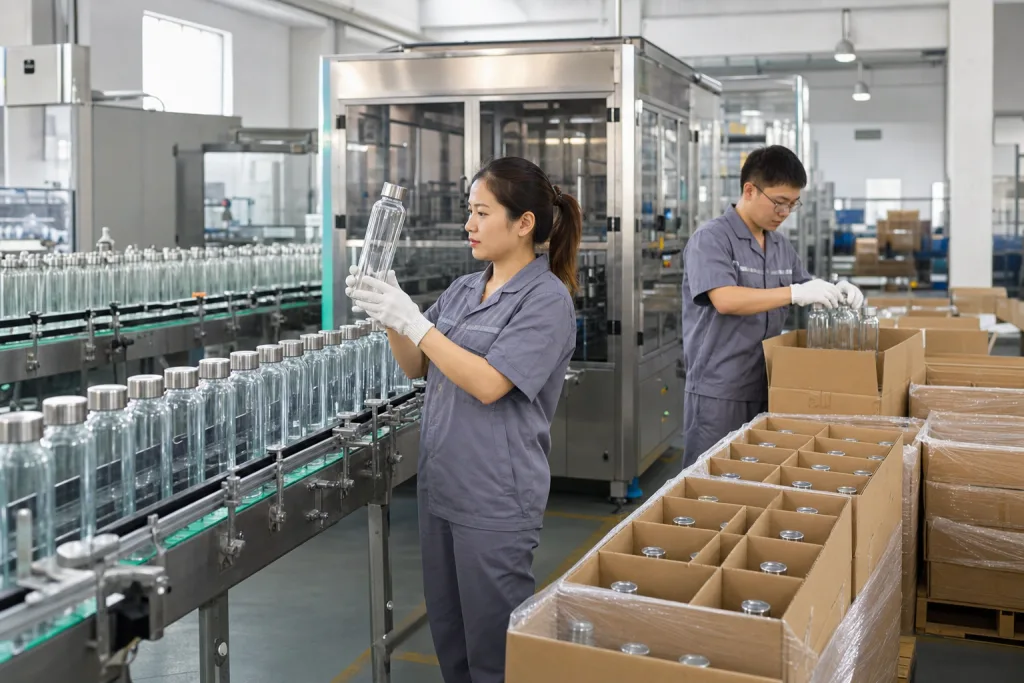
Key Takeaways
- Plan 3,000 pcs MOQ for most stainless steel glass water bottle wholesale custom orders
- Borosilicate glass usually runs 2.0-2.5 mm wall thickness for daily-use bottles
- Private label cartons add 7-12 days if artwork is not approved before mass production
- AQL 2.5/4.0 inspection catches most functional defects before FOB China shipment
A stainless steel glass water bottle looks straightforward until we start quoting it. You are not buying a standard glass bottle. You are lining up glass wall thickness, stainless steel parts, silicone seals, print method, and carton spec so the first PO does not stall on the line.
If you run a wellness brand or a retail program, your buyer is looking at clean taste, plastic reduction, shelf impact, and breakage rate. From our Zhejiang factory in Hangzhou, we keep seeing the same mistake: the buyer approves the sample first, then asks about the cap structure, and that is the wrong order. QC pulled one 500 ml sample last month at 1.8 mm glass; the spec sheet said 2.0 mm, and the math did not work for export packing.
Start With The Product Architecture
I’ll rewrite the section in-place, keep the HTML exactly as-is, and tune the voice to sound like a factory-side sales engineer. After that I’ll do a quick pass for the banned filler phrases and any awkward AI phrasing.The first call is not the logo. It is the bottle architecture. A stainless steel glass water bottle usually pairs a borosilicate glass body with stainless steel in the cap, sleeve, base, infuser, or outer shell. Add more steel and the bottle looks more premium, but fit tolerance, weight, and assembly cost get tighter fast.
For wellness brands, we usually steer buyers to a 500-750 ml borosilicate glass bottle with a 304 stainless steel cap, food-grade silicone seal, and an optional stainless steel tea infuser. That setup keeps the taste clean and the carry weight manageable. A full stainless sleeve cuts breakage complaints, though it also hides the glass body that a lot of sustainable retailers want to show on shelf.
Ask your stainless steel glass water bottle manufacturer for the exact material breakdown, not just “food grade.” For the glass body, request borosilicate glass with the thermal shock range printed on the spec sheet. For stainless parts, 304 is standard for caps and infusers; 316 is possible, but the extra cost usually does not pencil out unless you sell into a marine, medical, or top-tier wellness channel. QC pulled a sample here last month, and the buyer flagged a vague spec line on the PO.
At our stainless steel glass water bottle factory in Zhejiang, normal monthly mixed capacity for glass bottle assembly runs around 220,000 units, but complex stainless shells slow the line. If your launch date is fixed, keep the first run simple. We have seen this go sideways when a buyer asked for a four-part sleeve on a 30-day schedule. Develop the heavier ODM version after sell-through data proves the range.
Choose Capacity Before Decoration
I’ll keep the HTML intact and rewrite the prose with tighter B2B sourcing language, concrete factory details, and fewer AI-style transitions.Capacity sets most of the cost. A 350 ml bottle fits spa, hotel, and kids wellness lines. A 500 ml bottle sells better for office, yoga, and retail gifting. A 750 ml or 1,000 ml stainless steel glass bottle looks stronger on a product page, but the packed carton gets heavier, freight climbs, and the drop test gets less forgiving. We’ve seen 1,000 ml cartons fail at 1.2 m when the inner tray was too loose.
For stainless steel glass water bottle bulk orders, pick one hero capacity and one backup size, not four sizes at launch. Every extra size means another mold or fixture, another print screen, another packaging dieline, and more stock sitting in the warehouse. The math does not work. If you need stainless steel glass water bottle private label packaging for several retailers, keep the bottle the same and change the outer carton, hang tag, or sleeve. One buyer once sent a PO with three capacities and one artwork file; QC pulled the sample and the barcode placement was already off by 4 mm.
Decoration comes after the capacity call. Silkscreen printing is the cleanest option for logos and wellness claims. Laser engraving works on stainless steel caps or sleeves, but it will not decorate the glass body. Decals handle detailed artwork, though they add firing or curing steps and need abrasion testing. For a stainless steel glass bottle custom program, we usually start with one glass color, one cap finish, and one logo method. That keeps the line moving and avoids a scrap pile.
Do not sign off on a rendering alone. Ask for a pre-production sample with the final capacity mark, logo size, cap thread, silicone seal, and retail packaging. A bottle that looks balanced at 500 ml can look awkward at 1,000 ml because the cap diameter and shoulder angle do not scale neatly. We have seen buyers flag a 2 mm cap gap only after the sample hit the table.
Understand MOQ And Price Levers
I’ll rewrite the section in place, keep the HTML exactly as-is, and tune the prose to sound like a sales engineer on the factory floor.MOQ is where a lot of wholesale talks go sideways. For stainless steel glass water bottle wholesale projects, 3,000 pcs per design is a fair starting point when we use an existing mold and standard cap tooling. If you need a custom glass shape, exclusive cap tooling, or a full stainless outer housing, the line usually moves to 10,000 pcs or more, plus tooling fees of USD 800 to USD 3,500 depending on the part count.
For a working FOB China reference, a 500 ml borosilicate bottle with 304 stainless cap, silicone seal, one-color logo, and color box may sit around USD 2.10-3.60 per unit at 3,000-5,000 pcs. Add a stainless steel infuser and the number can shift to USD 2.70-4.20. A brushed stainless sleeve, premium gift box, or full-color retail packaging can push the unit above USD 5.00. QC pulled the sample last week on a 1.2 mm wall bottle, and the buyer flagged the packaging spec first. These are bands, not promises.
Your main price levers are mold status, glass thickness, cap design, decoration passes, packaging structure, and inspection level. Saving USD 0.12 with a weaker carton is the wrong trade if your goods go through Amazon FBA, retail DCs, or distributor warehouses. Breakage claims eat that back fast.
When you compare a stainless steel glass bottle manufacturer in China with another supplier quote, check whether the price includes inner tray, printed color box, master carton, barcode label, and export carton marks. We had a PO typo on carton marks once, and the buyer held the shipment for two days. A quote that leaves those items out is not cheap; it is unfinished.

Compliance Is A Commercial Filter
I’ll rewrite the section in-place, keep the HTML exactly as-is, and tighten the copy to sound like a factory-side sales engineer wrote it.For Europe and North America, compliance is the first supplier filter, before sampling. A stainless steel glass water bottle supplier should know LFGB or EU food contact rules, REACH for restricted substances, and FDA food contact expectations for the US market. If you sell to children, school promotions, or family retail, ask about ASTM F963 and small-parts risk, even when the bottle is not sold as a toy. We have seen buyers skip this and get burned on the first compliance review.
The contact points are the glass interior, stainless steel cap or infuser, silicone ring, coating, ink, and the adhesive on labels. Stainless steel glass water bottle branded programs usually miss on decoration or colored coating, not the bottle body itself. QC pulled a sample last month and the ink rubbed off after 50 cycles on the rub tester. If you claim BPA-free, lead-free, plastic-reduced, or recyclable packaging, keep the factory file and third-party lab report on hand.
Factory audits matter too. BSCI, ISO 9001, and basic social compliance records do not make the bottle better on the line, but they cut retailer pushback. A buyer once flagged a supplier because the corrective action plan had no closure date. Many sustainable retailers ask for audit documents before listing, especially when sourcing from China. If your stainless steel glass bottle factory cannot show a current audit or explain its corrective action plan, that is a risk signal.
For production inspection, use AQL 2.5 for major defects and 4.0 for minor defects as the baseline. Run leak testing, cap torque, logo rub testing, carton drop testing, barcode scan checks, and gross weight verification. We ship better when the checklist is attached to the PO, not buried in an email after goods are finished. One typo on a PO can throw the whole lot off.
Private Label Needs Earlier Decisions
I’ll rewrite the prose in place, keep the HTML exactly intact, and tune the language to sound like a factory-side sales engineer.Private label is not just putting a logo on the bottle. A stainless steel glass water bottle private label order usually means logo placement, retail box art, care card, barcode, carton marks, warning text, insert layout, and sometimes country-specific recycling symbols. Leave those until the line is nearly done, and the order sits while cartons get corrected. We have seen a 2-color box typo on a PO turn into a 3-day hold.
For stainless steel glass bottle private label projects, approve packaging before mass production starts. A normal printed color box takes 7-12 days after artwork approval. If the box uses foil stamping, embossing, magnetic closure, or FSC paper certification, add time. For distributor programs, confirm whether the master carton needs mixed SKUs, retailer PO labels, or FNSKU labels for marketplace fulfillment. QC pulled one sample last month because the carton mark was 4 mm off center.
Brand owners often ask for stainless steel glass water bottle custom shapes on the first order. That can work if you already have a committed retail buyer; otherwise, the math does not work. A lower-risk route is stainless steel glass water bottle oem using an existing body, then changing the cap finish, silicone color, logo, and packaging. Move to stainless steel glass water bottle odm only when the forecast supports tooling and the development cycle, or you will burn time on samples that never ship.
Good artwork control saves money. Send vector logo files, Pantone references, barcode files, dieline approval, and legal text in one pack. Your supplier should return a production proof with dimensions, print position, and carton layout. If they only reply “OK,” push back. We run export packaging every week in Zhejiang, and the buyer flagged it before because the logo file was fine but the warning text was 1 line short.
Build A Safer Supplier Shortlist
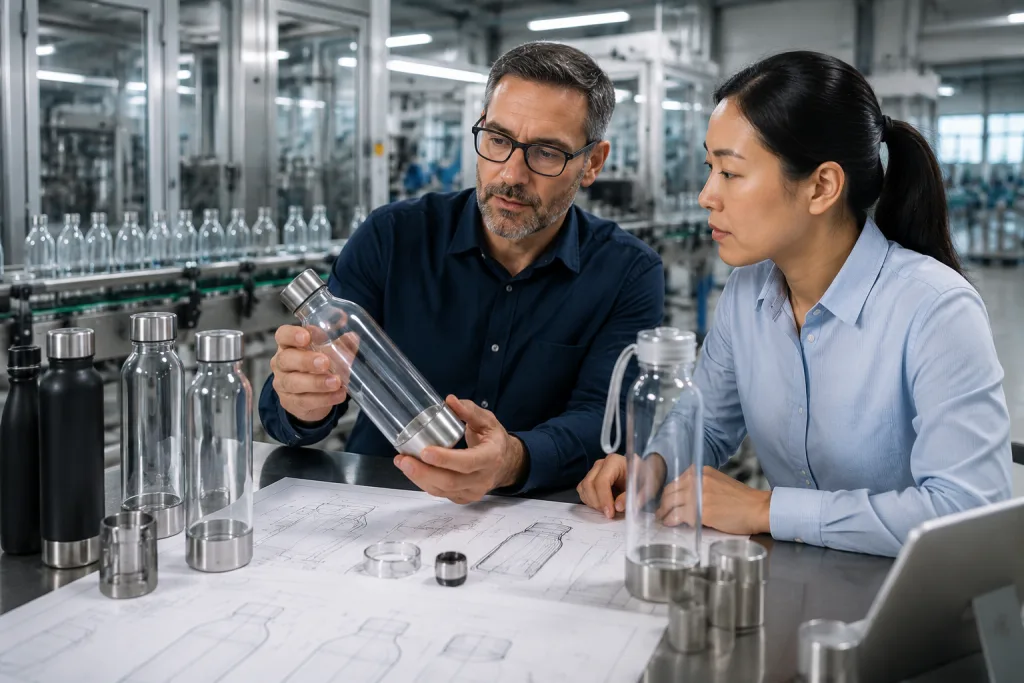
A tight shortlist beats a fat quote sheet. For stainless steel glass bottle wholesale sourcing, twenty prices will only blur the buyer’s view. We usually keep it to 3-5 suppliers who can show shipped items close to your target, name the common defects, send FDA or LFGB files without chasing, and answer with drawings or measurements instead of catalog screenshots. One buyer once sent us a PO with “350ml” in the subject and “500ml” in the line item; the supplier who catches that typo before sampling belongs on the list.
Ask each stainless steel glass water bottle supplier the same set of questions: current MOQ by model, monthly capacity, lead time after deposit, glass wall thickness in mm, stainless grade, silicone standard, inspection method, packaging options, and payment terms. For a standard stainless steel glass bottle bulk order, 30% deposit and 70% before shipment is common. Lead time is usually 30-45 days after sample and artwork approval; new tooling can add 20-35 days. Ask for the answer in one table. If they cannot fill it cleanly, the math later will not work.
Listen to how the factory talks about risk. A serious stainless steel glass bottle manufacturer will discuss leakage rate, cap thread tolerance, carton compression, print adhesion, and replacement policy with numbers attached. For example, QC pulled the sample after a 0.3 mm cap-thread mismatch on one run because the gasket looked fine but the bottle still seeped after inversion. A weak supplier says “no problem.” In export manufacturing, “no problem” often means nobody has measured the problem yet.
For wellness and sustainable retail, ask about packaging material reduction and plastic-free inserts, then get specific on spare silicone rings and whether the bottle can ship without individual polybags. We ship some programs with paper sleeves and egg-crate dividers, but the buyer flagged scuffed glass when the carton had too much empty space. A stainless steel glass water bottle branded program must look responsible when the consumer opens the box, not only on the product page.
Once samples arrive, run a quick internal check: fill the bottles, invert them for 12 hours, wash them 10 times, rub the logo with a wet cloth, and drop the packed carton from 60 cm on corners and edges. No lab coat needed. Use a kitchen scale, a ruler, and one marked carton; take photos after each drop so the factory cannot argue about “shipping damage.” It is not a lab test, but it quickly shows which stainless steel glass water bottle factory understands real distribution.
Build your stainless steel glass bottle program correctly
Send your target capacity, logo method, market, and packaging needs. We will return a practical MOQ, FOB range, and sampling plan.
Frequently asked questions
What is a realistic MOQ for stainless steel glass water bottle wholesale orders?
For an existing mold with standard 304 stainless steel cap and one-color logo, plan around 3,000 pcs per design. Some factories in China may quote 1,000 pcs, but the unit price is usually higher and packaging customization is limited. If you need a custom glass mold, exclusive stainless steel cap, special sleeve, or private label gift box, 10,000 pcs is more realistic. For a first wellness retail test, we usually suggest 3,000-5,000 pcs in one capacity rather than splitting the budget across too many colors.
Is borosilicate glass necessary for a stainless steel glass water bottle?
For most premium drinkware programs, yes. Borosilicate glass has better thermal shock resistance than common soda-lime glass, which matters when consumers add warm tea, cold infused water, or wash the bottle frequently. A daily-use bottle often uses 2.0-2.5 mm wall thickness, depending on capacity and shape. Thicker glass feels stronger but adds weight and freight cost. If your product includes a stainless steel infuser, borosilicate is the safer specification because users are more likely to pour hot water into the bottle.
How should I compare two stainless steel glass bottle supplier quotes?
Compare the full FOB China package, not just the unit price. Check glass type, wall thickness, stainless steel grade, silicone material, logo method, packaging structure, carton strength, spare parts, testing documents, and inspection terms. One quote at USD 2.40 may exclude color box and barcode labels, while another at USD 2.85 may include them. Also ask about defect replacement policy and lead time. A proper comparison table should include at least 12 fields, otherwise the cheapest supplier usually wins for the wrong reason.
Can I do stainless steel glass water bottle private label without new tooling?
Yes, and for many first launches it is the smarter route. You can use an existing glass body and customize the logo, cap finish, silicone color, infuser option, retail box, care card, and carton labels. This keeps MOQ near 3,000 pcs and avoids tooling fees that can run from USD 800 to USD 3,500. New tooling makes sense when you have a committed forecast, usually 10,000 pcs or more, or when your retailer needs an exclusive silhouette that cannot be built from current factory models.
What quality checks should I require before shipment?
Use AQL 2.5 for major defects and 4.0 for minor defects as a baseline. The inspection should include leakage testing, cap fit, silicone seal placement, glass scratches, stainless steel dents, logo adhesion, color box quality, barcode scanning, carton marks, and master carton drop testing. For glass bottles, packaging checks are as important as product checks. Ask the factory or third-party inspector to record sample size, defect photos, and carton condition. Do not release the 70% balance until the report matches your PO requirements.