Key Takeaways
- Mold costs for custom glass bottles range from $2,000 to $6,000 depending on complexity and cavity count.
- A standard 64oz beer growler weighs approximately 1.1kg empty; factor this into your shipping calculations.
- MOQ for custom silkscreen printing is typically 3,000 units per color to justify setup time.
- AQL 2.5 is the industry standard for glass thickness and surface defect inspection.
- Sea freight from Zhejiang to Europe takes roughly 30-35 days; plan inventory 4 months ahead.
You know the pressure when a launch date is fixed and the supplier keeps saying “next week.” Last month a buyer from Manchester sent us a 64oz beer growler bulk order for a brewery anniversary, and they needed 5,000 units in 45 days. Their old contact in Guangdong had put 57 days on the PO, so the shipment would have landed 12 days late. That is where glass bottle wholesale usually goes sideways: no clean spec sheet, no slot on the line, and everyone pretends the date will hold.
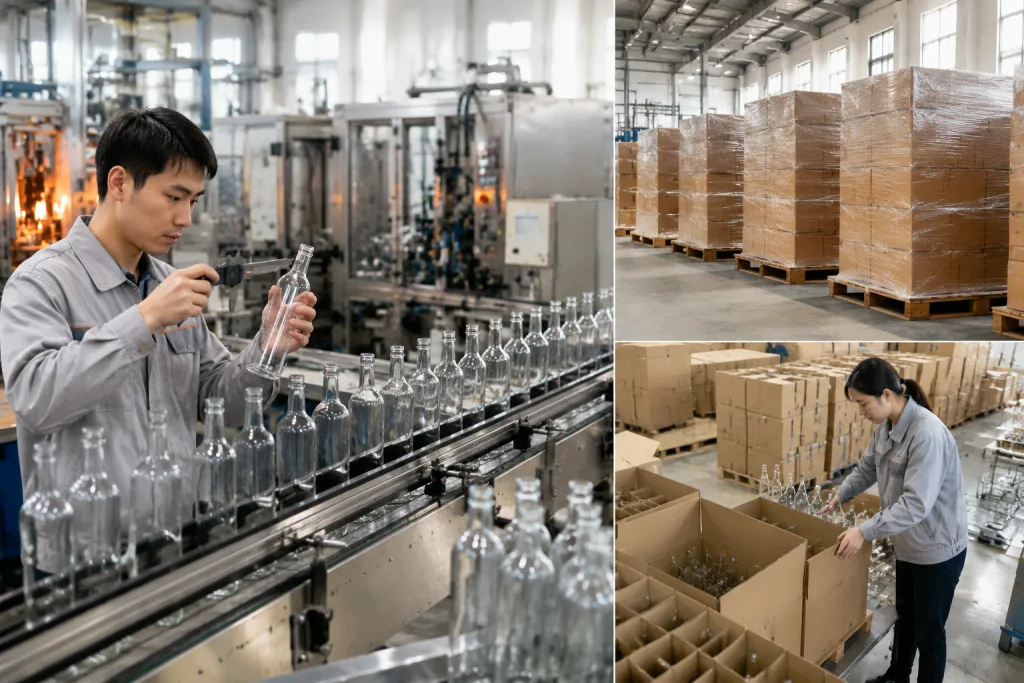
Price by itself does not tell you much. We run the line by the gram, and a 680g bottle behaves differently from a 520g one once carton count, breakage allowance, and mold amortization get pulled into the quote. If you are buying a wholesale growler for craft beer or an alcohol flask wholesale for spirits, the math does not bend. In our Hangzhou shop, QC pulled the sample, checked the mouth finish with a caliper, and we locked the order on the actual tooling and inspection result, not a neat spreadsheet guess.
Defining the Specification and Wall Thickness
The first job was to lock the technical drawing. The buyer asked for a "standard" wholesale growler, but that word shifts by market. In the US, 64oz is the common ask, about 1.9 liters. In Europe, we still see 1-liter and 2-liter bottles on the same PO. We kept 64oz because it matched their export channel. The real fight was wall thickness. That is the wrong thing to leave vague.
Glass thickness drives drop resistance and thermal shock. It also drives weight. For a bulk growler order, we quoted 3.5mm to 4mm and checked it with a caliper on the line. Go thinner and the bottle starts failing at filling and carton vibration; the buyer flags the damage claim, and the math does not work. Go thicker and material cost climbs by about $0.15 to $0.25 per unit, but we have seen breakage move from 2% to under 0.5% after QC pulled the sample.
Weight Tolerance and Shipping Impact
We sent a sample at 1,100 grams net. That number matters. If you order a bulk canteen or growler, you run the freight math from day one: 5,000 units at 1.1kg is 5.5 metric tons before cartons and dividers. A 20ft container fills up fast. By contrast, a lighter wholesale drink bottle for water can load around 30,000 units in the same cube. We had one PO with "110g" typed instead of "1,100g" - the buyer caught it, and that typo would have wrecked the booking.
Mold Development and Sampling Costs
The buyer wanted a raised logo on the neck, so stock bottles were off the table. We opened a mold job. For a custom source glass bottle wholesale run, plan on $2,500 to $4,500 for the first mold set. That covers the cast iron tooling we run on the blow-blow line, plus the first CNC cut on the cavity plate.
QC pulled the first sample in 15 days. The buyer flagged a small twist in the embossing, and that is normal when the glass pulls unevenly during cooling. We opened the cavity 0.3 mm and ran the next pull 5 days later. For a canteen bulk order or any custom bottle job, give yourself 2 to 3 weeks for sample fixes. Approving off a screen shot is the wrong question to ask. We have seen that turn into 5,000 bad units, and the math does not work.
Never sign off on a 3D render alone. We need the real bottle in hand to check weight balance and seam lines.
Decoration: Silkscreen vs. Applied Ceramic Labeling
The buyer asked for a full-wrap graphic on their beer growler wholesale order. We ran two routes on the line: silkscreen and Applied Ceramic Labeling (ACL) in the kiln. Silkscreen handles 1-3 colors and usually adds $0.10 to $0.20 per unit. Clean logo work. A full-color wrap is another job.
For this drinkware bulk order, we chose ACL. The label goes through firing at 560°C, so the print stays dishwasher safe and scratch resistant. QC pulled the sample after firing and checked edge lift with a 0.5 mm gauge; it held. Setup cost is higher, and the math only works at around 5,000 units or more. We have seen buyers push ACL on a 2,000-piece run, and that goes sideways fast. If you are sourcing an alcohol flask wholesale item with a small label panel, silkscreen keeps cost down and the artwork stays clean.
We also sorted the handle attachment. A wholesale growler often comes with a handle, fitted by hand or with a semi-automatic jig after the body comes off the forming line. That adds labor, plain and simple. One PO came through with a typo on the handle spec, 18 mm instead of 8 mm, and the buyer flagged it before we ran the batch. In Zhejiang, the labor rate still works, but this step needs tight AQL checks so the handle bond does not fail in transit.
Production Timeline and Factory Capacity
Once the sample passed, we booked the slot. The furnace runs 24/7. No drama. One gob feeder jam or a mold set swap, and the line stops. Our monthly output is 200,000 units, and this 5,000-unit bulk drinkware order sat in a 20-day window because we needed a fresh setup and a full mold changeover.
We sent the buyer a plain schedule: 3 days for silica sand, soda ash, and limestone prep, 15 days for blowing and annealing, then 2 days for decoration and curing. The annealing tunnel holds a steady cool-down curve, and QC pulled the sample at 12 mm wall thickness before release. On source glass bottle wholesale jobs, this is the step that keeps hairline stress out of the bottle; shaving a day here is the wrong question.
For a beer tumbler bulk order, the line moves faster because the shape is simpler and the mold set is cleaner. A wholesale canteen or a handled growler is a different case. We have seen that go sideways when the buyer pushes for speed before the cooling curve is locked. The math does not work. One bad curve, and we ship brittle glass.
Quality Control: Checking for Aesthetic and Structural Defects
QC is where margin disappears fast. We run AQL 2.5 for major defects and AQL 4.0 for minor ones, and the black-light table sits on the line for quick picks. For this wholesale growler order, we used a three-step inspection plan. One missed chip becomes a claim.
Stage one was inline inspection during blowing. We checked bird-swings, wall thickness at 2.8 mm, and hairline cracks while the glass was still warm. Stage two came after decoration, with color match and label position against a steel ruler, and the buyer flagged a 1.5 mm drift on the front print. Stage three was the final pre-shipment inspection (PSI), where we pulled 200 units from the 5,000-unit lot. The math does not work any other way.
Common Defects in Glass Drinkware
- Checks: Fine surface cracks that the eye misses, but a polariscope catches fast. We had a batch where QC pulled the sample and found three at the shoulder.
- Seeds: Small air bubbles trapped in the glass. On a wholesale drink bottle for premium spirits, that is a reject, not decoration. The buyer usually says “send photos,” and we do.
- Sharp Finish: Rough rim edges. This matters on beer tumbler wholesale orders because the lip touches the mouth, and a 0.3 mm burr is enough to trigger pushback.
We rejected 45 units at PSI for minor label misalignment, then swapped them from safety stock before packing. QC kept the accepted cartons under AQL 4.0, and we shipped the lot clean. “Can we sort it later?” is the wrong question. We have seen that go sideways.
Packaging Standards for International Freight
Glass ships best in a carton that can take a hit and keep the bottle off the wall. The buyer asked for plain cartons first, but we pushed back on that for a bulk growler sea shipment. We ran partition cartons with cardboard dividers on the line. That added about $0.05 per pack, and QC pulled the sample after a drop test showed corner chips would show up fast in transit.
For the alcohol flask bulk run or smaller bottles, tray packing saves cube and cuts carton count. For a 1.1kg growler, loose movement is the problem, not the carton price. The buyer flagged the “too much packing” line item, but the math does not work any other way. We print “This Way Up” and “Fragile” marks to ASTM D5164 standards, with the arrow label set at 80 mm.
Palletizing happened in our Hangzhou warehouse, with stretch film wrapped six turns on each pallet. The total volume for this drinkware wholesale order was 12 cubic meters. We combined it with another box of best wholesale drink bottle accessories, and that saved the client LCL fees. A PO typo once sent us 120 cartons instead of 12, so we check every pallet tag before we ship.
Navigating Customs and Compliance
Before the cartons left Zhejiang, we signed off the file pack. REACH is mandatory for glass entering the EU. We handed the buyer a Declaration of Conformity with lead-free and cadmium-free results on the bottle body, and for the US side we lined up FDA food-contact papers. QC pulled the sample from the line twice before release. Clean paperwork saves a lot of phone calls.
The buyer asked for the HS code. Fair question. For glass bottles, it usually sits under 7010. We put the FOB value and HS code on the commercial invoice with no guessing, because one typo can hold customs for 7 days. For a alcohol flask wholesale bulk order, I always ask for closure test reports too; caps bring their own plastic or metal parts, and the officer will check the whole set, not just the bottle body.
We booked the vessel with our freight forwarder early. The line was tight, so we took space out of Ningbo and kept the beer growler wholesale bulk shipment on a 32-day run to Rotterdam. The buyer pushed for a faster promise, but the math does not work when the booking cut-off is gone and the container plan is already locked.
Ready to specify your next glass bottle order?
Send us your technical drawings or reference samples. We will provide a detailed quote including mold costs, unit pricing, and a realistic production timeline within 24 hours.
Frequently asked questions
What is the typical MOQ for a custom glass bottle order?
For a custom mold glass bottle, the standard MOQ is usually 10,000 to 30,000 units. However, for specific projects like a bulk growler or specialized alcohol flask in bulk, we can sometimes accommodate runs as low as 3,000 to 5,000 units, though the unit price will be higher due to setup costs. Stock items have a much lower MOQ, often just one carton (50-100 units).
How long does it take to receive a sample?
For existing molds, we can send samples within 3-5 days via express courier. For custom molds, the process takes longer. You should expect 15-20 days for mold making and sampling. If you are sourcing a beer tumbler in bulk with custom printing, allow an extra week for the decoration sampling.
Can I mix different products in one container?
Yes, consolidation is a standard practice. You can mix a wholesale canteen order with a beer growler bulk order or other drinkware wholesale items. We manage the consolidation at our warehouse in Zhejiang to ensure you maximize container space and minimize shipping costs.
What are the payment terms for a wholesale order?
Standard terms are 30% deposit by T/T (telegraphic transfer) to initiate production, with the remaining 70% due before shipment. For long-term partners sourcing drinkware bulk regularly, we can negotiate L/C (Letter of Credit) or monthly settlement terms.
How do you handle breakage during shipping?
We pack all glass products in shock-absorbing materials. We typically include 1-2% spare units in the shipment free of charge to cover potential breakage. If breakage exceeds this due to severe handling, we work with the insurance company to settle the claim, provided the correct packaging standards were used.