Key Takeaways
- MOQ is usually 500-1,000 pcs per SKU in China; expect 1,000 pcs for custom colors and 30-45 days lead time after sample approval.
- A spec mismatch can change landed cost by 12-25%, especially when you move from single-wall cans to double-wall vacuum or from 304 to 316 stainless.
- For export, check REACH, LFGB, FDA, and ASTM where relevant; do not rely on a generic “food grade” claim.
- FOB Zhejiang pricing for common stainless drinkware often starts around USD 2.10-4.80 per unit, but lid type, coating, and decoration move it fast.
If you source drinkware in bulk, the first mistake is treating every bottle, tumbler, growler, and flask like the same buy. They do not run the same on the line. A 500 ml stainless tumbler with powder coat is a different job from a 64 oz growler or an alcohol flask bulk order, even when the buyer files them under one drinkware wholesale budget. We had one PO with "500ml" typed as "50ml" on the first draft, and QC pulled the sample before it hit packing.
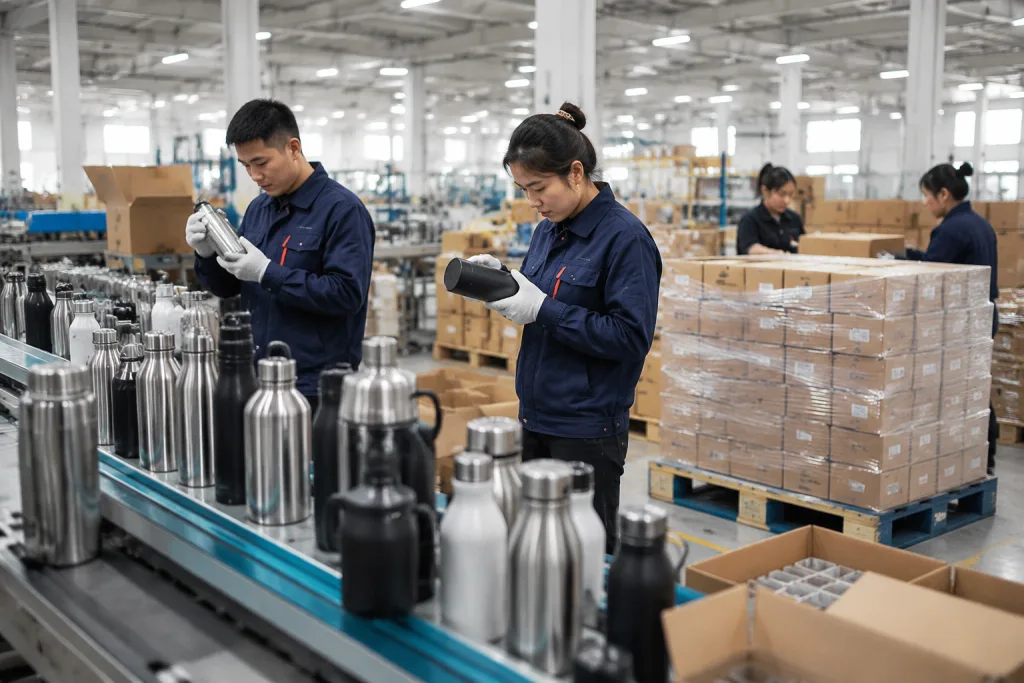
The right way to buy from China is to compare by use case, not by product name. In Zhejiang, we run mixed drinkware programs for retailers, distributors, and private label brands that need one shipment to cover canteen wholesale, bulk growler, and best wholesale drink bottle SKUs. A serious factory should quote by material, finish, insulation structure, and test standard, then spell out MOQ, lead time, and monthly capacity without side-stepping. Ours runs 300,000 units per month, with a normal MOQ of 1,000 pieces per color for most stainless SKUs. The math does not work any other way.
Compare by use case first
Buyers ask how to source drinkware in bulk. I ask one thing back: what job does the piece need to do? For stadium hydration, a bulk canteen or wholesale canteen spec with a wide mouth and carry loop beats a fancy finish. For outdoor retail, a bulk growler or beer growler bulk order needs thicker walls, a cap that seals, and a surface that survives 200 wash cycles. We had a buyer flag a 1.2 mm wall as "too light" on the first sample, and they were right.
Do not start with catalog photos. We compare dimensions, steel grade, and how the item gets used on the line. A 32 oz stainless drinkware bulk order can land at USD 1.10-1.80 FOB as a single-wall cup, or USD 3.20-5.60 FOB as a vacuum insulated tumbler, depending on liner thickness, cap design, and decoration. The math doesn't work any other way. In Zhejiang, quotes move faster when you spell out commuting, outdoor, hospitality, promotional, or alcohol service up front. QC pulled a sample with a 0.3 mm print shift last week; the buyer saw it in 10 seconds.
Use this split:
- Wholesale drinkware for promotions: low unit cost, fewer parts, faster run time.
- Wholesale growler for craft beer retail: insulation, a solid handle, and cap sealing matter.
- Alcohol flask wholesale bulk for gifting: polish quality and leak testing matter more than capacity.
Start here and the rest gets easier. The buyer once wrote "wholesale canter" on a PO, and we still had to ask which SKU they meant.
Read the spec table properly
A sourcing sheet is not decoration. It tells you fast whether the cup will hold up on the line. For any drinkware wholesale program, we run the table for material, wall structure, capacity, lid type, coating, logo method, test standard, MOQ, lead time, and FOB price. We once caught a PO typo that turned “0.5 mm” into “5 mm” on a run sheet; the buyer flagged it before sampling, and that saved a bad batch.
Here is the comparison that matters on the line:
- 304 stainless, single-wall: lighter, lower cost, fine for canteen bulk or event stock. We ship these with a 0.4 mm body on entry models.
- 304/316 vacuum insulated: the better call for premium wholesale drink bottle and beer tumbler bulk programs. The vacuum gap and cap torque are where the money goes.
- PP or Tritan lid: cheaper, but we check odor resistance and hinge life at the hinge pin. QC pulled a lid that cracked after 200 open-close cycles.
- Powder coat: holds up better than paint, and usually adds USD 0.25-0.60 per unit. A 60 mm tape rub test tells you more than a sales pitch.
Wall thickness needs hard numbers. A 304 body often runs 0.4-0.5 mm on entry-level items and 0.6-0.8 mm on heavier premium pieces. That gap shows up in dent resistance, net weight, and freight. QC pulled the sample on a 0.42 mm cup after a 1.2 m drop test left a flat spot near the base. For a beer growler wholesale bulk order, 0.7 mm with a wide mouth and secure cap is a solid baseline. For alcohol flask in bulk, the number that matters is leak rate under tilt and seal compression after 50 opening cycles. We’ve seen buyers push for the cheapest line item, then the math falls apart on freight and claims. Zhejiang suppliers who ship professionally show those figures; guessing is the wrong question to ask.
Price bands that actually help
Buyers burn days asking for “best price” before they lock the spec. Wrong question. We run into this on the line every week. A sourcing manager needs a price band that fits the build, not a lucky guess. For common wholesale canteen and wholesale drink bottle items from China, these FOB guideposts hold up: single-wall stainless bottles at USD 1.10-2.20, basic vacuum tumblers at USD 2.80-4.20, premium powder-coated tumblers at USD 3.90-6.50, and custom growlers at USD 4.80-8.90 depending on size and lid. A 500 ml bottle can sit 18% apart from a 750 ml build, and the gap comes from steel weight, not sales talk.
Four things move the number: material grade, decoration method, package build, and testing. Laser engraving usually beats multi-color print on small runs, unless setup wipes out the gap. Last month QC pulled a sample with a 0.35 mm lid gap, and that tiny miss would have sent the buyer straight into a return claim. A custom box, barcode label, and drop-test insert can add USD 0.15-0.45 per unit. If you need FNSKU for Amazon, count the label labor and the extra handoff time. We had one PO where the buyer wrote “matte blk” and the carton art still said gloss black; the line caught it before print, which saved a scrap run.
For beer tumbler wholesale bulk and beer tumbler in bulk programs, the unit math starts working at 3,000 pcs and up because print setup, tooling amortization, and carton loading all improve. That is where a Zhejiang factory with 300,000 monthly capacity matters: we ship without sitting behind tiny trial orders. A buyer once pushed back on a 2,000 pcs reorder because the first PO had a typo on the lid color, and the math does not work for a restart. The real question is whether your spec will hold for the next order. On 304 stainless, a 0.2 mm wall change can move the quote more than a week of email back and forth.
Do not let a low sample quote hide a high mass-production quote. The sample should prove the structure; the purchase order should lock the production spec.
Compliance is not optional
For Europe and North America, put compliance in the sourcing brief before you ask for price. We run it that way on the line. Do not bolt it on after the PO. A factory in China that ships clean should hand over FDA material declarations for the US, REACH for EU chemical limits, and LFGB where food-contact testing is required. For coated metalware, ask for heavy metal migration, coating adhesion, and dishwasher resistance when that channel needs it. QC pulled one sample at 65C water and the coating flaked at the rim. That shipment was done.
For stainless steel, ASTM and ISO references matter when you need repeatable test results for leak, impact, and temperature retention claims. This is the wrong question to ask if you only want the lowest unit price. If you are buying alcohol flask wholesale or alcohol flask wholesale bulk, get seal test results and material traceability before you send deposit. A flask that fails after 3 refills turns into chargebacks fast. We saw that go sideways on a 2,000-piece order because the buyer flagged a 0.5 mm gap at the cap. The math does not work.
Ask for these documents before deposit:
- Material declaration by component
- Third-party test report for REACH or LFGB if the destination requires it
- Carton drop test or transit packaging evidence
- BSCI or equivalent social audit status if your retailer requires it
Zhejiang factories that export every week know these terms. If a supplier in China hesitates on them, the risk is not abstract, it sits in your warehouse. We ship against this every month, and a typo on a PO for carton count or inner pack size can slow customs or trigger a rework at the packing table. We caught one PO with “24pcs/ctn” typed as “42pcs/ctn”; that was 18 days of mess, not 12. Plain fix. Ugly delay.
Choose the right product family
Not every sourcing program starts with a bottle. Some start with a tumbler, a canteen, or a growler. The channel sets the shape. A retail order usually wants the best wholesale drink bottle in 500-750 ml with one-hand operation. Hospitality and outdoor buyers often need a larger bulk canteen or insulated canteen bulk spec. Beer retail and taproom buyers should look at bulk growler and beer growler in bulk options with tight neck geometry and cap repeatability; we have seen a 1.5 mm neck drift turn into a pallet of complaints, so this is the wrong question to ask if the channel is still undefined. We ran that test on a caliper, and the buyer flagged it before packing.
Here is the blunt version:
- Choose a drink bottle when people carry it all day and refill it at the office, gym, or school.
- Choose a tumbler when desk use, coffee, and gift appeal drive the order.
- Choose a growler when volume, insulation, and beer service matter.
- Choose a flask when compact gifting and premium packaging matter.
For canteen wholesale programs, we run for easy cleaning and durable loops, not fancy shapes that jam up the line. For beer growler wholesale programs, wide-mouth filling and a closure that still seals after transport matter most. For bulk drinkware gifting, decoration quality usually beats a 2 mm body change in sell-through. QC pulled the sample on one run and flagged a pad-print shift of 0.8 mm; the buyer noticed it fast. If you are buying from China, ask for actual production photos, not catalog renders. In Zhejiang, a plant that makes these categories every week will know where defects show up: coating edge wear, lid fit, and carton crush.
Decoration changes the economics
Decoration is where sourcing budgets slip fast. We see it on the line every week. A brushed stainless body is usually the low-cost base, but once you add full-wrap screen print, laser logo, UV print, or a color-spray finish, setup time and scrap rate move fast. That changes the math for drinkware wholesale and for a premium wholesale growler program.
Match the logo method to the channel. Laser engraving stays clean on premium B2B gifts. Screen print is the workhorse for bold branding at scale. UV print gives more color, but it needs tighter surface control. On a 500 ml tumbler, a two-color logo might add USD 0.18-0.40 per piece. A full-wrap print costs more, especially on a tight curve; QC pulled the sample and found edge lift at the seam, so that piece was dead on arrival.
Ask the factory for decoration yield after 100 pieces, not after one sample. That is the right question. A decent supplier should tell you whether the decoration line can hold a 95%+ pass rate at the agreed color standard. We run this check before mass run starts, because a buyer once flagged a PO typo on the Pantone code and the whole batch had to be rechecked. For beer tumbler bulk and beer tumbler wholesale bulk orders, keep print placement clear of condensation zones and grip areas. For alcohol flask in bulk, mirror polish and laser engraving usually beat heavy print for gift channels.
Ordering from Zhejiang the smart way
Buying from Zhejiang is not just about circling a pin on the map. The value is on the line: one town cuts caps, another prints cartons, a third runs sleeve work. That setup can save 3 to 5 days on a clean order. We split sample lead time, mass production lead time, and packing slot into three lines because buyers keep asking where the time went. For standard drinkware, sample approval usually takes 7-10 days, production runs 30-45 days, and ocean booking adds another 7-14 days, depending on season. Our carton sealer runs at 18 boxes a minute, and that number matters more than a polished brochure.
When you source drinkware in bulk, start with stable SKUs. Same lid, same carton size, same steel grade across the color set. Keep it boring. The math works. We had a buyer flag a PO because one color used a 330 mm carton and the rest used 345 mm; QC checked the pallet count on the floor, and the totals did not match. A Zhejiang factory that ships mixed containers can split by SKU for North America or Europe, but the carton plan has to be fixed before the line starts, or you spend the week chasing rework.
Keep the commercial terms plain:
- FOB Ningbo or Shanghai for export clarity
- 30% deposit, 70% before shipment on standard terms
- AQL 2.5/4.0 for inspection unless your customer contract says otherwise
That is enough to keep the file clean. If you need a custom carton mark, barcode, or FNSKU labeling, lock it before production starts. We ran a 500 ml tumbler order last quarter, and QC pulled the sample to catch a barcode typo on the outer carton; fixing it after assembly cost us 2 days and one reprint on the thermal labeler. We've seen this go sideways, so this is the wrong question to ask after the line is packed.
What to ask before deposit
The supplier call should stay tight if the buyer is ready. We run this every week. A factory that knows wholesale drinkware will answer cleanly: exact steel grade, wall thickness in mm, tested capacity instead of nominal capacity, carton size, master carton qty, test reports on file, and whether the same color can be held for a repeat order in 60 days. One PO came through with “6000 pcs” typed as “600 pcs”; QC caught it before the line moved.
For a bulk drinkware or drinkware bulk program, ask for a live production photo from a current order. That beats a polished sales deck. If you are buying canteen wholesale, check lid fit and spare parts, because a 2 mm mismatch turns into a bin of complaints. If you are buying beer growler wholesale bulk, ask whether the weld or seam line is internal or external and how it is checked. If you are buying alcohol flask wholesale bulk, ask for leak testing at an incline, not just upright; we saw a 0.8 mm cap gasket fail on the tilt test.
The better suppliers in Zhejiang are direct about limits. They will tell you when a finish blows the target retail math, or when a shape slows mass production on the polishing wheel. This is the wrong question to ask: “Can you do it?” Ask what it costs, what the defect risk is, and what the MOQ is. A buyer once pushed back on the price, then the sample fell outside the cup gauge by 1.5 mm. That answer saves more than a low sample quote ever will.
Source your next bulk order with real specs
Send the capacity, finish, and target market. We will quote the right structure, not just the cheapest-looking bottle.
Frequently asked questions
What MOQ should I expect when I source drinkware in bulk from China?
For standard stainless items, a realistic MOQ is 500-1,000 pcs per SKU. Custom color powder coat often starts at 1,000 pcs, while simple stock finishes can sometimes open at 300-500 pcs. If you need mixed colors, many factories will still set 1,000 pcs per color family. In Zhejiang, a factory with 300,000 units per month can usually handle that without stretching lead time, but you should still budget 30-45 days after sample approval.
How do I compare bulk canteen and bulk growler pricing fairly?
Compare by structure, not only by volume. A single-wall canteen in stainless may land around USD 1.10-2.20 FOB, while a vacuum insulated bulk growler with a stronger cap and thicker wall can be USD 4.80-8.90 FOB. The difference usually comes from the vacuum process, lid design, and powder coating. If the quote does not separate body, lid, decoration, and carton, you are not getting a fair comparison.
What compliance documents should I request for Europe and North America?
Ask for REACH and LFGB where needed for EU food-contact sales, plus material declarations for each component. For the US, request food-contact material confirmation and relevant migration or finish test reports. If you need retail accounts, BSCI or equivalent audit status often matters. For drinkware wholesale, also ask for drop-test and leak-test evidence. Generic words like 'food grade' are not enough for a procurement file.
Is laser engraving better than screen print for wholesale drink bottle programs?
Not always. Laser engraving is durable and usually cleaner for premium or corporate gift channels, especially on stainless steel. Screen print is often cheaper for simple one- or two-color logos at scale. A two-color print might add USD 0.18-0.40 per unit, while laser may be more cost-effective once you factor durability and lower setup complexity. Choose based on brand position and expected wash cycles, not on habit.
What lead time should I plan for repeat orders?
For a repeat order with no spec changes, plan 30-40 days production plus shipping. If you change color, lid, or packaging, allow 35-50 days because the factory may need new material slots or decoration setup. In China, especially Zhejiang, repeat business moves faster when you keep the same carton size, same accessory set, and same logo method. That reduces the chance of delay and keeps unit cost stable.