Key Takeaways
- A 1,000-unit MOQ is standard for custom logo drinkware, but 3,000+ units unlocks 15-20% better pricing.
- 18/8 stainless steel costs ~$0.40 more per unit than 18/0 but is mandatory for acidic beverage compliance.
- Lead times in Zhejiang typically run 25-35 days; rush orders under 15 days incur a 20% surcharge.
- Double-wall vacuum insulation adds 40% to the production cost compared to single-wall bottles.
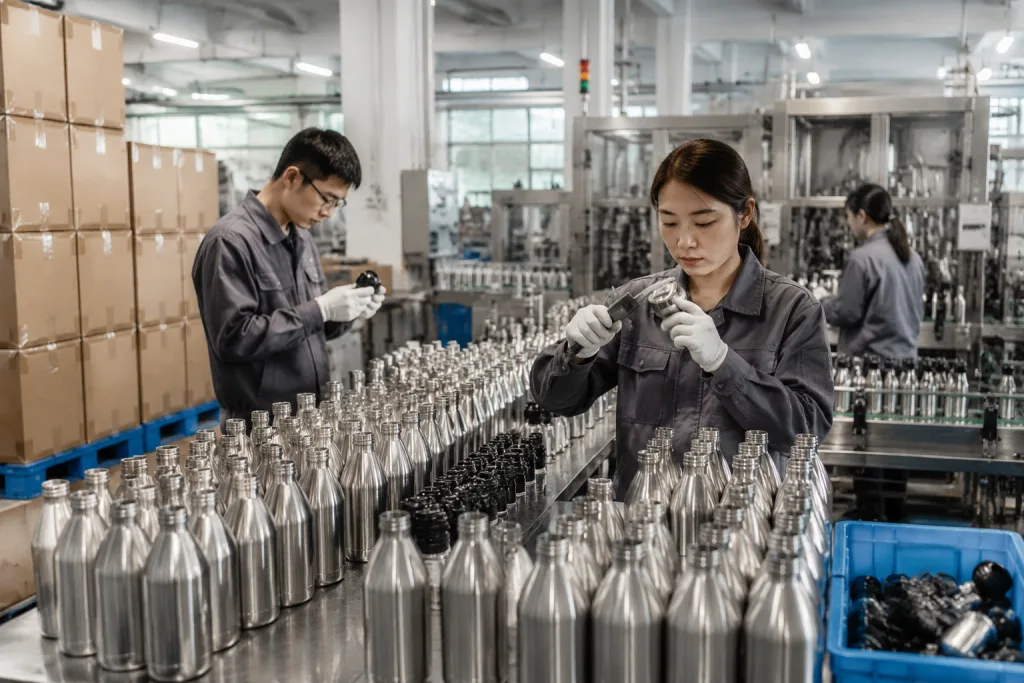
Source drink bottle wholesale for a new line, and the catalogs blur fast. Same claim. Same lightbox shot. The spec sheet is where the truth sits. A buyer pushed back on a 0.4mm vs 0.6mm wall callout until QC pulled the sample and the drop mark showed up after 3 falls. We run a caliper on the line for that check. Zhejiang still holds a big share of this work, but a plant with a polished brochure is not the same as a line that holds tolerance on 64oz caps and 12oz kid bottles.
This guide breaks the job down by material grade, production limits, and landed cost. Start with copy, and the math doesn't work. We will look at the numbers that matter on the floor—MOQ, lead time, unit price bands, and the typo that showed up on a PO for 5,000 pcs—so you can source bulk canteens for outdoor retail or alcohol flask wholesale with fewer surprises. The buyer flagged it, and we fixed it before the run.
Material Grades: 18/8 vs 201 Stainless
Stainless grade decides most of the risk. Full stop. We source drink bottle wholesale on 304 (18/8) or 201, and the gap is not subtle: 201 runs about 20% cheaper per ton. That looks fine on a quote sheet. It goes sideways in humid warehouses or with acidic fills like juice, because the lower nickel and higher manganese content bring rust spots out fast. We saw it on a 25 kg coil once, right after a buyer pushed back on price.
For retail and outdoor buyers, 304 (18/8) is the grade we push. It clears LFGB and FDA food-contact requirements, and QC pulled a cup after a 48-hour salt-spray check with no red marks on the weld seam. If you are sourcing a bulk canteen for hiking or camping, this is the wrong question to ask: the real issue is whether the bottle still looks clean after 12 months in a damp pack. A rusty return costs more than the $0.35 per unit you saved. For a wholesale growler for craft beer, 304 keeps the taste stable and the carbonation where it should be. We ship these all the time.
Cost-Benefit Analysis
- 201 Stainless: Best for short-run promo orders. MOQ is often 500 units. We have seen rust spots after 3 to 6 months of daily use, especially on thin-wall bottles. The line shows it first at the weld.
- 304 (18/8) Stainless: Standard for retail programs. Better corrosion resistance. Needed for vacuum-insulated bodies that have to hold shape after the drop test. That is the safe call.
- 316 Stainless: Used only when the buyer has medical, saltwater, or strong-acid requirements. It adds about $1.00+ to unit cost, and most drinkware programs do not need it. We only quote it when the spec really calls for it.
Always ask for a material test report (MTR) from the factory. We tag every coil of steel in our Hangzhou plant with a lot number, and that traceability matters when the buyer flags a PO typo or a claim shows up 8 weeks later. Smaller workshops skip it to save time. The math doesn't work. One missing digit on a PO can turn into a lost week on the line.
Insulation Types: Single-Wall vs Vacuum
Pick single-wall or vacuum first. That call sets the buyer profile, carton count, and how the line gets packed. Single-wall bottles are light, cheap to ship, and easy to push through a 10,000-piece MOQ. They fit corporate giveaways, trade show handouts, and short-use hydration jobs. We ran 50,000 pieces in 15 days on a clean single-wall order, and QC pulled the sample with no sweat-ring test needed. The catch is plain: they sweat, they do not hold temperature, and a 0.6 mm dent shows up fast after one drop.
Vacuum insulation is the workhorse for the best wholesale drink bottle retail program. We weld two walls, pull the air out, and seal the neck; that thermal gap keeps the bottle hot for 12 hours or cold for 24 hours. On a typical drinkware bulk run, lead time lands at 30-40 days, and the math does not work if the buyer wants retail specs at giveaway pricing. We've seen this go sideways when the buyer flagged a PO typo on the vacuum color code, then blamed the seal test. AQL 2.5 or 4.0 is normal here, because a failed vacuum seal means a real reject, not a cosmetic one.
Pro Tip: If the market wants retention but the budget is tight, use copper-lined vacuum insulation. On our bench test with the thermal meter, it lifted performance by 10-15%, and you can sell a pro grade without changing the bottle shape.
Product Category Showdown: Flasks vs Growlers
Start with use case and fill volume. The alcohol flask wholesale line is for pocket carry and gifting. We run 6oz and 8oz stock sizes every week, and a 180mm x 95mm flat body still moves best with buyers who want a clean shelf look. On the line, the finish does the selling: mirror polish, leather wrap, or a curved hip shape that sits clean in the hand. Material use stays low, so unit price stays sharp. The cap is where the trouble starts. Captive tops and hinged lids need tight QC, and QC pulled the sample for a 0.8 mm gap on the hinge. A leaking flask comes back fast.
The beer growler wholesale side serves craft breweries and homebrew buyers. Common sizes run from 32oz to 128oz, or 1 gallon. Here the seal and pressure tolerance matter more than looks. A beer tumbler wholesale order often asks for a pressure-release lid so carbonation does not bleed off in transit. These units are heavy, so freight from China climbs faster than buyers expect. We ship a lot of these, and the buyer usually flags the same point: the swing-top grade. Cheap ceramic tops crack in transit. Stainless steel tops hold up better, but they add $0.50-$0.80 to the bill of materials. The math doesn't work any other way. We saw one PO typo turn 64oz into 46oz, and that shipment had to be reworked before loading.
| Feature | Flask (6-8oz) | Growler (64oz) | |||
|---|---|---|---|---|---|
| Primary Use | Personal / Gifting | Social / Brewery | |||
| Wall Type | Single or Double | Double Wall Vacuum | |||
| Key QC Point | Lid Seal / Finish | Pressure Retention | Avg FOB Cost | $1.50 - $3.00 | $4.50 - $8.00 |
Surface Finish and Branding Techniques
The exterior finish sets the look and the wear life of the branding. Powder coating stays our main pick for wholesale drinkware because it gives a matte grip, takes Pantone color well, and hides the 1 mm scuffs that show up after packing. It adds one more step on the line, about 12 minutes per 1,000 pcs. We had a buyer ask for raw stainless with laser engraving because the ship date was tight, and that was the right call. Laser marking is permanent, looks clean, and leaves the steel showing through.
For a wholesale canteen or outdoor bottle, a textured paint finish gives better hold when the bottle is wet. For alcohol flask in bulk orders for corporate gifts, screen printing keeps the logo cost down on runs of 500 pcs and up, but the ink has to be cured right or it scratches off in transit. QC pulled the sample last week and found a soft print after the oven sat at 165°C instead of 180°C. The buyer flagged it, and they were right. In Zhejiang, the curing oven is often the bottleneck. This is the wrong question to ask if someone says the finish is “basically the same” across factories.
Costing needs the setup fees in black and white. Screen printing has low setup cost, but the price climbs with each extra color. Transfer printing, or water decals, can carry full-color art, but it runs slower and usually adds 0.15 to 0.30 USD per piece. On one PO, we saw a typo on the art file name, and the line printed the wrong Pantone twice before the buyer stopped it. That kind of error burns time fast.
Logistics: FOB vs DDP Pricing Models
Incoterms move landed cost more than the unit price on the quote. We see it on the line every week. FOB is the usual start: we hand the cartons to Ningbo or Shanghai for Zhejiang shipments and clear export customs. The buyer books ocean freight, insurance, import duty, and inland trucking. That keeps control on the carrier and sailing date, and it usually wins when the forwarder knows the lane. A buyer once flagged a PO typo that changed the port code from Ningbo to Nbo; the rate sheet blew up in one afternoon.
DDP fits smaller orders and first-time buyers better. The supplier takes the load to your warehouse door. Clean on paper. The math does not lie, though: supplier margin sits in the shipping quote, and it shows fast once carton weight climbs. For a beer growler in bulk or other heavy drinkware bulk items, weight changes the number fast. A 64oz stainless steel bottle weighs about 400g empty. At 1,000 units, that is 400kg. At 10,000 units, you are into full container load (FCL) territory if you want sane freight. LCL (Less than Container Load) often looks cheap until the per-cubic-meter rate lands. QC pulled a sample at 398g on our scale once, and the buyer still pushed back on DDP because the landed price came in 12 days behind FOB on a clean FCL booking.
Quality Control Standards and AQL
Do not trust a factory's internal QC on its own. Lock the AQL before production starts. For drinkware, we run AQL 2.5 for major defects like leaks, sharp edges, and wrong size, and AQL 4.0 for minor defects like small scratches or slight color variance. If we are shipping a beer tumbler in bulk for a brewery client, a leaking lid is a hard fail. A faint mark on the base is a different call. QC pulled the sample with a 0.02 mm feeler gauge, and that is the kind of check that stops a buyer from arguing after cargo leaves Ningbo.
SGS or Intertek usually charge about $300-$400 per man-day in Zhejiang. A normal inspection takes 1-2 days, depending on order size and how messy the line is. We saw a buyer flag a 5,000 pcs PO because the factory mixed 304 and 201 coils to save a few cents a unit. The math does not work. A magnet test is a fast check—304 stainless is non-magnetic, while cheaper 201 is magnetic—but only a spectrometer tells you the alloy composition with confidence.
Common Defects to Watch
- Vacuum Failure: The bottle loses insulation. Pour hot water, then check the outer wall after 5 minutes. If the shell warms fast, we stop the line.
- Welding Marks: Visible seams inside the bottle. That hurts cleaning and gets called out in inspection, especially on cups with a 0.3 mm inner polish spec.
- Printing Alignment: Logo shifted by >1mm. Looks sloppy. We had a buyer reject a PO because the artwork file said 1.2 mm off-center and the sample came in at 2.1 mm.
Packaging for Retail vs Industrial Use
Packaging is the last line item buyers argue over, right up until a pallet shows up with dented corners. If you are a distributor moving canteen bulk into industrial supply stores, we run 50-pack or 100-pack cartons every week. That keeps cube down and freight sane. For a brand owner selling on Amazon or into retail boutiques, single-unit gift boxes are the default. A plain white box adds $0.10-$0.15 per unit. A custom printed color box adds $0.30-$0.60. The math does not work any other way. On the line, we check carton size in mm before we print the label.
Amazon FBA has its own rules. Suffocation warnings. Scannable barcodes. No guessing. If you source wholesale growler products for online retail, the box has to hold up to courier abuse, so we spec double-wall corrugated cartons and QC pulled the sample from 1 meter during the drop test. The buyer flagged a crushed corner on the first run, and that is the kind of miss that turns into returns fast. A typo on the PO for carton count can do the same. We have seen 12 days of delay turn into 18 days after one bad carton code.
Ready to Source High-Quality Drinkware?
Discuss your specs with our engineering team. We provide transparent pricing and detailed timelines for your next order.
Frequently asked questions
What is the standard MOQ to source drink bottle wholesale?
For custom logo printing, the standard MOQ is usually 1,000 units per color. For stock colors without printing, you might find MOQs of 500 units or less. If you are ordering a specific pantone color powder coating, expect an MOQ of 3,000 units to justify the line setup. Some factories in Zhejiang offer 'trial orders' of 200-300 units at a premium price to test the market.
Can I get a sample before placing a bulk order?
Yes. Most factories provide existing samples for free, with the buyer paying freight (approx $30-$50 via DHL/FedEx). For a custom sample with your logo, expect to pay a setup fee of $50-$100 and wait 5-7 days. Never commit to a large bulk drinkware order without approving a golden sample first.
How long does production take for a wholesale canteen order?
Standard lead time is 25-35 days after deposit payment and artwork confirmation. This includes material sourcing, forming, welding, polishing, and printing. Peak season (August to November) in China can extend this to 45-50 days. Rush orders (15 days) are possible but typically incur a 20% expedite fee.
Are there specific certifications required for exporting to Europe?
Yes. For the EU market, LFGB certification is the gold standard for food contact materials, stricter than FDA. You also need REACH compliance for the paint and coating. If you are selling a bulk growler for beer, ensure the product is tested for specific migration limits. Request the test reports from the factory; valid reports cost $200-$500 to generate if not already on file.
What payment terms are standard for drinkware wholesale orders?
The industry standard is 30% deposit via T/T (bank transfer) and 70% balance before shipment. For repeat customers with established trust, terms may shift to 30% deposit and 70% against copy of B/L (Bill of Lading). L/C (Letter of Credit) is used for very large orders exceeding $50,000. Be wary of suppliers asking for 100% upfront payment.