Key Takeaways
- Collapsible silicone bottles offer 40% space savings but require 1.0mm+ wall thickness to maintain shape.
- Food-grade LFGB-certified silicone costs 15-20% more than standard FDA-grade but reduces compliance risks in the EU.
- Hybrid designs (silicone body + stainless base) allow for premium pricing and better stability.
- Standard MOQ for custom silicone molding is 3,000 units; stock designs often have a 500-unit entry point.
- Lead times for custom silicone drinkware average 35-45 days due to long curing cycles.
Demand for flexible, light hydration gear has climbed. Silicone packs down in a way stainless steel and glass never will. One buyer cut carton weight by 18% after switching to a 450 ml foldable bottle, then the first PO carried a 2 mm cap typo and QC pulled the sample off the line. For silicone water bottles wholesale, shape is not the hard part. Wall stability, smell control, and whether the bottle survives 5,000 folds are where deals get won or sent back. A weak batch gets returned fast.
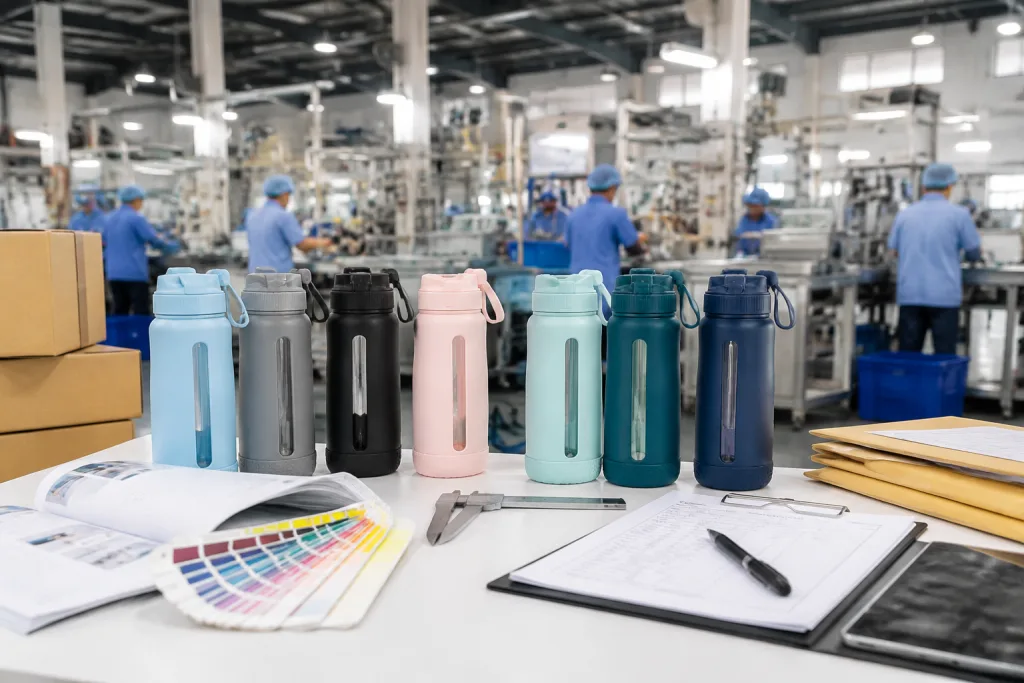
From our Hangzhou shop floor, we run these bottles through the same checks we use on other bulk drinkware: drop test, seal test, and a 24-hour odor check after boiling water. The bench gauge read 1.8 mm wall thickness, and that number matters more than a glossy rendering. We have narrowed the field to five bottle builds that ship cleanly, with mold cost, MOQ, and gross margin in view. This is the right question to ask: which SKU can the line make cleanly and your buyer can sell without drama. If you are comparing a bulk growler substitute with a compact sports bottle, this guide breaks down wall thickness, sealing parts, and FOB math in plain terms.
1. The Foldable Sports Bottle: Best for Portability
Buyers ask for this first in silicone water bottles wholesale. We ship it to hikers, gym chains, and promo buyers who want a bottle that folds flat and still holds its shape on shelf. Empty, it collapses into a disc. On the line, QC pulls the sample and checks rebound with a press gauge. If the wall drops under 0.8mm, the bottle goes limp and tips over.
We run 1.0mm to 1.2mm on the body. That gives the base enough bite to stay upright, and cheap drinkware wholesale imports get exposed fast here. The locking lever on the cap is not optional. Friction-fit lids look cheaper for a reason. We saw one pop open in a backpack after a 3 km run, and the buyer was right to flag it. The math does not work.
Production Specs
- Standard Capacity: 500ml to 750ml.
- MOQ: 1,000 units per color.
- FOB Ningbo Price Range: $1.80 - $2.60 USD.
For outdoor retail, this bottle gives good volume-to-weight efficiency. We ship it clean, but cartons need tighter packing than rigid bulk canteen orders because folded bottles still trap air if the inner sleeve is sloppy. One buyer flagged a PO typo on carton count, and that extra headspace pushed freight up 12%.
2. The Silicone Sleeve Hybrid: Best for Brand Perception
If your buyer wants a premium lifestyle shelf, not a light hiking rack, the hybrid is the cleaner quote. We run a borosilicate glass or Tritan inner bottle inside a colored silicone sleeve, and that wipes out the "plastic taste" complaint we hear on full-fold bottles. For office gifting, this is the best wholesale drink bottle line to put on the table. Clean and simple.
The sleeve gives grip and takes the hit. In our Zhejiang plant, QC pulled the sample, we dropped it from 1.2 meters onto concrete, and the good sleeves held while the weak ones split at the rim. One buyer flagged a sleeve sitting 2 mm off-center at the seam, so alignment is not a cosmetic issue. You can print on the inner bottle and deboss the sleeve, which gives you two brand hits from one SKU.
Compared with a standard wholesale canteen, this piece feels heavier in hand, and that is the point. We have seen it move at a 30% premium over a basic foldable bottle, and the MOQ stays sane because the inner vessel is stock while only the sleeve needs new tooling if you want a custom texture. A PO typo once came in as 5000 instead of 500, and that kind of mistake will clog the line fast. The math does not lie.
Production Specs
- Standard Capacity: 400ml to 600ml.
- MOQ: 500 units.
- FOB Ningbo Price Range: $2.50 - $3.80 USD.
3. The Wide-Mouth Beer Growler: Best for Beverage Storage
Craft beer buyers want a container that takes a drop and still seals under pressure. A silicone beer growler wholesale model is a reinforced foldable bottle with a real closure, not a soft jug with a cap slapped on. We run swing-top samples with a threaded cap, a silicone gasket, and a locking wire bail on the bench. Friction caps fail fast.
For a bulk growler order, the first number we ask for is pressure rating. Fermentation pushes hard, and QC pulled the sample when the base started to balloon after repeated squeeze tests. We use 1.5mm walls on the bottom. The buyer flagged a 2mm typo on the PO once, and that tiny mismatch turned into a week of back-and-forth. Treating it like a scaled-up water bottle is the wrong move.
Distributors adding this next to beer tumbler wholesale lines get a cleaner story at retail. It sells for kombucha and cold brew too, so one mold covers three drink programs. The fold-down shape helps after a taproom visit. Darker silicone, especially black or navy, blocks more light for hop-forward drinks; we saw clear samples come back with color complaints after 12 days on a shelf under store LEDs.
Production Specs
- Standard Capacity: 1L to 2L (32oz - 64oz).
- MOQ: 500 - 1,000 units.
- FOB Ningbo Price Range: $3.20 - $4.50 USD.
4. The Collapsible Shot Flask: Best for Compact Carry
Niche buyers need niche gear. The collapsible shot flask, often searched as alcohol flask wholesale, fits concert gates, camping checklists, and festival bags. A rigid stainless steel alcohol flask in bulk eats pocket space. This silicone version rolls flat and slides into a jacket pocket. We ship tooling samples in 12 days versus 18 days for the first metal run. Margins are decent. Volume is not. The line tells you that fast.
The cap is the weak point. We run this line with a pull test at 15N, and cheap press-fit caps fail fast. One buyer flagged a missing cap on PO line 3, typo and all, so we moved to tethered lids with a silicone loop bonded to the body. That is the right call. If someone wants the cheapest lid, this is the wrong question to ask. Platinum-cured silicone matters here, or spirits pick up off-flavor after 3 fills.
For procurement teams, this is a clean add-on to a bigger drinkware bulk order. Same raw material, different molds, no drama on the line. QC pulled the sample at 1.2mm wall thickness and the drop test held. It gives brands a lower-risk entry into the alcohol flask bulk market before they commit to the heavier MOQs that come with metal flasks. The math works, and we have seen the metal version go sideways on first article sign-off.
Production Specs
- Standard Capacity: 150ml to 250ml (5oz - 8oz).
- MOQ: 1,000 units.
- FOB Ningbo Price Range: $0.90 - $1.50 USD.
5. The Kids' Squeeze Bottle: Best for Family Retail
Silicone is soft by nature, so it fits kids' drinkware. The squeeze bottle stays on the order sheet for canteen wholesale runs to school stores and family retailers. Small hands like the feel. A bottle still has to act like a bottle. We check the spout first. It needs to be one-piece molded, not a loose plastic insert that QC can yank out with a simple tug test.
We run these with a squishy outer texture. That usually means a second molding step or a textured mold plate, and the line needs clean venting or the finish prints poorly. For canteen bulk orders for kids, LFGB or FDA is the baseline, and we ask for a heavy metal report before we cut steel. The buyer flagged blister packs, and that pushback made sense—retail shelves move these faster in sealed packs than in plain polybags.
This range still has to beat cheap plastic, and that is the wrong question to ask. Parents who want BPA-free gear care about the bottle they can wash and reuse, not the one that cracks after three drops. We saw it go sideways when a seller tried to save 8 cents on a PO typo and lost the order.
Production Specs
- Standard Capacity: 250ml to 350ml.
- MOQ: 1,000 units per color.
- FOB Ningbo Price Range: $1.60 - $2.40 USD.
Critical Sourcing Checks: Odor and Certification
Silicone quality swings a lot. We saw a 500 ml bottle pass visual check on the line and still fail odor after 24 hours in a sealed PE bag. The buyer flagged it as a return risk. Cheap silicone turns chemical once it warms in transit or sits in the sun. That is where silicone water bottles wholesale orders start going sideways.
For factory audits in Zhejiang or anywhere else, run the smell test on one sealed sample, then open it after 24 hours and again after a 200°C bake-out. Check the report code line by line. FDA-grade and LFGB-grade are not the same, and LFGB is the stricter ask for Europe. A 3.2 mm wall bottle can still fail if the resin mix is off. This is the wrong question to ask: how cheap can the silicone be? The math does not work.
Buyer Tip: Always ask for a bake-out sample. We have seen shops wash silicone with scented cleaner before QC pulls the sample, and that hides the odor for a day or two. Heat the piece to 200°C for 2 hours, then smell it again. That tells you what we ship, not what a polished sample card says.
Tooling and Customization Costs
Silicone tooling costs less than stainless steel tooling, but the mold does not live as long. We run an aluminum mold for a foldable bottle at $2,000 to $4,000, and the line usually gets 50,000 to 100,000 cycles before wear starts to show. That is the math. A buyer once pushed back on a 3 mm wall spec because the first PO typo read 30 mm; QC pulled the sample, checked it with calipers, and the mistake was obvious in 2 minutes.
Customization is not only the mold. Debossing holds up best because the logo sits in the silicone and stays put in shipping. Screen printing works on flexible bodies, but we have seen it peel after repeated folding, so this is the wrong question to ask if the mark has to survive daily use. For a wholesale growler or any bottle with a hard plastic cap, we can print both sides of the cap for a small extra charge, and the MOQ for that add-on is usually low enough to keep the order moving.
Flash is the thin silicone edge left on the parting line. A clean shop sends it through cryogenic deflashing or trims it by hand with a knife jig, and the buyer flagged it fast when the edge felt sharp on a 1.5 mm seam. If flash shows up in bulk, the tooling setup or QC is weak. We have seen that go sideways on export orders before.
Logistics: Shipping Soft Goods Efficiently
Silicone ships as soft volume. That is the problem. A 20ft container of rigid beer tumbler bulk orders holds more value per cubic meter than folded silicone bottles, because the cartons trap air and the cube fills fast. We run a carton test on the line first, then lock the height at 240mm and the bottle count per carton. On one load, that cut cubic volume by 27% and saved 8 CBM.
Transit climate matters too. Silicone picks up odor fast. Do not put silicone drinkware bulk next to chemicals, tires, or strong-smelling food in the same container; QC pulled a sample once and the buyer flagged a rubber smell before the cartons were even opened. Use inner polybags at 0.05mm or thicker, and ask for fresh pallet wrap on loading day. The buyer saying "odors are rare" is the wrong question to ask. We've seen that go sideways.
Lead time is usually shorter than for stainless steel vacuum flasks, but silicone still needs curing time. For a standard wholesale drinkware order, plan on 30-35 days from sample approval to ship date. Rush jobs can move, but the math changes fast once you add 2 hours of overtime on the molding line and a second QC check at packing. One PO typo on carton marks cost us a full day once, so confirm the shipping name and carton count before release.
Ready to source high-quality silicone drinkware?
Contact our engineering team in Hangzhou to discuss mold specs, material grades, and pricing for your next order.
Frequently asked questions
What is the minimum order quantity (MOQ) for custom silicone bottles?
The standard MOQ for custom silicone bottles is typically 1,000 to 3,000 units per color. This is because the vulcanization process requires a full oven load to be energy efficient. For stock designs with simple logo printing, we can sometimes accept orders as low as 500 units. However, for a fully custom mold, you should budget for the higher MOQ to amortize the tooling cost effectively.
Can silicone water bottles handle hot liquids safely?
Yes, food-grade silicone is heat resistant up to 230°C (446°F). You can safely pour boiling water into them. However, the heat will transfer through the silicone walls quickly. If you intend to sell bottles for hot beverages, we strongly recommend adding a 'sleeve' or using a thicker wall gauge (1.5mm+) to protect the user's hands from burns. Always verify that the cap material (usually PP plastic) is also heat resistant.
How do I ensure the silicone does not retain flavors or odors?
Material purity is the deciding factor. Platinum-cured silicone is non-porous and resists flavor retention, whereas peroxide-cured silicone can retain smells over time. We exclusively use platinum-cured silicone for all our <strong>silicone water bottles wholesale</strong> production. Advise your end-customers to clean the bottles with lemon juice or baking soda periodically to remove any surface buildup.
Are silicone bottles dishwasher safe?
Most are, but it depends on the cap assembly. The silicone body itself is completely dishwasher safe (top rack recommended). The issue lies with the cap mechanism, which may contain a stainless steel pin or a plastic valve that could degrade in high heat. We recommend hand-washing the cap to extend its lifespan, though the bottle body can go in the machine.
What is the difference between debossing and screen printing on silicone?
Debossing creates a recessed impression in the silicone surface using a heated die. It is permanent and does not rub off, making it ideal for branding. Screen printing applies ink to the surface. Because silicone is flexible and non-porous, ink adhesion is difficult; screen prints can peel or flake off after repeated use or washing. For premium <strong>wholesale drinkware</strong>, we always recommend debossing for longevity.