Key Takeaways
- FOB silicone bottle pricing usually lands between USD 1.65 and 4.20 per piece at 1,000 to 5,000 pcs
- Most custom drinkware projects add 7 to 12 days for samples and artwork confirmation
- A molded logo or custom cap can raise unit cost by 8% to 22% depending on cavity complexity
- For Europe and North America, ask for REACH, FDA-grade materials, and AQL 2.5 inspection before you place the order
Buying from a silicone water bottles supplier looks easy until the quote lands on your desk. Then the math breaks. One factory throws out a low unit price with a 60-day lead time. Another looks faster, then hides tooling, printing, and packaging in the sample bill. We have watched buyers miss a 12-day vs 18-day proofing gap because nobody asked what sat inside the number.
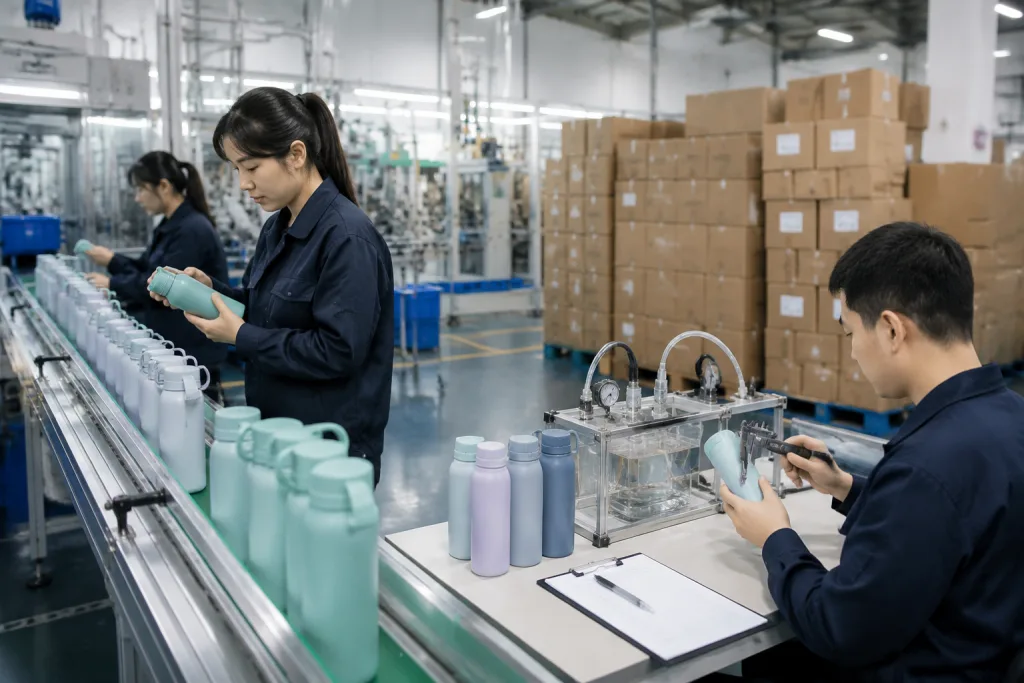
We run this from Zhejiang, and the same pattern shows up across China: a cheap quote turns into the expensive PO once you add silicone grade, cap hardware, logo method, compliance testing, and carton structure. Unit price alone is the wrong question to ask. A solid canteen factory should quote MOQ, sample time, bulk lead time, and monthly output on the first call. At BottleForge, QC pulled the sample with a caliper at 1.2 mm wall thickness, our drinkware line runs at 250,000 units per month, MOQ starts at 1,000 pieces per SKU, and standard lead time is 25 to 35 days after sample approval.
Where the price actually moves
If you buy from a silicone water bottles supplier, the quote shifts on five points: silicone grade, wall thickness, cap construction, decoration method, and packaging. The body is only part of the number. A plain 500 ml silicone bottle with a PP lid lands around USD 1.65 to 2.20 FOB Ningbo or Shanghai at 1,000 pieces. Add a stainless-steel inner ring, a flip cap, or a leakproof lock, and the price jumps into the USD 2.60 to 4.20 band fast. We ship this every week. A buyer once typed “500ML” as “50ML” on the PO, and the sample sign-off sat for two days while we checked whether it was a typo or a new spec.
Wall thickness moves the math more than most buyers expect. A 1.8 mm wall works for light promo use, while 2.4 mm to 3.0 mm gives a stiffer hand feel and better collapse resistance for a custom drinkware run. Thicker silicone means more raw material and slower molding on the line, so unit cost rises and daily output drops. We run 2.4 mm on a lot of export bottles because the thin-wall quote looks clean until QC pulled the sample and the sidewall folded in a squeeze test. This is the wrong question to ask if the only target is a low unit price. Ask for cross-sections, not just renderings.
Decoration is another clean cost driver. A one-color silkscreen logo can add USD 0.08 to 0.18 per piece. Laser engraving on a stainless accent may add USD 0.12 to 0.30. A full mold-color match or custom relief logo changes the tooling conversation entirely, especially for a canteen customized program or a custom growler format. If the logo has to survive 12 months of handling, the cheap mark usually fails first. On one job, the buyer pushed for a soft-touch print, then asked for abrasion resistance after the third rub test failed at 500 cycles. The math doesn't work if you want low cost and permanent branding.
- Body material: food-grade silicone, platinum-cured silicone, or silicone with PP/SS hardware
- Tooling: flat logo, embossed logo, special lid, or full new mold
- Packing: polybag, color box, mailer, or FNSKU-ready retail pack
- Compliance: REACH, LFGB, FDA, and migration test requirements
MOQ tiers you can plan around
The MOQ line is where a lot of canteen suppliers lose the order. Buyers want room to move; we need stable runs. On our line, 300 to 500 pcs works for stock-color, stock-lid sampling, or distributor drinkware with existing tooling. Once you move into custom color, custom print, or a canteen distributor program with private label, 1,000 pcs per SKU is the floor we usually quote. For a fully customized growler or nonstandard shape, 3,000 pcs is where the numbers stop getting messy. QC pulled a 500 ml sample last week and the buyer flagged a 2 mm print shift. That miss costs real money.
Do not treat MOQ as a wall. It is a pricing switch. If you order 1,000 pieces in one color, your per-unit price is usually 12% to 18% lower than a split-color order of the same quantity because the line skips an extra setup. We have seen this go sideways when a buyer splits 600/400 across two lids and then asks why the quote jumps. If you are running multiple canteen customized variants for different sales channels, keep the body the same and change only the lid or sleeve. A canteen vendor in China can run that pattern without hurting output, and the carton count stays easier to control. The die-cut sleeve tool is where the time goes, not the logo art.
For a canteen factory in Zhejiang, the right question is not “Can you make 200 pieces?” It is “Can you make 200 pieces at a price I can resell?” This is the wrong question to ask if you want a usable quote. For a distributor canteen buyer, a lower MOQ can work for a market test, but the landed cost usually rises by 20% to 40% versus the 1,000-piece bracket. We shipped a PO with “1OOO” typed as “1000” and the buyer still had to recheck the unit price; one sloppy digit can turn into a week of back-and-forth. The math does not work if the MOQ is too low.
Ask for MOQ by configuration, not by category. A plain 500 ml silicone bottle, a printed bottle, and a retail-boxed bottle are three different purchasing problems.
Lead time from sample to shipment
Lead time has three clocks: sample approval, production, and freight booking. We run the sample room first. For a standard silicone bottle on existing tooling, QC pulled the first piece in 5 to 7 days. If the buyer wants a new logo plate, a cap color swap, or a packaging proof, plan on 7 to 12 days. A PO typo on the artwork file can burn a day fast. That delay usually starts on the buyer side, not the line.
Bulk lead time after sample sign-off and deposit is usually 25 to 35 days for orders up to 5,000 pieces. We have seen it stretch to 40 to 55 days when the job needs a new mold or a more complex canteen customizable structure. The wrong question is “How fast can you ship?” The better one is whether the pack-out is locked, because molding can finish on time and the line still waits for cartons, inserts, or test approval. One missed carton spec can hold 12 pallets. We saw that go sideways on a 3 mm insert, and the math does not work.
Freight adds its own lag. Air freight can save a launch date on a small batch, but the math does not work if the bottle margin is thin. Sea freight from China to the U.S. West Coast or Northern Europe usually needs another 18 to 35 days, depending on the port and booking window. We ship plenty of Amazon loads, and the buyer flagged it when the FNSKU label was still changing after production. That fix belongs before the cargo leaves Zhejiang, not after it hits the warehouse. On one 20 kg carton run, QC caught the label mismatch before loading, which saved a rework bill.
- Sample stage: 5 to 12 days
- Production stage: 25 to 55 days
- Ocean transit: 18 to 35 days
What compliance buyers should check
For Europe and North America, a clean quote is not enough. The paper trail has to match the market. Ask your silicone water bottle supplier for REACH declarations, food-contact compliance, and, where needed, FDA or LFGB test support. One buyer flagged a PO because the cap ink was missing from the report. Silicone can pass. The cap, seal, print, and even the polybag can fail the job. Check the whole pack, not just the body. That is the wrong question to ask if you stop at the raw part.
Inspection matters just as much. For repeat orders, we run AQL 2.5 for major defects and AQL 4.0 for minor defects on appearance-heavy retail programs. On one line, QC pulled the sample and found a 1.2 mm flash edge at the lid seam; that turns into a return in the field. If the bottle goes to distributor promo stock, a little cosmetic spread is fine. Gift retail and premium e-commerce do not give you that room. Leakage testing should be fixed: at least 30 minutes inverted at 40 degrees C for batch checks, and longer only when the lid has moving parts. The math does not work any other way.
The clean way to handle compliance is simple: confirm the destination market first, then lock material and decoration after that. A supplier who asks about the country before quoting is thinking like an exporter. A vendor who skips it is thinking like a local job shop. We ship both ways. The first one is the safer call, especially when the carton leaves Zhejiang for the EU or the U.S. A typo on the PO for the destination can cost a week.
Choosing the right bottle format
Silicone bottles are not one product. We run collapsible travel bottles, rigid bottles with silicone sleeves, hybrid canteens, and insulated-style custom growler formats, and each one solves a different buying job. A collapsible bottle is lighter for promo travel kits. A rigid canteen sits better on shelf and packs cleaner in a retail box. A custom growler works for outdoor, gym, or beer channel programs, but the lid, gasket, and wall structure need to take rough handling. On the line, a 28 mm cap test can fail on a weak thread before the first carton is sealed.
If you are a canteen distributor, pick the format that fits your channel, not the sample price. That is the wrong question to ask. For distributor canteen programs, 500 ml to 750 ml usually moves best because the carton rate stays sane and the shelf price does not scare the buyer. For a canteen promotional giveaway, 350 ml or 400 ml keeps freight down. For private label custom drinkware, we push body shapes that can share caps and seals across SKUs, because one loose gasket at MOQ 3,000 turns into spare-part mess later. We have seen that go sideways. The buyer flagged a 0.5 mm mismatch on a cap sketch, and the whole PO needed a redraw.
One practical test: hold the bottle, close the cap, shake it, then drop it into a box and see how much it moves. If the unit feels fragile before packaging, the customer will feel that after delivery. QC pulled the sample on the line at 1.2 mm wall thickness and found a soft shoulder; that is the kind of miss that shows up after transit. A decent canteen manufacturer will send a sample that matches final production thickness, not a hand-finished showroom piece. That is the standard you should demand from canteen manufacturers in China and anywhere else. We ship to buyers who ask for the real sample, then they stop arguing after the first drop test.
How to compare supplier quotes
Compare quotes on one base. Same Incoterm. Same carton count. Same print method. Same test list. If one supplier gives you USD 2.05 FOB with a polybag and another gives you USD 2.24 FOB with a retail box, inner tray, and carton marks, the second quote is often the cleaner number. We had a buyer flag a PO typo once because the packing line on the sheet said 24 pcs/carton, while the sample run was built at 36. That gap changes the math fast.
Use a short sheet: unit price, mold fee, sample fee, lead time, carton quantity, drop-test standard, payment terms. For custom drinkware, 30% deposit and 70% before shipment is still the normal split. On repeat orders, some buyers ask for balance against copy documents, but credit history decides that, not hope. If a supplier cannot tell you how many cartons fit on a pallet, or cannot separate net weight from gross weight, they are not ready for a North American or European account. We run that check with a tape measure at the packing table, and the weak quotes fall apart there.
Ask for three quote bands: stock SKU, semi-custom SKU, and fully custom SKU. That gives you a cost ladder, not a headline price. A serious silicone water bottles supplier in China should turn those around in 24 to 48 hours if your brief is complete. QC pulled the sample on a 58 mm cap last week because the buyer wanted a tighter seal spec. That is the right pressure point. Everything else is noise.
Send your brief for a real factory quote
Give us capacity, logo method, target market, and carton spec. We’ll return a clear FOB price, MOQ, and lead time from Zhejiang.
Frequently asked questions
What is a normal MOQ for silicone water bottles?
For most export orders, 1,000 pieces per SKU is the practical MOQ for custom color or printed silicone bottles. If you use existing tooling and stock color, some canteen suppliers will accept 300 to 500 pieces, but the unit price will usually rise 20% to 40%. For a fully customized canteen or custom growler shape, 3,000 pieces is more realistic because the factory needs to protect machine time and material yield. If you are testing a market, ask for a split-order structure: 500 pieces in one color and 500 in another only if the tooling and setup cost stay reasonable.
How much does a custom silicone water bottle cost FOB China?
At 1,000 pieces, a standard silicone bottle usually lands around USD 1.65 to 2.20 FOB, depending on size, lid, and packaging. A more elaborate canteen custom build with special cap parts, thicker walls, or retail box can move to USD 2.60 to 4.20. Add USD 0.08 to 0.18 for one-color silkscreen and USD 0.12 to 0.30 for laser work on mixed materials. The biggest mistake is comparing body-only pricing to finished packed pricing. For Europe and North America, always compare the quote on the same Incoterm and carton spec.
How long does sample and production usually take?
Standard samples take 5 to 7 days if the factory already has the mold, and 7 to 12 days if you need custom artwork or a new logo plate. Bulk production for a normal order is usually 25 to 35 days after sample approval and deposit. A new mold or more complex customizable canteen design can push that to 40 to 55 days. If you need ocean freight to the U.S. or Europe, add another 18 to 35 days depending on port congestion and booking. Build the calendar around the slowest step, not the fastest one.
What compliance documents should I ask for?
For EU and North American buyers, ask for REACH support, food-contact declarations, and if your market needs it, FDA or LFGB-related test reports for the full assembly. Do not stop at the silicone body; caps, seals, inks, and coatings matter. Also ask for AQL inspection terms, usually AQL 2.5 for major defects and AQL 4.0 for minor defects on retail goods. If you sell on Amazon, confirm carton markings and FNSKU placement before production. A good canteen manufacturer should be able to provide these documents without scrambling.
How do I choose between a canteen and a growler format?
Pick based on channel, not just appearance. A canteen custom format works well for everyday retail, gyms, and distributor drinkware because it is easy to shelf-pack and ship. A custom growler makes sense when the buyer expects a larger capacity, stronger cap system, or more rugged presentation. For promo programs, 350 ml to 400 ml is often cheaper to freight and easier to give away. For retail, 500 ml to 750 ml is the more stable range. If the product needs to survive repeated travel, check wall thickness and leak testing, not just the render.